Every Week It's Wibbley-Wobbley Timey-Wimey Pookie-Reviewery...
Showing posts with label Dragons. Show all posts

Friday, 27 June 2025

[Free RPG Day 2025] The Scourge of Sheerleaf

Now in its eighteenth year, Free RPG Day for 2025 took place on Saturday, June 21st. As per usual, Free RPG Day consisted of an array of new and interesting little releases, which are traditionally tasters for forthcoming games to be released at GenCon the following August, but others are support for existing RPGs or pieces of gaming ephemera or a quick-start. This included dice, miniatures, vouchers, and more. Thanks to the generosity of Waylands Forge in Birmingham, Reviews from R’lyeh was able to get hold of many of the titles released for Free RPG Day.

—oOo—

One of the perennial contributors to Free RPG Day is Paizo, Inc., a publisher whose titles for both the Pathfinder Roleplaying Game and the Starfinder Roleplaying Game have proved popular and often in demand long after the event. The emphasis in these releases have invariably been upon small species. Thus, in past years, the titles released for the Pathfinder Roleplaying Game have typically involved adventures with diminutive Player Characters, first Kobolds, then Goblins, and then with the release of A Fistful of Flowers for Free RPG Day 2022 and A Few Flowers More for Free RPG Day 2023, it was Leshies, where as for Free RPG Day 2024, it was the turn of toys with The Great Toy Heist! However, for Free RPG Day 2025 literally makes a big change by making the scale of its contribution for the Pathfinder Roleplaying Game big and make the villain of the piece even bigger!

The Scourge of Sheerleaf is designed for four Tenth Level Player Characters and makes use of the Pathfinder Roleplaying Game Player Core, the Pathfinder Roleplaying Game GM Core, the Pathfinder Roleplaying Game Monster Core, Pathfinder Rage of Elements, Pathfinder Secrets of Magic, and Pathfinder Last Omens Grand Bazaar. It is a lot of sourcebooks and rulebooks, and what it means is that it supports the Game Master and the gaming group who has already invested time in the roleplaying game. This is not to say that the Game Master who has access to all of those books could not run the adventure for players who do not, running it as one-shot or demonstration adventure. That said, being designed for use with Tenth Level Player Characters means that The Scourge of Sheerleaf is more complex to run and play than the useful offering for low Level Player Characters that Paizo, Inc., normally releases for Free RPG Day.

The Scourge of Sheerleaf is set in the town of Sheerleaf which stands below Mount Zoldos,  between the Arthfell Mountains and the Arthfell Forest. It comes to the attention of the Player Characters when come across a pamphlet being circulated in nearby taverns. It tells of how the village has been attacked by a dragon, demanding fealty from the villagers, and wrought its revenge when the demand was rebuffed. When they arrive in Sheerleaf to help, they will find several collapsed buildings, many people now living in tents, and the town’s the mayor, Eliana, waiting for them. She will be able to tell the Player Characters that Zikritrax, the dragon, is an Adamantine Dragon, and with its ‘Avalanche Breath’ attack, was able to pummel the buildings into collapsing; that he has a lair in a cave up on Mount Zoldos; and worse, that Zikritrax not only refuses to negotiate, but because the town has still not acquiesced to his demands, has kidnapped Eliana’s wife and children. So, not only do the Player Characters have to defeat an Adamantine Dragon, they have to recuse a women and her children!

The action part of the scenario sees the Player Characters ascend the mountain, avoiding an avalanche on the way, and entering the cave. Here, they will face Zikritrax and his Armoured Cave Bear minions. Zikritrax is a tough opponent, being thirteenth Level, possessing 220 Hit Points, fearsome claw and tail strike as well as the ‘Avalanche Breath’ attack, let alone the fact that it has a ‘Fearsome Presence’ and a ‘Resilient Form’. The former inflicts fear, of course, whilst the latter potentially downgrades critical attacks against the creature.

And that is it. As an adventure, The Scourge of Sheerleaf is short. It is also very combat focused and arguably really only consists of combat since there is no other way to resolve the situation.

The rest of The Scourge of Sheerleaf is dedicated to the four pre-generated Player Characters. They are all Tenth Level and they all share a similar feature—their Heritage is ‘Dragonblood’. They consist of Brave Wanderer, a Leshy Sorcerer; Kiana, a Human Figher who has the wings, horns, and scales of a dragon; Ruvior, an Elf Cleric who uses a wheelchair; and Sizkmi, a Kobold Rogue with dragon wings. All four are given a two-page spread each and each includes his background, a guide to playing the character, with notes on whet he will do in combat, exploration, and when healing is required, as well as what he thinks about the other characters. The four Player Characters are very well done and easy to read, and also include references for the various abilities.

Physically, The Scourge of Sheerleaf is professionally presented. The artwork is excellent and the writing is clear. The one map included, which is of Zikritrax’s lair, is serviceable.

Despite how professionally The Scourge of Sheerleaf is done, it is difficult not to be disappointed at the end result. The adventure consists of three scenes, an underwritten roleplaying scene, an exploration scene, and a combat scene, the combat scene being the one that dominates the whole scenario. And that is it. There is very little on the town of Sheerleaf, and certainly no map of it, and the players and their characters have no real agency as to how they tackle the scenario and there is almost no scope for roleplaying. Further, whilst the adventure is simple—arguably simplistic—its Player Characters are complex with a lot of mechanical detail as befitting a Tenth Level Player Character. The end result is that The Scourge of Sheerleaf is likely to be too complex for players new to the Pathfinder Roleplaying Game and little more than a single encounter for players who have been playing it for a while. It is thus difficult to work who exactly, The Scourge of Sheerleaf is aimed at. 

Saturday, 10 August 2024

Solitaire: Dragon Dowser

The world of Praelar dying. It was driven to the point of collapse by climate change and then exacerbated by colossal poisonous tornados called ‘spore storms’. It was then that dragons appeared. They came from a world parallel to us to save us. They drew Dragon Essence extracted from their unhatched eggs and used it to power machines long-buried under the spore fields that cleared the poisons from the air and the water, and even began to abate the spores storms. Yet humanity took advantage of them. The Mecharch leaders took the power of the dragon yolk and reprogrammed the machines as devices of war before sending them out to slay dragons and take their eggs. As one dragon after dragon died, the Mecharch leaders gained power and many eggs were lost or abandoned, or broken. There are those who see this as an injustice and have rallied around to rescue the remaining eggs and not only save them, but raise the hatchlings. Their hope is that the newborn dragons would heal Praelar and restore the communities to what they once were.

This is the background for Dragon Dowser: A Journalling Game for One Player, in which the player will use his dowsing crystal to overcome the elements, uncover ancient secrets, battle long-buried machinery, and in the process, save the last of the dragon eggs. It is published by Hatchlings Games, best known for Inspirisles, the Deaf-aware, sign-language as magic, Arthurian roleplaying game. In comparison, Dragon Dowser is more anime-inspired, though not heavily so and leaves much of its setting to be interpreted, created, and written down by the player. It is a solo journalling game in which the aim is to locate abandoned dragon eggs and return to a Sanctuary. However, this requires the expenditure of resources. If the Dowser succeeds before all of his resources are expended, the hatchling can be reared to adulthood and together change the world. It requires a standard deck of playing cards, a six-sided die, a set of tokens, and a journal for the Dowser to record his story. As an alternative to the deck of playing cards, the game has its own deck of cards. These have their art and text, so that the player does not have to refer to the book for the card descriptions.

The game requires some set-up before play begins. The first is choose one of four Dowsings. These correspond to the Ace cards of the four card suits and determine the story’s element, season, and theme, which all together suggests where the dragon egg might be. For example, the Hearts dowsing is associated with water, spring, and community, and the egg is lost to the currents of a river and washed away downstream from the chasing soldiers. The player chooses one of the four and draws twenty-three cards from the deck. Together with the selected Dowsing, these are placed face down in a six by four grid. Two Sanctuary cards are placed either side. The player’s die is put on one of these Sanctuary. Together, this forms the play area.

On a turn, the player moves from one card in the play area to another. A card can give the dowser more Resources or force him to expend them. Cards also have a Description and a Prompt. For example, the ‘3 of Hearts’ has the Card details, “I should trust my instincts… and my crystal more!”; the Description, “A stranger you meet at a crossroads says there are a clutch of dragon eggs to the north. You follow the path to straight into an ambush.”; and the Prompt of, “Describe the fight. How do you survive the ambush?”. Lastly, its Effect of -4 deducts Resources from the dowser’s pool. It is possible for the dowser to move in any direction, including returning to a card that has already been flipped over. Doing so will trigger the effect upon the Dowser’s Resources, but not the Description and the Prompt. The likelihood is that this will cost the Dowser in times of Resources, so it is better to keep moving forward and continue the search. At each stage the player describes what happens to his Dowser, taking inspiration from the Description and the Prompt. Both are written to be open-ended rather than proscriptive, allowing the player to engage his imagination.

If the Dowser finds the Dowsing he drew at the start of the game, he has found the egg. It is then his objective to return the egg to one of the Sanctuary cards. In doing so, he has succeeded and the game is over. There are still years of nurturing and training of the hatchling to come, but those are outside the scope of Dragon Dowser: A Journalling Game for One Player (though there is potential in a sequel to the game here). If the Dowser runs out of Resources before then, the play comes to an end, the Dowser has not succeeded, but he has not died. This does not mean that the Dowser cannot try again, whether from a rearrangement of the current spread of cards or from a completely fresh spread. It is also possible to discover other Dowsing cards or Aces in the grid of cards. This a definite moment of sadness for the Dowser as he has discovered the site of broken eggs. At this moment, he has the opportunity to offer a eulogy or a ritual to the lost hatchling.

The rules to Dragon Dowser are simple and easy to learn and play. This makes it suitable for younger players and this is helped by an extended example of a Dowsing that shows how the game is played in just a quick read through. The fact that the Dowser cannot die—just try again—also makes it suitable for younger players.

Physically, Dragon Dowser is well presented. It is a small, landscape format book with some excellent artwork, much of it replicated from the game’s cards. The writing is clean and simple, making the game easy to pick up and play. With only half of the deck being used at any one time, there is plenty of replay value in the game.

Dragon Dowser: A Journalling Game for One Player is both a solo journalling game and a map game, both of which require some Resource management. Proper handling of the latter will keep Dowser exploring, but the random nature of turning over cards and exploring means that the Dowser and his player is going to be constantly challenged, constantly weighing which up card to move to next. There is a high degree of luck in that the Dowser’s objective card—the Ace or Dowsing card—might be flipped over early in the game or much later. (One way to offset that might be to place it in the lower half of the cards drawn to form the grid.) Overall, Dragon Dowser: A Journalling Game for One Player is a charming journalling game that leaves a lot of room in how the player interprets the game’s prompts and how he tells his Dowser’s story.

Saturday, 10 June 2023

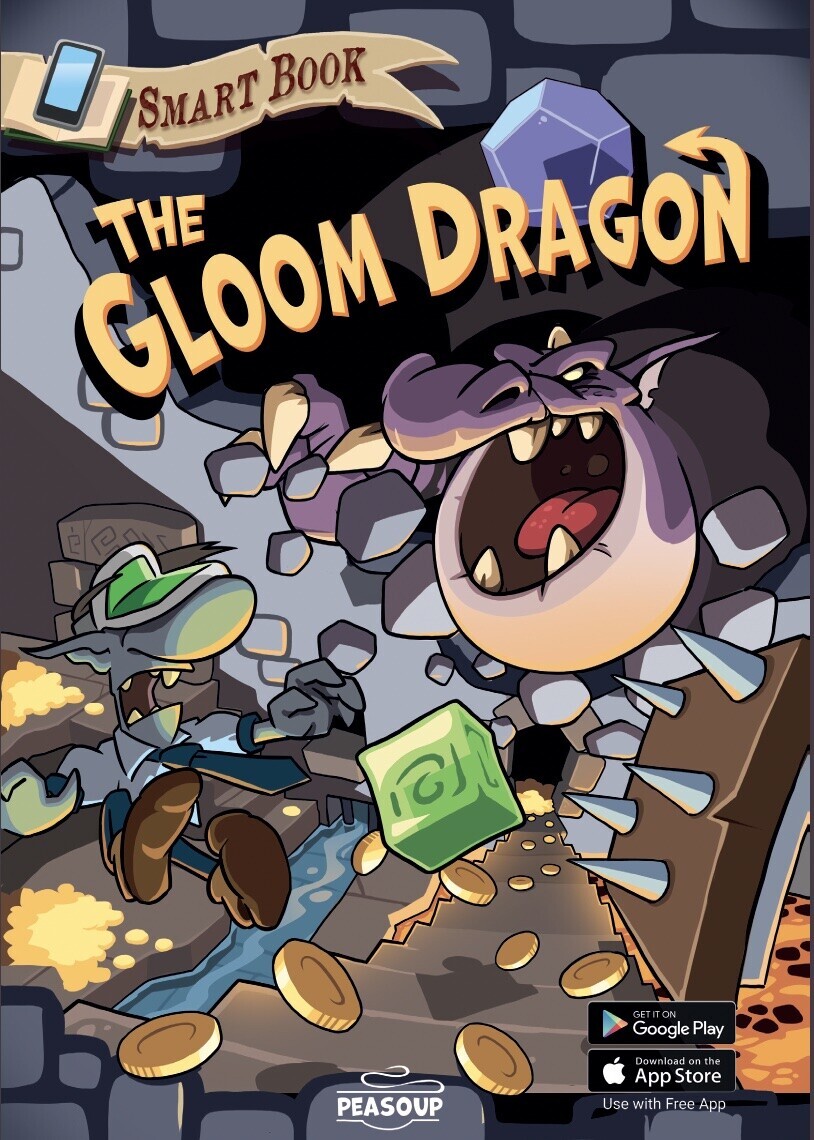
Solitaire: The Gloom Dragon

You are a brave adventurer, a Swordsman. After a long apprenticeship with Swordmaster Krago and now armed with your magical sword Rilgist and a shield, you travel the land, righting wrongs, and making the occasional bag of coin for your services. Such is the stuff of legend and such is the stuff of solo adventure books of which there have been many over the past four decades. However, this is the set-up for The Gloom Dragon, which although being a solo fantasy adventure, is somewhat different to others of its type. Published by Peasoup ApS—a Danish publisher—The Gloom Dragon is what is known as a ‘Smart Book’. In a traditional solo adventure book, the reader and player will create a character and explore the world detailed in the pages and random paragraphs of the adventure book, rolling dice to see whether his character avoids traps or successfully attacks a goblin, for example. The Gloom Dragon does not do this. Instead, encounters and combats and other situations are handled via an app specific to the book. What the player does is read through the book, skipping from paragraph to paragraph and from page to page as determined by the story and the choices he makes in play. Then, when prompted, typically indicated by a ‘TASK’ instruction, he uses the camera on his mobile phone or tablet to scan the image alongside the page in the app. This will typically initiate combat with a foe.

Combat in The Gloom Dragon is simple and completely handled by the app. The player rolls three six-sided dice. These will either display a sword or shield symbol, or be blank. A sword symbol will inflict one point of damage, whereas a shield will protect the wielder from one point of damage. A blank symbol does nothing and a player can lock the symbols he wants to use as he roll rolls them in the app. A player can choose to roll or keep as many of these as he likes. The fight continues until either the player or the enemy is defeated. At which point, the player will often receive a reward, but will definitely be directed to another entry or chapter in the book. Not all of the challenges involve combat. Others include finding the right bottle, which might contain a useful potion, from amongst a pile of bottles of beet juice; picking some coins up, or interacting with a combination lock.

The setting for The Gloom Dragon is in and near the village of Randomia in the Pea Soup universe. The village is being regularly visited by Worm Deathtail, the Gloom Dragon, each time threatening to eat the villagers unless they give him all of his gold. Of course, our steps up to the task, and promises to stop the Gloom Dragon, and very early in the adventure, on its next visit to the village, confronts the great beast. However, this proves too much of a challenge for the hero, who is quickly swatted away with a swing of the Gloom Dragon’s great tail. So forewarned of the strength and capabilities of the great beast, much of the adventure concerns itself with finding the means to defeat and making the hero more powerful. This includes finding more gold to spend and finding magical items that enhance the hero’s health and increases the number of dice he rolls in combat.

The interaction between the app and the book is fairly smooth, and combat is quick and easy. In general, the puzzles are easy to operate, although moving the mobile phone around to view particular rooms for clues felt somewhat clumsy. Nevertheless, the package as a whole is easy to navigate and the player will find himself switching back and forth between book and app with relative ease.

The Gloom Dragon is not designed for the veteran player of solo adventure games who started out forty years ago with The Warlock of Firetop Mountain or Buffalo Castle for Tunnels & Trolls. This is not to say that they will not enjoy playing through The Gloom Dragon, though the entries in the book are relatively limited at just one-hundred-and-forty-seven and the sense of peril is fairly low. Instead, the target audience for The Gloom Dragon is the young reader, aged nine and up, who to date has been challenged by reading. The aim of the series—and The Gloom Dragon is the third to be released—is to encourage such readers to have a greater desire to read. To that end, both the series and The Gloom Dragon encourages this through its big, bold cartoon style artwork, clear instructions, and more immediate degree of interaction in the story via the app.

Physically, The Gloom Dragon is well presented. The book is clear and simple to read, the artwork is big and bold, and crucially, the format of the book is designed to facilitate the use of the app. To that end, it has a Euro binding which means that the inside of the cover is not glued to the spine. This means that it looks like the spine is broken, but it is by design and clearly says so inside the front cover.

The Gloom Dragon is a likeable and engaging affair, a classic fantasy tale of a lone hero facing a dragon. Veteran players of solo adventure books will be doubtless be intrigued by the combination of format, but for the intended audience, The Gloom Dragon will keep the player involved through both the text and the app from start to finish, and thus both reading and playing.

Friday, 1 May 2020

Friday Fantasy: To Free the Storm

The last thing you should do is say no to a dragon, right? This is a situation in which the Player Characters find themselves in To Free the Storm, a short, one or two session scenario for Dungeons & Dragons, Fifth Edition. Written by Andrew Peregrine, author of The Seventh Doctor Sourcebook as well as contributor to and author of many other roleplaying books, it is an adventure for characters of Fifth to Seventh Level. It is setting neutral, but whatever the setting the Dungeon Master decides to use it with, that setting requires an area of dead and barren land with a volcano at its heart, and a village near the area. As written, the volcano at the heart of the barren land in To Free the Storm is Mawspire Mountain. Now only home to a few hardy mountain goats, local legends say that the region was blasted into lifelessness by a dragon, but since no one can recall having seen a dragon, no one believes the legends. Beyond the barren surrounds of the mountain, the region is fertile, which has drawn settlers who farm the land and loggers who work the forests. One village in the area is Carverton.

As To Free the Storm opens, the Player Characters are staying in Carverton, perhaps because they are en route to somewhere or between adventures, and enjoying a drink and decent food when suddenly, the village is attacked. Which is not that unusual when it comes to villages and adventures in just about any Dungeons & Dragons-style fantasy world as it goes. What is unusual is the fact that the attacker asks for them by name. What makes the situation worse is that the attacker asking for them is a dragon! Not only that, the dragon has a favour to ask of them, a favour which he suggests that the Player Characters fulfil lest he continue blasting the village to bits. Which is perfectly in keeping with the attacker—Zzaladar—which happens to be a Blue Dragon.

The favour is this. Zzaladar has long been tied to the area by an arcane manacle, placed on him by a mage many years ago. The manacle is tied to an orb kept deep in a ruined temple on Mawspire Mountain and as Zzaladar has grown in size and power, the effectiveness of the orb has weakened and he thinks that with a little of help, he can break free. Which is where the Player Characters get involved. Zzaladar  wants them to go to the temple and destroy the orb that keeps him prisoner. In  return, Zzaladar promises to not only not destroy Carverton, but also not harm a single sentient creature for a year. Which sounds like a not unreasonable deal—at least for the following year. After that, who knows?

The bulk of the adventure takes place in the ruined temple on Mawspire Mountain. Here the adventurers will have to contend with the volcanic temperatures, the ancient and undead knights of the Order of the Orb who have sworn to protect the orb—and some who have not, and how the god of the volcano, Darmaw, was worshipped before the temple was abandoned and his faith forgotten. The latter is where the dungeon—consisting of just fourteen locations—is at its most interesting. There are a number of elements here which look a little like traps, but may well help the Player Characters in their quest, whilst others will at first seem to be of use, but will ultimately hinder their efforts.

The dungeon offers a reasonable mix of puzzle like elements and plenty of combat along with some roleplaying. Certainly, the Dungeon Master has a couple of fun NPCs to roleplay, after all, what Dungeon Master does not relish the prospect of roleplaying a dungeon? Yet the design of the dungeon is really linear and not all interesting and were it not for the roleplaying elements and how the worship of Darmaw is brought into play, would have little to recommend it.

Available via the DM’s Guild, To Free the Storm is a fifteen page, 2.06 Mb file full colour PDF. It is generally well written, but does need another edit. The cover is nice, but is the only illustration. The map though, is dull and murky, and leaves the reader wishing that the author had drawn it himself or got someone else to do so. This does not mean that the map cannot be used, for it can. It is simply the case that the map is unattractive.

Rounding out To Free the Storm is a quartet of further adventure ideas which raise further questions and suggest as to the consequences of the Player Characters’ actions. Now one obvious oddity with the scenario is that it involves a Blue Dragon and has the Player Characters going to a temple on a volcano. This seems an odd choice, when possibly a Red Dragon with its fire association or even a White Dragon with its icy disassociation might have been more strongly thematic choices. That aside, there is no denying the strength of the set-up to the scenario with the monster coming to the Player Characters rather than the other way around. Similarly, the handling of worship of Darmaw is well done, but unfortunately this is done in an uninteresting, linear dungeon and on decidedly unattractive maps, which all together does not make for a pleasing combination.

There is a lot of potentially good story in To Free the Storm and as the introduction to a campaign of thwarting a threat which the Player Characters were forced to unleash, is actually a good set-up. It would be fantastic to see the consequences of their actions explored in sequels to this scenario as well as have Zzaladar return again and again so that the Dungeon Master can roleplay him as he develops into a memorable villain. Overall, To Free the Storm is a serviceable adventure which feels as if it deserved better, but is still good enough to ask what happens next.

Thursday, 23 October 2014

Dicing with Dragons

Dragon Slayer: The Dice Game with a Twist is a ‘Push Your Luck’ dice game released by Indie Boards & Cards, the publisher of notable titles such as The Resistance, Coup, and Flashpoint: Fire Rescue. Funded through Kickstarter, it is designed for two to five players, aged fourteen and more—though younger players could play it, and it can be played through in fifteen minutes or so.

In Dragon Slayer, each player is a doughty warrior, a fearless hunter of dragons, ready to be crowned ‘Master Slayer’. He must set out into the Mountains; locate each dragon’s Head to determine where it hunts, its Wings to see where it soars, and its Tail to find its lair; Axe in hand ready to slay the beasts and Shield held ready to withstand each dragon’s deadly Fire Breath. There are three dragons of increasingly difficult challenge—Blue, Green, and Red—that a slayer will need to kill again and again to be crowned ‘Master Slayer’. Unfortunately, every slayer has a certain pride and once he has one dragon kill under his belt, he can be goaded into continuing the hunt. Otherwise he will lose face (and points!). This is the ‘Twist’ of the title.


Dragon Slayer consists of twelve dice. Three dice for the Warriors, marked with Axe, Shield, and Fire Breath symbols; and three dice for each dragon, marked with Mountain, Dragon’s Head, Tail, and Wing, and Fire Breath symbols. There is a scoring track and tokens for each player to track his score, a simple chart to track each slayer’s hunt, and a Challenge Token for each player.


On his turn a player rolls both the Warrior dice and the three dice for the dragon he wants to hunt. His aim is to roll the Dragon’s Head, Tail, and Wings plus an Axe to kill the beast. As soon as any one of them is rolled, those dice are put aside and the player can keep rolling. Mountains and repeated results can be re-rolled. If the dragon rolls a Fire Breath—on the Dragon dice or the Warrior dice—the slayer can defend against with a rolled Shield on a one-for-one basis. If a slayer has not rolled any Shields, then he loses a Warrior dice for every unblocked Fire Breath dice. Once a slayer has lost all of his Warrior dice, his dragon hunt ends for that turn.  

Once a player has rolled a Dragon’s Head, Tail, and Wings plus an Axe to kill the beast, he can score it. Just two points for a Blue Dragon, four for a Green Dragon, and six for a Red Dragon. He can stop there or carry on, using any Warrior dice he has remaining plus the matching dice for the new dragon. He must defeat the other two dragons before he can attempt to slay again the type he just killed. Or another slayer could challenge him into carrying on. Refuse and the player loses half his points, the challenger scoring five points. Carry on and the slayer gets double points for every subsequent dragon slain, but if he fails at any time, he loses all points for that round! Each player only has one Challenge token, so it can only be used once.

For example, Debbie attempts to slay the Green Dragon. On the Warrior dice she rolls Axe, Shield, and Fire Breath, plus Mountains and Dragon’s Tail and Wings on the Dragon dice. She sets aside the Dragon’s Tail and Wings plus the Axe. Then she blocks the Fire Breath with the Shield and then rerolls the Shield, Fire Breath, and Mountain dice. The result is two Axes and a Dragon’s Head. This enough is to slay the Green Dragon and score Debbie two points.

Dave decides use his Challenge token to goad Debbie to continue, which she does against the Blue Dragon. This time she rolls Axe, Shield, and Shield on the Warrior dice, plus Mountains and Dragon’s Tail and Wings on the dragon dice. She sets aside the Dragon’s Tail and Wings plus the Axe. Rolling again, the result is a Dragon’s Head and an Axe and Shield, again enough to slay the Blue Dragon and score Debbie eight points—double the Blue Dragon’s value.

Debbie continues against the Red Dragon. This time she rolls Axe, Shield, and Fire Breath on the Warrior dice, plus Fire Breath and Dragon’s Head and Wings on the dragon dice. One Shield is used to block a Fire Breath, leaving one Fire Breath to get through. Debbie is forced to discard the Axe result, but can keep the Dragon’s Head and Wings. This leaves her one Dragon die and two Warrior dice to roll. This time Debbie rolls the needed Dragon’s Tail and an Axe, which scores her twelve points—again the Red Dragon’s value. Debbie has done well this time and was up to the challenge!

Once a player has scored forty points in slain dragons, play continues until everyone has had the same number of turns. The player with the most points scored wins and is crowned the ‘Master Slayer’.

Physically, Dragon Slayer is pretty little game, its artwork reminiscent of the Dragon’s Lair computer game of the early ‘80s. The dice in particular, are quite fine (though the standard retail version will lack the metallic inks etched into the dice), handle nicely, and have differently illustrated dragons. The rules feel underwritten and need a surprisingly careful read through given such a light game.

Easy to learn and quick to play, Dragon Slayer presents easy decisions—when to challenge, when to stop rolling, and which dragon to roll for. Do you roll for the Green Dragon and work up to Red or roll for Red and work down to Green as it is easier? Most likely a player will Challenge when another takes the lead and looks to be winning…

Of course Dragon Slayer feels not unlike Steve Jackson Games’ Zombie Dice, but it adds a decent twist and its genre is not as gruesome. Overall, Dragon Slayer: The Dice Game with a Twist is a nice filler and a nice addition to the ‘Push Your Luck’ style dice game.