Every Week It's Wibbley-Wobbley Timey-Wimey Pookie-Reviewery...
Showing posts with label Filler Game. Show all posts

Friday, 8 August 2025

Friday Filler: Rafter Five

Everyone has agreed that the best way of getting off the island is to build a raft. However, nobody can agree on the best way to build a raft, or even how to build a raft. Whilst everyone has also agreed that the best way to get off the island with their treasure is the raft, the raft is so rickety that it is in danger of collapsing and dumping everyone into the sea. Fortunately, there are no sharks, but when you fall into the sea, it is everyone for themselves as they try to rescue their treasure. It is perfectly possible to rescue your own treasure, but not the treasures belonging to your fellow raft builders, and if you lose their treasure, they will get mad at you and throw you off the raft! This is the set-up for Rafter Five, a fast-playing dexterity game for one to six players, ages seven and up. Published by Oink Games—best known for the games Scout and Deep Sea RescueRafter Five is a game that uses all of its components, including the box lid and base, looks great on the table, plays in twenty minutes or so (but probably faster depending on the dexterity of the players), and surprisingly for an Oink Games title, is not a squeeze to get back in the box!

Rafter Five consists of five Rafters, forty-two Treasure Chests, six Penalty Boards, one Raft Card, forty-two Lumber Cards, and the rules leaflet. The Rafters are the game’s meeples, ones that the players will move around from one turn to the next. They are much larger than standard meeples and vary in size and shape, tall, fat, thin, short, and really help to give the game much of its character. Plus, they feel good in the hand. The Treasure Chests come in six colours, so that each player has a set of seven. The Penalty Boards also come in six colours to match the Treasure Chests and have five slots marked with an ‘X’. If a player’s Penalty Board is filled up with the Treasure Chests of the other players, he loses and is out of the game. The Raft card forms the base for the players’ raft, whilst the Lumber Cards are slightly wavey lengths of card, marked with the sea on one side and wood on the other.

Set up is simple. The game’s box is turned upside down, placed in the centre of the table, and the lid to the box is placed on top, also upside down. The Raft Card is put on top of the lid, as are all five Rafters. Each player receives the Penalty Board and Treasure Chests of his colour. In two- and three-player games, each player will be given Penalty Boards and Treasure Chests of multiple colours.

The aim of Rafter Five is to build as big a raft as possible, whilst loading it up with treasure, without it collapsing. When it does collapse, the player who caused the collapse receives all of the Treasure Chests tipped into the sea. He keeps his own Treasure Chests to place again, but Treasure Chests belonging to the other players must be put onto his Penalty Board. If a player accrues five Treasure Chests belonging to other players on his Penalty Board, the game ends, and he is the loser, whilst everyone else wins! The game also ends when there are no more Lumber cards to place or all of the players have put their Treasure Chests on the raft. In either case, the player with the most Treasure Chests belonging to other players on his Penalty Board is the loser and everyone else wins.

On his turn, a player does three things. He picks up a single Rafter from the raft and then a Lumber Card. He must then place the Lumber Card on the raft and the Rafter on top of that. The Lumber Card must be placed so that part of it is on top of another Lumber Card on the raft (except on the first turn, when a player is free to place the Lumber card how he wants). Lastly, he put one of his Treasure Chests anywhere on the Lumber Card he just placed.

Rafter Five is as simple as that, but the longer a game goes on and the more that Lumber Cards and Treasure Cards are added, the more precarious the splay of the Lumber cards that make up the poorly constructed raft grows. The Rafters are the balancing factor, acting as a counterweight to lengths of Lumber Card hanging over the edge of the raft with their Treasure Chests perched precariously on their lengths. Picking the right one can the key to a tense, but safe turn, but pick the wrong one and everything goes tumbling into the sea! Placing a Treasure Chest where it is more likely to tip into the sea, such as at the end of a Lumber Card, dangling over the edge, is a legitimate move, but this highlights the key aspect to Rafter Five. Most dexterity games are about placing one thing or removing one thing to a stack. Rafter Five is about placing three—the Rafter, the Lumber Card, and the Treasure Chest!

Physically, Rafter Five is very nicely presented and packaged. The components are of good quality and the Rafter pieces are nice and sturdy in the hand, and ever so cute! The simplicity of the game means that the rules are easy to read and grasp.

Rafter Five does include a solo-mode, but it is more of a stacking puzzle than a game, so consequently less interesting. That said, the game plays well at whatever player count, with four or five being about right, and it is suited to play by the family, being very easy to teach and learn. Rafter Five is a great filler game, easy to learn, quick to play, but full of tension that grows and grows as more Lumber Cards are added to the raft.

Saturday, 31 May 2025

The Little Book of Death ...in Spaace!

Escape the Dark Sector: The Game of Deep Space Adventure is about survival. About making a break from the cell of the
detention block of a vast space station where they have found themselves incarcerated. They have an opportunity to escape their imprisonment, but the route they must take, between the detention block and their spaceship, is fraught with danger. The escapees must find their way out of the Detention Level, through the Heart of the Station, and then the Forgotten Zones to their impounded spaceship—and escape! Published by Themeborne Ltd., Escape the Dark Sector is the Science Fiction sequel to Escape the Dark Castle: The Game of Atmospheric Adventure, which was inspired by the Fighting Fantasy series of solo adventure books and also the dark fantasy artwork of those books. As with its fantasy predecessor, Escape the Dark Sector can be played solo or collectively and
offered plenty of replay value and variability with six Character Cards, fifty-three Chapter Cards—fifteen of which form the encounter deck, and five Boss Cards. Then of course, there are game’s three expansions: Escape the Dark Sector – Mission Pack 1: Twisted Tech, Escape the Dark Sector – Mission Pack 2: Mutant Syndrome, and Escape the Dark Sector – Mission Pack 3: Quantum Rift. Each of these provided players with new characters to play, a new mechanic—which meant a new challenge to overcome, new equipment, and of course, a new Boss standing in the way of the players’ escape. However, when it came to death—and there is no denying that Escape the Dark Sector is definitely about death, as well as escaping, if not more so—what neither Escape the Dark Sector, nor any of its expansions, or even Escape the Dark Castle, could offer was much mote than a mechanical outcome whenever a player’s character dies in the game.

The solution is Death in Deep Space, the Science Fiction equivalent of The Death Book for Escape the Dark Castle. This is a book of over one hundred death scenes, each corresponding to a particular Chapter or Boss. It is very easy to use. Whenever a character dies as a result of the events in a Chapter or the showdown with a Boss, he checks the relevant entry in the pages of The Death Book. This is made possible because every card in Escape the Dark Castle as well as in all three of its expansions is marked with a unique code. Cross reference the code with corresponding entry in the book, whether for a Chapter or a Boss card, read out the description provided, and so provide an unfitting, but final end for your character, followed by that of everyone else.

For example, the details on the Boss card, ‘The Alien Queen’ reads as follows:

“Die, humansss!”

The Alien Queen was lying wait! Jets of venom fly towards you as she pounces—YOU must roll two HIT DICE now.

If a player should die in the course of this final confrontation before he and his companions, always a strong possibility in Escape the Dark Sector, he picks up Death in Deep Space and after finding the entry for ‘The Alien Queen’, he reads aloud the following:

The Alien Queen

Once it enters your bloodstream, the paralysing venom of the Alien Queen works quickly – a spreading rigidity coursing through your entire body, locking your joints one by one until you are all but paralysed. Even your eyelids cannot close, and you are forced to watch in horror as the terrible creature captures your fellow crew with equal ease.

With a series of hissed commands to her countless, scurrying servitor spawn, you are all dragged back her vast, deck-spanning nest. There, a slick, black, fleshy membrane covers the walls and beneath the vaguely humanoid shapes of her decomposing victims are still recognisable. Their shallow breaths rise and fall in eerie synchronicity, an indication that their suffering is yet to be ended. Soon, you and your crew join them.

Once in place, your spines are sliced open. The shimmering spools of nerve fibre that spill out are intertwined with those of the other captives suspended around – the connection sealed with a sticky, mucus coating. In this way, you become part of the fabric of the hive, a sensory node in a living web, lining the walls as far as the eye can see, warning the hive of approaching threats and passing the news back through the biotic chain in an instant.

For the rest of your days, your pain is theirs and theirs is yours; you see what they see and hear what they hear, your collective existence painfully prolonged in service to your bestial captor.

Your adventure ends here.

Physically, Death in Deep Space is a neat and tidy, if plain affair. A page of introduction explains how to use the book and contains the book’s single illustration which shows where the unique code for the Chapter or Boss card is located. Then each entry has a page of its own. There is a degree of repetition to the entries, but only a little, and it really only becomes apparent when reading the book from end to end, which is not its intended use. A small and relatively slim book, Death in Deep Space fits easily into Escape the Dark Sector: The Collector’s Box Set.

Death in Deep Space is book of endings, but one that provides a final narrative and some context to that death. Escape the Dark Sector is an enjoyable game, but character deaths can feel little, “Is that it?”. With Death in Deep Space, it is no longer the fact that you died, but very much how you died. Grim and ghoulish, The Death Book brings the death of every character, and with it, the game of Escape the Dark Sector to a nasty and unfortunate, but fitting end.

—oOo—


Themeborne Ltd. will be at UK Games Expo which takes place on Friday, May 30th to Sunday June 1st, 2025.

Friday, 25 April 2025

Friday Filler: Order Overload Café

Ever spent a shift in a café receiving and trying to fulfil ever more confusing orders from probably annoying customers? Being forced to put on your best customer service and make sure that despite the confusion and despite the probable annoyance, the customer receives the right order with a smile? Well, that is what playing Order Overload Café is all about. Published by Oink Games—best known for the games Scout and Deep Sea RescueOrder Overload Café is a game about memorising confused orders from too many customers in which every employee in the café has to do their very best to remember as much as they can. As the game progresses, the café gets busier and the orders get bigger and more complex. This is a co-operative game and it is designed to be played by between two and six players, aged six and over, with a typical game lasting no more than twenty minutes.

Being an Oink Games title, Order Overload Café comes in a tiny attractive box which is packed tight—but thankfully, not too tight, with the game’s components, Besides the ‘Game Instructions’, these include eighty-four Order Cards, six Special Ability Cards, seven Level Tokens, and six Salesperson Tokens. The Order Cards include a wide range of drinks and snacks—French Toast, Banana, Chocolate Chip Cookie, Banana Milk, Iced Coffee, Iced Coffee without Ice, Room Temperature Coffee, Extra Hot Café Latte, and more. Some of these items are very specific and detailed. The Special Ability Cards, which can be used once per Level, do things like forcing another player to say the first letter of each card in his hand or allow the player to discard an Order Card from his hand. The Level Tokens are numbered from one to seven, indicating ever increasing degrees of difficulty that the players have to beat to proceed to the next Level. The Salesperson Tokens each have a smiling face on one side and a frowning face on the other. It should be noted that the cards and rules for Order Overload Café are given in French, German, and Spanish as well as English, meaning that the game could be used in the classroom as an aid to both teaching and learning another language.

Game set-up is simple. The Level Tokens are laid out in order, from one to seven. Each player receives a Special Ability Card and a Salesperson Token. The latter is placed on the table with the smiling face face-up.

At the start of the Level, the current active player draws a number of Order Cards equal to the players multiplied by the current Level. So, with four players, this would be four Order Cards in the first Level, eight Order Cards at Level Two, twelve Order Cards at Level Three, so and on. At the start of each Level, one player is the Order Taker. His task is to read each of the Order Cards that make up the current order out loud and as he does so, all of the other players have to memorise as many of them as they can. The Order Taker then shuffles the Order Cards in the current order and deals them out to all of the players. A player is allowed to look at his cards, but must keep them hidden from the other players. The player to left of the Order Taker becomes the Active Player, whilst the other players are the Checkers.

The meat of Order Overload Café is checking the order. The Active Player turns to the Checker on his left and asks him if he has one of the Order Cards that the Order Taker read out at the start of the turn. If the Checker does, he discards that Order Card from his hand. The turn now ends. If the Checker does not have the Order Card, the Active Player can ask the next Checker and so on and so on, until either a Checker does have it and can discard it, or no player has it. If no Checker has the Order Card, then the Active Player has failed! The Active Player turns his Salesperson Token over so that the frowning face is visible. The Active Player cannot be the Active Player again, but he can be a Checker. The Active Player can also call out an Order Card in his hand as well as asking the other Checkers.

The aim is for the players—both the Active Player and the Checkers—to discard all of the Order cards from their hand. It does not need to be all of the players, but one player per Level if there are two players, two players per Level if there are three or four players, and three players per Level if there are five or six players. If this happens, a Level is completed and its Level Token is turned over. All of the Order Cards are collected, shuffled, and then dealt out again according to the number of the new Level. Play continues like this until either the players manage to complete the seventh Level or all of the players’ Salesperson Tokens are turned over so that the frowning face is visible. If this occurs, the game is over, and the highest Level completed is the players’ final result.

In addition, the rules do include options for competitive play and for mixing the Order Cards from Order Overload CaféOrder Overload: Burgers, Order Overload: Spiel23, and Order Overload: Insects. However, all three of these alternate versions are out of print and difficult to find. It would have nice if there was more variety in terms of the Special Ability Cards, but other than that, are no real issues with the game.

Physically, Order Overload Café is very nicely presented and packaged. The cards are of good quality and the cardboard pieces are nice and sturdy in the hand.

Order Overload Café is not difficult to play and its simple rules means that it is easy to teach and play with the family or with the gaming group. Although it is not difficult to play, it is challenging—or at least it becomes so. The first Level or so is a cake walk, but as one Level is completed and the next Level started, it becomes more and more of challenge as the size of the Order and the number of Order Cards that the players have to memorise increases. Not only that but the balance between the difficulty of the game and the number of the players remains constant, and play progresses, there is the constant feel of success as another Order Card is discarded and the players progress work towards completing a Level, knowing that at any moment, the Active Player might get an Order wrong and move everyone one step closer to failure. And failure is frustrating because you do want to beat each and every Level! Plus, unlike many a co-operative game, there is no alpha player attempting to steer everyone’s turn.

Order Overload Café is not a game that you are going to play again and again. Especially once you have beaten its top Level, but it is a good game to bring out occasionally or to play with casual or new players as the challenge is very quickly obvious and the rules are very, very easy to teach and the play is relying on memory not skill. Order Overload Café is a surprisingly good and challenging filler, best suited for the occasional play.

Friday, 20 December 2024

Friday Filler: Dropolter

Most dexterity games involve removing things from a stack and trying to have the stack collapse or stacking things and not having things fall down, because if you cause the stack to fall down, you lose. Think Jenga or Bausack or Villa Paletti. One of the newest games from Oink Games is all about dropping things. Or rather, about dropping the right thing or things. Dropolter begins when everyone is asleep, but all of a sudden, eerie noises wake them up in the night. A ghostly wail. A thud. A boom. And then one-by-one, ghosts begins to appear from beneath each of the players’ beds. Fortunately, everyone is prepared and has the five charms to hand—quite literally—that will ward off the ghosts. However, the charms—each a little brass bell—have got mixed up with a number of items, including a Ring, a Cookie, a Key, a Seashell, and a Gem—and each player needs to get the right ones out of his hand whilst keeping the bells in his hand. Sounds easy, right? Well, it is far from easy, because each player has to do it only with the hand that he is holding the objects in. In other words, he cannot use his other hand!

That is about as far as the backstory goes in Dropolter—a game designed to be played by between two and five players, aged six or more, and in fifteen minutes—and as backstories go, that is incredibly thin. What it amounts to is that in each round, a player has five objects in his hand. These are a Ring, a Cookie, a Key, a Seashell, and a Gem. At the start of a round, a Theme Card is drawn and this will determine which of the five items each player has to drop from his hand. The Theme Cards range in difficulty from one to four objects. The first player to drop the required number of items from his hand and grab the very friendly Ghost Piece wins the round and is awarded a brass bell. This is added to his hand on subsequent rounds. The first player to get five brass bells, wins the game.

If a player drops a wrong object, he must start again with all five objects in his hand. Worse, if he drops a brass bell, he loses it and it is not added back into his hand.

The objects themselves are shaken in a player’s at the start of each round, and then after that, what a player is doing is manipulating them as they sit on his palm with his fingers and thumb, attempting to push, pull, and tip them from his hand with dropping anything else. This requires no little manual dexterity. There is a delightful sense of shared frustration as everyone concentrates, trying to manipulate the objects in their palm in a manual exercise that we rarely have to attempt, exacerbated when someone drops the wrong object, and relieved when someone drops the right objects.

Physically, Dropolter is as nicely done as you would expect for a game from Oink Games. The rules are easy to read and understand and the components, although small, each have a different shape and tactile feel that aids play.

With its promise of “Ghost vs Palm Muscle” action, Dropolter has a simplicity and physicality that are both a hindrance and a boon. It is simple to learn and teach, making it suitable for a wide audience, but it does not offer a great deal of game play beyond the short term. Its physicality gives it a highly interactive presence at the table, but not everyone has the manual dexterity to play and there are a lot of little pieces which are all too easy to loose. Yet Dropolter is the perfect filler game because it does not take that long to play. It is also the perfect novelty game, its very concept and physicality is intriguing enough to anyone who has not played it to ask, “How does this work again?” What this means is that Dropolter is a great little icebreaker, its novelty big enough despite the size of its box and components to make people want to play.

Saturday, 28 September 2024

The Little Book of Death

Escape the Dark Castle: The Game of Atmospheric Adventure is about survival. About making a break from the deep dank dungeon cell you have been thrown into and working your way through the rooms and corridors of the dark castle until you can get to the main gate and escape. Of course, in between there is lots of uncertainty and plenty of death—the latter your own included, and that is all before you encounter the big Boss who will definitely try to kill you and prevent your escape. Published by Themeborne Ltd., inspired by the Fighting Fantasy series of solo adventure books and also the dark fantasy artwork of those books, Escape the Dark Castle offered plenty of replay value and variability with six Character Cards, fifty-three Chapter Cards—fifteen of which form the encounter deck, and five Boss Cards. Then of course, there are game’s three expansions: Escape the Dark Castle: Adventure Pack 1 – Cult of the Death Knight, Adventure Pack 2 – Scourge of the Undead Queen, and Adventure Pack 3 – Blight of the Plague Lord. Each of these provided players with new characters to play, a new mechanic—which meant a new challenge to overcome, new equipment, and of course, a new Boss standing in the way of the players’ escape. However, when it came to death—and there is no denying that Escape the Dark Castle is definitely about death, as well as escaping, if not more so—what neither Escape the Dark Castle, nor any of its expansions could offer was much mote than a mechanical outcome whenever a player’s character dies in the game.

The solution is The Death Book. This is a book of over one hundred death scenes, each corresponding to a particular Chapter or Boss. It is very easy to use. Whenever a character dies as a result of the events in a Chapter or the showdown with a Boss, he checks the relevant entry in the pages of The Death Book. This is made possible because every card in Escape the Dark Castle as well as in all three of its expansions is marked with a unique code. Cross reference the code with corresponding entry in the book, whether for a Chapter or a Boss card, read out the description provided, and so provide an unfitting, but final end for your character, followed by that of everyone else.

For example, the details on the Boss card, ‘The Dark One’ reads as follows:

“Your pitiful trinkets are no match for my dark magic!”

As YOU enter the Dark One’s presence, any items YOU are carrying vaporise (other players keep theirs). Discard them now.

If a player should die in the course of this final confrontation before he and his companions, always a strong possibility in Escape the Dark Castle, he picks up The Death Book and after finding the entry for ‘The Dark One’, he reads aloud the following:

The Dark One

From the strange, clawed fingertips of The Dark One a terrible torrent of dark magic pours, crackling through the air and striking you down. The unrelenting stream intensifies, coiling around you and holding you in place like spectral chains. You roll and twist on the chamber floor, wracked with agony, foaming at the mouth. With a single motion of it staff, The Dark One sends you hurtling through the air. Your body slams into each of fellow prisoners, the impact knocking them from consciousness one by one. By an upward motion of the staff, you are now sent soaring high into the air, only to be released as The Dark One turns his back and glides out of the chamber. As quickly as rose you tumble helplessly downward, slamming to the cold stones and exploding in a shower of gore.

Your adventure ends here.

Physically, The Death Book is a neat and tidy, if plain affair. A page of introduction explains how to use the book and contains the book’s single illustration which shows where the unique code for the Chapter or Boss card is located. Then each entry has a page of its own. There is a degree of repetition to the entries, but only a little, and it really only becomes apparent when reading the book from end to end, which is not its intended use. A small and relatively slim book, The Death Book fits easily into Escape the Dark Castle: The Collector’s Box Set.

The Death Book is book of endings, but one that provides a final narrative and some context to that death. Escape the Dark Castle is an enjoyable game, but character deaths can feel little, “Is that it?”. With The Death Book, it is no longer the fact that you died, but very much how you died. Grim and ghoulish, The Death Book brings the death of every character, and with it, the game of Escape the Dark Castle to a nasty and unfortunate, but fitting end.

Friday, 20 September 2024

Friday Filler: Holi: Festival of Colours

Celebrated as the Festival of Colours, Love, and Spring, Holi is the Hindu festival that both celebrates the eternal and divine love of the deities Radha and Krishna and commemorates the victory of Vishnu as Narasimha over Hiranyakashipu. It is notable outside of India as the festival in which richly coloured ‘gulaal’ powder is flung by the celebrants resulting in street scenes that are a riot of colour. It is also the theme of Holi: Festival of Colours, a board game from Floodgate Games, in which the players will try and outscore each other by placing more of their colour on the board, grabbing sweets, and hitting each other with their colour. It combines area control mechanics with elements of hand management and pattern building, the result being a colourful, abstract design that has a very physical, vertical presence at the table. It is designed for two to four players, plays in about half an hour, and is designed for players aged thirteen and up. That said, younger players who plenty of experience with board games should have no difficulties learning to play Holi: Festival of Colours.

The components to Holi: Festival of Colours really begin with its Courtyard Tower. This is a three-level tower with each level consisting of a clear plastic tray with a six-by-six grid of spaces. The Courtyard Tower requires construction for each play. It does wobble slightly, but is sturdy enough. The other components consist of four Helper Cards, twenty-four Sweets Tokens, a Score Tracker and four Score Markers, twenty-one Rivalry Cards, fifty-two Colour Cards in four colours, one-hundred Colour Tokens, four Player Markers, and the First Player Marker. All of the Sweets Tokens, Colour Tokens, and the frame for Courtyard Tower are done in rich, vibrant colours. Colour Cards show the pattern of spaces in a three-by-three grid that Colour Tokens will land on when thrown. The Rivalry Cards are bonus cards. For example, ‘Sweet Tooth’ scores extra points for each Sweets Tokens and ‘Snack’ forces a player to give up a Sweets Token if another player scores a Direct Hit on him.

To set up, the Courtyard Tower is put together and Sweets Tokens are placed on the ground and middle levels. Each player receives the Colour Tokens and Colour Cards in his colour and a Helper Card. Two or three Rivalry Cards are revealed. These affect scoring or add a new rule to game, often radically changing how the game is played. It is suggested that the Rivalry Cards be omitted for a simpler play experience.

On his turn, a player can take between one and three actions, in any order. The mandatory action is the ‘Throw Colour’ action, whilst the others are Move and Climb. For the Throw Colour action, the player chooses one of his Colour Cards—he always has three in his hand and plays it. Each Colour Card indicates the point where the player’s Marker is located and then the pattern where the Colour Tokens will fall when he throws him. The player can rotate the Colour Card to fit the pattern onto the board. If a Colour Token lands on another player’s Marker, then a Direct Hit is achieved. This scores the player a point and the Colour Token which lands on the other player’s Marker goes into the other player’s supply of Colour Tokens. Colour Tokens in another player’s supply will score the scoring player further points. This can only happen when the players have their Markers on the same level.

Alternatively, a player can simply expend the Colour Card to place a Colour Token anywhere on the level. This includes on a Sweets Token, but not on another player’s Marker.

The ‘Move’ action enables a player to move his marker to anywhere on the level. This can be anywhere, including on Colour Tokens, which are returned to the player’s supply. If they belong to another player, they go into the moving player’s supply and will score the other player points at the end of the game.

The third option is ‘Climb Up’. When a player’s Marker is surrounded on all four orthogonal sides, the player can choose to move up to the same space on the next level up. Once a player has moved to an upper level, he cannot move down. Once on an upper level, when a player does a Throw Action, if there is no Colour Token in the squares in the corresponding squares on the levels below, then the Colour Token will fall to the level until it lands on an empty square. This means that a Colour Token can fall from the top level to the ground level.

Play continues like this until each player is unable to do the Throw Colour action and have run out of their Colour Tokens. This triggers the end of the game. Each player score points for the Colour Tokens he has on the three levels of the Courtyard Tower, the higher the level, the more points scored; Colour Tokens in other players’ Colour Supply; and lastly for each player who has a fewer number of Sweets Tokens than he does.

Physically, Holi: Festival of Colours is a very nice-looking game. The Player Markers are bright and cheerful and eye-catching. The rules are easy to understand and the components are of a sturdy quality, though the Courtyard Tower does wobble a bit despite its sturdiness. It remains to be seen if the Courtyard Tower will stand up to too much taking apart and putting together necessary for each play. The artwork is excellent and the cover of the box is stunning.

Holi: Festival of Colours is simple to learn and play. It is perhaps a little fiddly to play between levels, especially when working out where Colour Tokens will land when they fall from another level and if there is another token below. The game does include a ‘Take That’ element in that another player’s Marker can be targeted with a Direct Hit, but this is very much a minor part of play. The Rivalry Cards do add a much-needed element of randomness to the game in scoring and rules, though it is a pity that they are used for all of the players rather than each player being able to draw his own and keep them secret until the end.

From its box artwork to its Courtyard Tower, Holi: Festival of Colours is eye-catching. That it takes a little known—at least in the West—Hindu festival and turns it into a pleasingly light, but physically impressive and tactile game, is an indication of the skill of the designer and publisher. Game play is solid rather than spectacular, but Holi: Festival of Colours is a decent game, not so light as to be less enjoyable for experienced gamers, but not too difficult for family or casual players. Overall, Holi: Festival of Colours an impressively lovely looking game, with easy to understand and playable rules, with a playing time that suits a filler.

Friday, 7 July 2023

Friday Filler: Scout

You have been put in charge of the circus and are determined to put on the best series of acts and performers possible in order to wow the audience and make your circus the best. However, the running order has already been set, but you might be able to pull the performers you have out of that order knowing that they will outperform the previous act directed by a rival circus. If that is not possible, then you can scout the previous act and hire its best performer to join your circus, slotting into the running order you already have. Sometimes, you can even scout the previous act, hire its best performer, slot them into your running order, and have them perform immediately to really outdo the previous act. Do all of that enough times, and your circus will undoubtedly be the best!

This is the set-up for Scout, a quick-playing card game from Oink Games. Like nearly all of the Japanese publisher’s games, the game is small, tightly packaged, and comes with simple rules, but delivers terrific game play. The game was a Spiel des Jahres nominee in 2022 and won the Origins Award for Best Card Game in 2023. It is designed for two to five players, aged nine and up, and can be played in about twenty minutes. It is also easy to teach, plays quickly, and it can be enjoyed by the casual gamer as much as the veteran. In fact, its simplicity makes it a good family game whilst still providing a challenge for the experienced gamer. Plus, it is incredibly portable. That said, its theme is about as thick as the canvas on a worn circus tent, but then every card is named, such as ‘Anthony the Clown’ or ‘Jennifer the Bicyclist’. So, there is a personal touch to the game—just about.

Scout consists of forty-five cards, twenty-three Scout Tokens, thirty Score Tokens, five ‘Scout & Show’ Tokens, a Starting Player Marker, and a Game Manual. The forty-five, brightly coloured cards are numbered from one to ten, not once, but twice—at the top or bottom of the cards. In fact, the cards do not have a top or a bottom as such, because they are intended to be played with one number at the top. Notably, the numbers at either end of a card are never the same. This is important because a player can choose which way a card is orientated and thus which number is on display at certain points in the game. The game consists of a number of rounds equal to the number of players. Once the round have been completed, the player with the highest score is the winner.

The game’s key mechanics are ‘Hand Management’ and ‘Ladder Climbing’. Unlike other card games, Scout limits the degree of hand management a player can conduct—adding or playing cards in his hand, but not arranging the order of the card. ‘Ladder Climbing’ has the players attempting to play better cards or sets of cards than those currently on the table. In Scout, this is sets of the same value or runs of sequential number.

At the start of the round, adjustments are made for the number of players and the cards are shuffled and dealt out so that everyone has a hand the same size. A player also receives a ‘Scout & Show’ Token. Here appears the first wrinkle in the play of Scout. When a player receives his hand, he looks at it in order to see the numbers at the top or the bottom. Having done so, he choses one or the other. What he cannot do is change the order of the cards in his hand. The order will not change throughout the whole of the round unless he either plays cards or adds a card to his hand. This has two effects. It constrains what he can play, but it also gives him the foundation of something he can build upon to create a better hand and hopefully outscore his rivals.

On a turn, a player has a choice of three actions— ‘Show’, ‘Scout’, or ‘Scout & Show’—of which he must do one. To ‘Show’, he plays a set or run of cards. A set is multiple cards of the same number, whilst a run is a sequential series, but when played that set or run must be better than the cards in play on the table. If this replaces the current set or run of cards on the table, the player picks them up and adds them to his score pile. To ‘Scout’, the player takes one card from those on the table, which come from either end rather than the middle and adds it to his hand. When he does so, it can be added to anywhere in his hand and with either number. With careful or lucky choice of a card from a ‘Scout’ action, a player can begin to build a bigger set or run of cards in his hand that will hopefully be better than that on the table in another turn. A ‘Scout’ action also scores a ‘Scout Token’ for the player who played the current set or run of cards on the table. The ‘Scout & Show’ combines both actions and is the most powerful action in the game. Each player begins a round with a ‘Scout & Show Token’ which is turned in once a player decides to do a ‘Scout & Show’ action. Once handed in, a player cannot do another ‘Scout & Show’ action, so it is a one-use action.

Play continues until either a player has played all of the cards in his hand or a player plays a high enough set or run that no-one else can do anything else except the ‘Scout’ action and play passes back to the player who played that set or run. Each player determines his score for the round. This is equal to the number of cards in his score pile and ‘Scout Tokens’ he earned in the round, minus the number of cards in his hand. The player who played the last set or run does not have to deduct points for the cards in his hand. Play continues like this until a number of rounds equal to the number of players have been completed.

Scout is simple to play, but it has a surprising amount of depth and requires a bit more thought than at first glance. The inability to rearrange a player’s hand is frustrating, but it presents a player with a challenge as he is forced to ‘Scout’ over and over in search of the right cards that will enable him to create the best set or run that he can. The double and differently numbered cards make this less of a challenge and add some flexibility in the choices available to the players. Also, as a round progresses and better and higher sets and runs are played, the players will potentially—as long as they are on the end of a set or run—have access to the better and higher cards that they need and can acquire via a ‘Scout’ action. Playing a good set or run early on in the game can be devastating as the other players are likely to be unable to outdo it with the hands they have, forcing them to ‘Scout’, and if they all ‘Scout’, the round is over, forcing them to score negative points because they have been unable to play cards from their hands. However, the right card from a ‘Scout’ action or the right card and then cards played with the ‘Scout & Show’ action can be devastating when done at the right time. Plus, a player can benefit when it is not his turn, because if another player does the ‘Scout’ action and takes from the set or run of cards he played, he scores points for doing nothing. So, there is balance between the luck of the cards a player begins a round with and the choices he makes as round progresses.

Where Scout suffers is in the number of players. It is designed for two to five players, but at two players, the players do very little more than ‘Scout & Show’ actions most of the time. It is not as engrossing or as challenging as games played with more participants. It is thus better with three players, but with four or five, it becomes a great game. Then there is the theme, which is really neither here nor there.

Physically, Scout is, for the most part, well presented. The card quality is decent, but it is definitely worth sleeving the cards for repeated play. The Scout Tokens, Score Tokens, and ‘Scout & Show’ Tokens, plus the Starting Player Marker are all bright and cheerful and on good stock cardboard. The rulebook though, is a bit small and a bit flimsy.

Scout is great game. It would be an almost perfect game were it good to play with two players. It is not, so it is merely great. Easy to learn, easy to play, challenging enough to win at its play length, and easy to transport, Scout is a great addition to any games collection and a great go to filler game.

Friday, 2 September 2022

Friday Filler: The Fighting Fantasy Science Fiction Co-op V

Escape the Dark Sector: The Game of Deep Space Adventure
brought the brutality of the Fighting Fantasy solo adventure books of the eighties to both Science Fiction and co-operative game play for up to four players in which their characters begin incarcerated in the detention block of a vast space station and must work together to ensure their escape. Published by Themeborne, with its multiple encounters, traps, aliens, robots, objects, and more as well as a different end of game Boss every time, Escape the Dark Sector offered a high replay value, especially as a game never lasted longer than thirty minutes. Now, like its predecessor, Escape the Dark Castle: The Game of Atmospheric Adventure, the game has not one, but three expansions! Funded via a Kickstarter campaign, each of the three expansions—Escape the Dark Sector – Mission Pack 1: Twisted TechEscape the Dark Sector – Mission Pack 2: Mutant Syndrome, and Escape the Dark Sector – Mission Pack 3: Quantum Rift—adds a new Boss, new Chapters, new Items, and more, taking the path of the escapees off in new directions to face new encounters and new dangers. Each expansion can be played on its own with the base game, or mixed and matched to add one, two, or three mission packs that increase the replay value of the core game.

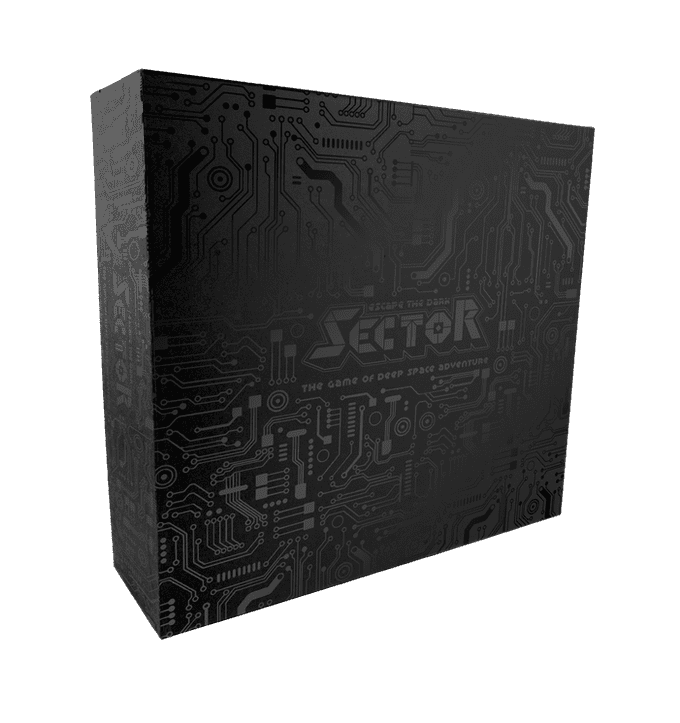
Escape the Dark Sector: The Collector’s Box is no mere pretty box to hold the core game and all three of its expansions, although it is pretty. The large, square, and sturdy box is matte black and has circuitry picked out in UV detailing for quite a subtle effect and a quiet, but imposing presence on your shelf. Inside there is space to hold and organise all of the game’s cards—sleeved or unsleeved—as well as dice, playmats for the escapees, scorepads, pencils, and the various rulebooks. If you are looking for somewhere to hold your copy of Escape the Dark Sector and its three expansions, both to store and organise for play, then Escape the Dark Sector: The Collector’s Box is very much what you need. That is not all though.

In addition to holding everything for the game, Escape the Dark Sector: The Collector’s Box also comes with its own content. These begin with not one, but four new Bosses which could be faced at the end of a game as part of the players’ escape attempt. They include ‘The Changeling’, which can never take two consecutive wounds of the same type so that the escapees need to vary their attack types; ‘The Monolith’, simply inflicts damage by its very presence and cannot be flanked, so there is no teaming up for attacks; ‘Grottle & Snork’ are a pair of murderous aliens who also cannot be flanked, but vary their attack type from round to round; and ‘Madame Chrome’, a cyborg or robot defended by a drone swarm.

The three new Start cards provide new beginning points for the escapees, all three of which have them finding a way out of their cells. For example, having prised their cell doors open, one Start card presents the players with two options. If they take the left door, the players ‘Discard the first Act 1 Chapter Card’ and each draw a ‘Starting Weapon Card’ for each escapee. If they take the right door, the players ‘Add one Act 1 Chapter Card’ to the mission deck and then a ‘Starting Weapon Card’ for each escapee as well as two new Item Cards. This Start Card presents the players with a simple choice—reduce the number of Chapter Cards and thus the difficulty of the escape attempt and get a simple reward, or increase the number of Chapter Cards and thus the difficulty of the escape attempt and get a bigger reward. The most fun involves a scavenger breaking into the escapees’ cell and the players having the choice of fighting it or making a bargain with it. If they defeat it, the escapees gain all of the scavenger’s items, but if they strike a bargain, they gain one item it has previously stolen, and they get to ‘Discard the first Act 1 Chapter Card’. It is delightfully thematic.

The new crew member is K-100, an android escapee. It rolls an entirely different die—a twelve-sided die. One faced is marked with a ‘Triple’, the face being marked with all three traits. This counts as a Double when rolled and a Block in close combat. However, one face of the die is ‘Blank!’ and this is rolled, the android’s neural-net freezes and it is forced to reboot for the next round. This is the player missing a go, but again, it is thematically appropriate.

Escape the Dark Sector: The Collector’s Box adds three new Items or pieces of equipment. The ‘Alien Blaster’ can fire both ballistic ammunition and energy ammunition, the player being able to choose between them. Since it is an ‘Alien Blaster’, sometimes its bio-identification feature will discourage the escapee from using it with its imposter repulsion system, converting an ammo die into damage it inflicts on the wielder! The escapees begin play with the ‘Life Support Module’ in their inventory and can be used be transfer Hit Points between escapees. It is then discarded after use.

The biggest Item in the Escape the Dark Sector: The Collector’s Box is the ‘Demolition Mech’! This has its reference card and Event Card, which is drawn randomly from the Item Deck. Any escapee can pilot it, but cannot carry Items when doing so. The ‘Demolition Mech’ itself is represented by four mech section cards which together form the image of the mech itself. Although the pilot cannot use any Items or mutations (from Escape the Dark Sector – Mission Pack 2: Mutant Syndrome), he can use the mech’s Demo-Cannon in ranged combat or Wrecking Ball in close combat. Both are powerful weapons. In addition, the ‘Demolition Mech’ is armoured, able to take any amount of damage on each of the four locations—represented by its four mech section cards—but only the once. When that happens, the damaged mech section card is turned over and cannot take any further damage. Damage to the torso can destroy the Demo-Cannon or it can hinder the use of the Wrecking Ball. Should all four section cards of the ‘Demolition Mech’ be damaged, it explodes! The pilot is thrown from the wreckage and suffers a lot of damage. The pilot can eject from the ‘Demolition Mech’ before this happens.

The ‘Demolition Mech’ adds a new level to the play of Escape the Dark Sector, literally powering it up. Of course, it has a downside or two. Push its use to far when it takes damage and an escapee can be badly injured, and it also limits what an escapee can carry. Its use is fun though and energises the game when the event card for the ‘Demolition Mech’ is drawn.

Lastly, Escape the Dark Sector: The Collector’s Box comes with a new ‘YOU’. This is in sturdy metal and has a hefty weight to it as it passes from one player to the next, Chapter Card after Chapter Card.

Physically, Escape the Dark Sector: The Collector’s Box is as well produced as the core game. The new Start Card and Boss Cards are large and in general easy to read and understand, whilst the ‘Demolition Mech’ includes its own reference card. Each one is illustrated in Black and White, in a style which echoes that of the Fighting Fantasy series and Warhammer 40K last seen in the nineteen eighties. The box itself is sturdy and capacious.

Escape the Dark Sector: The Collector’s Box is both an entertaining and a practical addition to Escape the Dark Sector. As with the three Mission Packs for Escape the Dark Sector, this box adds more randomness and just a little more flavour to the play of the game, but always balances the advantage that any one card—Crew Member, Chapter Card, Start Card, Boss Card, and even the ‘Demolition Mech’ cards—with potential disadvantages too. The Escape the Dark Sector: The Collector’s Box provides more choice and more randomness and more Sci-Fi theme, as well as more storage space, nicely rounding (or squaring off) out the game with its own big box.

Friday, 22 July 2022

Friday Filler: The Fighting Fantasy Science Fiction Co-op IV

Escape the Dark Sector: The Game of Deep Space Adventure
 brought the brutality of the Fighting Fantasy solo adventure books of the eighties to both Science Fiction and co-operative game play for up to four players in which their characters begin incarcerated in the detention block of a vast space station and must work together to ensure their escape. Published by Themeborne, with its multiple encounters, traps, aliens, robots, objects, and more as well as a different end of game Boss every time, Escape the Dark Sector offered a high replay value, especially as a game never lasted longer than thirty minutes. Now, like its predecessor, Escape the Dark Castle: The Game of Atmospheric Adventure, the game has not one, but three expansions! Funded via a Kickstarter campaign, each of the three expansions—Escape the Dark Sector – Mission Pack 1: Twisted TechEscape the Dark Sector – Mission Pack 2: Mutant Syndrome, and Escape the Dark Sector – Mission Pack 3: Quantum Rift—adds a new Boss, new Chapters, new Items, and more, taking the path of the escapees off in a new direction to face new encounters and new dangers. Each expansion can be played on its own with the base game, or mixed and matched to add one, two, or three mission packs that increase the replay value of the core game.

Escape the Dark Sector – Mission Pack 3: Quantum Rift differs from the previous two Mission Packs that it does not expose the escapees to the further secrets of the Dark Sector, but rather to secrets beyond its limits in terms of both time and space. The ‘quantum rift’ of the title is a strange anomaly which opens up a gateway in the fabric of time-space through which can pass inadvertent travellers caught in its field and malevolent forces taking advantage of the opening. As with Escape the Dark Sector – Mission Pack 1: Twisted Tech and Escape the Dark Sector – Mission Pack 2: Mutant Syndrome before it, Escape the Dark Sector – Mission Pack 3: Quantum Rift includes twelve new Chapter cards which represent the encounters the escapees will have as they flee. Some of the new Chapter cards have black backgrounds. These are Rift Chapters and indicate that the escapees have been caught up in the Rift and thrown into the past where they might run into a pair of Roman legionnaires barking commands at them in a language they do not understand, a drunken guard in a castle wondering who they are, a gunslinger at the end of a dusty street ready to draw and shoot you, a treasure chest on a sandy shore under the watchful gaze of the crew of a pirate ship. Surviving each Rift Chapters though, is not the only danger as every time the escapees find themselves cast into the Rift, the players must roll the Rift die. Although they might pass through the Rift safely, the other possibilities are they lose Hit Points, lose Hit Points and an item, or even suffer Rift Disruption! When this happens, all of the players must swap their items!

More than half of the new Chapter cards are Rift encounters and add a fun mix of time periods which the escapees must survive, including a pleasing crossover with Escape the Dark Castle. The other Chapter cards do not throw the escapes through the time and space, but they are no less weird. For example, they might run into an old woman who visits prisoners scheduled for execution, but might read the escapees’ last rites, or find themselves under the gaze of some incomprehensible being which casts it judgement upon them... Lastly, of course, there is the end-of-game Boss card, the ‘Araknochron’, the arachnid-like alien being whose ability to control time can temporarily prevent the escapees from acting, completely replace their weapons and gear, and of course, inflict deadly damage!

Other mission packs added new Items, but not Escape the Dark Sector – Mission Pack 3: Quantum Rift. Instead it gives Artefacts to be found. For example, it might be a Roman shield or javelin, a bundle of dynamite or bottle of grog, or a ration tin or a samurai sword. These enforce the sense of times and places that the escapees can visit with the various Rift chapters.

Escape the Dark Sector – Mission Pack 3: Quantum Rift also adds three new escapees. Lieutenants Gorn, Voki, and Taloch all have ‘split doubles’ as new symbols on their dice. These have two different symbols, and when rolled, generate doubles of both. However, a player can only use one set of these. Otherwise, the double symbol works as normal.

Physically, Escape the Dark Sector – Mission Pack 3: Quantum Rift is as well produced as the core game. The new Chapter card and Boss card are large and in general easy to read and understand. Each one is illustrated in Black and White, in a style which echoes that of the Fighting Fantasy series and Warhammer 40K last seen in the nineteen eighties. The Artefact cards are also easy to use and the dice are clear and simple. The rule book requires a careful read, if only to grasp how the different new mechanics work.

Escape the Dark Sector – Mission Pack 3: Quantum Rift does not so much add new subsystems, as add an even greater degree of randomness to fit the randomness of its theme. It is a fun theme and one that easily expandable with yet more Rift cards which will take the escapees across time and space. As with the other Mission Packs for Escape the Dark Sector, this third one easily mixes with the others, perhaps even more so given its random nature. Escape the Dark Sector – Mission Pack 3: Quantum Rift is an entertaining addition to Escape the Dark Sector: The Game of Deep Space Adventure, pushing its Sci-Fi theme to an even more random height.

Friday, 24 June 2022

Friday Filler: The Fighting Fantasy Science Fiction Co-op III

Escape the Dark Sector: The Game of Deep Space Adventure brought the brutality of the Fighting Fantasy solo adventure books of the eighties to both Science Fiction and co-operative game play for up to four players in which their characters begin incarcerated in the detention block of a vast space station and must work together to ensure their escape. Published by Themeborne, with its multiple encounters, traps, aliens, robots, objects, and more as well as a different end of game Boss every time, Escape the Dark Sector offered a high replay value, especially as a game never lasted longer than thirty minutes. Now, like its predecessor, Escape the Dark Castle: The Game of Atmospheric Adventure, the game has not one, but three expansions! Funded via a Kickstarter campaign, each of the three expansions—Escape the Dark Sector – Mission Pack 1: Twisted TechEscape the Dark Sector – Mission Pack 2: Mutant Syndrome, and Escape the Dark Sector – Mission Pack 3: Quantum Rift—adds a new Boss, new Chapters, new Items, and more, taking the path of the escapees off in a new direction to face new encounters and new dangers. Each expansion can be played on its own with the base game, or mixed and matched to add one, two, or three mission packs that increase the replay value of the core game.

Escape the Dark Sector – Mission Pack 2: Mutant Syndrome exposes the escapees to the further secrets of the Dark Sector. Whether caused by cosmic radiation or proximity to toxic waste, the whole of the Dark Sector is plagued by a mutagen which alters and distorts the bodies of the inhabitants of the giant space station. Some the effects of the mutagen simply kills, but others it leaves with extra limbs and appendages, endowing them with abilities beyond the mere human. The result is that the Dark Sector has a growing population of mutants, which the escapees will likely encounter as well as the possibility that they too will be exposed to the mutagen and changed...

As with Escape the Dark Sector – Mission Pack 1: Twisted Tech before it, Escape the Dark Sector – Mission Pack 2: Mutant Syndrome 
includes twelve new Chapter cards which represent the encounters the escapees will have as they flee. They may run into raging mutant prisoners, dumping grounds for radioactive waste, hideously mutated guards, three-headed security dogs, gain medical assistance from a hologram, and even a mutant testing station! The single Boss card is for The Mutanoid, a mutant so twisted that his body consistently emit mutagenic spores that inflict damage on the escapees—or mutate them. It makes use of the new core mechanic in the expansion, the ‘Mutation Die’.

The ‘Mutation Die’ is not only rolled for The Mutanoid Boss at the end of the game but also for certain Chapter cards and Item cards—or rather Mutation cards which are added to the Item deck. When drawn, these can force an escapee to discard Item cards from his Inventory as they prevent him carrying anything, but their most immediate effect to prevent an escapee from using his Cybernetic Implant. However, a Mutation can have a greater effect. Depending upon the symbol rolled on the ‘Mutation Die’, an escapee might lose Hit Points, but he might suffer another effect all together. For example, a Mutation to the Arm can add a single Might result to an action or allow a Block in Close Combat, a Mutation to the Leg can add a single Cunning result to an action or prevent the loss of Hit Points from a single die roll, and so on. These are all one use mutations, but others change a roll of the Crew Die to a Wisdom result and reduce Hip Point loss by one, and are ongoing effects. Between Chapters, an escapee can excise a Mutation and permanently lose its effect, whether positive or negative. This is dangerous and painful and means that the escapee again loses Hit Points. Other items in the expansion include the ‘Stun Baton’ which on the successful inflicting of a wound, stuns the enemy and prevents them from attacking that round, whilst the ‘Life Serum’ either restores two Hit Points or removes a mutation.

Escape the Dark Sector – Mission Pack 2: Mutant Syndrome also adds three new escapees. Lieutenants Grib, Parvon, and Xaree are new alien crewmembers and each comes with their Crew die. This introduces the ‘Mixed Double’ consisting of two symbols within a shield, which even though they are different, they count as a double of either symbol as required. This gives the three new Lieutenants some flexibility in terms of their die results. 

Physically, Escape the Dark Sector – Mission Pack 2: Mutant Syndrome is as well produced as the core game. The new Chapter and Boss Cards are large and in general easy to read and understand. Each one is illustrated in Black and White, in a style which echoes that of the Fighting Fantasy series and Warhammer 40K last seen in the nineteen eighties. The Item and Drone cards are also easy to use and the dice are clear and simple. The rule book requires a careful read, if only to grasp how the different new mechanics work.

Escape the Dark Sector – Mission Pack 2: Mutant Syndrome adds new subsystems as well as new encounters with the Chapter and Boss Cards. They add both elements of complexity and luck, though more of the latter than the former. Design wise, this expansion is again thematically strong rather than narratively strong, but the Mutation is only strong when it comes to the Chapter cards and the encounters the escapees can have. In comparison, the potential mutations they might suffer during their escape attempt are underwhelming, in terms of both number in the expansion and theme. Anyone expecting a rioting of weird and wonderful powers and defects will be disappointed. Even so, Escape the Dark Sector – Mission Pack 2: Mutant Syndrome is still easy enough to add to the core game. Overall, Escape the Dark Sector – Mission Pack 2: Mutant Syndrome is not quite as interesting as it could have been, but still a decent expansion which adds more Sci-Fi theme to Escape the Dark Sector: The Game of Deep Space Adventure.

Friday, 10 June 2022

Friday Filler: The Fighting Fantasy Science Fiction Co-op II

Escape the Dark Sector: The Game of Deep Space Adventure brought the brutality of the Fighting Fantasy solo adventure books of the eighties to both Science Fiction and co-operative game play for up to four players in which their characters begin incarcerated in the detention block of a vast space station and must work together to ensure their escape. Published by Themeborne, with its multiple encounters, traps, aliens, robots, objects, and more as well as a different end of game Boss every time, Escape the Dark Sector offered a high replay value, especially as a game never lasted longer than thirty minutes. Now, like its predecessor, Escape the Dark Castle: The Game of Atmospheric Adventure, the game has not one, but three expansions! Funded via a Kickstarter campaign, each of the three expansions—Escape the Dark Sector – Mission Pack 1: Twisted TechEscape the Dark Sector – Mission Pack 2: Mutant Syndrome, and Escape the Dark Sector – Mission Pack 3: Quantum Rift—adds a new Boss, new Chapters, new Items, and more, taking the path of the escapees off in a new direction to face new encounters and new dangers. Each expansion can be played on its own with the base game, or mixed and matched to add one, two, or three mission packs that increase the replay value of the core game.

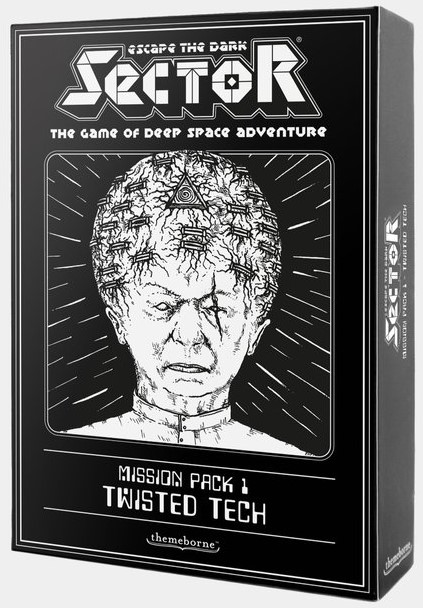
Escape the Dark Sector – Mission Pack 1: Twisted Tech takes the escapees off into the tech-based areas of the station. It includes twelve new Chapter cards which represent the encounters the escapees will have as they flee. They may run into security droids which attempt to detain or destroy the escaping prisoners; find a partially constructed android which can be scavenged for devices like a Medical Beam or a Replicator; discover a logistics terminal which can be hacked to determine the location of the nearest equipment stash; and even find a noodle seller to gain some rest and respite! The single Boss card is for Neuroshima, a technological genius with multiple cybernetic implants, such as automatically hitting in ranged combat or close combat. Fortunately, only one implant works each time he is faced—the particular implant being determined by a roll of the ‘Tech Die’.

Escape the Dark Sector – Mission Pack 1: Twisted Tech has nine new Item cards and three Drone cards. The Drone cards—Replication Drone, Surgical Drone, and Sentry Drone—give the escapees a tactical edge. All three drone models have the one basic function, simple healing, which is always guaranteed to work, but each model also has several advanced functions, which unfortunately not guaranteed to work, and may even harm the characters. The Replication Drone replicates items out of the Discard Pile;  the Surgical Drone restores Hit Points and can even remove a mutation (a feature of Escape the Dark Sector – Mission Pack 2: Mutant Syndrome rather than Escape the Dark Sector – Mission Pack 1: Twisted Tech); and the Sentry Drone inflicts damage on designated targets in combat. However, if a Drone malfunctions, it can inflict damage on a character, and whether it malfunctions or uses a particular advanced function determined by a roll of the ‘Tech Die’. Further, the characters can only take one Drone with them, and of course, a Drone can only be used once per action.

The nine Item cards include a mix of new cyberware, gear, and guns. The ‘Drone Commander Implant’ grants a second use of a Drone’s Basic Function before its card is flipped over. The ‘Chrono Rig’ enables any type or number of dice to be rerolled once per chapter (Escape the Dark Sector is played out in four chapters) and the second result used; the ‘Teleporter’ is used and discarded to gain a flanking attack in combat; and the ‘Nutri-Pill’ heals two Hit Points. Escape the Dark Sector – Mission Pack 1: Twisted Tech also includes three new weapons—the ‘Punch-Gun’, the ‘Sniper Rifle’, and the ‘Flame Thrower’. All three work in slightly different ways. Both the ‘Punch-Gun’ and the ‘Sniper Rifle’ need to be loaded using the ‘Special Ammo’ die, but the ‘Sniper Rifle’ must be then primed before it can be fired. If either hits, the Special Ammo die is rolled and can have an extra effect. This is extra damage for the ‘Punch-Gun’, but removes either the chapter dice of one type in the combat or three chapter dice of any type. This is a powerful effect as it helps negate the effects an encounter or chapter. Lastly, the ‘Flame Thrower’ can fire three bursts of flame of varying length, represented by rolling the ‘Flame Ammo’ dice, either one, two, or three per burst. These can result in inflicting damage on a target, no effect, or even engulfing a character in flames and causing them damage. Lastly, of course, there are the dice—the ‘Tech Die’, ‘Special Ammo’ dice, and the ‘Flame Ammo’ dice. (It will be easy to see the ‘Tech Die’ being used in the other two Mission Packs for Escape the Dark Sector.)

Physically, Escape the Dark Sector – Mission Pack 1: Twisted Tech is as well produced as the core game. The new Chapter and Boss Cards are large and in general easy to read and understand. Each one is illustrated in Black and White, in a style which echoes that of the Fighting Fantasy series and Warhammer 40K last seen in the nineteen eighties. The Item and Drone cards are also easy to use and the dice are clear and simple. The rule book requires a careful read, if only to grasp how the different new mechanics work.

Escape the Dark Sector – Mission Pack 1: Twisted Tech adds new subsystems as well as new encounters with the Chapter and Boss Cards. They add both elements of complexity and luck, though more of the latter than the former. Design wise, this expansion is thematically strong rather than narratively strong, adding new technology that the escapees can use and technology that the escapees must defeat or overcome. What this means is that it has no intrinsic story of its own and is thus easier to integrate with the core game and its other expansions. Overall, Escape the Dark Sector – Mission Pack 1: Twisted Tech is a solid expansion which adds more Sci-Fi theme to Escape the Dark Sector: The Game of Deep Space Adventure.

Friday, 13 August 2021

Friday Filler: The Fighting Fantasy Science Fiction Co-op I

In the dim and distant past, an Abbot, a Cook, a Miller, a Smith, a Tanner, and a Tailor were wrongly incarcerated below Dark Castle for more years than any of them can recall. There came a moment for several of them to make their escape and take up their old lives again, but between them and freedom lay some fifteen encounters or locations, as well as a boss responsible for their imprisonment. Using their Cunning, their Might, and their Wisdom, they faced traps, monsters, choices, and more, all of which forced them to work together if they were to overcome these challenges and so make their escape. It was an all or nothing proposition—they all had to survive or none would and they all had to escape or none would!

This is the set-up for Escape the Dark Castle: The Game of Atmospheric Adventure, a grim co-operative dice game published in 2017 which echoes the Fighting Fantasy series of solo adventure books from the nineteen eighties. Published by Themeborne, Escape the Dark Castle is designed to be played by between one and four players, aged fourteen plus, so just like those Fighting Fantasy books, it can be played solo. It can be played in thirty minutes or less—probably less because Escape the Dark Castle is a brutally challenging game to beat and it offers plenty of replay value because of the number of cards it comes with and the random set-up each time it is played.

Centuries have now passed and Lieutenants Abbot, Cook, Miller, Smith, Tanner, and Tailor—perhaps the descendants of those who successfully escaped the Dark Castle?—have found themselves incarcerated in the detention block of a vast space station. Like their ancestors, they now have their own opportunity to escape their imprisonment, and just like back on Earth, the route they must take, between the detention block and their spaceship, is fraught with danger. The escapees must find their way out of the Detention Level, through the Heart of the Station, and then the Forgotten Zones to their impounded spaceship—and escape!

This is the set-up for Escape the Dark Sector: The Game of Deep Space Adventure, the Science Fiction sequel to Escape the Dark Castle. Designed to be played by between one and four players—so can be played solo—aged fourteen and up, Escape the Dark Sector has a longer playing time than Escape the Dark Castle. This is because Escape the Dark Sector is moderately more complex than its forebear and adds new elements and rules to the format. However, this complexity adds new options for the players and flavour to both the story and play of the game which reflects the Science Fiction genre of Escape the Dark Sector.

Funded via KickstarterEscape the Dark Sector comes as solidly appointed as Escape the Dark Castle, if not more so. This includes six Crew Cards, forty-eight Chapter Cards, five Boss Cards, and three Start Cards, all of which are A6 in size. The twenty Item Cards, four Starting Weapons cards, six Starting Cybernetics, and two Tactical Action cards are all standard sized cards. The thirty-five, large six-sided dice are divided between the nine black Chapter Dice and the six white Crew Dice—just as in Escape the Dark Castle, but also add four Hit Dice and sixteen Ammo Dice (representing a mixture of ballistic, energy, and explosive ammunition). A Medical Record pad—which actually looks like a heart rate tracker—and several pencils are included to track the Crewman’s Hit Points. The black and white rule book runs to some twenty-eight pages, over double the length of the rulebook for Escape the Dark Castle.

The Character Cards depict Lieutenants Abbot, Cook, Miller, Smith, Tanner, and Tailor. Each has ratings in three Traits—Cunning, Might, and Wisdom. The ratings each Character has in these Traits indicates how many times they occur on their Character die. So, Lieutenant Abbot has four in Wisdom, three in Might, and one in Cunning, and the corresponding number of symbols appear on Lieutenant Abbot’s Character Die. Some of the symbols appear twice on the face a Character Die and in shield. When rolled, this means that a Character is twice as effective, whilst the shield indicates that all damage has been blocked. The Chapter Dice simply show the three symbols twice.

The Chapter Cards depict the creatures and challenges the crew members have to overcome and the horrors and choices they will face. Each Chapter Card clearly indicates what the Characters have to do, how many Chapter Dice need to be rolled if required, and how much damage the Characters will suffer if they fail. For example, the Characters might pass through the engineering deck where a neglected warp cell is in its final stages of destabilisation, pulsing intermittently and snaking out crackling tendrils of irradiated energy. They immediately lose a Hit Point due to the radiation, and have the choice of leaving the room immediately or searching for further equipment, but at the cost of further exposure to irradiation. Alternatively, the Characters find themselves locked in an alien laboratory containing a control terminal and a stasis tank in which floats a mutated humanoid monstrosity. One character has to work the controls, and if he successfully understands and manipulates the pattern of alien symbols, he can open the exit allowing everyone to escape. If not, the stasis tube powers down and the mutated humanoid monstrosity is freed… The Characters must defeat this creature before they can progress.

The Item Cards are a mix of consumables, equipment, and weapons. So, a bottle of Unmarked Pills can be consumed to restore a Hit Point or Brain Stim taken to change the result of a die roll to a Wisdom result; a Chrono-Bomb can be detonated to allow the reroll of all the dice; and the Beam Emitter ranged weapon comes with relatively high ammunition and rate of fire, but when fired has a chance of overheating and causing the Character wielding it to lose a Hit Point! One notable addition in terms of equipment is that of Cybernetic Implants. Every Character starts play with one of these, such as Advanced Targeting which lets the Character reroll an Ammo Die during ranged combat. This has the added effect of making the Character feel a little more different to each other—more so than in Escape the Dark Castle. Each Character has enough space to carry four items, though some larger items count as double.

Lastly, the rulebook is a quick read and the rules are relatively easy to learn. Some close attention will need to be paid to the new rules, especially those for ranged combat and flanking. Escape the Dark Sector requires some degree of set-up, more than its forebear. Not only does each player need to choose a Character, he also needs to select a Cybernetic Implant and one of the Starting Weapons. Ideally, this should be done together, so that the three Traits—Cunning, Might, and Wisdom—are best represented and enable the Characters to potentially deal with most challenges and enemies. All depending on luck and player choices, of course. Lastly, the Mission Deck is created. This consists of twelve Chapter cards, divided into three Acts of four cards each for the Detention Level, the Heart of the Station, and the Forgotten Zones, topped with a Start card and tailed with a Boss card. There are sixteen cards for each of the three acts, three Start cards, and five Boss cards, and the set-up is done randomly. This allows for plenty of variety in terms of challenges and replayability in the long term.

Game play begins with a player turning over the Start Card and reading it. Then the first Chapter Card is turned over and play proper begins. There is no turn order, the players deciding who will turn over each Chapter Card and what they will do to overcome them. It can be important who turns over a Chapter Card as some have conditions which apply only to the Character of that player. From one Chapter to the next, the Characters will find themselves fighting or evading a suddenly powered-up security ’mech; creeping past large glistening eggs which sprout acid-seeping tentacles; bribing or attacking their way past rival gangs; abducted, experimented upon, and found again; swarmed by alien insectoids, and more. Along the way they will find items which will help them and if they are lucky, they will be strong enough to face the Boss at the end of the dungeon and defeat him to escape.

The major addition to Escape the Dark Sector in terms of rules is the ability for the Characters to engage in Ranged Combat. In some Chapters this is mandatory, others not, but adds new tactical options for the Characters, who can now Shoot and expect Return Fire from the enemy. To attack with a ranged weapon, a player rolls the Ammo Dice for that weapon—the number determined by the weapon’s rate of fire—and applies the effects. This varies from creature to creature, as some creatures are more susceptible to energy blasts than slug hits for example. It is also possible to miss and for weapons to suffer a malfunction which will harm the wielder. Instead of shooting, a Character can Flank the enemy, rushing out from behind cover to reach a better vantage point. This makes the Character vulnerable to attack from the enemy when moving, but it grants him a bonus attack in the extra Flank Round which takes place before the Ranged Combat or Close Combat Rounds. This bonus attack can either be a Ranged Combat or a Close Combat attack, inflicts extra damage if successful, and it cannot be blocked, but it can only be done once per Chapter.

In Close Combat, the players have a number of actions to choose from, the first of which is the Fight action. This covers attacking and defending, each player rolling his Character Dice in an attempt to match the symbols on the Chapter Card which represents the enemy. Unless a player has rolled a Shield on one of his Character Dice which would block any damage, his Character suffers damage automatically. Other actions include Reload—to reload any ranged weapon (so essentially when a Character finds a weapon, it comes with unlimited ammunition!), Trade or take an Item from another Character, Take Cover and take no action, and Activate Drone. The latter activates the drone carried in the backpack of one of the Characters. It heals the activating Character by one Hit Point and then recharges. It can only be used once per Chapter. This is a significant change to the game play of the format because in Escape the Dark Sector, unlike in Escape the Dark Castle, there is no Rest action during which a Character can heal. Between Chapters, the Characters are free to use Items or exchange with other Characters, and reload a weapon.

Escape the Dark Sector: The Game of Deep Space Adventure could simply have been a reiteration of Escape the Dark Castle: The Game of Atmospheric Adventure, but with a Science Fiction twist. Fortunately, it is anything but that. Although very much based on the set-up and mechanics as Escape the Dark Castle, the sequel is very much a development of it, adding theme and rules that are very much in keeping with both its Science Fiction genre and inspirations. Now the inspirations for Escape the Dark Castle were in the fantasy and the Fighting Fantasy solo adventure books of the eighties, but whilst Escape the Dark Sector draws from the Escape the Dark Sector solo adventure books for its style of play, its Science Fiction inspirations are the grungy, Blue Collar Science Fiction of the nineteen seventies and eighties, so Alien, Bladerunner, Outland, and others. There is another inspiration too, but one from the nineties rather than the eighties, and that is the computer first person shooter, Doom. It is inspirational only though, and although Escape the Dark Sector does involve gun combat, the resulting game is not a shoot ’em up. It is grimmer and more challenging, fraught with danger from one Chapter to the next.

Physically, Escape the Dark Sector is well presented and packaged. The cards are all on a good linen stock and their artwork has a grubby, rough quality which fits both theme and setting. There is a certain pleasure to be had examining the artwork and spotting the references and so on. Lastly, the dice feel solid and heavy in the hands, just waiting to be rolled. The rulebook is decently presented and written, and includes rules for solo play as well as standard play with multiple players.

As much as the new rules and mechanics in Escape the Dark Sector add structure and give the players options, they add complexity, they give more choices to be made, and thus they increase playing length. Whether coming to Escape the Dark Sector or after having played Escape the Dark Castle, the rules also need more attention paid to them because of their relatively greater complexity and increased procedural nature of play. However, a careful read through and a play or two of the game, and a gaming group should be fine.

Like its forebear, Escape the Dark Sector: The Game of Deep Space Adventure is both fun and challenging to play, offering frustration in failing to escape the confines of the space station and elation in overcoming the challenges of the Chapter Cards and defeating the final Boss. The game is fairly quick to set up and play through, making it a good filler—though one which warrants occasional rather than regular play. The new rules and structured Mission Deck add options as well as better storytelling, all pushing the players to make more choices and work better together. Escape the Dark Sector: The Game of Deep Space Adventure is an enjoyably brutal and challenging co-operative game, whether played solo or in a group.