Every Week It's Wibbley-Wobbley Timey-Wimey Pookie-Reviewery...
Showing posts with label Escape. Show all posts

Friday, 10 June 2022

Friday Filler: The Fighting Fantasy Science Fiction Co-op II

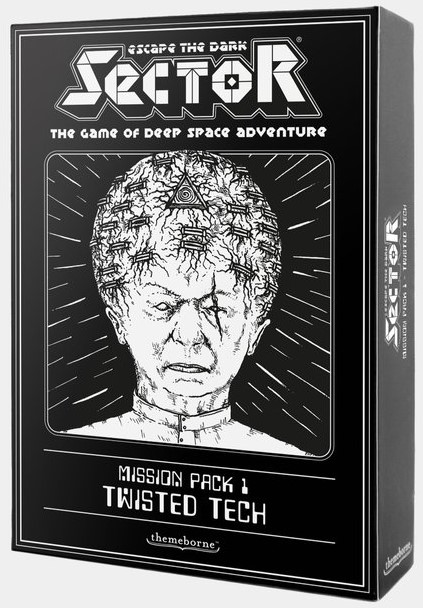
Escape the Dark Sector: The Game of Deep Space Adventure brought the brutality of the Fighting Fantasy solo adventure books of the eighties to both Science Fiction and co-operative game play for up to four players in which their characters begin incarcerated in the detention block of a vast space station and must work together to ensure their escape. Published by Themeborne, with its multiple encounters, traps, aliens, robots, objects, and more as well as a different end of game Boss every time, Escape the Dark Sector offered a high replay value, especially as a game never lasted longer than thirty minutes. Now, like its predecessor, Escape the Dark Castle: The Game of Atmospheric Adventure, the game has not one, but three expansions! Funded via a Kickstarter campaign, each of the three expansions—Escape the Dark Sector – Mission Pack 1: Twisted TechEscape the Dark Sector – Mission Pack 2: Mutant Syndrome, and Escape the Dark Sector – Mission Pack 3: Quantum Rift—adds a new Boss, new Chapters, new Items, and more, taking the path of the escapees off in a new direction to face new encounters and new dangers. Each expansion can be played on its own with the base game, or mixed and matched to add one, two, or three mission packs that increase the replay value of the core game.

Escape the Dark Sector – Mission Pack 1: Twisted Tech takes the escapees off into the tech-based areas of the station. It includes twelve new Chapter cards which represent the encounters the escapees will have as they flee. They may run into security droids which attempt to detain or destroy the escaping prisoners; find a partially constructed android which can be scavenged for devices like a Medical Beam or a Replicator; discover a logistics terminal which can be hacked to determine the location of the nearest equipment stash; and even find a noodle seller to gain some rest and respite! The single Boss card is for Neuroshima, a technological genius with multiple cybernetic implants, such as automatically hitting in ranged combat or close combat. Fortunately, only one implant works each time he is faced—the particular implant being determined by a roll of the ‘Tech Die’.

Escape the Dark Sector – Mission Pack 1: Twisted Tech has nine new Item cards and three Drone cards. The Drone cards—Replication Drone, Surgical Drone, and Sentry Drone—give the escapees a tactical edge. All three drone models have the one basic function, simple healing, which is always guaranteed to work, but each model also has several advanced functions, which unfortunately not guaranteed to work, and may even harm the characters. The Replication Drone replicates items out of the Discard Pile;  the Surgical Drone restores Hit Points and can even remove a mutation (a feature of Escape the Dark Sector – Mission Pack 2: Mutant Syndrome rather than Escape the Dark Sector – Mission Pack 1: Twisted Tech); and the Sentry Drone inflicts damage on designated targets in combat. However, if a Drone malfunctions, it can inflict damage on a character, and whether it malfunctions or uses a particular advanced function determined by a roll of the ‘Tech Die’. Further, the characters can only take one Drone with them, and of course, a Drone can only be used once per action.

The nine Item cards include a mix of new cyberware, gear, and guns. The ‘Drone Commander Implant’ grants a second use of a Drone’s Basic Function before its card is flipped over. The ‘Chrono Rig’ enables any type or number of dice to be rerolled once per chapter (Escape the Dark Sector is played out in four chapters) and the second result used; the ‘Teleporter’ is used and discarded to gain a flanking attack in combat; and the ‘Nutri-Pill’ heals two Hit Points. Escape the Dark Sector – Mission Pack 1: Twisted Tech also includes three new weapons—the ‘Punch-Gun’, the ‘Sniper Rifle’, and the ‘Flame Thrower’. All three work in slightly different ways. Both the ‘Punch-Gun’ and the ‘Sniper Rifle’ need to be loaded using the ‘Special Ammo’ die, but the ‘Sniper Rifle’ must be then primed before it can be fired. If either hits, the Special Ammo die is rolled and can have an extra effect. This is extra damage for the ‘Punch-Gun’, but removes either the chapter dice of one type in the combat or three chapter dice of any type. This is a powerful effect as it helps negate the effects an encounter or chapter. Lastly, the ‘Flame Thrower’ can fire three bursts of flame of varying length, represented by rolling the ‘Flame Ammo’ dice, either one, two, or three per burst. These can result in inflicting damage on a target, no effect, or even engulfing a character in flames and causing them damage. Lastly, of course, there are the dice—the ‘Tech Die’, ‘Special Ammo’ dice, and the ‘Flame Ammo’ dice. (It will be easy to see the ‘Tech Die’ being used in the other two Mission Packs for Escape the Dark Sector.)

Physically, Escape the Dark Sector – Mission Pack 1: Twisted Tech is as well produced as the core game. The new Chapter and Boss Cards are large and in general easy to read and understand. Each one is illustrated in Black and White, in a style which echoes that of the Fighting Fantasy series and Warhammer 40K last seen in the nineteen eighties. The Item and Drone cards are also easy to use and the dice are clear and simple. The rule book requires a careful read, if only to grasp how the different new mechanics work.

Escape the Dark Sector – Mission Pack 1: Twisted Tech adds new subsystems as well as new encounters with the Chapter and Boss Cards. They add both elements of complexity and luck, though more of the latter than the former. Design wise, this expansion is thematically strong rather than narratively strong, adding new technology that the escapees can use and technology that the escapees must defeat or overcome. What this means is that it has no intrinsic story of its own and is thus easier to integrate with the core game and its other expansions. Overall, Escape the Dark Sector – Mission Pack 1: Twisted Tech is a solid expansion which adds more Sci-Fi theme to Escape the Dark Sector: The Game of Deep Space Adventure.

Monday, 16 August 2021

Solitaire: Cantaloop

Cantaloop is likely not something that you will have heard of—and there is a good reason for this. Published by Lookout Games, a publisher of board games rather than roleplaying games, Cantaloop has caught the attention of the board game hobby rather than the roleplaying hobby, despite the fact that Cantaloop is not a board game. In fact, Cantaloop—or rather Cantaloop – Book 1: Breaking into Prison—is a solo adventure, part of the Lookout Games’ Paper Point ‘N’ Click line. The name of the line should give a clue as to the inspiration for the line, that is classic ‘point and click’ computer adventure mystery games, such as Myst, Monkey Island, and Indiana Jones and the Fate of Atlantis. The designer has taken that inspiration and instead of producing a ‘point and click’ computer adventure game, he has given it a physical form, for Cantaloop – Book 1: Breaking into Prison comes as an eye-catching landscape format folder with a mugshot of the adventure’s protagonist on the front. Inside, the player will find a complete adventure consisting of twenty locations, a double-sided poster which serves as the player’s Inventory, a deck of sixty Item cards, a post card, a trigger sheet, and last, but not least, a decoder! Now this decoder is needed because much of the text is obscured and needs to be viewed through the decoder, which is a transparent piece of red plastic. Place the decoder over the text and it becomes clear! Roleplaying game fans of a certain age will remember TSR, Inc. using a similar mechanic for the adventures MV1 Midnight on Dagger Alley for Advanced Dungeons & Dragons and IJ4 The Golden Godden Goddess for The Adventures of Indiana Jones Role-Playing Game back in the nineteen eighties.

The set-up for Cantaloop – Book 1: Breaking into Prison is simple. ‘Hook’ Carpenter is a charismatic and resourceful crook, who ten years ago was forced to flee Cantaloop Island and hide out in Switzerland—as detailed in the free to play Cantaloop – Book 0: The Prequel—and now he is back for revenge! For that though, he needs a team, starting with a Hacker and a ‘Lady in Red’. The Hacker is the problem though, because the best Hacker in town is in prison. However, this is not going to the determined and ever resourceful ‘Hook’ Carpenter. He is going to find a way to break into Cantaloop Island’s prison, bust the Hacker out, and help bring his plan to fruition.

Cantaloop – Book 1: Breaking into Prison is designed to be played by a player aged sixteen and above—some of the narrative’s humour is slightly adult in tone, though not risqué—and can be completed in about five hours or so. There is nothing to stop more players getting involved and working together to help ‘Hook’ in his plan, but really, more than two players and playing Cantaloop – Book 1: Breaking into Prison is going to get crowded. Better for the players to work through it and then lend their copy to the third (and fourth) player to enjoy.

The game opens with a seven-page tutorial explaining what the components to Cantaloop – Book 1: Breaking into Prison do and how the adventure is played. The majority of the book consists of twenty locations, beginning with the lighthouse and eventually ending with—well, lets not spoil that. Each location is given a two-page spread. On the righthand side is an illustration of the location complete with an indication of possible exits and various objects and items which the player as ‘Hook’ Carpenter can examine and interact with. On the lefthand side is a block of obscured text. At the start of the game, the player only has two items, the equivalent of a Nokia 3310 mobile phone and a magnifying glass. These have code fragments down their sides. When the player aligns one of these with the code fragment of an object in the scene it will generate a full four-digit code which can be referenced in the obscured text on the left. Alternatively, two item cards can be aligned to generate another four-digit code which can be referenced with an entry on the double-sided Inventory poster.

When revealed, whether from the Inventory poster or the location, the text might instruct the player to take more items which will help ‘Hook’ in his plan, give access to another location, and more, though sometimes it will just be warnings to the player to not cheat or just nonsense. Certain codes will instruct the player to cross off particular numbers on the Trigger Sheet, which will unlock other areas of the story, whilst other will open up scenes where the player can read the dialogue between ‘Hook’ and another character. Other codes reveal secrets and jokes—none of which are mentioned elsewhere in the game, but are worth finding if the player can.

Just like the ‘point and click’ computer adventure games which inspired it, Cantaloop – Book 1: Breaking into Prison is built around a lot of puzzles. Many of these are quite challenging and when a player manages to solve them, he deserves to feel a sense of achievement. Some of them feel impossible or oddly out of left field though, but when the player really gets stuck, there is a lengthy help section at the back of the folder. Containing more obscured text of course…

Physically, Cantaloop – Book 1: Breaking into Prison is problematic. The storage for the cards—three different pockets is a bit tight, but the main issue is that the paper quality for the pages is poor. The paper is too thin to really withstand much more than the gentlest of handling or be torn from the ring binder. It would have been nice if the decoder had been mounted in a holder for ease of use also, and depending upon the player, the text may be too small to read with ease. However, the artwork is excellent and has a great cartoon feel to it. Lastly, it should be noted that Cantaloop – Book 1: Breaking into Prison is part of a trilogy, so there will be another two parts before ‘Hook’ Carpenter has his revenge.

Cantaloop – Book 1: Breaking into Prison is an incredible piece of design because it successfully translates the digital style of the ‘point and click’ computer adventure game a la Lucas Arts into an analogue format, bringing with it a strong sense of silly, often cheesy humour. Cantaloop – Book 1: Breaking into Prison is a lot of fun to play and it is not difficult to imagine the exploits of ‘Hook’ Carpenter as a cartoon with soundtrack akin to Mission: Impossible which you can hum along to as you play.

Friday, 13 August 2021

Friday Filler: The Fighting Fantasy Science Fiction Co-op I

In the dim and distant past, an Abbot, a Cook, a Miller, a Smith, a Tanner, and a Tailor were wrongly incarcerated below Dark Castle for more years than any of them can recall. There came a moment for several of them to make their escape and take up their old lives again, but between them and freedom lay some fifteen encounters or locations, as well as a boss responsible for their imprisonment. Using their Cunning, their Might, and their Wisdom, they faced traps, monsters, choices, and more, all of which forced them to work together if they were to overcome these challenges and so make their escape. It was an all or nothing proposition—they all had to survive or none would and they all had to escape or none would!

This is the set-up for Escape the Dark Castle: The Game of Atmospheric Adventure, a grim co-operative dice game published in 2017 which echoes the Fighting Fantasy series of solo adventure books from the nineteen eighties. Published by Themeborne, Escape the Dark Castle is designed to be played by between one and four players, aged fourteen plus, so just like those Fighting Fantasy books, it can be played solo. It can be played in thirty minutes or less—probably less because Escape the Dark Castle is a brutally challenging game to beat and it offers plenty of replay value because of the number of cards it comes with and the random set-up each time it is played.

Centuries have now passed and Lieutenants Abbot, Cook, Miller, Smith, Tanner, and Tailor—perhaps the descendants of those who successfully escaped the Dark Castle?—have found themselves incarcerated in the detention block of a vast space station. Like their ancestors, they now have their own opportunity to escape their imprisonment, and just like back on Earth, the route they must take, between the detention block and their spaceship, is fraught with danger. The escapees must find their way out of the Detention Level, through the Heart of the Station, and then the Forgotten Zones to their impounded spaceship—and escape!

This is the set-up for Escape the Dark Sector: The Game of Deep Space Adventure, the Science Fiction sequel to Escape the Dark Castle. Designed to be played by between one and four players—so can be played solo—aged fourteen and up, Escape the Dark Sector has a longer playing time than Escape the Dark Castle. This is because Escape the Dark Sector is moderately more complex than its forebear and adds new elements and rules to the format. However, this complexity adds new options for the players and flavour to both the story and play of the game which reflects the Science Fiction genre of Escape the Dark Sector.

Funded via KickstarterEscape the Dark Sector comes as solidly appointed as Escape the Dark Castle, if not more so. This includes six Crew Cards, forty-eight Chapter Cards, five Boss Cards, and three Start Cards, all of which are A6 in size. The twenty Item Cards, four Starting Weapons cards, six Starting Cybernetics, and two Tactical Action cards are all standard sized cards. The thirty-five, large six-sided dice are divided between the nine black Chapter Dice and the six white Crew Dice—just as in Escape the Dark Castle, but also add four Hit Dice and sixteen Ammo Dice (representing a mixture of ballistic, energy, and explosive ammunition). A Medical Record pad—which actually looks like a heart rate tracker—and several pencils are included to track the Crewman’s Hit Points. The black and white rule book runs to some twenty-eight pages, over double the length of the rulebook for Escape the Dark Castle.

The Character Cards depict Lieutenants Abbot, Cook, Miller, Smith, Tanner, and Tailor. Each has ratings in three Traits—Cunning, Might, and Wisdom. The ratings each Character has in these Traits indicates how many times they occur on their Character die. So, Lieutenant Abbot has four in Wisdom, three in Might, and one in Cunning, and the corresponding number of symbols appear on Lieutenant Abbot’s Character Die. Some of the symbols appear twice on the face a Character Die and in shield. When rolled, this means that a Character is twice as effective, whilst the shield indicates that all damage has been blocked. The Chapter Dice simply show the three symbols twice.

The Chapter Cards depict the creatures and challenges the crew members have to overcome and the horrors and choices they will face. Each Chapter Card clearly indicates what the Characters have to do, how many Chapter Dice need to be rolled if required, and how much damage the Characters will suffer if they fail. For example, the Characters might pass through the engineering deck where a neglected warp cell is in its final stages of destabilisation, pulsing intermittently and snaking out crackling tendrils of irradiated energy. They immediately lose a Hit Point due to the radiation, and have the choice of leaving the room immediately or searching for further equipment, but at the cost of further exposure to irradiation. Alternatively, the Characters find themselves locked in an alien laboratory containing a control terminal and a stasis tank in which floats a mutated humanoid monstrosity. One character has to work the controls, and if he successfully understands and manipulates the pattern of alien symbols, he can open the exit allowing everyone to escape. If not, the stasis tube powers down and the mutated humanoid monstrosity is freed… The Characters must defeat this creature before they can progress.

The Item Cards are a mix of consumables, equipment, and weapons. So, a bottle of Unmarked Pills can be consumed to restore a Hit Point or Brain Stim taken to change the result of a die roll to a Wisdom result; a Chrono-Bomb can be detonated to allow the reroll of all the dice; and the Beam Emitter ranged weapon comes with relatively high ammunition and rate of fire, but when fired has a chance of overheating and causing the Character wielding it to lose a Hit Point! One notable addition in terms of equipment is that of Cybernetic Implants. Every Character starts play with one of these, such as Advanced Targeting which lets the Character reroll an Ammo Die during ranged combat. This has the added effect of making the Character feel a little more different to each other—more so than in Escape the Dark Castle. Each Character has enough space to carry four items, though some larger items count as double.

Lastly, the rulebook is a quick read and the rules are relatively easy to learn. Some close attention will need to be paid to the new rules, especially those for ranged combat and flanking. Escape the Dark Sector requires some degree of set-up, more than its forebear. Not only does each player need to choose a Character, he also needs to select a Cybernetic Implant and one of the Starting Weapons. Ideally, this should be done together, so that the three Traits—Cunning, Might, and Wisdom—are best represented and enable the Characters to potentially deal with most challenges and enemies. All depending on luck and player choices, of course. Lastly, the Mission Deck is created. This consists of twelve Chapter cards, divided into three Acts of four cards each for the Detention Level, the Heart of the Station, and the Forgotten Zones, topped with a Start card and tailed with a Boss card. There are sixteen cards for each of the three acts, three Start cards, and five Boss cards, and the set-up is done randomly. This allows for plenty of variety in terms of challenges and replayability in the long term.

Game play begins with a player turning over the Start Card and reading it. Then the first Chapter Card is turned over and play proper begins. There is no turn order, the players deciding who will turn over each Chapter Card and what they will do to overcome them. It can be important who turns over a Chapter Card as some have conditions which apply only to the Character of that player. From one Chapter to the next, the Characters will find themselves fighting or evading a suddenly powered-up security ’mech; creeping past large glistening eggs which sprout acid-seeping tentacles; bribing or attacking their way past rival gangs; abducted, experimented upon, and found again; swarmed by alien insectoids, and more. Along the way they will find items which will help them and if they are lucky, they will be strong enough to face the Boss at the end of the dungeon and defeat him to escape.

The major addition to Escape the Dark Sector in terms of rules is the ability for the Characters to engage in Ranged Combat. In some Chapters this is mandatory, others not, but adds new tactical options for the Characters, who can now Shoot and expect Return Fire from the enemy. To attack with a ranged weapon, a player rolls the Ammo Dice for that weapon—the number determined by the weapon’s rate of fire—and applies the effects. This varies from creature to creature, as some creatures are more susceptible to energy blasts than slug hits for example. It is also possible to miss and for weapons to suffer a malfunction which will harm the wielder. Instead of shooting, a Character can Flank the enemy, rushing out from behind cover to reach a better vantage point. This makes the Character vulnerable to attack from the enemy when moving, but it grants him a bonus attack in the extra Flank Round which takes place before the Ranged Combat or Close Combat Rounds. This bonus attack can either be a Ranged Combat or a Close Combat attack, inflicts extra damage if successful, and it cannot be blocked, but it can only be done once per Chapter.

In Close Combat, the players have a number of actions to choose from, the first of which is the Fight action. This covers attacking and defending, each player rolling his Character Dice in an attempt to match the symbols on the Chapter Card which represents the enemy. Unless a player has rolled a Shield on one of his Character Dice which would block any damage, his Character suffers damage automatically. Other actions include Reload—to reload any ranged weapon (so essentially when a Character finds a weapon, it comes with unlimited ammunition!), Trade or take an Item from another Character, Take Cover and take no action, and Activate Drone. The latter activates the drone carried in the backpack of one of the Characters. It heals the activating Character by one Hit Point and then recharges. It can only be used once per Chapter. This is a significant change to the game play of the format because in Escape the Dark Sector, unlike in Escape the Dark Castle, there is no Rest action during which a Character can heal. Between Chapters, the Characters are free to use Items or exchange with other Characters, and reload a weapon.

Escape the Dark Sector: The Game of Deep Space Adventure could simply have been a reiteration of Escape the Dark Castle: The Game of Atmospheric Adventure, but with a Science Fiction twist. Fortunately, it is anything but that. Although very much based on the set-up and mechanics as Escape the Dark Castle, the sequel is very much a development of it, adding theme and rules that are very much in keeping with both its Science Fiction genre and inspirations. Now the inspirations for Escape the Dark Castle were in the fantasy and the Fighting Fantasy solo adventure books of the eighties, but whilst Escape the Dark Sector draws from the Escape the Dark Sector solo adventure books for its style of play, its Science Fiction inspirations are the grungy, Blue Collar Science Fiction of the nineteen seventies and eighties, so Alien, Bladerunner, Outland, and others. There is another inspiration too, but one from the nineties rather than the eighties, and that is the computer first person shooter, Doom. It is inspirational only though, and although Escape the Dark Sector does involve gun combat, the resulting game is not a shoot ’em up. It is grimmer and more challenging, fraught with danger from one Chapter to the next.

Physically, Escape the Dark Sector is well presented and packaged. The cards are all on a good linen stock and their artwork has a grubby, rough quality which fits both theme and setting. There is a certain pleasure to be had examining the artwork and spotting the references and so on. Lastly, the dice feel solid and heavy in the hands, just waiting to be rolled. The rulebook is decently presented and written, and includes rules for solo play as well as standard play with multiple players.

As much as the new rules and mechanics in Escape the Dark Sector add structure and give the players options, they add complexity, they give more choices to be made, and thus they increase playing length. Whether coming to Escape the Dark Sector or after having played Escape the Dark Castle, the rules also need more attention paid to them because of their relatively greater complexity and increased procedural nature of play. However, a careful read through and a play or two of the game, and a gaming group should be fine.

Like its forebear, Escape the Dark Sector: The Game of Deep Space Adventure is both fun and challenging to play, offering frustration in failing to escape the confines of the space station and elation in overcoming the challenges of the Chapter Cards and defeating the final Boss. The game is fairly quick to set up and play through, making it a good filler—though one which warrants occasional rather than regular play. The new rules and structured Mission Deck add options as well as better storytelling, all pushing the players to make more choices and work better together. Escape the Dark Sector: The Game of Deep Space Adventure is an enjoyably brutal and challenging co-operative game, whether played solo or in a group.