Friday, 24 July 2026
Friday Fantasy: The Cursed Farm
The Cursed Farm is a scenario for Age of Vikings: The Roleplaying Game, the low fantasy, deeply historical game published by Chaosium, Inc. and designed to help tell stories of home, hearth, and honour, myth and magic, and bring new sagas to life. Subtitled ‘An Introductory Scenario for the Age of Vikings Roleplaying Game’, it is designed as a first scenario be played for the roleplaying game and in many cases it has been. That said, it is not designed as a quick-start. In other words, it does not come with the rules necessary to play it, although links are provided so that the Game Master has a set of ready-to-play Player Characters. Instead, The Cursed Farm works as a demonstration scenario. It not only tells a tale of how dark Viking magic can come to affect the innocent, of past lives, and misplaced ambitions, but involves a classic Norse monster too! Further, it can be run in a single session. This means that is very easy add to a campaign, to be run as a showcase for the Game Master’s own group, or run as a demonstration scenario at a convention. In the case of the latter two options, this includes teaching the rules to the players. The rules themselves are not difficult to learn and anyone with experience of Basic Roleplaying: Universal Game Engine will pick them up with ease.
The family will quickly reveal what they know and the Player Characters are free to examine the farm and its current state, and will very likely discover that as the title of the scenario states, that it is cursed. The Second Sight skill is important here and a mixture of interaction and perception skills will play a major part in determining what is happening at the farm. The likelihood is that the Player Characters will quickly track down the source of the curse and deal directly with it. This can result in combat, and in particular, there is a chance for a warrior and his honour to shine, and even ultimately benefit. Combat is not the only solution though, and the source is willing to communicate and wait. That said, the Game Master is given an optional combat encounter if the Player Characters have avoided combat so far or if she wants to add another combat encounter. Ultimately, resolving the situation in The Cursed Farm relies upon interaction and perception. To that end though, the NPCs are simply drawn and the Game Master will need to strengthen their individual characters in her portrayal of them. This is due more to the limited page rather than any other reason.
Physically, The Cursed Farm is solidly presented. It is well written, easy to understand, and quick to prepare, and the artwork is good. The cartography, done in colour and black and white, with versions for both the players and the Game Masters, is clear and easy to read.
The Cursed Farm is good little scenario for Age of Vikings: The Roleplaying Game. It is straightforward and easy to prepare, whether to add to a campaign or run as a demonstration, and gives a good flavour of Icelandic horror and mystery.
Saturday, 18 July 2026
[Free RPG Day 2026] Age of Vikings Quickstart
Now in its nineteenth year, Free RPG Day for 2026 took place on Saturday, June 27th. As per usual, Free RPG Day consisted of an array of new and interesting little releases, which are traditionally tasters for forthcoming games to be released at GenCon the following August, but others are support for existing RPGs or pieces of gaming ephemera or a quick-start. This included dice, miniatures, vouchers, and more. Unfortunately, due to vagaries of International Customs, Free RPG Day in the UK did not take place until Saturday, 22nd August.
This review is possible due to the generosity of Waylands Forge in Birmingham.
Quick-starts are a means of trying out a roleplaying game before you buy. Each should provide a Game Master with sufficient background to introduce and explain the setting to her players, the rules to run the scenario included, and a set of ready-to-play, pre-generated characters that the players can pick up and understand almost as soon as they have sat down to play. The scenario itself should provide an introduction to the setting for the players as well as to the type of adventures that their characters will have and just an idea of some of the things their characters will be doing on said adventures. All of which should be packaged up in an easy-to-understand booklet whose contents, with a minimum of preparation upon the part of the Game Master, can be brought to the table and run for her gaming group in a single evening’s session—or perhaps two. And at the end of it, Game Master and players alike should ideally know whether they want to play the game again, perhaps purchasing another adventure or even the full rules for the roleplaying game.
Alternatively, if the Game Master already has the full rules for the roleplaying game the quick-start is for, then what it provides is a sample scenario that she still run as an introduction or even as part of her campaign for the roleplaying game. The ideal quick-start should entice and intrigue a playing group, but above all effectively introduce and teach the roleplaying game, as well as showcase both rules and setting.
What is it?
Age of Vikings Quickstart: Further Adventures in a Land of Sagas and Mystery is the quick-start for Age of Vikings: The Roleplaying Game, the low fantasy, deeply historical game published by Chaosium, Inc. and designed to help tell stories of home, hearth, and honour, myth and magic, and bring new sagas to life.
The Age of Vikings Quickstart is a thirty-nine page, 8.38 MB full colour PDF.
The Age of Vikings Quickstart includes the scenario ‘Belly of the Beast’. It can be played in roughly two hours.
What else do you need to play?
The Age of Vikings Quickstart needs a standard set of polyhedral dice.
The Age of Vikings Quickstart includes four pre-generated Player Characters. They include two warriors, an archer, and a skaldic poet.
Rolls can be augmented with another skill or Passion. A successful augmentation roll will apply a bonus, which will be better with a Critical success. A failed augmentation levies a penalty whilst a Critical failure results in the temporary despair of the Player Character. Devotion points can be spent to gain a bonus and Player Character can also call upon his Wyrd to change his fate. This turns a failed roll into a successful roll, but at the permanent cost of a point of Power. Do this too often and a Player Character’s Wyrd or fate has played out.
The combat rules in the Age of Vikings Quickstart and Age of Vikings are skill-based. Order of action is based on Dexterity, and during a round, a combatant can move, act or attack, and defend. Attacks can be dodged or parried and armour deducts damage, as does a shield, but only a few points in each location. Damage is done by location, but if the Hit Points in a particular location are reduced to zero, a limb becomes useless, the combatant is left bleeding to death, or knocked unconscious and dying. Damage done to locations is also applied to general Hit Points and reducing those will knock a combatant unconscious. First aid is available, but natural healing takes weeks. (Age of Vikings includes rules for healing magic.)
What do you play?
‘Belly of the Beast’ is short and linear, but it clearly teaches the rules and advises the Game Master on how to handle and stage its encounters. There is some limited opportunity for roleplaying, but the main focus of the scenario is on action and combat. As its title suggests, the action of the scenario takes place within the belly of the Kraken from which the Player Characters must escape. It is a great set-up and the tale of escaping from it is worthy of a saga.
No. The Age of Vikings Quickstart has everything that a Game Master needs to run the included scenario.
Is it easy to prepare?
Yes. The Age of Vikings Quickstart is direct and to the point and the advice makes the rules easy to understand and the various scenes easy to run.
Yes. The Age of Vikings Quickstart is a well done, solid introduction to the basics of Age of Vikings: The Roleplaying Game. It clearly explains both rules and the action of the scenario.
Sunday, 1 February 2026
Icelandic Stories
This is the set-up for Age of Vikings: The Roleplaying Game in which the Player Characters are farmers and adventurers in medieval Iceland. They seek fame and fortune through adventure and also raiding during the season, but to protect their honour and their family too. It is published by Chaosium, Inc. and it is not the publisher’s first foray into the Viking Age and medieval Iceland, having previously published Mythic Iceland and been associated with Avalon Hill’s Vikings: Nordic Roleplaying for RuneQuest, published in 1985. Like those roleplaying games, it uses the mechanics of the Basic Roleplaying: Universal Game Engine, but mechanically, it bears some similarity to RuneQuest: Roleplaying in Glorantha. Such that if you have played RuneQuest: Roleplaying in Glorantha, then mechanically, adjusting to Age of Vikings will not be an issue. That said, any experience with Basic Roleplaying: Universal Game Engine will work too. Lastly, it should be pointed out that Age of Vikings: The Roleplaying Game straddles the line between the historical and the mythical. It draws heavily upon both the history of the period and on the Icelandic Sagas, but allows the Game Master and her players to decide to focus on the historical elements of the setting or the mythic elements of the setting or both. The default is the latter as it reflects the outlook of the Icelanders upon the world and the land around them.
A Player Character in Age of Vikings: The Roleplaying Game is defined by his name and nickname, his Passions and devotions, family history, characteristics and skills, plus Spirit Animal, Devotions, Family, and distinctive features. A Player Character’s Passions represent his values and emotional desires, and in play, they can drive him to act (and mechanically grant a bonus) and bring him into conflict with others. He starts with three: Honour, Loyalty (goði), and Love (Family), and he will have more, typically created during the process of roll for his Family History. The latter gives the Player Character his backstory from the time of his grandfather in 900 CE all the way up through his parents’ history to his own 977 CE. The characteristics are Strength, Constitution, Size, Dexterity, Intelligence, Power, and Charisma. These are rated between three and eighteen, although the minimum value for Size and Intelligence is eight. Skills are divided in seven categories—Agility, Communication, Knowledge, Manipulation, Mythic, Perception, and Stealth, plus Weapons. His Spirit Animal reflects a Player Character’s soul and will grant a bonus for certain categories, such as the Owl, Snow Fox, or Weasel, which means that the Player Character is cunning and gains a bonus to Perception and Stealth skills. A Player Character’s Devotions are made to the gods that he most values and can draw upon for inspiration, represented by points of Dedication that grant him a bonus when acting according to their ideals. For example, the ideals for Baldur are light, happiness, and peace, whilst those for Óðinn are magic, war, and wisdom. The worship of Loki and Hel is rare and frowned upon.
Creating a Player Character in Age of Vikings: The Roleplaying Game is a mixture of random rolls and making choices. Options are given to simplify the process, but the default does take time. The player chooses or rolls for his character’s name and nickname, his family background, and then selects his Homeland skill bonuses. If the character is to be a Runemaster or a Seiðkona, his player selects from the skills for those options. He selects the three gods for his Devotions and assigns the Dedication points to them. Lastly, he rolls for his family details, its wealth, and its farm, and thus the equipment he has access to, as well as the distinctive feature.
Name: Álfdís Hallisdóttir
Nickname: Coal-brow
Passions: Honour 90%, Loyalty (Goði) 60%, Love (Family) 60%, Loyalty (Sweden) 60%, Hate (English) 70%, Loyalty (Norway) 60%
Devotions: Óðinn (1), Freyr (1) Forseti (1)
Animal Spirit: Cat (Spiritual)
Distinctive Features: Alluring expression, Eyebrows grown together, Red hair
CHARACTERISTICS
Strength 09 Constitution 13 Size 11 Dexterity 15 Intelligence 16 Power 18 Charisma 14
ATTRIBUTES
Move 10 Magic Points 18
Hit Points 14
Head 5 Left/Right Arm 5/5 Chest 6 Abdomen 5 Left/Right leg 5/5
Healing Rate 3
Maximum Encumbrance 10
Reputation 13
Status 25%
SKILLS
Agility (+10%): Ride 30%
Communication (+10%): Sing 45%, Skaldic Poetry 30%
Knowledge (+10%): Area Lore (Iceland) 40%, Customs (Norse) 35%, Farm 50%, First Aid 45%, Law 30%, Myth Lore 45%, Survival 35%, Treat Poison 25%, Treat disease 25%
Manipulation (+15%):
Mythic (+10%): Go Under the Cloak 45% Prophecy 40% Second Sight 40% Seiður Magic 60% (Weave), Worship (Forseti) 30%, Worship (Freyr) 10%, Worship (Óðinn) 30%
Perception (+10%): Insight 55%, Spot Hidden 45%
Stealth (+15%):
Weapon Skills (+15%): Knife 55%
Her grandmother, Bergdís, journeyed to Iceland from Sweden where she travelled, but did not settle. She was at the Alþing as one of the thirty-six first Goðar to preside over the law courts. The following year she was aboard Gunnbjörn Ulfsson’s ship when it sailed to the west, but what she saw there, she swore never to reveal. When she returned, she dreamed of the Fire Canyon breathing once again and her warnings persuaded her family to leave their farm in time. She dreamed again of the invasion of kings and fought at the Battle of Wineheath as part of the Norse army and fled when they were defeated. She hated the English ever after. Late in life she travelled far, dying with glory in the Battle of Constantinople. Her son, Halli, did not agree with his mother’s dislike of the English at first, but when in England fought alongside Eiríkur Bloodaxe at the Battle of Stainmore in England and saw him betrayed by the English, barely escaping with his life, he found himself in the wrong. Fleeing England, he found favour at the Norwegian royal court, but left for Iceland to avoid converting to Christianity. Sadly, King Haakon the Good followed him and began converting the Icelanders, but Halli resisted this and helped throw up a temple to Óðinn. When the prophet Þórdís visited the farm in honour of Bergdís, she prophesied that love would take someone away. Halli’s oldest son, Gaukar, disappeared a year later, only being seen with someone who was suspected of being one of the Hidden Folk. Halli fought honourably at the Battle of Assembly Bay, but his wound did not keep him from being at the assembly later that year where he spoke in favour of dividing Iceland and his words were greatly received.
In the Great Winter of Famine, the family survived by foraging and hunting and when the seas settled and the priests of Christ came to Iceland once again, Bergis mocked them in song to the pleasure of many. When the Goði’s hall was set alight, she rode a horse dedicated to Freyr and was rightly scolded even though she caught the culprit. More recently, she has been involved in the feud between the family of the renowned warrior poet Egill Skallagrímsson and Önundur Ánason over cattle grazing rights. She helped protect Egill Skallagrímsson against those who would kill him. Last year, she came across a spooked and bloodstained horse. In its saddle bag was a healing stone.
Mechanically, as a Basic Roleplaying: Universal Game Engine roleplaying game, Age of Vikings: The Roleplaying Game is a percentile system. All a player has to do is roll percentile dice and get a result equal to, or lower than the value of the characteristic roll or the skill, and his character succeeds. A characteristic roll is typically a characteristic multiplied by three, but can be higher or lower depending on difficulty. Any result of ninety-six and above is always a failure and can be a fumble, whilst a roll of one fifth of the success or less is a Special success and one twentieth a Critical success. These will give enhanced outcomes, such as increased damage. Rerolls may be possible, but impose a penalty each time. Age of Vikings: The Roleplaying Game does make use of the Resistance Table to make determining the outcome of opposed rolls, such as withstanding the effects of poison or overcoming the mind of another, easier and faster. It is possible to have skills above 100%, but not at the start of play. If a roll is failed and the situation is absolutely dire, a player can choose to spend his character’s Wyrd. This turns a failed roll into a successful roll, but at the permanent cost of a point of Power. Do this too often and a Player Character’s Wyrd or fate has played out.
Rolls can also be augmented prior to a characteristic or skill roll. This can be done with another skill as well as a Passion. A failed augmentation roll will actually levy a penalty on the roll being augmented, whilst a successful augmentation roll will apply a bonus, which will be better with a Special or Critical success. Passions lie at the heart of a Player Character for they reflect his emotions and values, but they are more than a means to augment a skill or characteristic roll, to explain why he is acting the way he is. They can also be used to compel a Player Character to act according to them. This can be with a roll or if high enough he can be forced to.
Combat uses the same core mechanic. Initiative is determined according to Dexterity values, and once in physical combat, each combatant can either make a physical attack and defend or make a magical attack and defend. Defending is either dodging or parrying, and the outcome of both is determined by comparing the quality of the success for both the attack roll and either the parry or dodge rolls. This requires reference to their own tables often from blow to blow and the need to consult both tables does slow the flow of combat, if only slightly. (It is where the Age of Vikings: Gamemaster Screen Pack will undoubtedly prove to be useful.) If an attack is a Special success, it will do roughly double damage, whilst a Critical success indicates that any protection or armour has been bypassed and maximum damage inflicted. Of course, it is possible to roll a Fumble for an attack or parry, and there is a table of results for that. Rune magic can be used in combat, but Seiður magic cannot as it takes too long.
Armour protects, but not all locations and the best armour—either helmets, chain, or scale—is expensive. Shields will also stop damage, but can be damaged too. Damage is done by location, but if the Hit Points in a particular location are reduced to zero, a limb becomes useless, the combatant is left bleeding to death, or knocked unconscious and dying. Damage done to locations is also applied to general Hit Points and reducing those will knock a combatant unconscious. First aid and healing magic are available, but natural healing takes weeks.
What Age of Vikings: The Roleplaying Game makes clear is that combat is deadly and should be avoided if possible. If it cannot, it suggests that the Player Characters should prepare beforehand, casting weapon-enhancing magic and defensive spells, if possible, ambush and attack first, use missile weapons, and wear even minimum armour. And lastly, be prepared to flee if necessary.
In keeping with the setting, the rules for Age of Vikings: The Roleplaying Game cover alcohol and drinking contests, ships and seafaring, the latter giving stats for the classic longship, as well as cogs, biremes, and triremes, plus combat and other dangers. Alongside the guide to Viking life, including the gods (and that does include a section on Christianity in the Iceland of the period), and there are rules too for running a raid, on anywhere from an isolated farm or monastery all the way up to a metropolis with their associated Risk and Reward Ratings. Once any immediate opposition has been dealt with, the Player Characters can search the location, what they find being primarily determined by the Loot Table. Depending upon the nature of the campaign, both the seafaring and raid rules will be consulted again and again when the Player Characters decide each year that it is the time to be ‘going Viking’. Similarly, the rules for Icelandic legal system will probably be consulted again and again as a means to resolve conflicts without resorting to combat—though it is likely too as going before the courts is a measure of last resort when everything has failed. The process takes the participants through the legal battle in four phases consisting of travel to the court, presentation of cases, giving testimony, and final arguments, in between which both sides—but primarily the Player Characters—can conduct manoeuvres, such as intimidating a witness, researching the law, and even offering a favourable marriage to a judge to persuade him to one side or another, in order to gain Legal Advantage Points. Acquire seven Legal Advantage Points and the case is won, but then the winning side has to enforce it. Depending on how underhanded the Player Characters want to be, there is plenty of scope for roleplaying a Viking legal drama.
Magic in Age of Vikings: The Roleplaying Game takes two forms. Rune magic has specific rules, but essentially involves him choosing and carving three Runes or more closely associated with the desired effect and dying them with the caster’s blood. He also needs to create a Galdur, a script that he intones upon casting them. The more runes carved, the greater the number of effects and the greater the number of Magic Points that need to be expended. In the form of the twenty-four Elder Fúþark, the Runes offer incredible flexibility. For example, Vend means bliss and has the purview of happiness, relationship, hope, and kinship, and it can be used to give a bonus to the Charm and Insight skills as well as increase Charisma. Vikings: The Roleplaying Game does not just detail the twenty-four Elder Fúþark, but gives multiple combinations, their effects, and Galdur in each case. As with any magic system in any roleplaying game, there is a lot to learn, but player and Game Master alike are encouraged to create and prepare scripts, lest play get bogged down as they try to put a script together.
Where Rune magic can be cast all but immediately and only has a short effect, Seiður magic requires a long ritual and once completed, has a much longer-lasting effect. The Seiður practitioner, or Seiðmaður, is only really limited by the number of Magic Points that his player wants to expend in determining the duration, distance, and dimension of the spell, and whether or not the effect falls within the preferred Realm. There are four of these—Mind, Body, Spirit, and Weave (fate)—and the Seiðmaður favours one over the other three. This means that he is at a penalty when working within the realm of the others. In this way, Seiður magic is even more freeform than Rune magic, only limited by the player’s imagination. There are no formulaic spells for Seiður magic, but there are examples given drawn from the sagas for each of the four realms.
Age of Vikings: The Roleplaying Game gives a history of Iceland, from the Mythic times all the way up to the start of the game, as well as a Traveller’s Guide to the land itself. The guide is threaded with numerous adventure seeds. There are details too, on the lands beyond Iceland, but they are very much not the focus of the roleplaying game. It also reveals the secrets of the Hidden People and gives a detailed bestiary, which lists a variety of mortals, from berserkers, foreign raiders, and goði to thralls, traders, and warriors. The Mythic Folk include the Hidden People, Jötunn, Merfolk, and Trolls. There are descriptions of beasts too, but also Draugur, Fallen Ravens, and Seal Mothers, plus horrors like Wicked Whales and Kraken.
Age of Vikings: The Roleplaying Game supports the long term with rules for experience and downtime activities, such as worshipping, the progress of the farm and family, which again though mechanical, can spur opportunities for roleplay and stories. In the short term, it provides a single scenario, ‘The Alþing’. This is the annual meeting of the community, at which there are opportunities to arrange for the collection of goods, conduct courtships, settle disputes, recruit for raids in the coming season, and so on. ‘The Alþing’ gives plenty of opportunity for the players to roleplay and learn more about the community and the scenario itself sets up a potential dispute between the Player Characters and some NPCs as well as having both players and their characters participate in the rules for the court. Certainly, its general set-up really does show off the social aspect of the setting and its mundane rather than mythical nature means that it is suitable for historical as well as mythical play. However, it is not necessarily the best adventure for the group that wants more of a directed adventure or one that deals with more of the mythical elements. The Game Master may want to work with her players to develop some motivations as what their characters want from attending and build those into the scenario. Yet is still a good adventure, its format being one that the Player Characters can return to again and again, with unused elements being saved for the next one and the Game Master adding new ones, perhaps more tightly tailored around the drives and activities of the Player Characters.
Physically, Age of Vikings: The Roleplaying Game is very presented. The book is well written, the artwork is excellent, and there are plenty of examples of play throughout, as well as a set of six ready-to-play pre-generated Player Characters. It needs a slight edit in places.
Given that Age of Vikings: The Roleplaying Game employs the Basic Roleplaying: Universal Game Engine, there is a complexity to the core rules, especially in combat, and whilst it can be argued that Rune magic and Seiður magic are both complex, that is more conceptual than mechanical. In comparison, the rules for Viking legal battles and for raiding do not add complexity, but rather add depth to the setting and help develop situations and opportunities for roleplaying. This is balanced by the richness of the medieval Icelandic setting and its historicity versus fantasy, leaning towards the former than the latter in portraying a people (and thus Player Characters) and their outlook rather than the clichés of Viking raiders. It places the Player Characters as farmers first, part of a wider community whose disputes and stories that they can become a part of as well as creating their own. Age of Vikings: The Roleplaying Game is a low fantasy, deeply historical game that is designed to help tell stories of home, hearth, and honour, myth and magic, and bring new sagas to life, and in that it succeeds admirably.
Friday, 16 May 2025
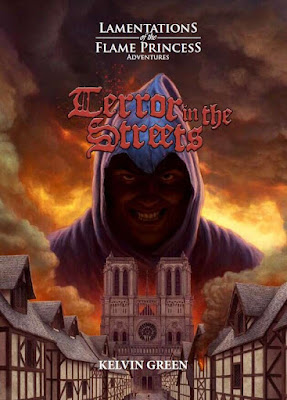
Friday Fantasy: Terror in the Streets
Terror in the Streets is published by Lamentations ofthe Flame Princess and fulfils a brief that was given to the author as, “Jack the Ripper, but 250 years early.” It is a murder mystery—inspired by historical events of thirty years before, the ‘Werewolf of Châlons’—involving the disappearances and then deaths of initially, four children from the streets of Paris. It is quickly followed by more as the rate of disappearances and deaths accelerates, driving the Player Characters to investigate ever deeper in an attempt to stop further murders and whatever it is that the murderer is planning. Clearly, Paris has a serial killer stalking its streets and alleyways, one who like Jack the Ripper did in London two-hundred-and-fifty-years later, taunts the authorities with a series of letters that hint at his motivations. Ostensibly, the Player Characters are hired by a Deputy Provost, one of several city officials reporting to the Provost of Paris, the king’s representative and governor of the city, though other set-ups are possible. The adventure opens on November 7th, 1630, and will be over by November 18th. The Player Characters have the freedom of the city to investigate as they like, first the deaths and then the letters. Similarly, the players are free to approach the investigation how they want and the scenario facilitates that with a very clean layout that makes everything easy to find by the Game Master and by not having the players roll for their characters to find clues. Instead, the focus is on interpreting them and using them to further the investigation and the story.
However, there is one issue that will hamper the Player Characters’ investigation—Paris. Getting around Paris is difficult, a city just two square miles, but threaded through with narrow streets and alleyways that makes getting anywhere slow and occasionally difficult, and this despite the fact that there are numerous taxi services that run throughout the city. Then there are the Parisians, who will grow increasingly fractious and give themselves over to mob rule, which will ultimately lead to city offices closing, Paris being shut down, and martial law being declared. This tension is measured through an ‘Unrest Die’, a large—ideally, the largest that the Game Master has—six-sided die which sits in the middle of the table where the players can see it. As the tension rises, the Game Master will adjust the die to the new face indicating the increase in tension. Thus, the players will be aware of the tension in both narrative terms, as portrayed by the Game Master, and in mechanical terms. It is, as the author acknowledges, very similar to the ‘Escalation Die’ used to track the degree of action in Pelgrane Press’ 13th Age.
The investigation is neatly organised into tautly detailed
little scenes that are clearly presented on the page making each and every easy
for the Game Master to run and expound upon as necessary. The smaller scenes
are typically with the families of the missing children and thus pertinent to
the exploration, whilst the longer, more detailed scenes and locations tend to
be red herrings—a potential werewolf attack and the search of a townhouse
belonging to the wizard, Alain de la Mare.* Much like the rest of the scenario,
these scenes can be played mundane or magical. Thus, for the encounter with the
werewolf if magic factors into the campaign, this yes, it is werewolf, but if
the campaign is mundane, then the werewolf is a fake. The Author does give
advice on the Player Character use of spells to gain information, in case they
decide to go down that route. Ultimately, the efforts of the Player Characters’
investigation will reveal that Armand Jean du Plessis, First Duke of Richelieu,
also known as Cardinal Richelieu, is connected to the murders, but how? There
is potential at the end of the scenario for the Player Characters to actually
gain a degree of influence over the most powerful man in France, for good or
ill. They could actually change history here if the ‘Day of the Dupes’ does not end in the way it did
in our history! That said, apart from these scant few hours when the Player
Characters can leverage their knowledge into a proper favour, Cardinal Richelieu
is described as constantly playing fourth dimensional Chess and will always be
a step or three in front of whatever they have cooked up.
* Yes, this really is who you think it is meant to be. Just not living in Northampton.
The scenario is very
well appointed and the Game Master ably supported. Besides the description and
map of Paris, there are full stats and details of Cardinal Richelieu, details
of the various taxi companies operating in the city, and a full discussion of
the possible outcomes to the scenario.
There are also the various letters sent by the perpetrators as handouts, rare in a fantasy roleplaying game, and a table of encounters. For the most part, there are no stats provided for these, so the Game Master will need to provide these herself.
Lastly, Terror in the Streets closes with a quintet of appendices. The first, ‘La Perfide Angleterre’ provides an optional event involving an English spymaster who wants the Player Characters to smuggle a ring out from a prisoner currently being held in the Grand Châlet, which is also the headquarters of the Provost of Paris. The English spymaster simply calls himself ‘W’, so could be Sir Francis Walsingham as the appendix suggests. Which is odd, because Walsingham has been dead for forty years when the scenario starts. The second appendix gives a full description of the Grand Châlet, whilst the third is potentially the most fun. ‘Musketeers’ gives stats and details of the main characters from Alexander Dumas’ The Three Musketeers for use with Lamentations of the Flame Princess Weird Fantasy Roleplay and thus other retroclones. It opens up the possibility of Terror in the Streets being as a one-shot as an investigation in the style of The Three Musketeers using the given characters, but it also suggests that Terror in the Streets could be run using other roleplaying games set in the swashbuckling period, such as Musketeers vs. Cthulhu: A Simple Nightfall RPGBook, AllFor One: Régime Diabolique, Swordpoint: A Swashbuckling Roleplaying Zine, and Miseries & Misfortunes – Book 1: Roleplaying in 1648 France, though the scenario will require some historical adjustment as it is set in 1648 rather than 1630. The fourth appendix, ‘Comment t’appelles-tu?’ provides a list of ready names for NPCs in the scenario, whilst the firth appendix, ‘Maison Richelieu’, which describes the home of Cardinal Richelieu, should the Player Characters ever need to visit (or break in).
Physically, Terror in the Streets is very well presented. The artwork has a slightly scratchy, cartoonish quality to it, but is still decent, and the cartography is good.
So, what of its utterly awful problem? Terror in the Streets—beginning with the acronym for its title—contains a profusion of puns and bad humour that in places does not so much veer as leer into slightly poor taste. To be clear, this is no Asterion or Beware the Mindfuck, so not utterly tasteless, but the schoolboy humour and dad jokes of Terror in the Streets gets wearisome very quickly. That said, in comparison to both Asterion and Beware the Mindfuck, let there be no doubt that Terror in the Streets is a work of profound genius and skill.
Humour aside—and
there is a lot to put aside—Terror in the Streets is a very good scenario, an
engaging murder mystery with lots of historical flavour and detail and options
to run with or without magic, depending on how fantastical the Game Master’s
campaign actually is. The scenario is well written, well presented, and well, one of the
best scenarios for Lamentations of the Flame Princess Weird Fantasy Roleplay.
—oOo—
DISCLAIMER: The author of this review is an editor who has edited titles for Lamentations of the Flame Princess on a freelance basis. He was not involved in the production of this book and his connection to both publisher and author has no bearing on the resulting review.
Saturday, 16 March 2024
A Hoard of Heresies
Heirs to Heresy: Faith & Fear does include a fourth order, the Teutonic knights. They are not, though, included as a Player Character option, but as NPC villains. Several options are suggested as to why, from Teutonic Grand Master simply coveted the Templar wealth to the Teutonic Order having been corrupted by some dark influence. However, as a possible ally, a location somewhere in the Teutonic Order’s lands might become the sanctuary that the Player Characters are trying to reach and that lends itself to a campaign with a Gothic feel located in Eastern Europe.
‘Modes of Play’ gives rules for solo play or play without a Grand Master. This includes the ‘Yes/No Oracle’, a simple means of resolving player choices, and tables of Action and Theme options to inspire and prompt the player. A set of tables, based on their Health level, whether Full, Halved, or Quartered, provides random actions in combat for NPCs, whilst another provides reactions out of combat. A further set of tables enable the Grand Master to create a conspiracy and the basis of a campaign using the content in this supplement and the core rulebook.
In Heirs to Heresy, a Player Character Knight can bring his faith and commitment to bear on a situation. To reflect this, he has Faith points to spend on various effects, including adding his Faith Attribute to a single Test, damage total, or reducing incoming damage by the same, to reroll a single Test, and if they factor into a campaign, power esoterica, Gifts, and Relics. Heirs to Heresy: Faith & Fear adds an option for using Faith called ‘Acts of Faith’. These include ‘Acts of Exorcism’, ‘Acts of Foresight’, ‘Acts of Healing’, and ‘Acts of Sacrifice’, the latter enabling the Player Character to protect a fallen ally against a grave threat. All four ‘Acts of Faith’ require the expenditure of a point of Faith and a may require a Religion skill test. The converse, ‘Acts of Fear’, including ‘Acts of Deceit’, ‘Acts of Incitement’, and ‘Acts of Violence’, require Corruption points, which are gained for committing sins, to be used. It is possible for a Player Character Knight, to be corrupt and have fallen from the Grace of God, and use these ‘Acts of Fear’. However, should such a Knight become too corrupt, there will be no way back for him to the Grace of God, and he becomes an NPC under the control of the Grand Master and likely a major threat to the Player Characters.
‘Strongholds and Sieges’ adds rules for building bases, such as castles and fortifications, and then laying siege to them. These include natural caverns, towers, and new fortifications, and a stronghold has actions of its own that the players can trigger. This can be to Fortify, Repair, or Upgrade the structure, Hire an employee (such as a Blacksmith, Builder, or Priest), Rest, or spend time in Introspection. Rest grants temporary Stamina points and Introspection points to spend on advancing Faith. Strongholds have Traits of their own, such as Famous, Gnostic Monastery (which grants an esoteric benefit), Living(!), and even Religious Sanctuary. The Siege rules are an addition to the Mass Battle system and are fairly quick and dirty, the aim being to reduce the Army Strength of one side to zero. Both Attacker and Defender have a limited number of options—Assault, Resupply, Sabotage, or Starve Out for the Attacker and Fortify, Repair, Sally Forth, and Smuggle in Supplies for the Defender, but can undertake four actions per day. There is room too for Player Character actions and roleplaying too, but the rules are quick and simple.
At the core of Heirs to Heresy are the relics, one of which the Player Characters are attempting to get from Paris to sanctuary. The choice can determine certain aspects of the campaign, such as how Faith interacts with the Player Characters. The four here are the Ark of the Covenant, the Head of Saint John Baptist, the Turn Shroud, and the Spear of Longinus. For example, the Ark of the Covenant will slay the unfaithful, grant insight and Faith for a battle, and if unlocked, that is, a Player Character attunes to it, it grants further Faith. Of course, it is relatively large and so not easy to transport. Each one of these four is major Christian relic and will really affect the nature of a campaign.
As well as the relic they are charged with protecting, the Player Characters may have access to another resources, that of the Templar spy networks to be found in the cities and towns across Europe. Most obviously, they could be used to provide safehouses as the Player Characters flee from Paris, but they can also provide supplies and information, and perhaps they can actually be made greater use of if the Player Characters establish a stronghold and want monitor or weaken the forces hunting for them. There are tables too for creating NPCs and their personalities, for exploration and the weather, and a host of new enemies, mobs both supernatural and mundane, and supernatural foes such as the Basilisk, Maddening Mist, and Warlocks or Witches.
The supplement also comes with four adventures of varying length and complexity. ‘The Wolfcairn’ finds the Player Characters camping somewhere deep in the forest when they begin to be stalked by a massive wolf that is more than it seems; in ‘The Basilisk’s Den’ they visit a tavern of that name looking for a connection to the local Templar spy network and run against all manner of NPCs with their own interests; in ‘Last Stand’, the Inquisition has caught up with the Player Characters who will have to hold them off, perhaps giving one of their number to make a desperate final defence of the others; and lastly, the ‘Cursed Brothers’ interlude gives the Player Characters a chance for respite at a Templar castle, but their fellow brothers turn out to be as bad as King Philip IV of France claimed the order to be. All four scenarios are easy to run and include pointers on their set-up descriptions of locations and NPCs, and both consequences and possible complications. They are all relatively easy to drop into a campaign. Lastly, the supplement includes another three pre-generated Player Characters, one for each of the new orders given at the start of the book.
Physically, Heirs to Heresy is cleanly and simply presented. The book is easy to read and the artwork is excellent.
Heirs to Heresy: Faith & Fear is not absolutely necessary to play a campaign of Heirs to Heresy. What it does do though, is provide a range of options and rules that can be used to expand the Grand Master’s campaign. The new scenarios are the easiest to use, each one readily dropped into a campaign, whilst the rules for spy networks, sieges, and ‘Acts of Faith’ require more effort and perhaps certain situations to arise to be fully useful. Overall, Heirs to Heresy: Faith & Fear widens the number of options that the Grand Master can choose from when planning her campaign and when making it more exciting in play, so making it useful for any Heirs to Heresy: The Fall of the Knights Templar campaign.
Sunday, 3 October 2021
Last Flight of the Templars
It is Friday, October 13th, 1307. For over two hundred years, the Poor Fellow-Soldiers of Christ and of the Temple of Solomon, commonly known as the Knights Templar, has dedicated itself to protecting Christians making their pilgrimage to the Holy Land. Blessed by the Church and an official charity, the militant order of monks has become a power unto itself, a series of Papal bulls having placed the order above local laws, rendering them exempt from taxes, borders, travel restrictions, and legal oversight from any power short of the Papal Throne itself. In addition to protecting the Holy Land and participating in numerous Crusades against the infidel, the influence and power of the Templars has spread far beyond Outremer, primarily through the clever management of the vast tracts of lands given to the order as gifts, but also through the financial and banking network that it developed, ensuring the safe and transferred transit of credit. Yet in recent years, the reputation of the militant order of monks has suffered. Military defeats have forced it out of the Holy Lands and lost it access to the sites it was supposed to protect and there rumours of mysterious rituals and misdeeds, ranging from idol worship, sacrilege, and denying Christ to financial corruption, fraud, and secrecy. Then there are fears that the Knights Templar wanted to establish its own state in Europe, equal to any kingdom. Lastly, many of those kingdoms, including their monarchy and their nobility owed vast debts to the Knights Templar. It was for these reasons that the Templars fell from grace and from power.On the morning of Friday, October 13th, 1307, French forces, on orders from King Philip IV of France with permission from Pope Clement V, moved in secret to arrest dozens of Knights Templar in the Templar’s Parisian stronghold, the Enclos du Temple, including their Grand Master Jacques de Molay, and their Commander of Normandy, Geoffroi de Charney. Both would ultimately be charged with heresy, excommunicated, and burnt at the stake. On the morning of Friday, October 13th, 1307, as the Enclos du Temple was assaulted by French troops, Grand Master Jacques de Molay would his last orders. Faced with betrayal and defeat, he commanded the last Templars to take the secrets of the order to safety. They would be the last thirty to escape the fallen stronghold and theirs would be a perilous journey across Europe in search of sanctuary, harried all the way first by forces loyal to King Philip, and then the Inquisition. Did they find sanctuary and do they ever discover the true secrets of the Poor Fellow-Soldiers of Christ and of the Temple of Solomon?
This is the set-up for Heirs to Heresy, a roleplaying game published by Osprey Games in which the last thirty free members of the Knights Templar carry the order’s great treasure and secret to sanctuary—to Avallonis. Avallonis may be a mystical dimension that only the gnostic Templars know how to access; a demonic realm to which the all the souls of the Templars are bound to; a faerie city, shrouded in mist with gleaming silver towers; the city of Lisboa where its friendly King will shelter the Templars from the wrath of the King of France and his lackey, the Pope; a state of mind or even a second word that will grant them eternal reward; and ultimately, even a lie… As to the great treasure, it might be the Grail, the Lineage of Christ, the idol of Baphomet, the Library and Seal of Solomon, or something else. The exact nature of both destination and treasure are up to the Grand Master—as the Game Master is known—to decide, although the length of the flight from Paris will heavily influence the former. The further the destination from Paris, the longer the campaign. Thus, if the destination is London, then the campaign will be relatively short, whereas Malta, owned by the Knights Hospitaller, sister order to the Knights Templar, would be a longer journey and thus a longer campaign. Similarly, The Grand Master will also need to set the degree of Esoterica available in the campaign and thus potentially, the Player Characters. This can be mundane, infused, or mystical, and the higher the degree of Esoterica, the more likely that magick will play a role in the campaign, including the foes that the Player Characters encounter. Finally another limiting factor upon an Heirs to Heresy campaign is the number of Templars who escaped Paris—thirty. If they all die before any one of them reaches sanctuary with the treasure, then both the secrets and the last treasures of the Knights Templar will have been lost.
Of course, Heirs to Heresy is not the first roleplaying game to explore this legend, designer John Wick having done so with Thirty in 2005. Although they share similar themes, Thirty emphasises the esoteric, whereas Heirs to Heresy explores that aspect of the Templar legend as a range of options. The other difference, of course, is that what constitutes as safe and good roleplaying is today is openly discussed and stated. Thus, Heirs to Heresy is up front about what is. In the foreword, the author rejects the adoption of the iconography of the Poor Fellow-Soldiers of Christ and of the Temple of Solomon, the Knights Templar by hate groups which espouse white supremacy, religious intolerance, and persecution. It is also clearly stated that whilst Heirs to Heresy draws very much upon the history and religions of the fourteenth century, it is not written as a historically accurate roleplaying game. Rather it blends history, mystery, and legend to create the potential for exciting stories—much like a film or television series would. Ultimately, it is more historical fantasy, and that includes the types of characters that the players can roleplay. The Knights Templar recruited from France, Germany, England, the Iberian Peninsula, and Italy, as well as Scandinavia, the Middle East, North African, and other Mediterranean countries. As long as a Templar is a devout Catholic, there is no bar in terms of origin, or indeed, his or her gender.
A Knights Templar is defined by six Attributes—Might, Vitality, Quickness, Intellect, Courage, and Spirit as well as fifteen skills. The Attributes typically range between zero and four, and skills between zero and five. To first create a Knights Templar, a player decided whether his character is a Dedicated Knight or a Versatile Knight. This will determine the spread available for his attributes. A Dedicated Knight has a mix of higher and weaker Attributes, whilst a Versatile Knight has a more balanced range. Similarly, whether a Templar’s training, either Focused training or Well-Rounded training, determines whether he has mastered one skill if Focused training, or a wider range of skills if Well-Rounded. With Focused training, a Templar has fewer skill points to assign, but two skills can be high, whereas with Well-Rounded training, there are more points, none of them can be high. Notably, a Templar does not have any combat skills or a Horsemanship skill. Every Templar is supposed to be skilled in both, so they are covered by his Attributes rather than dedicated skills. This is in addition to determining what the character looks like, his nationality, whether or not he has seen combat, how far he has travelled, his degree of spirituality, when he became a Templar, and so on. A player can also roll for quirks for his Templar and lastly choose some relationships with his fellow Templars.
Our sample Templar is Gudbrand Signysdottir, originally from Scandinavia, who travelled to Constantinople with her merchant father. Although he was killed by bandits, she saw how fiercely the other members of the caravan were protected by a band of Templars. Scarred in the attack, she decided to join the Templars and dedicate her life to the White Christ rather than return home where her brothers would take their father’s business.
Name Gudbrand Signysdottir
Nationality Scandinavia
Languages: French, Latin, Old Norse
Quirks: Exceptionally long hair, scar over one eye
ATTRIBUTES
Might +1 Vitality +1 Quickness +3 Intellect +2 Courage +3 Faith +2
SKILLS
Athletics 3 Awareness 3 Battle 3 Craft – Courtesy 3 Explore 3 Healing – History – Hunting – Inspire 3 Insight 3 Persuade 3 Religion 3 Stealth – Travel 3
HEALTH
Maximum 15 Crippling Blow 5
COMBAT
Melee Attack +4 Melee Damage Bonus +2
Ranged Attack +5 Ranged Damage Bonus +5
Defence 18
Damage Reduction 7
WEAPONS
Longsword (1H) d12 (On a 1: ignore Damage Reduction)
Londsword (2H) 2d8 (On two 1s: ignore Damage Reduction)
Dagger d6 (On a 1: ignore Damage Reduction)
Mace 2d4 (On a 1: permanently reduce Damage Reduction by 1)
Axe d8 (On a 1: shatter shield, or reduce Damage Reduction by 1)
Crossbow d10 (On a 1 or 2: ignore Damage Reduction)
ARMOUR
Chainmail 5 Damage Reduction
Shield +2 Damage Reduction
Mechanically, Heirs to Heresy is straightforward. To perform a Test, a character’s player rolls two ten-sided dice and adds an Attribute and a Skill to beat a target. A task which requires effort has a target of fifteen, challenging is eighteen, and difficult is twenty-one. If the result beats the target and consists of doubles, it is a critical outcome. This means it is done with a flourish, perhaps faster, with a better effect, or similar. In combat, it means double damage. If the task is made with Advantage, three ten-sided dice are rolled and the best two selected. Conversely, if the task is made at a Disadvantage, three ten-sided dice are rolled and the worst two selected. Advantage can be gained from the situation or one Templar can grant by supporting another. Notably Heirs to Heresy does include fumbles in its rules, because the Templars are meant to be competent and because fumbles are boring.
In addition, as God’s chosen warriors, every Templar can bring his faith and commitment to bear on his situation. To reflect this, he has Faith points to spend on various effects, including adding his Faith Attribute to a single Test, damage total, or reducing incoming damage by the same, to reroll a single Test, and if they factor into a campaign, power esoterica, Gifts, and Relics. Faith points are recovered slowly, a point every Sunday morning or by spending an hour in deep prayer at a Church or Catholic Holy Site. The latter requires a Test. However, Faith points are lost if a Templar breaks his vow of chastity, steals from the less fortunate, fails to pray upon awakening, or leaves a fellow Templar behind who could not have been rescued.
Combat is slightly more complex, but throughout Templars intended to be highly competent and capable combatants. In the main, the opponents a Templar will face are Mobs and Fearsome Foes. Mobs are either particularly courageous or fanatical to want to attack Templars, who can easily outfight them. A Templar always goes first and kills or defeats one member of the Mob per point of damage inflicted, whilst a Mobs only acts when a Templar fails to deal damage. Thus the Templar will in general have the upper hand and only when he fails will be vulnerable.
A Fearsome Foe represents a challenging opponent who fights like a Templar and can attack first before a Templar can act. Initiative is handled by pulling tokens out of a bag—one colour for the Templars and one for the Fearsome Foes, and when one colour is drawn from the bag, one of its associated combatants can act. Combat covers manoeuvres such as furious blows, defending, parrying, and so on. One interesting element of combat occurs when damage is rolled. An attacker can hope to roll high and simply inflict a large amount of damage after Damage Reduction has been deducted, but if a one is rolled with several of the weapons the Templars commonly wield, the damage ignores Damage Reduction. What this means is that an attack can inflict damage if even the damage roll is low. Other weapons have different effects when a one is rolled. When a Templar suffers damage greater than his Crippling Rating, his player begins ticking off boxes on his Templar’s character sheet, which can be stunned, bleeding, broken limb, or worse.
For example, Gudbrand Signysdottir and her companions have fled the chapterhouse in Paris and reached the outskirts of the city where they encounter a patrol consisting of two knights—both treated as Fearsome Foes and a Mob of foot soldiers. They are challenged and combat ensues, her companions engaging the Mob and one of the enemy knights, whilst Gudbrand Signysdottir faces off against the other. When the Grand Master draws the token for the NPCs and decides that the knight will charge and attack. She rolls the two ten-sided dice and adds the knight’s Attack bonus of +6. This roll is made at Disadvantage. She rolls two, five, and ten, and whilst the five and ten are enough with the Attack bonus, this at Disadvantage, so the Grand Master must choose the worst two rolls. The two and the five, plus the bonus are not enough to beat the Gudbrand Signysdottir’s Defence of eighteen. As his second action, the knight presses the attack. Her roll of seven, nine, and the bonus is enough to beat Gudbrand Signysdottir’s Defence. The knight’s damage roll is four plus six, for a total of ten, which when reduced by Gudbrand Signysdottir’s Damage Reduction of seven, means she suffers just three points of Health damage.Beyond the core rules, Heirs to Heresy adds simple rules for combat, and in terms of the campaign, rules for travel and pursuit. Travel is handled via Travel Tests and becomes more difficult if the Templars have to leave the road, with failures leading to their becoming lost running out of supplies, enemies catching up with them, having an obstacle encounter, and so on. The Templars begin play with a pool of Pursuit points, one per Player Character, and they are accrued for being seen, engaging in combat, being pursued by an Inquisitor, and more. The Grand Master can spend these to have the Templars encounter a patrol of guards, penalise Downtime activities, and other activities. When they stop at places of safety on their journey, whether in the wilderness or civilisation, the Templars can attempt Downtime actions. For example, Conceal Trail might enable them to reduce their Pursuit points, find someone to aid them, spread rumours to throw off their pursuers and so reduce their Pursuit points, train to gain Advantage on a roll.
When one of the players’ tokens is drawn, her player decides that it is now Gudbrand Signysdottir’s turn to act and like the knight, she has two actions. The first is to attack, striking at the knight with her Longsword. Gudbrand’s player rolls eight and eight—which indicates a critical strike and doubles damage—and adds her Melee Attack of +4. The total is twenty, which means that the attack is a success. This definitely beats the knight’s Defence of sixteen and the damage roll is a twelve-sided die plus her damage bonus of +2, doubled of course for the critical result. The result is nine, plus the damage bonus, doubled for a result of twenty-two. The knight’s Armour rating of seven reduces this to fifteen, which is deducted from the knight’s Stamina of eighteen. As her second action, she pulls back and decides to Parry against the next attack. This means that any attack against her will be at Disadvantage.
In terms of experience, a Templar can acquire Advancement Points and Gifts. A Templar can acquire a Gift once every four sessions or so, such as Armour of God, which increases his Damage Reduction by a Templar’s Faith Attribute, but the player cannot spend Faith Points to reduce damage; Nobility, which enables a Templar to request lodging from peasantry or royalty alike; and Spiritual Well, which gives a chance to recover the first Faith Point spent each day. Advancement Points are earned for making Critical rolls and can be spent during Downtime to increase Skills, to unlock Relics, and to learn Esoterica, the latter including Magicks, Blessings, and Martial Esoterica.
Learning Magicks means learning esoteric spells and the gnostic unlocking of the universe’s secrets through greater mystical understanding, and requires a Templar to study the Library of Solomon. This grants the Templar the Gnosis skill and access to an increasingly harder to cast circles of spells, such as Angelic Light or Obscured From Man’s Eyes. The Third Circle includes Bind Angel/Demon and Resurrect the Dead. Blessings are granted by the Saints, such as St. Adrian, who as the Patron Saint of Guards, grants Advantage on Awareness Tests made when keeping watch or trying to detect ambushes, or St. Christopher, who as the Patron Saint of Travelling, eases travel, enabling a Templar to spend a Faith Point to automatically find a safe place to shelter for the night. It is up to the Grand Master how a Templar comes to learn a Blessing, though he needs a high Piety to learn each one. The one suggested method is having access to the Holy Grail, but Templar might easily be granted through great acts of piety or a gift from a sympathetic member of the church. Lastly, Martial Esoterica such as Agile Climber, Hammering Blows, or Sword Savant are mundane abilities that can be learned or taught from training, meditation, and a host of other sources.
Of the three types, Martial Esoterica is the easiest to learn and include in an Heirs to Heresy campaign. Both Magicks and Blessings are more difficult, and not only require the Grand Master to decide whether her campaign is infused or mystical in nature, but also what the source for either is going to be. There are obvious choices here—the Library of Solomon for Magicks and the Holy Grail for Blessings, and if the Grand Master decides that either of these has a role in her campaign, especially as the treasure that which Grand Master Jacques de Molay has bid the Player Characters take to safety, that treasure becomes doubly important. It not only serves as their burden, but also a source of their mystical power, and ultimately, their faith made real.
Although Heirs to Heresy is simple in its core set-up and its mechanics, the Grand Master actually has a fair amount of work to do in bringing a ready to play to the table. She has to decide the length of the campaign and the destination that the Templar Player Characters have to travel to, who is pursuing them—the roleplaying game comes with a good list of enemies, what Avallonis is and what the treasure is that they are carrying, the nature of magic and presence of esoterica in the campaign, and ultimately, the truth about the Poor Fellow-Soldiers of Christ and of the Temple of Solomon. The suggestions cover most of the classic theories, that the Knights Templar were the Guardians of the Grail or the Lineage of Christ, Idol worshippers, or Gnostic knights, wanted to establish a Templar Nation-State, or had entered into an agreement, even an alliance, with the Order of Assassins. Of course, with a subject like the Knights Templar, there is a wealth of source material available to research and draw inspiration. And to some extent, research is really necessary for a roleplaying game like Heirs to Heresy, for as much as it is a work of historical fantasy, it still draws from and is set in that history. The Grand Master will want to research interesting locations and persons along the route that the Templar Player Characters decide to take to get to their Avallonis, and the longer the campaign, the more that the Grand Master will need to do this. This suggests, especially for those of a medium or long length, a possible structure for an Heirs to Heresy campaign, that of episodic television, in particular in the mode of the series The Incredible Hulk or The Fugitive. This may ease the amount of research the Grand Master has to do as well as helping her organise and develop her campaign.
The actual advice for the Grand Master is split into two strands. There is the advice for setting up a campaign and running adventures, and there is advice on being a Grand Master and on running a safe game, the latter being nice and clear in its presentation. All of which is welcome, but leads to a certain imbalance between whether Heirs to Heresy is designed as a roleplaying game for players new to the hobby or for long time players. The advice on running a safe game is welcome for either, but the effort needed to go into the set-up and the potential research needed for a campaign suggests that the roleplaying game is better suited to experienced players and potential Grand Masters.
Heirs to Heresy includes the beginning scenario, ‘The Flight from Paris’, which is intended to be played in a single session and lead into a campaign of the Grand Master’s own design. It specifically opens on the morning of Friday, October 13th, 1307 with the Player Characters awakened to find the Enclos du Temple already under assault and as they prepare to defend their order, they are pulled aside for an important mission. Which of course, is the flight from Paris, the exact details of which the Grand Master will have to define and her players roleplay. As a one-session scenario it throws the Player Characters into the action and teaches the players the rules, so has them ready for what is to come.
Rounding out the roleplaying game is an appendix of pre-generated Player Characters and a lengthy list of Angels and Demons. There are four pre-generated Player Characters and they are nicely balanced between Dedicated Knights and Versatile Knights, male and female knights, and diverse origins. The list of the Angels and Demons is lengthy and designed to work with the Angel and Demon Binding magick detailed earlier in the book. The list of demons is taken from the Key of Solomon, the Lesser Key of Solomon, and various other texts in the Library of Solomon.
Physically, Heirs to Heresy is presented in a clean, tidy, and fairly open fashion. It does need a slight edit and is decently illustrated in full colour. Except for when it comes to the tables, the Heirs to Heresy very much looks like anything other than a roleplaying game from Osprey Games. This is primarily due to Heirs to Heresy being a lighter game in terms of its background and mechanics, and ultimately, tighter in its focus, which results in a less compact presentation.
Heirs to Heresy is a toolkit to run a historical fantasy campaign, one which will need preparation and research. Almost a toolkit to run a single campaign for a single group of players, since it is designed to tell a particular story, and once played it is hard to retell that or a similar story with the same group. Within that story though—that of the exodus in the wake of their order’s downfall—Heirs to Heresy allows scope to tell of the Knights Templars’ last flight and of their fear, faith, bravery, and hopefully, their enlightenment.
Saturday, 28 December 2019
1979: Bushido
Bushido is significant for being the very first Samurai role-playing game set in Feudal Japan. Designed by Robert N. Charrette and Paul R. Hume—who would go on to design the highly regarded Shadowrun in 1989—and originally published in 1979 by the short-lived Tyr Gamesmakers Ltd., it is best known from the 1981 boxed set published by Fantasy Games Unlimited, so it this version that is being reviewed here. Drawing upon the Japanese film genre of ‘sword fighting’ or samurai cinema known as ‘Chambara’, it is set in a semi-historical heroic, mythic, and fantastic version of Japan, in which Bushi, Budoka, Yakuza, Ninja, Shugenja, and Gakusho seek to serve their liege lords or masters, and do so with honour and loyalty. Notably, as much as there is an emphasis in Bushido on sword-fighting and magic, myth and history—almost like any other roleplaying game—the roleplaying game places a strong emphasis upon the player characters’ honour and social position.
The 1981 boxed set comes with two thick books, a map of Nippon marked with its provinces, a Game Master’s Screen, and a character sheet. The books consist of ‘Book I, The Heroes of Nippon’, which provides rules of play and the players guidebook, and ‘Book II, The Land of Nippon’, a Gamemaster’s Guidebook. Both are black and white books, lightly illustrated, but filled with dense text. ‘Book I, The Heroes of Nippon’ covers characters, skills, the core mechanics, and spells, whilst ‘Book II, The Land of Nippon’ covers NPCs, battles, treasure, places of Nippon, non-adventuring activity, and a scenario.
A character in Bushido is defined by six Attributes—Strength, Deftness, Speed, Health, Wit, and Will; Saving Throws—derived from the Attributes to determine the success of an action using a particular Attribute; Abilities—derived factors such as health and learning; Capabilities and Skills. The Classic Man in Bushido has a value of ten in each of the Attributes, which can actually range between one and forty. A character will also have a Profession and a Level—Bushido being a ‘Class and Level’ roleplaying game, although with just the six Levels of Experience. The six Professions are Bushi—honourable warriors, the classic samurai, Budoka—martial artists, Yakuza—gangsters and folk heroes, Ninja—status-less, dishonourable thieves, spies, and assassins, Shugenja—Taoist-style wizards, and Gakusho—either Buddhist or Shinto priests. Each Profession provides a character with Attribute bonuses and has its own skills as well as Ki powers, each fuelled by a character’s inner spiritual reservoir. Notably, the skills are divided into Bugei or combat skills, Fine Arts, Practical Arts, Ninja skills, and Magical and Mystical skills with a lot of attention paid to each. Lastly, a character has On, a measure of the respect that the character has for himself, gained by winning contests, battles, and duels, being heroic, going on pilgrimage, and so on, but lost for acts of cowardice or dishonesty, rashness, and the like. On is necessary—though not for Ninja—when gaining Levels in a Profession, but if too much On is lost, a character can lose Levels. Lastly, Status represents a character’s standing in society.
Now creating a character in Bushido is not an easy process, primarily because it is not presented in what would be regarded as a logical order. The actual explanation of the process does not come until half way through the eighty pages of ‘Book I, The Heroes of Nippon’. The first forty or so pages of the book are devoted to explaining the stats, skills, Ki powers, and Professions, basically everything to do with the make-up of character, but without a starting point. So it feels backward because essentially, a player has to read so far into the book in order to actually begin the creation, but then go back to the beginning of the book to continue it, plus there is a lot of flipping back and forth as part of the process.
To create a character in Bushido, a player rolls to determine his character’s caste, which determines the Professions open to him, his initial On, and starting funds. If he rolls low he will be of Samurai class, but if he rolls high, he will be of the Eta caste and can only be a Ninja. Otherwise, a player is free to choose whatever Profession he wants for his character, though there are social and other consequences, for example, a Samurai who chooses to become a Yakuza , loses half of his On. The character’s caste will provide some initial skills, whilst his Profession will add more plus Attribute modifiers, starting goods, and Hit Points. A player also needs to distribute sixty points to his character’s Attributes. Numerous factors, including skill values, are then derived from all of this.
Name: Eiichi
Caste: Heimin (Farmer, Low)
Age: 20 On: 5
Profession: Yakuza Level: 1
Status: 10
Strength 10 ST: 4 Enc. Cap: 20 lbs. Dam: 0 Unarmed: 1d3
Deftness 20 ST: 7 BAP: 10
Speed 15 ST: 6 MNA: 1 BMA: 5
Health 15 ST: 6 HPT: 20
Wit 20 ST: 7 FIS: 20 Per: 6
Will 20 ST: 7 Power: 20
Learning Rate: 2 Zanshin: 1
Capabilities
Brawling: 6 Climbing: 10 Leaping: 7 Magic: 40 (8) Swimming: 5
Skills
Commerce 40 (9), Fishing 60 (13), Gambling 60 (13), Katakana 70 (14), Massage 40 (9), Popular Dance 55 (12), Sumai 50 (11), Tantojujitsu 55 (12), Yakuza Dialect 70 (14)
Goods
Dice, aiguchi (d3), 4 silver
Mechanically, Bushido uses a twenty-sided die for its resolution system. Originally, this would have been in the days of twenty-sided dice with the numbers zero through nine marked on it twice, so players and Game Masters alike would have needed to mark their dice accordingly. To have his character undertake an action, a player rolls against the Saving Throw of an appropriate Attribute, Capability, or Skill. The Saving Throw of any Attribute is approximately a third of its value, the value of a Capability an average of three different Saving Throws, and the Base Chance of Success or BCS of a skill equal to a fifth of its value, skills being rated as percentiles. If the skill is a bonus skill for a Profession, then the character’s Level is also added. Critical successes are possible on a roll of one and failures on a roll of a twenty. The quality of any skill test can be determined how much the result is under the adjusted Base Chance of Success.
Combat uses the same mechanics with a character being able to do between one and three actions depending on his Speed Attribute and taking into account the character’s combat awareness or Zanshin. Combat takes into account various types of attack, including bash, butt stroke, disarm, strike, thrust, and more, but ultimately it involves the player rolling against the weapon or Bugei skill being used, its BCS adjusted by the opponent’s Armour Class, which ranges from zero for ordinary clothing up to ten for master heavy samurai armour. Damage is inflicted directly from a character’s Health with a critical success in combat potentially causing double or triple damage, and a high chance of a special effect which might be the loss of a limb or even death. Conversely, a critical failure might see a character might injure himself. Overall, combat in Bushido is potentially really quite deadly, especially against unarmoured combatants.
Magic in Bushido is used by two different Professions. The Shugenja knows a number of basic spells or powers, like Magic Detection and Astral Senses, but his more powerful spells come one of the five schools based on the elements—Water, Fire, Wood, Metal and Soil, plus some common spells. Every spell has a minimum in terms of the knowledge of the school required as well as the Level of the character. The other Profession is the Gakusho or priest, whose powers vary according to whether he is a Buddhist or Shintoist. Instead of the five schools of magic, the Gashuko studies the Five Yoga—each of which corresponds to one of the five elemental schools—and sacred texts, ‘Sutras’ for Buddhists or and ‘Norito’ for Shintoists. Both Shugenja and Gakusho take a degree of commitment upon the part of the player and the Game Master to play. Ninja in Bushido possess the expected mix of stealth and combat skills, but can also manufacture Gimmicks like flash grenades, blowguns, blinding powders, and so on.
Apart from the initial selection determined from a character’s caste and Profession, a player is free to choose the skills he wants for his character, that is, if he can find a school and a teacher which will accept him. Certain Professions provide bonuses to learning certain skills, but there is a certain emphasis on combat skills in Bushido, only exacerbated by the inclusion of Okuden, secret combat skills or manoeuvres such as Piercing Thrust or the Lightning Stroke. All six Professions also have their own Ki powers—focussed and unfocussed—the former requiring concentration, the latter not. So for the Bushi, that might be Damage Focus, Distant Death for the Budoka, and Lore Master for the Shugenja, but all enable a character to do amazing feats.
To progress, a character needs to earn experience points or Budo and have a minimum level of On. On though, can go down as well as up, so what this means is that as much as it is gained by winning contests, battles, and duels, being heroic, going on pilgrimage, and so on, but is lost for acts of cowardice or dishonesty, rashness, and the like. So characters are encouraged to roleplay the positive aspects of the setting and so will be rewarded for it. Besides this, progression is not just a matter of adventuring, but studying and learning too.
In addition to the mechanics of the roleplaying game, Bushido includes background on Nippon, the structure of its society, customs, religious beliefs, the place of women in society, and details of weaponry—including a good illustration of them all together on the back cover of ‘Book I, The Heroes of Nippon’. ‘Book II, The Land of Nippon’ covers creating NPCs as well as a bestiary of creatures mythic—legendary and supernatural—and mundane, a discussion of events the player characters can get involved in, places in Nippon, jobs they can take in addition to adventuring, and the benefits and duties of being in particular groups, such fiefs, schools, ninja clans, yakuza gangs, and so on. The advanced game covers founding and running these as the player characters gain status. Lastly there is an adventure, ‘An Evening at the Inn of Restful Sleep’, a fairly simple affair in which the player characters are victims of skulduggery when they stay at an inn. It is at least a good reason to introduce the characters and get them working together. Overall, the setting of Nippon manages to be just about fantastic enough without detracting from its not too historical feel and flavour—it is not strictly speaking a completely historical treatment of feudal Japan, but then neither is it wholly fantastic either. Bushido owes this to its Chambara origins as much as it does the authors.
Physically, Bushido is a densely presented pair of books. The layout is generally tidy, but the editing is wanting. If there is a real issue with Bushido, it is that there is no index for either book, whilst a glossary would have been useful. The roleplaying game could have done with more examples, but above all, it needed better organisation and more clearly separated sections of rules. The result is often a frustrating mess, as players and Game Master alike are forced to search for a rule or other content. There is a solid game here, the organisation is a hindrance to that aim.
Bushido was reviewed extensively at the time of its publication—by all three of its publishers. Steven L. Lortz reviewed it in Different Worlds Issue 3 (June/July, 1979), comparing it to the leading roleplaying games of the day, “RuneQuest and Dungeons & Dragons typify two styles of role-play which are very different in mechanics and philosophy; specific expertise versus general experience levels, character specialization versus character classes, spell points versus Vancian magic, and static versus dynamic hit points. In Bushido, Hume and Charrette have produced a well-knit integration of elements from each of these styles and provided a fairly complete and playable social milieu for the characters to operate within. For these reasons, I highly recommend Bushido to people who are interested in running a fantasy campaign based primarily on the Japanese mythos and to people who are interested in the art of RPG design. However, the Basic Chance of Success mechanism is a reversal of the die rolling conventions of both RuneQuest and Dungeons & Dragons, so some work would be required before a person could adapt from Bushido into a campaign based on either of these two systems.”
In Dragon #34 (February, 1980), D. Okada noted that, “With the exception of M.A.R. Barker’s Empire of the Petal Throne, virtually every game that comes out has a common outlook. Each game is based on a view of life (whether in fantasy or science fiction) that draws its roots from Western culture. This is to be expected. The largest, if not only, market for games is found in the Western world. But now the gamer is offered a new choice.” Which of course is Bushido. He commented though, that, “...[T]he game is not perfect. There are a horrendous amount of typographical errors in the rules. While the game does not always suffer from these errors, there are times when they do hamper understanding of what is supposed to be going on.” before concluding that, “Despite these faults, the game is worth the price to the person interested in developing a more cosmopolitan outlook. After all, while it’s fun to be Conan or Gandalf in D&D, there is also a time to try and be Miyamoto Musashi seeking perfection in the use of the sword, don’t you think?”
Conversely, writing in The Space Gamer Number 29 (July, 1980), Forrest Johnson was distinctly dismissive, stating that, “Students of Japan may be irritated by such things as misspellings, the translation of “on” as face and the omission from the map of the island of Hokkaido. The metaphysics seem more Hindu than Japanese and some of the monsters (trolls, vampires, ogres) are distinctly round-eyed.” before concluding, “Karate fans and samurai fans may dig this one. Serious students will just have to wait for something better.”
Similarly, in Ares Nr. 7 (March, 1981), Eric Goldberg was critical of the character generation method, saying that, “The mechanics for character generation represent two contradictory theories. The point distribution system is intended to promote equality among the characters. The caste and rank system randomly creates great disparities between them. There is a logical argument for both methods – even in conjunction – but one’s purpose defeats the other’s. Furthermore, restricting one profession (ninja) to those who are of that caste (a 15% chance) limits those unfortunate characters who cannot be a ninja to four professions. (Also, a character who is of the ninja caste is almost forced to be a ninja, unless he feels no qualms about throwing away an advantage.) I am surprised the designers did not extend their point assignment system to that the players could “buy” caste and rank, thus ensuring that everyone would have free choice.” It is notable that this is exactly what the designers did with Shadowrun.
Nevertheless, Eric Goldberg was slightly more positive in his conclusion, saying that “Bushido’s strong points are the inventive game mechanics (for the time), the “feel” of Japanese culture, and the tentative emphasis on playing a role. Most FRP games rely on the players to determine in which direction their characters will go, and often force them into stereotyped roles. Hume and Charette were players turned designers, and remained aware of the difficulties they had met in previously published games.” and “A quest for knowledge about Japanese culture would not begin with Bushido, partly because of the interpolation of mythic beliefs into the background. However, the players of the game do not wish to know all the ins and outs of that country, however interesting they may be. Bushido is a nice enough meld of a surrealistic and D&D-style flavor, and has a game system sturdy enough to support this impression.”
Reviewing Bushido in White Dwarf Issue No 32 (August, 1982), Mike Polling was wholly more positive, exclaiming that, “If you’re for the ultimate Fantasy Role-Playing Game, look no further. This is it.” before awarding both Bushido and the separate adventure, Valley of the Mists, a score of ten out of ten.
Bushido has also been the subject of a number of retrospectives. In Dragon #134 (June, 1988), it was reviewed again, this time by Jim Bambra and alongside reviews of Land of Ninja, a supplement for RuneQuest III and Oriental Adventures, the supplement for Advanced Dungeons & Dragons. In light of the other two supplements being reviewed, he was more guarded in his praise, stating that, “The BUSHIDO game was the first game to open up the mysterious East to roleplayers – but at a cost. While admirably capturing the flavor of medieval Japan, the BUSHIDO game is densely written and difficult to grasp. It is a game for dedicated gamers who, in their pursuit of Oriental action, are willing to struggle with rule books that make advanced nuclear theory texts seem like light reading by comparison.” before concluding that, “If you’re looking for a stand-alone system, then check out the BUSHIDO game. But if accessibility and ease of use are your primary requirements, stay well away.”
In ‘The Way of the Warrior, The Way of Bushido’ in The Last Province Issue 1 (October, 1992), Paz Newis said, “Ah, the early eighties when a game system said complete rule system, by jingo, it meant it... However the initial rush of joy is likely to be short lived. Upon opening one of the books the level of undertaking becomes apparent. You want to authentically simulate feudal fantasy Japan? It might be quicker to move there and join their Sealed Knot equivalent.” The reviewer was otherwise positive about the game. Similarly, Bushido was described Arcane issue 6 (May, 1996) as having, “...[C]aptured the spirit of the Samurais’ [sic] greatest era: feudal Japan.” and that, “Politics and action went hand in hand with Bushido and the game had an innately epic scale.” Editor Steve Faragher’s obvious enthusiasm should be tempered by the fact that he had been part of the Games of Liverpool team which published the scenario, Takishido’s Debt, for Bushido in 1983.
As the first roleplaying game set in feudal Japan, Bushido is groundbreaking, providing a lot of information about the setting, the types of characters which can be played, and what they can do. There is a lot of flavour and detail in Bushido, especially so in the descriptions of the various types of skills—Bugei or combat skills, Fine Arts, Practical Arts, Ninja skills, and Magical and Mystical skills—but also in the explanations of society and customs, and of course, in the On or personal honour rules which encourage roleplaying and immersion in the setting. Yet as much as it set a standard in terms of background for the characters, who they and what they do, Bushido got just about everything wrong in terms of how a roleplaying needs to be presented. The density of the text, the explanation of terms before they are needed, and the dreadfully poor organisation of the rules—exacerbated by a lack of index—made Bushido inaccessible. Instead of needing to be read, Bushido needed to be studied, its textbook-like layout and structure also making the game difficult to teach.
Bushido had the potential to be a good roleplaying game and a great treatment of its genre. Yet from the start, Bushido needed a second edition of the Fantasy Games Unlimited version to rip the organisation of its contents apart and put it back together to make it accessible. It is a shame that this never happened, for it let other Oriental-set roleplaying games shine in its stead.
With thanks to Steven Ward for granting me last minute access to The Last Province #1.


