Every Week It's Wibbley-Wobbley Timey-Wimey Pookie-Reviewery...
Showing posts with label Lamentations of the Flame Princess. Show all posts

Friday, 29 May 2026

Friday Fantasy: Altar of Madness

Altar of Madness is not a scenario per se. It is definitely not an adventure. It is definitely a book for Lamentations of the Flame Princess Weird Fantasy Roleplay published by Lamentations of the Flame Princess. It is definitely a place that the Player Characters are likely to visit again and again and it can be placed almost anyway in the known multiverse. So, what it is, is a single room. A large room, but a single room. A single large encounter that the Game Master can add to any dungeon. Given what it is though, it really works as an addition to a large dungeon. So good for a megadungeon. Or actually two megadungeons. This is because the room can move and as they explore a megadungeon, the Player Characters find might the entrance to this room on more than one dungeon level and later on, they might find the entrance in another altogether. So far, so many generalities. Which is entirely the fault of the encounter, because Altar of Madness has no plot, no beginning, middle, or end, and so none of that can be reviewed. Which leaves the description of what is a very detailed room to review and that is going to be difficult to review without giving away any spoilers because there is a great deal to spoil in Altar of Madness.

Altar of Madness is the final resting place of the mythical First Wizard and the good news is that it has been found. Who or what the First Wizard was is not known, but what is known is that he was interred with a splendid variety of magical treasures ripe for the taking. To which the blurb for Altar of Madness adds, “You are so, so fucked.” Which is entirely accurate, because what Altar of Madness actually is a deathtrap dungeon, or rather a deathtrap room. A room filled with features that are going to entice the players to have their characters investigate and search and play around with and have things go wrong, oh so wrong, that their characters are going to walk away changed. Changed. Cursed. Poisoned. Maddened. Scarred. Aware. Altered. Infested. Bleeding. Incensed. Undead. Armoured. Prescient. Bejewelled. Blinded and blinding. Unlucky. Colourblind. Deviated. All of these are entirely possible conditions that a Player Character can suffer in Altar of Madness. Essentially, this is a tomb with not so much traps as items and objects and spaces which if the Player Characters interact with them, they are going to suffer. This is one giant ‘screw you’ for the players and their characters if their curiosity and greed get the better of them—and it will because there are good magical items to be found—and touch things.

The Altar of Madness is a room one hundred feet in diameter and twenty feet high, with a five foot wide ledge running round the edge. Steps lead down to a bowl of thick phosphorescent mist out of which rises in the centre of the room is fountain topped with demonic skulls and filled with an oily black liquid. A ten foot high diameter hangs over the fountain. Spaced around the room is a statue of a naked woman holding aloft an actual bolt of lightning and a chain hangs straight up from the floor to a hole in space. To the left, there is writing in an unknown language on the wall, whilst to the right, there is a mural of a star-filled sky. In alcoves dotted around the room is an altar carved with human faces, a skeleton dressed in fine clothes lying on a couch, two sarcophagi in separate alcoves, and an eyeball floating in a jar, sitting on a table. There is more, but this is what is visible from the door.

All of this can be interacted with and all of it is described in a very great detail. As are the effects of what happens when the Player Characters do, those effects being rolled on the tables that are associated with each piece of furniture or dressing in the room. Some of the features in the room are connected, primarily through the treasures that they hide, but most are not. The result is that actually many of the features are more installations, almost pieces of art that are designed to screw with the Player Characters. They do not feel out of place as such, but they could be used in a dungeon of the Game Master’s design without any real issue.

This being a design for Lamentations of the Flame Princess Weird Fantasy Roleplay, it should be no surprise that the content is intended for mature players. That said, some of the descriptions of what the Player Characters could do and what the consequences are, is prurient, if not distasteful, concerning as it does the molestation of a highly anatomically accurate statue and a pliant woman. To be clear, the author is not encouraging or condoning such actions, but rather explaining the consequences if a player has his character undertake such actions. The first reaction is to wonder quite who you are roleplaying with if a player does think of these actions and voices them, and then the Game Master allows it. The second reaction is to wonder if that content should have been in the book at all, to which the answer is no. Of course, the Game Master can ignore such content if she wants and not allow for the possibility of the players suggesting such ideas, but still… No.

Physically, Altar of Madness is well done. It has an arcane look to it with just the sigil on its front cover and no title or blurb. Inside the book is in black and white and full of dense text. This encounter does need a careful study to understand how each item in the room works.

Altar of Madness is an amazingly inventive exercise in ‘screw the characters, screw the players’ in deathtrap dungeon design. A comical circus of consequences for the overly curious.

—oOo—

Lamentations of the Flame Princess will be at UK Games Expo which takes place from Friday, 29th to Sunday 31st of May.

Saturday, 23 May 2026

[Fanzine Focus XLIII] Black Dogs Issue II

On the tail of the Old School Renaissance has come another movement—the rise of the fanzine. Although the fanzine—a nonprofessional and nonofficial publication produced by fans of a particular cultural phenomenon, got its start in Science Fiction fandom, in the gaming hobby it first started with Chess and Diplomacy fanzines before finding fertile ground in the roleplaying hobby in the 1970s. Here these amateurish publications allowed the hobby a public space for two things. First, they were somewhere that the hobby could voice opinions and ideas that lay outside those of a game’s publisher. Second, in the Golden Age of roleplaying when the Dungeon Masters were expected to create their own settings and adventures, they also provided a rough and ready source of support for the game of your choice. Many also served as vehicles for the fanzine editor’s house campaign and thus they showed how another Dungeon Master and group played said game. This would often change over time if a fanzine accepted submissions. Initially, fanzines were primarily dedicated to the big three RPGs of the 1970sDungeons & DragonsRuneQuest, and Travellerbut fanzines have appeared dedicated to other RPGs since, some of which helped keep a game popular in the face of no official support.

Since 2008 with the publication of Fight On #1, the Old School Renaissance has had its own fanzines. The advantage of the Old School Renaissance is that the various Retroclones draw from the same source and thus one Dungeons & Dragons-style RPG is compatible with another. This means that the contents of one fanzine will be compatible with the Retroclone that you already run and play even if not specifically written for it. Labyrinth Lord and Lamentations of the Flame Princess Weird Fantasy Roleplay have proved to be popular choices to base fanzines around in the past, although as tastes change, this is no longer the case.

Black Dogs Issue II was published in February, 20218 by Daimon Games. Following on from Black Dogs Issue I, it describes itself as, “[A] dark fantasy collection of house-rules, materials, adventures, monsters, and together a toolbox to generate new content for OSR systems, and mostly for the Lamentations of the Flame Princess.” Its emphasis is on a dark, grim, medieval setting for monster hunters and mercenaries rather than horror. The setting is a fantasy version of Europe, mountainous and heavily wooded, cut through with lengthy rivers navigable by barge as well as the remains of an ancient imperial road network. It lays these details out in ‘Presenting the world’, describing in turn the lands, the woods, towns, customs and religion, and church and nobility. Most of the population adhere to Christian morals and attend nearby churches regularly. The setting described will be familiar to most, though without any specifics, so accessible in terms of feel and tone. Power is held by the nobility and the church, though the merchant class is growing in power and influence as it becomes richer whilst grip on power held by the nobility declines. Into the world step the ‘Black Dogs’ of the title. In ‘Why Black Dogs’, the author explains that they are outsiders driven by their conscience to act according to a code of conduct under which they fight demons, monsters, and particularly evil men, and in doing so protect the innocent—especially children, working commoners, and humanity in general. This gives a sense of who and what the ‘Black Dogs’ of the fanzine’s title are and presents a grim world that is nevertheless more positive than traditional Lamentations of the Flame Princess Weird Fantasy Roleplay. Both articles have nice pointers in the margins as quick reminders for the Game Master.

‘Encumbrance and Gear’ presents rules for things that the Player Characters can buy and how they can carry them. The Encumbrance is a straightforward ‘inventory slot’ system with a  Player Character able to carry a number of items equal to the modifiers for his Strength and Constitution. Most items take a single, but heavy items can take two. The cost of items is in Silver Pieces and most weapons take up one or two slots. Weaponry has a pike and shot feel. There are not a huge number of weapons, but enough, and they include blackpowder pistols, arquebuses, and muskets. They misfire if a one is rolled on the damage die, the target’s Armour Class is reduced by one, and any musket or black powder weapon-wielder must a Saving Throw versus Dexterity, or the gunpowder horn they are carrying might explode. The other missile weapons do have the advantage of allowing wielders to take one or more shots at anyone charging them. Armour also takes up slots in a Player Character’s Inventory and differentiates between small and large shields. Overall, these are serviceable rules.

Content for the Game Master begins with ‘Rolling Dice’. It advises that the player only roll the dice when it creates positive tension, there is risk or a time pressure or conflict, and so on. The Game Master is advised to make failures interesting, describing them as something more than a miss’, suggesting that a failure becomes a ‘fail-forward’ to make the otherwise failed outcome a success with a complication, twisted outcome, or at a greater cost. It is supported by plenty of examples. ‘Campaign Spirit’ makes clear that Black Dogs is about a game of exploration, rather than saving the world or just looting treasure. The Player Characters grow through their experience of the world, rather than through other means. This is a presentation of the author’s play philosophy, primarily building it around open areas marked with situations whose exploration is player-led. Above all, the Game Master is advised to keep an open mind and to respond to the players and their characters. The advice is decent enough, but not really developed in the article.

‘Adventure Seeds’ presents some ideas generated from tables annoyingly to be found in Black Dogs Issue III. Nevertheless, the author shows how he develops the results into something from which a Game Master can improvise. In one, ‘An Old Lover’, it sets up a town which has been beset by turmoil due to a feud between the local church and Bishop and a Witch, whilst in another, ‘The Black Market’, a village whose interbreeding families have tipped it into degradation and is now filled by addicts, drunks, beggars, and vagabonds, which by night it sells their organs at a market attended by alchemists and wizards, scholars and medics, necromancers and witches. ‘Witches and Smart Zombies’ detail the primary NPCs involved in both, in particular the new monster, the ‘Smart Zombie’. Unlike traditional zombie, the ‘Smart Zombie’ is still undead, but intelligent. It is vulnerable to sunlight and needs to eat flesh regularly. Unfortunately, the antagonists for both adventure seeds are better set up and explained than the overall situations for the adventure seeds. The Game Master will likely want to develop these further if she can.

Physically, Black Dogs Issue II is clean, tidy, and well laid out. The writing is good and is an enjoyable read. The fanzine is lightly illustrated, but the artwork is decent enough, being drawn from the public domain.

Black Dogs Issue II is a fanzine of ideas and suggestions, though none of them radical, and all of them pointing towards a roleplaying game that the author wants to write—or if that is not the case, it certainly feels like it. ‘Encumbrance and Gear’ is workable and likely the most useful thing in the issue, whilst the ‘Adventure Seeds’ are disappointingly underwritten in comparison to the scenario of the previous. Both have potential, but need development upon the part of the Game Master. Truth be told, Black Dogs Issue II feels outdated, even by the standards of the Old School Renaissance.

Friday, 16 May 2025

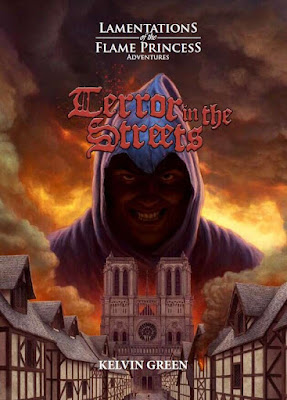
Friday Fantasy: Terror in the Streets

Terror in the Streets is perhaps one of the most mundane scenarios written for Lamentations of the Flame Princess Weird Fantasy Roleplay in recent times. In fact, there is nothing outré, weird, or even profane in the scenario, that is, unless the Game Master decides that is what she wants it to include. In which case, the scenario provides options to add aplenty. Otherwise, the Game Master could run it simply as a straight historical scenario and her players would be none the wiser that it is written for a fantasy roleplaying game with a certain reputation. Similarly, the author of Terror in the Streets breaks his track record of doing bad things with typically big things inspired by his childhood toys to English villages in the 1630s. Instead, he shifts the action to Paris and sets it against the background of the city’s political and religious turmoil as the Player Characters are hired to investigate the disappearances of a number of children from across the city. Yet despite that mundanity, Terror in the Streets is a terrific scenario, rich in historical detail background—decent enough to serve as the backdrop for further adventures in the city during the seventeenth century—and rife with real and interesting historical figures for the Player Characters to interact with, including the greatest and most powerful political figure of his age. However, Terror in the Streets suffers from a truly terrible problem of its own, one that can be almost, but not quite completely, be blamed upon the author. It cannot, though, be forgiven.

Terror in the Streets is published by Lamentations ofthe Flame Princess and fulfils a brief that was given to the author as, “Jack the Ripper, but 250 years early.” It is a murder mystery—inspired by historical events of thirty years before, the ‘Werewolf of Châlons’—involving the disappearances and then deaths of initially, four children from the streets of Paris. It is quickly followed by more as the rate of disappearances and deaths accelerates, driving the Player Characters to investigate ever deeper in an attempt to stop further murders and whatever it is that the murderer is planning. Clearly, Paris has a serial killer stalking its streets and alleyways, one who like Jack the Ripper did in London two-hundred-and-fifty-years later, taunts the authorities with a series of letters that hint at his motivations. Ostensibly, the Player Characters are hired by a Deputy Provost, one of several city officials reporting to the Provost of Paris, the king’s representative and governor of the city, though other set-ups are possible. The adventure opens on November 7th, 1630, and will be over by November 18th. The Player Characters have the freedom of the city to investigate as they like, first the deaths and then the letters. Similarly, the players are free to approach the investigation how they want and the scenario facilitates that with a very clean layout that makes everything easy to find by the Game Master and by not having the players roll for their characters to find clues. Instead, the focus is on interpreting them and using them to further the investigation and the story.

However, there is one issue that will hamper the Player Characters’ investigation—Paris. Getting around Paris is difficult, a city just two square miles, but threaded through with narrow streets and alleyways that makes getting anywhere slow and occasionally difficult, and this despite the fact that there are numerous taxi services that run throughout the city. Then there are the Parisians, who will grow increasingly fractious and give themselves over to mob rule, which will ultimately lead to city offices closing, Paris being shut down, and martial law being declared. This tension is measured through an ‘Unrest Die’, a large—ideally, the largest that the Game Master has—six-sided die which sits in the middle of the table where the players can see it. As the tension rises, the Game Master will adjust the die to the new face indicating the increase in tension. Thus, the players will be aware of the tension in both narrative terms, as portrayed by the Game Master, and in mechanical terms. It is, as the author acknowledges, very similar to the ‘Escalation Die’ used to track the degree of action in Pelgrane Press’ 13th Age.

The investigation is neatly organised into tautly detailed little scenes that are clearly presented on the page making each and every easy for the Game Master to run and expound upon as necessary. The smaller scenes are typically with the families of the missing children and thus pertinent to the exploration, whilst the longer, more detailed scenes and locations tend to be red herrings—a potential werewolf attack and the search of a townhouse belonging to the wizard, Alain de la Mare.* Much like the rest of the scenario, these scenes can be played mundane or magical. Thus, for the encounter with the werewolf if magic factors into the campaign, this yes, it is werewolf, but if the campaign is mundane, then the werewolf is a fake. The Author does give advice on the Player Character use of spells to gain information, in case they decide to go down that route. Ultimately, the efforts of the Player Characters’ investigation will reveal that Armand Jean du Plessis, First Duke of Richelieu, also known as Cardinal Richelieu, is connected to the murders, but how? There is potential at the end of the scenario for the Player Characters to actually gain a degree of influence over the most powerful man in France, for good or ill. They could actually change history here if the ‘Day of the Dupes’ does not end in the way it did in our history! That said, apart from these scant few hours when the Player Characters can leverage their knowledge into a proper favour, Cardinal Richelieu is described as constantly playing fourth dimensional Chess and will always be a step or three in front of whatever they have cooked up.

* Yes, this really is who you think it is meant to be. Just not living in Northampton.

The scenario is very well appointed and the Game Master ably supported. Besides the description and map of Paris, there are full stats and details of Cardinal Richelieu, details of the various taxi companies operating in the city, and a full discussion of the possible outcomes to the scenario.

There are also the various letters sent by the perpetrators as handouts, rare in a fantasy roleplaying game, and a table of encounters. For the most part, there are no stats provided for these, so the Game Master will need to provide these herself.

Lastly, Terror in the Streets closes with a quintet of appendices. The first, ‘La Perfide Angleterre’ provides an optional event involving an English spymaster who wants the Player Characters to smuggle a ring out from a prisoner currently being held in the Grand Châlet, which is also the headquarters of the Provost of Paris. The English spymaster simply calls himself ‘W’, so could be Sir Francis Walsingham as the appendix suggests. Which is odd, because Walsingham has been dead for forty years when the scenario starts. The second appendix gives a full description of the Grand Châlet, whilst the third is potentially the most fun. ‘Musketeers’ gives stats and details of the main characters from Alexander Dumas’ The Three Musketeers for use with Lamentations of the Flame Princess Weird Fantasy Roleplay and thus other retroclones. It opens up the possibility of Terror in the Streets being as a one-shot as an investigation in the style of The Three Musketeers using the given characters, but it also suggests that Terror in the Streets could be run using other roleplaying games set in the swashbuckling period, such as Musketeers vs. Cthulhu: A Simple Nightfall RPGBook, AllFor One: Régime Diabolique, Swordpoint: A Swashbuckling Roleplaying Zine, and Miseries & Misfortunes – Book 1: Roleplaying in 1648 France, though the scenario will require some historical adjustment as it is set in 1648 rather than 1630. The fourth appendix, ‘Comment t’appelles-tu?’ provides a list of ready names for NPCs in the scenario, whilst the firth appendix, ‘Maison Richelieu’, which describes the home of Cardinal Richelieu, should the Player Characters ever need to visit (or break in).

Physically, Terror in the Streets is very well presented. The artwork has a slightly scratchy, cartoonish quality to it, but is still decent, and the cartography is good.

So, what of its utterly awful problem? Terror in the Streets—beginning with the acronym for its title—contains a profusion of puns and bad humour that in places does not so much veer as leer into slightly poor taste. To be clear, this is no Asterion or Beware the Mindfuck, so not utterly tasteless, but the schoolboy humour and dad jokes of Terror in the Streets gets wearisome very quickly. That said, in comparison to both Asterion and Beware the Mindfuck, let there be no doubt that Terror in the Streets is a work of profound genius and skill.

Humour aside—and there is a lot to put aside—Terror in the Streets is a very good scenario, an engaging murder mystery with lots of historical flavour and detail and options to run with or without magic, depending on how fantastical the Game Master’s campaign actually is. The scenario is well written, well presented, and well, one of the best scenarios for Lamentations of the Flame Princess Weird Fantasy Roleplay.

—oOo—

DISCLAIMER: The author of this review is an editor who has edited titles for Lamentations of the Flame Princess on a freelance basis. He was not involved in the production of this book and his connection to both publisher and author has no bearing on the resulting review.

—oOo—

Lamentations of the Flame Princess will be at UK Games Expo which takes place on Friday, May 30th to Sunday June 1st, 2025.


Friday, 15 November 2024

Friday Fantasy: Bee-Ware!

If you suffer from apiophobia or hay fever when the pollen count is particularly high, or just hate bees, then Bee-Ware! is not a scenario for you. It is though, a scenario, where the inhabitants of Ambersham are happy with the bees and can actually transform into bees, producing a highly regarded mead that has mild restorative effect. Ambersham is a small village in the county of Kent—as default—and it is home to an infestation of giant shape-changing bee monsters that actually, are not on rampage, represent no active threat to anyone, and would just like to get on with being giant shape-changing bee monsters and making mead. However, this is a scenario for Lamentationsof the Flame Princess Weird Fantasy Roleplaying, published by Lamentations ofthe Flame Princess, and written by Kelvin Green. Which means that once again, that some poor, small, English village is going to get it in the neck. Kelvin Green really, really hates poor, small, English villages and delights in inflicting horrible situations on them. In this case, the horrible situation that Kelvin Green is going to inflict on Ambersham consists of the Player Characters. Once the Player Characters start poking around, the bee-people of Ambersham are going to react. This can be as benign as offering the Player Characters bribes to go away or even a stake in the mead-making business, but the lesson behind Bee-Ware! is that if you poke the bees’ nest, the bees are going to poke you. Or in the case of Bee-Ware! sting you. There fifty such inhabitants of Ambersham and their poison has an effect of forcing a Save versus Poison—or die. Most of the bee-people will die too, of course, but fifty giant bee-people with lethal stings? How many times is a player going to have to make such as Saving Throw before his character is killed?

Bee-Ware! has no actual real starting point. It has suggestions that can be used to get the Player Characters involved. These include their being hired to investigate the Ambersham mead, to look for a missing person, checking on the health of the village’s priest who has been heard from in some time, going to loot Lady Ambersham’s manor after rumours of her death, and even spot a bee-person attacking someone in a crowd and then fleeing, leaving the victim to whisper something intriguing as his dying words. Once the Player Characters reach Ambersham, they find it a quiet, bucolic place, with lots of wild meadows and flowers, bees buzzing around, and villagers going about their business. From the outset, as soon as the villagers spot the Player Characters, they will be telling them, “We don’t want your kind round here.” They will at least get a pint and a meal at the village tavern, The Dog & Bastard, before being told the same.

Further exploration will potentially reveal two buildings of note. One is the manor house, home to Lady Ambersham, now transformed into queen bee—quite literally—and containing rooms filled with honeycomb and furniture drenched in honey. The other is a ruin, which once they gain entrance, the Player Characters will find out what is really going on—if they can negotiate its multi-dimensional structure it has had since the owner unsuccessfully cast a spell forty years earlier. Not only is the owner still in the house, but so is the extra-dimensional swarm entity which gives the bee-enhanced lady Ambersham her power and her hold over the rest of the village and the parts of the scroll detailing the spell that was cast and thus the means to reverse it.

The situation is monstrous, but benign. The Player Characters could walk away and nothing would really happen. Or they could go on a monster-killing rampage—if they could survive the potential anaphylactic shocks, that is. Then again, as much as a monster as she is, Lady Ambersham is not entirely monstrous. She will negotiate and it is possible for the Player Characters to walk away with a good deal, whether that is money in their pockets or a stake in the mead business. There is also a quartet of youthful hotheads who will give the Player Characters more trouble than telling them simply to get out of the village and then is also the ridiculously named Captain Adamski Rimsky-Korsakov and Professor Gottfried Bosch, a pair of monster hunters reminiscent of Captain Kronos – Vampire Hunter, who both believe that the village is infested with lycanthropes and are there to gather intelligence and then kill everyone. If that includes the Player Characters, well, they were probably lycanthropes too. Plus, they refused to get tested. Of course, the other reason they are there is to cause chaos, get the action going, and mess up whatever it is that the Player Characters have planned so far. It depends on how the Game Master wants to use them.

Physically, Bee-Ware! is black and all shades of grey and honey. The artwork is cartoonishly entertaining and the cartography is excellent.

Bee-Ware! is set in roughly 1630, in the Early Modern period, the default period for Lamentations of the Flame Princess Weird Fantasy Roleplaying. Its isolated set-up means that it is easy to shift it to other times and settings, but it is easy to slip into a campaign anyway. Otherwise, Bee-Ware! is a classic ‘Kelvin-Green-village-in-peril’, or rather it is a classic ‘Kelvin-Green-village-in-peril’ with a twist, and that twist, is the Player Characters. They are effectively the monsters in the scenario, they are the ones whose presence will trigger a slaughter—theirs or the monsters. Which is absolutely great, but the benignity of the situation in Bee-Ware! also extends to the set-up and the Game Master will need work hard to get the players and their character motivated to Amersham. If she can, then the fun and weirdness can begin.

Friday, 6 September 2024

Friday Fantasy: Winnie-the-Shit

Kelvin Green must have had a horrible childhood and it must have taken place in a small village. After all he seems intent on twisting and destroying one toy or characters from childhood after another and inflicting the consequences upon some poor settlement of innocent villagers. It was Superman with Green Messiah and it was the Transformers with More Than Meets The Eye: A Short Adventure with Lots of Tentacles and it was… well probably best not to even think about it with Fish Fuckers – Or, a Record, Compil’d in Truth, of the Sordid Activities of the People of Innsmouth, Devon. The latest addition in the author’s programme to destroy, or at least besmirch, everything about his childhood—let alone our childhoods—is Winnie-the-Pooh. Yes, the loveable, yellow-haired, honey loving bear of very little brain, which Disney has been bringing us… Or not. Because the bear in question is Winnie-the-Pooh, but not the one that everyone knows and loves from the silver screen. No, this is the Winnie-the-Pooh of creator A.A. Milne, whose U.S. copyright expired at the beginning of 2022, meaning that Disney no longer held the exclusive copyright and other creators could thus make content based on this version of the character. Very quickly, the British slasher-horror film, Winnie-the-Pooh: Blood and Honey, appeared as a result of that. It is also why we now have Winnie-the-Shit.

Winnie-the-Shit is a scenario for Lamentations of the Flame Princess Weird Fantasy Roleplay published by Lamentations of the Flame Princess. Designed for Player Characters of between Second and Fourth Levels, it is set in the roleplaying game’s default period of the seventeenth century, the early modern era. Specifically, Sussex, not far from Town Littleworth, the location for Green Messiah, before the English Civil War. So, Winnie-the-Shit could be run before or after the events of Green Messiah, and the author suggests ways in which this can be done. Other ways of getting the Player Characters involved include their wanting to contact, study with, or simply rob the Magic-User rumoured to be active in the area, find out why he has imported a live bear from Europe, their having been paid to deal with some recalcitrant commoners in the area, or simply even because they are just passing through and spot something odd. Although that said, the author really, really hates that last option.* Another is that agents of Doctor John Dee—the seventeenth century equivalent of the Men in Black (doublet and hose)—have also heard of the new weirdness going on in the area and want it investigated.

* So the last thing you do as the Game Master is use this option and you definitely do not tell him about it on social media.

The scenario is a sandbox, a wooded area known as Lancaster Great Park. A wizard recently arrived in Lancaster Great Park and began a series of experiments that resulted in the creation of human-animal hybrids he called ‘New Men’. Believing them to be better than humanity, he planned to replace mankind with the superior New Men, a plan that was wholly embraced by the newly created creatures and saw the wizard himself being imprisoned for his inferior humanity. Now, the New Men, led by the brutish Edward Bear, a creature small of brain, big of ambition, small of attention span, and lover of mead, have taken over the area, captured anyone who has not fled, and are looking to expand. Progress is slow, primarily because despite their teachings and their regularly updated laws, the New Men are not all that superior and Edward Bear is bloody lazy.

Edward Bear’s sense of lassitude runs throughout Winnie-the-Shit. Thus, whilst there are factions within the New Men of Lancaster Great Park, they are not particularly adversarial in their attitudes towards each other, but rather have their own interests. Edward Bear enjoys the trappings of power, he gets bored with the responsibility too easily; Owl is primarily interested in learning since he is the only one of the New Men able to read; and Rabbit, the very busy messenger of the New Men, is distracted by treasure—especially the treasure he has found in a Roman villa below the woods and secreted in the tunnels he has dug connected to the villa. Then there is ‘The Ass, Not Complaining, But There It Is’, who is as depressed as you think he is, such that the Player Characters are likely to have a hard time deciding whether they want to pity him or kill him. Although monstrous, none of these New Men are the true monsters of Winnie-the-Shit. That would be Allain Alexandre Moreau—or A. A. Moreau—experimental wizard and eugenicist, currently being held prisoner by Edward Bear so that he can daily cast the spell, The Ascendant Synthesis of the New Man and so create one of the New Men. He is, though, the most sociable of persons to be found in Lancaster Great Park, though that should be tempered by the fact that he is an actual sociopath. How the Player Characters decide to deal with him potentially affects the fate of the world…

Physically, Winnie-the-Shit is decently presented in red and orange because it is Winnie-the-Pooh-inspired. The artwork is suitably inspired by the drawings of E. H. Shepard. The cartography is serviceable. The scenario also includes numerous comments and sidebars by the author, some of them helpful, most of them simply informative.

The inclusion of A. A. Moreau points to A.A. Milne as being not the only author whose work inspired Winnie-the-Shit. The other, of course, being H. G. Wells and the work being The Island of Doctor Moreau, here transplanted to leafy Sussex and the equivalent of the Hundred Acre Wood. The resulting combination is disturbing and unpleasant, and certainly not as clever as Green Face or as Fish Fuckers – Or, a Record, Compil’d in Truth, of the Sordid Activities of the People of Innsmouth, Devon. At the same time, it is also absurd, the congruency of the Player Characters hunting for monsters when they are suddenly confronted by an axe-wielding bear bent on bloody violence! This where it is at its strongest and perhaps the realisation upon the part of the player and their characters that the monsters in woods are not monsters. If they go down to the woods of Winnie-the-Shit, the Player Characters are definitely in for a big surprise!

—oOo—

DISCLAIMER: The author of this review is an editor who has edited titles for Lamentations of the Flame Princess on a freelance basis. He was not involved in the production of this book and his connection to both publisher and author has no bearing on the resulting review.

Friday, 14 June 2024

Friday Fantasy: Meanderings of the Mine Mind

One of the richest silver mines in the known world stands dormant, its workers having downed tools and gone on strike. The miners refuse to work because they say that the mine turned on them after they dug a shaft too deep, killing several of their number, and trapping others. The owner of the mine has ordered the guards to force the miners back to work, and may even hire outside muscle—that is, the Player Characters—to assist. This, though, is only one of the reasons why the Player Characters might want to visit one of the richest silver mines in the known world. Others might be that they simply want to take advantage of the standoff to mine some silver for themselves, a child needs rescuing from the mine, the local justice of the peace has posted a bounty on outlaws said to hiding in the mine, a rival to the mine owner wants the mine shut down, going into find the trapped miners, and so on. All of these can be combined, mixed, or matched to motivate the Player Characters into investigating the mine at the heart of Meanderings of the Mine Mind. This is an introductory scenario for Lamentations of the Flame Princess Weird Fantasy Roleplaying published by Lamentations of the Flame Princess. Designed for low Level Player Characters, it is not as necessarily lethal as other titles from the publisher, but it is no less weird.

Meanderings of the Mine Mind is, like other releases for Lamentations of the Flame Princess Weird Fantasy Roleplaying, set in the roleplaying game’s default period of the seventeenth century, the early modern era. This makes it easy to adapt Meanderings of the Mine Mind to other retroclones, but there are historical elements in the scenario—the appearance of Neanderthals, Romans, and Nazis—which are unlikely to fit every Game Master’s campaign world. Once past the standoff between the guards and the striking miners, the mine itself is actually quite small, just eight caves and tunnels. Each is decently described with the details of any NPCs and particular points within each area, either an item or particular location. Where there is a particular location in a cave or tunnel, they are not marked on the map, despite the organisation of cave and tunnel suggesting that they should be. This is not helpful, especially given that the scenario is designed to be an introduction to Lamentations of the Flame Princess Weird Fantasy Roleplaying. Plus, it means that the maps feel empty and bland.

In exploring the mine, the Player Characters will discover the missing miners often in strange situations and also a series of strange tableaus, one from the deep past, one from the more recent past, and one from the point of view of the Player Characters, the future. These consist of a band of Neanderthal hunters trapped by a cave bear, a surprisingly mundane Roman orgy, and a band of World War 2 German soldiers led by a member of the SS. What connects them are location of mine itself and its caves, and its true nature as well as the source of rich seams of silver that run through it. The shafts that have been dug into the bedrock of the mine and rich seams of silver that have been mined from that rock turn out to be tunnels bored into the fossilised remains of a great ancient spawn from the stars and the silver the highly conductive nerves that thread through the creature’s brain in its last dying moments. Moments that last aeons… As the miners smashed their picks into the sliver nerve-seams, their blows reverberated up and down their length, triggering synapses, and causing the alien star mind to pulsate and in its death throes bring memories past and future into their weird realities.

As an adventure, Meanderings of the Mine Mind is quite small, consisting of just eight locations, so whilst it is a very rich mine, it is also a small one. There is mention of a second level to the mine, but this left up to the Game Master to develop. One issue with there being a second level is how it is possible for the upper level to flood as the text suggests. It may well be better that there is a chance of the Player Characters being swept by the waters towards the lower level or simply the whole adventure being shifted to the lower level. One big feature of the adventure is the ‘What Happens When A Silver Vein Is Tapped?’ table, which provides numerous random and weird effects such as a Player Character becoming irrevocably attracted to another alien god after an erotic vision or losing a spell or e memory. Another feature is more traditional to Lamentations of the Flame Princess Weird Fantasy Roleplaying, and that is, ‘meddle at your peril’. The Player Characters are likely to blunder into situations, attempt to resolve them, and discover that their meddling has only made them worse… There is the chance that this will happen more than once and potentially shorten the scenario. Similarly, blundering about is not necessarily going to resolve the whole situation in the mine, though it is likely to be more entertaining.

Apart from the issue with the maps, where Meanderings of the Mine Mind has a problem is in addressing one of the motivations for exploring the mine—mining for silver. There is no suggested value for the amount of silver that the Player Characters could dig out and no suggested value for how much they might raise from selling it. This is compounded by the inclusion of a ‘diamond encrusted pickaxe’ which enables a miner to dig out ore without triggering the weird effects that would otherwise happen if using normal mining tools. It serves an obvious purpose in terms of the Player Characters’ exploration of the mine, that is, countering the effects of mining the silver with ordinary tools, but otherwise it sticks out in truly anomalous fashion.

Physically, Meanderings of the Mine Mind is cleanly and tidily laid out on notably silver, grey paper. Even the illustrations have an eerie metallic quality to them. That said, the book does need another edit.

Meanderings of the Mine Mind is an interesting twist upon the ‘giant body as dungeon’ adventure in which the Player Characters penetrate and explore the body of some gigantic beast or even a god. The twist being the brain being explored rather than the body and the brain still twitching and convulsing with sufficient life to make its memories a reality. Which all fits the tone and style of a Lamentations of the Flame Princess Weird Fantasy Roleplaying, but whilst there is some inventiveness to the adventure, in places Meanderings of the Mine Mind is underdeveloped and not as fully realised as it could have been. Which means that the Game Master will definitely want to make some adjustments before running it.

—oOo—

DISCLAIMER: The author of this review is an editor who has edited titles for Lamentations of the Flame Princess on a freelance basis. He was not involved in the production of this book and his connection to both publisher and thus the author has no bearing on the resulting review.

Friday, 31 May 2024

Friday Fantasy: Magic Eater

What happens when the Player Characters have their magical items stolen? They want them back, of course, but they also want revenge. And that about sums up the motivation for Magic Eater, a scenario for Lamentations of The Flame Princess Weird Fantasy Roleplaying. Except that there is a problem with that, because whilst Lamentations of The Flame Princess Weird Fantasy Roleplaying is an Old School Renaissance retroclone, it is not one known for the generosity of its treasure, let alone its magical items. In fact, Lamentations of The Flame Princess Weird Fantasy Roleplaying is renowned for its frugality with regard to such matters. So, what Magic User does instead is suggest that the Player Characters’ employer be the one who has the item, the MacGuffin, stolen and wants it returned. So, if the Player Characters have not actually had something stolen, then they can at least be repaid by someone who has. No matter who the victim of the theft is, a note was left by a notorious thief going by the name of Grimalkin, who works with a Northman, in an obvious nod to the Fafhrd and Grey Mouser stories of Fritz Leiber. Tracking the Grimalkin is intended to be easy because it gets to the next bit in the story, the fact that Grimalkin’s house has been set on fire, he is dead, and whatever MacGuffin the Player Characters have to retrieve is gone, having been stolen a second. This time by a gang which styles itself as the ‘Loquesymths’, which if any of the players find out how the gang spells its name, is going to result in the players thinking that their characters are dealing with a bunch of pretentious wankers.

This is the set-up for Magic Eater, a scenario for Lamentations of the Flame Princess Weird Fantasy Roleplaying published by Lamentations of the Flame Princess. And despite the antagonists having been identified as
pretentious wankers, things are going to get weirder from here on in, because it turns out that that yes, the ‘Loquesymths’ are a bunch of pretentious wankers, half of them are arseholes to boot. This is because half of them are now dedicated to the worship of a thing they call the ‘Magic Eater’. Part of this worship involves feeding him actual magical items—so yes, have a good guess as to has happened to whatever magical MacGuffin the Player Characters are after—and then take the great balls of excrement that the ‘Magic Eater’ defecates and brew them into psychoactive tea that grants them certain blessings whilst at the same the magic energies they are exposed to are causing them to deliquesce. Consequently, the thieves and the cultists in the ‘Loquesymths’ are easy to tell apart. The thieves look like thieves, bandits, or just ordinary folk, whilst the cultists are wrapped in cloaks to hide the fact that they have wrapped themselves in bandages. Unlike the cultists, the thieves do not make squishy sounds when they move.

The ‘Loquesymths’ hide out in a base in the boglands close to the city where the Player Characters or their employer resides. Infiltrating this base, the remnants of a Roman fort that has been used over the centuries and since fallen into a state of disrepair, is the focus of the scenario. (That said, it could be any old fortress, so need not be set in the default period of the Early Modern era for
Lamentations of The Flame Princess Weird Fantasy Roleplaying.) The fortress of thieves consists of three parts. First, the above ground ruins, consisting mostly of the remaining towers and partially repaired walls, then the damp cellars, and the cult temple, a mixture of caves and tunnels and worked corridors and tunnels. The cult temple stinks like a hot, sweaty toilet, areas marked with weird colours due to the arcane seepage from the Magic Eater. There is the possibility here for any spells or magic to fail here, and when it does, it is suggested that the Game Master use either Vaginas Are Magic! or James Raggi IV’s Eldritch Cock as a means to handle this failure, and probably the most entertaining. That said, it would have been just as easy and as easy to create a table of results that could have been included.

The end of the scenario, against the semi-gigantic thaumaphage that is the Magic Eater of the title, is essentially an end of level, big boss battle. The battles against the thieves in the upper parts of the fortress are going to be fairly normal, whilst the ones against the cultists are going weird and creepy with their bandaged hands and faces and their squishy sounds, let alone the odd powers imparted to them by imbibing the excrement-infused tea they brew. The battle against the Magic Eater is going to be a big brawl of all against the hulking, lumbering grump, enlivened by the fact that his consumption of magical items has given him random magical powers. The randomness does rely on the Game Master rolling a natural twenty, so the powers may not even change over the course of the battle. Which is a pity and the Game Master might want to alter the odds to make it all the more fun for herself, if not the players and their characters.

There are some suggestions too, as to what might happen to the Player Characters actually decide to drink that tea—definitely not a good idea; what they might do with the fortress afterwards, because possession is possession; and what actual treasure might found if the Player Characters search the fortress above ground and below. There are suggestions to determine if the MacGuffin that the Player Characters were attempting to retrieve is still here and has not been eaten and what might be found if the players and their characters decide that a colonoscopy is in order. It might be the MacGuffin, or it might be one of the most useless magic items ever created. It really is useless—and intentionally so.

Also included in Magic Eater is the bonus scenario, ‘Another Rough Night at the Dog & Bastard’. If that sounds like the author’s author’s tribute to ‘A Rough Night at the Three Feathers’, the classic scenario for Warhammer Fantasy Roleplay, recently updated as Rough Days & Hard Days, then you would be right. In this scenario, the Player Characters take refuge at the eponymous inn on the same night as a trio of nuns who are not as innocent as they look, a bounty hunter, a thief, and a pair of sex cultists, because after all, this is a scenario for Lamentations of The Flame Princess Weird Fantasy Roleplaying. And the cultists would not mind having sex with everyone and if that is done in front of their cult idol, it releases what can only be best described as ‘Jizz Pixies’. In addition, the inn and its staff have secrets of their own, randomly determined. The scenario primarily works off a relationship map which connects ten NPCs. The players will need to actively involve their characters in the relationship map to get the most out of the scenario, which is both roleplaying and NPC interaction heavy. As a one-night, one session affair, ‘Another Rough Night at the Dog & Bastard’ is pruriently serviceable.

Physically, Magic Eater is well-presented. Both artwork and cartography are decent, the maps being very clear and the depictions of the cultists a little creepy. It does need an edit in places.

Magic Eater is a daft scenario that punishes the Player Characters for being too attached to their possessions and then rewards them with a nice piece of real estate if they try to get them back—if they survive. That does not mean it is not entertaining though and Magic Eater is easy to drop into any campaign.

—oOo—

DISCLAIMER: The author of this review is an editor who has edited titles for Lamentations of the Flame Princess on a freelance basis. He was not involved in the production of this book and his connection to both publisher and author has no bearing on the resulting review.

—oOo—

Lamentations of the Flame Princess will be at UK Games Expo which takes place on Friday, May 31st to Sunday June 2nd, 2024.

Friday, 10 May 2024

Friday Fantasy: The Jovian Visitor

A year ago, the astronomer Giovanni Conti died and his student, Vincenzo Costa, set out to fulfil his last oath to his master. That is to protect his master’s work, which the Roman Inquisition and the church has good reason to be heretical. Thus, he took several tomes and notebooks from Giovanni Conti’s Florence villa and hid them around the city. Since then, Costa’s work has enabled him to revisit these locations and check that the books are still there. However, now they are missing. In desperation, he hires the Player Characters. They will need to check on the former locations and follow up on the clues that Costa will give them. This will lead them to a cult which has stolen the books for their astronomical knowledge and is using to bring about the culmination of its aims—the summoning of a second God. So far, the activities of the cult, the Cult of Secundus Deus, have not attracted the attention of either the city authorities or the Roman Inquisition, so both activities and beliefs are heretical. Of course, there is the possibility of the Player Characters’ investigation attracting the attention of the city authorities and ending up before the magistrates…

This is the set-up for The Jovian Visitor, a scenario for Lamentations of the Flame Princess Weird Fantasy Roleplaying published by Lamentations of the Flame Princess. Designed to be played by three to five Player Characters of First to Third Level, it is written by Glynn Seal, best known as the creator of the Midderlands Old School Renaissance setting, this is, thankfully, a much simpler, shorter, and above all, cleaner affair than his previously, quite literally, excrescent Faecal Lands. Set in Florence in 1642, The Jovian Visitor can also work as a sequel to Galileo 2: Judgment Day. That scenario involved the persecution of the famed astronomer Galileo Galilei by Pope Urban VIII using a Automaton or ‘L’Assassino Meccanico’, and the attempt by the astronomer to escape his house arrest and the mechanical man who has been tormenting him. Now neither Galileo Galilei, or his assistant, Vincenzo Viviani, actually appear in The Jovian Visitor, Giovanni Conti and his student, Vincenzo Costa, are modelled on them. Replacing them with their real world counterparts is easy to do, and it makes the scenario more interesting if the Player Characters encountered him when playing through the events of Galileo 2: Judgment Day.

The investigation itself is relatively straightforward. Vincenzo Costa will be able to furnish the Player Characters with some initial leads, including the locations where he hid the four books and the identity of a previous assistant. Following these will lead them down a number of blind alleys and possibly into punch-ups with the citizens of Florence if they irk them too much or getting arrested by the city watch of they cannot explain their interest in the four locations across the city. It is encounter with the latter that the scenario is at its weakest, not quite explaining what the outcome is if the Player Characters are brought before the city magistrates. If, however, the Player Characters can avoid entanglements with the authorities, they will also learn that they are being watched by a mysterious lady in red. It turns out that she is an important figure in the Cult of Secundus Deus, and will go out of her way to persuade the Player Characters to curb their interest in the books.

Coloured a little by a random encounter or two, persistent Player Characters should soon learn that something is going on in the woods on the hills to the north of the city, where flashes of light have been seen in the sky. Clues found there point to the imminent fruition of the plans of the Cult of Secundus Deus. Can the Player Characters act in time to prevent the summoning of the Second God? And if he is not a god, just what is he? That though, is not something that the Player Characters, or indeed, the whole world really wants to find out.

Physically, The Jovian Visitor is well presented. The artwork is decent, and of course, the cartography is excellent. The map of Florence, in particular, is very nice.

The Jovian Visitor is a short affair, easily played through in a single session, two at most. It has the feel of Lovecraftian investigative horror scenario, though of course, without the Mythos, and that is no bad thing. That it can work as a sequel to Galileo 2: Judgment Day is a bonus, but even on its own, it is a serviceable, if short little mystery that can easily be added to a campaign or adapted to fit elsewhere. That is a whole lot cleaner than the last book from the author for Lamentations of the Flame Princess Weird Fantasy Roleplaying is a double bonus!

—oOo—

DISCLAIMER: The author of this review is an editor who has both edited titles for Lamentations of the Flame Princess on a freelance basis and edited titles for the author of this book on a freelance basis. He was not involved in the production of this book and his connection to both publisher and author has no bearing on the resulting review.

—oOo—

Lamentations of the Flame Princess will be at UK Games Expo which takes place on Friday, May 31st to Sunday June 2nd, 2024.


Friday, 26 April 2024

Friday Fantasy: Asterion

It is difficult to describe what Asterion is without being as direct as its author is. So not to beat about the bush, Asterion is a sex dungeon. Asterion is a sex dungeon for Lamentations of the Flame Princess Weird Fantasy Roleplaying published by Lamentations of the Flame Princess. What it does is take the Ancient Greek myth of the creation of the Minotaur and turn it into a sex dungeon and combine it with a bloody meatgrinder. In the myth, Minos, King of Crete, prayed to the sea god Poseidon to send him a snow-white bull as a sign of the god’s favour and promised to sacrifice the bull to the god. When he did not, Poseidon punished Minos by making his wife fall in love with the bull and eventually she bore a child, a half-bull, half-man. Called Asterius, this is Minotaur. So inhuman and so ferocious was Asterius, that he would only eat human meat. After taking advice from the Oracle at Delphi, Minos had the craftsman, Daedalus, construct a mighty labyrinth to house the Minotaur. Into this, King Minos would cast his enemies. Asterion takes this myth and removes any references to Greece, enabling the Game Master to drop the adventure into her campaign, if, that is, she actually wanted to. Because remember, Asterion is a sex dungeon, as the Minotaur is not only wandering the labyrinth eating anyone he finds in there, he is also living out a priapic fantasy with anyone he finds in the labyrinth—whether they want to or not.

It should be noted that Asterion is written by the author of Beware the Mindfuck. That scenario carried a
n ‘18+ Explicit Content’ label on the front cover—and it deserved to. As does Asterion. Be warned. The language and the tone of Asterion is strong and of an adult nature and it deserves that exact same warning label. Unfortunately, it does not have one. In the meantime, some of the language and content in Asterion is repeated as part of the review where necessary.

After some immature posturing by the author about how he is not going to tell the Game Master how to run the adventure, how the adventure is not “…[F]or those that get easily butt hurt about touchy subjects”, and that the Game Master should run it if she has a “cool group”, he actually settles down and begins telling the reader what the adventure is about. The set-up is simple. The Player Characters are thrown into the Labyrinth, perhaps with a sword or a spear and some torches and then left to it. Accompanying them is a number of Zero Level tributes to Asterion, the Minotaur. The Labyrinth is described as a series of tight corridors crossed by many intersections, at which Bull Calves, the offspring of Asterion, will be grabbing them and attempting to eat them, have sex them—that is, rape them, take them back to their father, or a combination of all three. The Zero Level tributes are replacement Player Characters. So far, so bad. Fear not though, for it gets worse.

Instead of there being a map of the Labyrinth
—the Game Master is expected to make it up—there is simply a table of twenty, increasingly detailed and unpleasant encounters. Screams, statues, mushrooms growing in cow dung, corpses, and so on, seem perfectly normal. Elsewhere an incredibly attractive, incredibly large woman demands sex in return for oracular divinations and will get extremely frustrated if the Player Characters refuse; a male dominant, dressed all in leather, invites the Player Characters to participate in his sex dungeon and attacks them with his handcrafted sex toys when they refuse; and a scene of bestiality. Plus, there are the scenes with the Bull Calves having sex with and/or eating the women imprisoned in the Labyrinth.

Running Asterion involves the Game Master describing the Labyrinth to her players, occasionally rolling for an encounter on the table, and when all of those are crossed off, she can run the
scenario’s final scene in Asterion’s throne room. There are promises of freedom, but as the author makes clear in his ‘Wrapping Shit up’, “Everyone will die! Seriously. It’s a fuckin [sic] meatgrinder!” There are stats for the various monsters in Asterion, but that is about it.

Physically, Asterion is thankfully short. It is unpleasantly written and surprisingly, is illustrated with numerous images of statues and vases from Ancient Greece given that this aspect of the background to the scenario is ignored.

So, what you have in Asterion is a meatgrinder—in all senses of the word—one-shot in which the Player Characters are exposed to a lot of sex and semi-cannibalism, not expected to survive, and that is it, really. In fact, there really is very little for the Player Characters to do except wander around and fight. That is the extent of the agency they have. For the players, there is equally as little for them to do, little that is going to engage them or their capacity to roleplay, and ultimately, all Asterion does is expose them to the sexual fantasies of the author.

Asterion is repulsive, immature, and pointless. It does not deserve so much as an ‘18+ Explicit Content’ label, but an ‘Immature Players Only’ label.

—oOo—

DISCLAIMER: The author of this review is an editor who has edited titles for Lamentations of the Flame Princess on a freelance basis. He was not involved in the production of this book and his connection to both publisher has no bearing on the resulting review.

Friday, 12 April 2024

Friday Fantasy: A Gift for all of Norway

The land of Norway is one of mountain ranges and fjords, and according to legend, one of the mountain ranges is not at a mountain range at all! Instead, it is the body of a Jötunn, Hrungnir, who has been lying sleeping ever since he was killed and thrown out of Ásgard for being a very bad guest and threatening his hosts, whereupon his body turned to stone and formed the mountains! In the many centuries since, Norway has since changed, not least of which was the widespread adoption of Christianity and abandonment of the Old Ways. Not every Norwegian has abandoned the Old Ways though, and there is a cult whose members believe that they can be restored. The cult believes that when Hrungnir was killed by Thor, his mighty hammer, Mjonir, knocked a piece of the giant’s heart free that also fell to Earth. If the Heart of Hrungnir is restored to the mountains where the Jötunn is said to have fallen, the cult believes that a great gift will be bestowed upon the people of Norway. Only recently has the cult found the Heart of Hrungnir once again, in the possession of John Ostergaard, a London merchant, as part of his Cabinet of Curiosities. However, as the cult begins to make threats against him, John Ostergaard discovers that the object of the cult’s attention has been stolen!

This is the set-up for A Gift for all of Norway, a scenario for use with Lamentations of the Flame Princess Weird Fantasy Roleplaying published by Lamentations of the Flame Princess. The Player Characters are hired by John Ostergaard—perhaps at the recommendation of The Magnificent Joop van Ooms—to recover the Heart of Hrungnir. He is a hard, but fair bargainer, and will tell the Player Characters that he believes a recent acquaintance, Francois Arquette, stole it and is taking it to Norway. The Player Characters, of course, will follow in its stead.

A Gift for all of Norway really begins with the Player Characters standing before a cavern entrance on Hrungnir’s Peak. Once they enter, what they discover is a series of caverns, initially connected by a single, often convoluted tunnel. In places, the tunnel walls want to open and digest the Player Characters, oozes float around waiting for the opportunity to attach themselves to intruders, and there are signs too, of others already having passed through the caverns. The long tunnel connects to a bat-infested cave and another lined with sticky vines. The dungeon is actually quite long, but consists of a very few locations. In fact, bar confrontations the strange creatures to found within the caverns and the tunnel connecting, and perhaps cultists dedicated to restoring the Heart of Hrungnir to its rightful place, proceeding through the dungeon is very quick and the Player Characters could be in and out within an hour or two’s worth of actual game play with the Heart of Hrungnir in hand… Except…

Well, there is an ‘except’ here, and it is very much a big ‘except’ and a very small ‘except’. It also hinges on the fact that the legends are true, that Hrungnir’s body really did fall to the Earth and form a mountain, and that part of his heart is missing. What this means is that the tunnel and caverns the Player Characters are travelling through is his partly ossified alimentary canal. Now adventures in which Player Characters penetrate and explore the body of some gigantic beast or even a god, are a known design choice such that they have become almost a cliché in their own right. In general, the Player Characters find a way in via the mouth or nose or ears, but not through the anus. A Gift for all of Norway is, of course, written for use with Lamentations of the Flame Princess Weird Fantasy Roleplaying, so using the rear entrance was a given.

Anyway, the Player Characters will find the Heart of Hrungnir very quickly. Then they have a choice. Go home, return the Heart of Hrungnir to its ‘rightful’ owner, and take the money, or give it to the cultists or perhaps explore further and see if there is any truth to the cultists’ belief that a great gift will be bestowed upon the people of Norway if the Heart of Hrungnir is also restored to its ‘rightful’ owner. What that gift is, is left up to the Game Master to decide, but the inference is that whatever it is, might have been good for Norway during the age of the gods, but in modern day, Christian, Norway? Not a chance… Thus, taking the money is the good choice, whilst being overly curious is the wrong one. Which all begs the question, is that it?

Yes.

Physically, A Gift for all of Norway is well done. It is well written, the descriptions are good, the artwork fine, and the maps excellent.

A Gift for all of Norway combines a number of elements common to Lamentations of the Flame Princess Weird Fantasy Roleplaying. One is the consequences for the Player Characters if they are too curious. The other is a big, stompy threat that will probably unleash hell upon the surrounding countryside, and in most cases those scenarios have been a combination of entertaining, clever, and amusing. Unfortunately, A Gift for all of Norway is none of those. It is not that the scenario is bad per se, and it is certainly not a case of the scenario being presented badly, but rather that A Gift for all of Norway is not really sufficiently interesting or atmospheric to entice the Game Master to want to run it. At best A Gift for all of Norway is a sidequest that could have severe consequences for Norway and the Game Master’s campaign, but if it does not, the effect is underwhelming.

—oOo—

DISCLAIMER: The author of this review is an editor who has edited titles for Lamentations of the Flame Princess on a freelance basis. He was not involved in the production of this book and his connection to both publisher and thus the author has no bearing on the resulting review.

Friday, 1 March 2024

Friday Fantasy: Galileo 2: Judgment Day

Galileo Galileo is famous as the astronomer who attracted the ire of Pope Urban VIII and the Catholic church and the Roman Inquisition by championing Copernican heliocentrism, the concept of the Earth rotating daily and revolving around the Sun, rather than the Aristotelian geocentric view that universe revolving around the Earth. Tried for heresy, in 1633, he was condemned and sentenced to house arrest, remaining in his villa outside Florence until his death in 1642. What though, if Pope Urban VIII, deeply irked at an insult Galileo had insinuated at him in his work of 1632, Dialogue Concerning the Two Chief World Systems, believed that house arrest was too good for the heretical natural philosopher? How far would the Holy Father go in order to have his revenge? Would he commission a clockwork automaton that would tramp the halls of Galileo’s villa, tormenting him verbally and playing tricks on him, day after day? Well, to be fair, very probably not, but since this is the set-up for a scenario for Lamentations of the Flame Princess Weird Fantasy Roleplaying published by Lamentations of the Flame Princess, it is safe to assume that this did happen and the Player Characters got caught up in it, because otherwise, there is no scenario. The scenario in question is Galileo 2: Judgment Day, which if you are thinking the title of which sounds an awful lot like Terminator 2: Judgement Day, you definitely have some idea what this scenario is about, because it does involve Galileo and it does involve a big, near unstoppable, clomping robot. Just not from the future.

Galileo 2: Judgment Day takes place roughly in 1640. Galileo Galilei has been under house arrest for several years and the Inquisition maintains a steady watch on his villa, the Villa Il Gioiello, hiring spies to do so from a neighbouring house. The Player Characters are the latest to be hired to fulfil this role, discovering the pay to be a pittance and the house where they stationed, a mould- and rat-infested tumble down ruin. The job is also boring. Nothing happens. Except on this summer’s night when strange noises are heard in the villa and then a figure runs out through the games. Followed, not long after, by a mountain of a man, heavy-footed, but determined. With the change in circumstances, do the Player Characters have the chance to take advantage of the situation and come out of it richer either than they were before or they would have been if nothing had happened? Their choices are simple? Do they ransack the Villa Il Gioiello, said to be home to untold riches? Do they race after the fleeing man, and then after determining who he ismost likely Galileo—work out what to do with him then? Hand him into the Inquisition and collect the reward or let him go free because they believe him to have been unjustly imprisoned? And if they do let him go free, do they follow him, or do they take advantage of an empty house, to go back and ransack the Villa Il Gioiello and make off with any money and valuables that Galileo has left behind? Then what of the great bear of man, huffing and puffing after Galileo, taunting him all the way? Can he be stopped, bribed, or does he simply need to be bribed and done with it?

Galileo 2: Judgment Day takes places in the default setting for Lamentations of the Flame Princess Weird Fantasy Roleplaying of the Early Modern period, the first half of the seventeenth century. What it promises is a pair of one-shot adventures, but that is really not what it provides, because what Galileo 2: Judgment Day really sets up is a situation with a handful of options and another handful of endings. In one option, the Player Characters might see Galileo run out of Villa Il Gioiello and decide to burglarise the building and make a run for it themselves, being hounded by the Inquisition once the authorities realise what they have done and they attempt to fence their loot. In another option, they chase Galileo to nearby Florence, help his escape, and he rewards them with details about the Villa Il Gioiello and the many traps he has laid, letting them grab the loot. Alternatively, they capture Galileo, hand him over to the Inquisition and take the reward for doing so, and head for the nearest bar and get stinking drunk? These are the main options, but there are others too, including one where the Player Characters end up in the hands of the Inquisition themselves and face the possibility of torture and death—the table for which is just ever so slightly unpleasant—and another where the neighbours of Galileo decide the rob the Villa Il Gioiello before anyone else does. And that still leaves the unstoppable killing machine which has been tormenting Galileo and will stop at nothing to prevent his escape to Florence and beyond...

However, it is possible for the Game Master to run
Galileo 2: Judgment Day as two separate things. For example, whilst the Player Characters chase after Galileo on the road to Florence, his neighbours could be attempting to loot the Villa Il Gioiello. To that end, several nosy neighbours are provided, who either turn up whilst the Player Characters are still there or could be played as would be looters with a little bit of development. They include a widow wanting to prove the capability of old people, a castrato who takes the opportunity to perform, an Ottoman mercenary, a gossipy chandler and his wife, and so on. These are simply drawn, but could developed into playable characters.

And then there is the Automaton or ‘L’Assassino Meccanico’. All six feet of it, a half-tonne of steel, and dressed in the best boots, wig, and cloak that money can buy. Designed to impersonate a man to the best of its abilities and then placed to taunt the poor Galileo for as long as he shall live. The thing is described in some detail, and comes with a table of twelve wrestling moves for the Game Master to roll on and randomly determine if it engages in combat. Galileo Galileo is similarly detailed, though as an NPC rather than a monster.

Galileo 2: Judgment Day includes the detailed background for Galileo’s situation, his means of escape, and the resulting chase from the Villa Il Gioiello to Florence, plus a set of encounters along the road in the dark. Possible events in Florence are also covered, including a chase through its streets and encounters with the Inquisition. The Villa Il Gioiello itself is described in detail should the Player Characters decide they want to take advantage of the absence of its occupants. The description includes some really nasty traps, though of course, the Player Characters may avoid them should they help Galileo and he reward them with their particulars.

Physically,
Galileo 2: Judgment Day is a short, clean and tidy affair. It is well laid out, and easy to read. The cartography is decent and the artwork is excellent. The illustration of the Automaton is particularly good and in combination with its portrayal by the Game Master with its booming voice, it should enforce its imposing nature.

Galileo 2: Judgment Day demands a greater suspension of disbelief than might be required in other scenarios. If that is achieved though, then all bets are off, and that includes quite where the events of the scenario and the Player Characters will end up. This is a very player-driven scenario, with their decisions deciding which its parts will come into play. Go in one direction and only
Villa Il Gioiello does, go in another and only Florence comes into play, although there is the possibility of the scenario coming back round from Villa Il Gioiello to Florence and then back to Villa Il Gioiello. Yet if it does not, there is possibility of using Villa Il Gioiello all by itself as a target of the Player Characters’ larceny. So there is the possibility that the Game Master could use the parts of the scenario rather than as a whole. The nature of the scenario also means that it is difficult to work into a campaign, but an inventive Game Master should be able to come up with something suitable.

Galileo 2: Judgment Day—inspired as the author admits by Terminator 2: Judgement Day—takes the concept of the unstoppable robot killing machine and drops it into the last situation you would think of. It has the potential to be a classic slasher horror with a really weird premise that could be run as a one-shot and thus a convention scenario, or it swirl out of control and end up in another of the scenario’s various endings, which would probably take another session to play. Galileo 2: Judgment Day is a ridiculous, but still entertaining scenario, whose set-up is pleasingly detailed as are it various different endings.

—oOo—

DISCLAIMER: The author of this review is an editor who has edited titles for Lamentations of the Flame Princess on a freelance basis. He was not involved in the production of this book and his connection to both publisher and thus the author has no bearing on the resulting review.