Every Week It's Wibbley-Wobbley Timey-Wimey Pookie-Reviewery...
Showing posts with label Indiana Jones. Show all posts

Monday, 2 September 2024

Action & Archaeology

It is 1936 and as the world marches towards a greater conflict, there is a secret war being fought from one archaeological dig site to the next. Agents from the major nations are scouring the past to gain advantage and power in the present, unearthing and discovering ancient artefacts and objects of awe before the other side can. In this mix steps an archaeologist dedicated to keeping the past out of Nazi hands and in a museum, even if does involve working with Washington, D.C. and Army Intelligence. It is not though, Doctor Henry Jones, Jnr. Otherwise known as ‘Indiana Jones’ and this is not pitch for the third Indiana Jones roleplaying game. It is instead the set-up for Montana Drones and the Raiders of the Cutty Sark. Putting aside the fact that ‘Montana Drones’ is undoubtedly the worst name imaginable, beyond groanworthy, for any Indiana Jones-style, whip-cracking, fists flying archaeologist, Montana Drones and the Raiders of the Cutty Sark is an adventure and mini-supplement for
ACE!—or the Awfully Cheerful Engine!—the roleplaying game of fast, cinematic, action comedy. Published by EN Publishing, best known for the W.O.I.N. or What’s Old is New roleplaying System, as used in Judge Dredd and the Worlds of 2000 AD and Level Up: Advanced 5th Edition, the scenario is primarily intended as a one-shot, film night special.

Montana Drones and the Raiders of the Cutty Sark is an adventure for four adventurers—cocky archaeologist, Montana Drones, optimistic socialite, Lou Boble, clumsy professor Johan Henry, Jr., and cynical botanist, Johnnie Cobbleravailable to download from here. Alternatively, the players can create their own, inspired by the source material, and Montana Drones and the Raiders of the Cutty Sark does include details of several new Occupations, including Botanist, Double-Agent, Socialite, and Witch. Of course, changing the characters likely means changing name of the adventure too as Montana Drones will no longer be the star. There are relatively few additions to the Awfully Cheerful Engine! and relatively little setting background given in Montana Drones and the Raiders of the Cutty Sark because, after all, everyone is going to be familiar with the genre and the setting from the films which inspire this supplement.

‘Raiders of the Cutty Sark’ is not named for the famous tea clipper from the nineteenth century, but for the Cutty-Sark, the famous shift worn by the witch character in Tam o’ Shanter, the poem by Robert Burns. The Nazis are after it because they think it possess some kind of sorcerous power and stealing it from under the nose of the British government would be a major coup. The adventure will take the Player Characters from Jordan and the Middle East, around the world back to Halcyon Hall at Bennett College in upstate New York where Montana Drones teaches, and then out again to Scotland and a showdown with Nazis! The scenario is not very long, divided into three parts, and has room for the Game Master to insert her own content and so expand it beyond a single night’s worth of play. For example, for the third part, the Player Characters travel from London to Scotland and the scenario suggests that the Game Master run a ‘Murder on the Scottish Express’ mystery rather than describe the journey in narrative terms.

The scenario begins in Jordan with ‘Buried Secrets’ and essentially where Indiana Jones and the Last Crusade left off—Petra. The Player Characters are on the track of an ancient Greek artefact said to be in the Soldier Tomb, but in the course of finding and taking it, have to avoid a series of traps before they can escape the tomb. This leads to the Player Characters’ first big decision—how to deal with the scenario’s villain who turns up just at the wrong moment. Do they hand over the artefact or do they make a run for it. The scene is straight out of the start pf Raiders of the Lost Ark, as is the villain, right down to the white linen suit and Panama hat! This is mercenary archaeologist, Eric Freeman, neatly named after Paul Freeman who played archaeologist RenĂ© Belloq in the film. If ‘Buried Secrets’ is all action and traps, ‘Horror at Halcyon’ brings the Player Characters back home and to weirdness at Bennett College with a strange mystery, but not before they have a chance to play a game of Oubliettes & Occultists for those who want to play a roleplaying game within a roleplaying game! Something is causing vines to grow all over the walls of the college, trapping teachers and professors alike, so the Player Characters will have to hack their way through the foliage to find and confront the source. There are lots of Lovecraftian references in this adventure, but the pulpy tone means that the Player Characters are unlikely to be driven mad.

The third and final part of ‘Raiders of the Cutty Sark’ takes the Player Characters to Scotland. ‘A Breath of Fresh Ayr’ begins though in London where the Player Characters need to find out what the Nazis and their archaeological agent, Eric Freeman, are up to. This requires a mixture of charm and stealth because that information is held only at the German embassy, which fortunately, is holding a reception. What they will discover is that Freeman, and thus his Nazi masters have discovered the location of the Cutty-Sark. Unfortunately, the protectors of the Cutty-Sark know everyone is coming, so not only will the Player Characters have to deal with Freeman and the Nazis, but also with whatever those protectors have in readiness to prevent anyone taking the Cutty-Sark away.

Physically, Montana Drones and the Raiders of the Cutty Sark is a bright and breezy affair. The artwork is decent and the supplement is well written.

Each of the acts in ‘Raiders of the Cutty Sark’ is short and solid, but together they do not form a cohesive whole. This is because each act is about an entirely different situation and an entirely different archaeological treasure, and there is nothing to connect the three except the Player Characters. Act one, ‘Buried Secrets’ does set everything up very nicely in Indiana Jones style, but the second act is a diversion and where the third should be the main plot of the scenario, it is not. It does not help that equal focus is paid to each of the acts and ultimately, ‘Raiders of the Cutty Sark’ is episodic rather than a whole. It might be the case that the Game Master adjust it to give more of a lead in time for the Cutty-Sark and its importance to the Nazis to grow in terms of story significance, but that is moving away from the intended one-night, cinematic style of Montana Drones and the Raiders of the Cutty Sark.

Sunday, 4 August 2024

Review 2500: The Adventures of Indiana Jones Role-Playing Game

1974 is an important year for the gaming hobby. It is the year that Dungeons & Dragons was introduced, the original RPG from which all other RPGs would ultimately be derived and the original RPG from which so many computer games would draw for their inspiration. It is fitting that the current owner of the game, Wizards of the Coast, released the new version, Dungeons & Dragons, Fifth Edition, in the year of the game’s fortieth anniversary. To celebrate this, Reviews from R’lyeh will be running a series of reviews from the hobby’s anniversary years, thus there will be reviews from 1974, from 1984, from 1994, and from 2004—the thirtieth, twentieth, and tenth anniversaries of the titles. These will be retrospectives, in each case an opportunity to re-appraise interesting titles and true classics decades on from the year of their original release.

—oOo—

The Adventures of Indiana Jones Role-Playing Game
was published in 1984 by TSR, Inc. It was an attempt to create an introductory roleplaying game based on the highly successful films, Raiders of the Lost Ark and Indiana Jones and the Temple of Doom. Although supported by six adventures and an accessory pack, it was poorly received and would prove to be a failure. The licence lapsed the following year. In the years since, it has gained a poor reputation for not only being a flop, but also for being a badly designed game. Even in some cases, one of the worst roleplaying games ever published. Its problems can be attributed to just two design decisions. The first decision limited what you could play. The options were Indiana Jones and then Sallah, Marion Ravenwood, Short Round, Willie Scott, Wu Han, and Jock Lindsey. They were the only options because The Adventures of Indiana Jones Role-Playing Game does not have rules for character creation. Even then, the choice of characters for a young teenage audience was extremely limited. Did anyone really want to roleplay Willie Scott, let alone Wu Han or Jock Lindsey? Plus, this is not a roleplaying game for more than a few players, one of whom gets to roleplay Indiana Jones, whilst the others play his sidekicks, who are going to change from one story to the next. The second decision is more mechanical, but effectively, none of the heroes can die in The Adventures of Indiana Jones Role-Playing Game. This models the films—except for poor Wu Han, of course—but no matter how bruised or battered he gets, how far he falls, Indiana Jones cannot die. He can suffer a lot of damage, but he cannot die. Then, when he does suffer damage, he takes weeks to heal, which does not model what we see on screen. Forty years since it was published, is The Adventures of Indiana Jones Role-Playing Game as bad as its reputation claims it to be?

The Adventures of Indiana Jones Role-Playing Game comes as a boxed set. Inside is the sixty-four-page Games Rules Booklet, an eight-page Evidence File, a World of Indiana Jones Map, a Referee’s Screen, and three-dimensional cardboard figures to cut out and use in play. The Games Rules Booklet contains all of the rules to play, as well as a solo scenario, ‘The Ikons of Ikammanen’, which leads in to a scenario that can be played by multiple players. The Evidence File gives stats for Indiana Jones and his six companions, plus maps and clues for the ‘The Ikons of Ikammanen’ scenario. The World of Indiana Jones Map depicts the world as it was in the nineteen thirties and is marked with the common travel routes, sadly not in thick red lines though. The Referee’s Screen has many of the tables on it needed to play, but not all. The Referee will need to refer to the Games Rules Booklet for the ‘Chase Flow Chart’ as well as the back of the Games Rules Booklet for the ‘Modified Check Table’ and the ‘Check Results Table’ as both require full colour and only the front of the Referee’s Screen is in colour. The three-dimensional cardboard figures include all of the heroes, NPCs that appear in ‘The Ikons of Ikammanen’ adventure, and generic Goons and Villains. They also include a few rough buildings.

With a little colour fiction, the Games Rules Booklet pulls the reader into an explanation of what a roleplaying game is and the basics of the mechanics and what a Player Character looks like. Following this is ‘The Ikons of Ikammanen’ scenario, at this stage a solo adventure, although not a ‘choose your own’ style of solo adventure. Rather, it provides a few options, but keeps them all to the same page. In each case, what it is doing is getting the reader to make a few dice rolls and show how the previously explained rules work in practice, going from one page to two, and then more as the rules have to handle more complex situations. It does this in turn for combat, chases, and more, until it gets to part four and dealing with ‘Cronies & Contacts’ where Indiana Jones has to interact with some NPCs. This requires an actual player and a Referee. Up until that point it has been the reader playing through this, so what this means is that to get to this point, the Referee has to play through the first three parts and the player has to play through the first three parts, and then they have to come together for part four and beyond… This is annoyingly clumsy in its execution when the simplest solution would have been to have had player and Referee involved from the start. From this point on though, the remaining five chapters of the adventure do require the Referee and then  another player to take the role of Indiana Jones. That said, the format of the author explaining or telling the reader rules and then showing the reader the rules and getting him to use them in play is a good idea. It is just that its execution is poor.

Instead of character generation, The Adventures of Indiana Jones Role-Playing Game simply gives the stats for Indiana Jones and his sidekicks from the films Raiders of the Lost Ark and Indiana Jones and the Temple of Doom. A character has seven attributes—Strength, Movement, Prowess, Backbone, Instinct, and Appeal. Prowess is his fighting ability; Backbone is his determination and his guts, as well as his ability to overcome irrational fears; and Instinct is his perception. There is no Intelligence type ability, but there are Knowledges, areas of expertise that let a character do certain things or simply know about them. Notably Indiana Jones is not that much better than his sidekicks. Both Indiana Jones and Willie Scott have irrational fears that require a Backbone Check to overcome lest they be frozen in fear and ultimately, their players to roleplay their way past them. Some of the Player Characters have notes such as Wu Han knowing a little archaeology and being a master of disguise.

Indiana Jones
Attributes
Strength 68
Movement 80
Prowess 76
Backbone 72
Instinct 80
Appeal 88

Movement Rate (running); 25 squares (5 areas)/turn
Weapons: bullwhip, pistol, knife
Money: $500
Knowledges: Archaeology, Driving, Parachuting, Surveying
Irrational Fears: fear of snakes
Notes: Indy wears glasses to correct an astigmatism

Mechanically, The Adventures of Indiana Jones Role-Playing Game is a percentile system, similar, but very simplified in comparison to, the mechanics used in Marvel Super Heroes, also published in 1984. To have a character undertake an action, his player makes an Attribute Check. The Attribute Check is easily modified by either doubling the value if the task is easier, or halving or even quartering it if the task is difficult. Modifiers cancel each other out, so that a Prowess Check to shoot an NPC would be doubled because the weapon is resting on a solid object, but halved because the target is in cover. If the result on percentile dice is equal to, or less than, the attribute value, the character succeeds, but if how well the character succeeds, the Referee can consult the ‘Modified Check Table’ on the back of the rulebook. This compares the result of dice roll to the modified Attribute Check. The result is a colour coding and when that colour is checked on the ‘Check Results Table’ it will give a more nuanced outcome, depending upon whether a character is attempting to inflict damage in combat, discover something using Instinct, or persuade someone using Appeal.
For example, Indiana Jones wants to find the next clue to the location of a tomb. He is in a library, but a gang of goons is after him, so the Referee rules that this increases the difficulty and halves Doctor Jones’ Instinct of 80. So, his player will be making an Instinct Check of 40. He rolls ‘07’. This is between ‘06’ and a quarter of his current Instinct Rating and indicates a yellow box. Checking the corresponding yellow box under Instinct ‘Check Results Table’ and the Referee can tell Indiana’s player that he has a ‘What or Where’ result, meaning that he has found the information he was looking for.
If the result is five or less, then the character gets a ‘Lucky Break’, but suffers a ‘Bad Break’ if the player rolls ninety-six or more. A Lucky Break on a Movement Check might be that the enemy falls and trips up his companions or a trap fails to work on an Instinct Check. A Bad Break might be that an NPC finds the character repulsive on an Appeal Check or the character’s knife or sword breaks on a Prowess Check. However, the important line here is, “No one ever dies as a result of a Lucky Break or a Bad Break. Such events just make things just a little more interesting—one way or another.”

Combat is more complex and stats slightly oddly in that rolling for initiative is optional. The players and the Referee only roll if they want to act before anyone else. A Movement Check is used for initiative and also if a character’s action is to move, whilst a Prowess Check is used for all attacks. Specific actions, such as Indiana Jones using his bullwhip to snatch a gun from a goon’s hand or attempt to knock a goon off his feet rather than inflicting straight damage are handled as modifiers to the attacker’s Prowess. The level of damage inflicted is determined by the quality of the roll and checking on both the ‘Modified Check Table’ and the ‘Check Results Table’. The outcome can either be light, medium, or serious damage. Brawling inflicts injuries, whilst Shooting inflicts wounds. Some weapons increase the severity of damage inflicted, for example, from light to medium. This tends to be weapons that inflict injuries, such as a blackjack or the buttstock of a rifle when used as a club, whilst piercing or cutting weapons inflict wounds. Both injuries and wounds can lead to Attribute Ratings being reduced and unconsciousness, whilst wounds can result in death—although how that is handled is not addressed and in fact, this is the only mention of death in the roleplaying game. Goons—such as Nazi guards or Nepalese thugs—always act after the heroes and are knocked out if they suffer serious damage, whereas villains, like rival archaeologist RenĂ© Belloq, act and take damage like a Player Character. The fact that Goons can be knocked out by serious damage does model the films, for example, Indiana Jones shooting the swordsman in the marketplace scene or the fistfight against the German Luftwaffe mechanic. The roll also determines where the damage is inflicted. This is done by reversing the numbers on the roll and consulting the ‘Action Results Table’ on the Referee’s Screen.
For example, Indiana Jones is fighting his way out of the library and wants to punch one of the Nazis in front of him. This is a Prowess Check. Indiana has a Prowess of 76. His player rolls ‘25’ and the Referee compares it to the ‘Modified Check Table’ and the ‘Check Results Table’. This is between a quarter and a half of Indiana’s Prowess and indicates medium damage. The result of ‘25’ is reversed to ‘52’ and the ‘Action Results Table’ consulted—Indiana has landed a good blow in the Nazi goon’s gut! This forces a Strength Check on the goon. The check is successful and so all of the Nazi’s Attribute Ratings are halved for this and the next round. (If the roll failed, then the Nazi would have been knocked unconscious.)
As this is a roleplaying game based on Raiders of the Lost Ark and Indiana Jones and the Temple of Doom, there are rules for vehicles, chases, and combat whilst in a chase. This is the most complex part of the rules in the roleplaying game, but is decently explained, there is an example of it in play, and then the reader gets to try it out. The rules also make use of the ‘Chase Flow Chart’, which model routes and intersections and possible hazards that the Player Characters might encounter. (A similar chart would later appear in Top Secret/S.I., published by TSR, Inc. in 1987.) Other rules cover money, travel, equipment, and dangerous events. Of these, the rules for money are arguably superfluous since money never plays a factor in the films. The rules for dangerous events, whether falling, hanging on to a failing rope bridge, riding a runaway cart in a mine, drowning, and more are simply given a Danger Rating which works like an Attribute in play, using the same ‘Modified Check Table’ and ‘Check Results Table’.

There is good advice for the player as well as the Referee. For the player, this is about having fun, getting into the adventure spirit, and playing the good guys. In fact, there is a rule for enforcing the latter, the Referee having the right to demand a Backbone Check if she thinks that Indiana Jones, or a sidekick, is about to do something out of character. Since there is no means of creating Player Characters in The Adventures of Indiana Jones Role-Playing Game, there is no way of improving them either. There is, though, an optional rule for Player Points. These are earned by achieving the objectives in an adventure overall and in some episodes as well, such as rescuing an NPC or obtaining the artefact that Indiana Jones is searching for, whilst the Referee can earn them by having the NPCs capture the Player Characters or retain the artefact that the Player Characters are after. The players and the Referee can also reward each other with Player Points at the end of an adventure or episode for making the play fun, good roleplaying, and coming up with good ideas. A player cannot earn more than five Player Points per adventure or episode and cannot have more than fifteen in total. Player Points can only be spent to reduce the severity of a Player Character’s wounds or injuries, for example, from serious to medium, at a cost of five Player Points each time. This also applies to the Referee and her NPCs.

Another way to earn Player Points is a special bonus if a Player Character sacrifices himself to save another Player Character or NPC. If a Player Character is killed, the Player Points are carried over to the player’s new one. Given the lack of discussion of character death in The Adventures of Indiana Jones Role-Playing Game, this seems at odds with the nature of its play, and whilst the expenditure of Player Points counters the sometimes severity of the combat system, in hindsight it feels so limiting that they cannot be spent to undertake heroic or cinematic action. That said, this is a roleplaying game published in 1984 and the idea of Hero Points or Luck Points, of which Player Points are a sort, had yet to be adopted by the wider gaming hobby. Yet this is despite the pioneer of their broader use, James Bond 007: Role-Playing In Her Majesty’s Secret Service, being published by Victory Games the year before.

In terms of background, The Adventures of Indiana Jones Role-Playing Game provides a timeline and a very short history of the 1930s, plus descriptions of various archaeological locations around the world, none of which are marked on the World Map. The advice for the Referee is decent enough. The scenario though, ‘The Ikons of Ikammanen’, is in parts exciting, but as a whole never more than serviceable. It opens with the death of a former student of Doctor Jones, which puts him on the trail of a set of legendary artefacts from West Africa. Here he will be captured along with the student’s sister—who also took classes under Indiana Jones—by a greedy local, and together they will be forced to explore a mysterious and deadly volcanic island. The scenario stretches credulity in places, such as when a Nazi submarine torpedoes the ship they are on, rescues them, and actually transports them across the Atlantic to New York! It is a direct adaptation of the first story of Marvel Comics’ The Further Adventures of Indiana Jones series and highlights how ultimately, The Adventures of Indiana Jones Role-Playing Game is a very direct adaptation of the source material rather than a setting to be explored. It is disappointing that an original story could not have been included, perhaps one that could actually have involved more than one player. That said, it does get comic artist and writer, John Byrne, who wrote ‘The Ikons of Ikammanen’ for The Further Adventures of Indiana Jones comic, a roleplaying game design credit!

Physically, The Adventures of Indiana Jones Role-Playing Game is underwhelming. The Games Rules Booklet is illustrated with images from the first two films, all in black and white, but the rulebook does feel cramped and busy. The most colourful items are the three-dimensional cardboard three-dimensional cardboard figures, but the artwork is far from great. It captures the look of Indiana Jones and his sidekicks in the clothing that they wear rather than their actual appearance.

—oOo—
The first review of The Adventures of Indiana Jones Role-Playing Game appeared in Imagine No. 21 (December 1984), appropriately in an issue dedicated to superhero roleplaying games! In ‘Games Reviews’, Paul Mason said, “The main strength of the rules lies in the system used. The designers have come up with an ingenious way of combining chance with success, quality of result and (in the case of combat) hit locations with a single percentage role. The whole game depends on this simple system, making it easy to pick up.” In the main though, he was critical of the game, finishing with, “…[W]hile the game structure is spot on, the execution is poor, making me feel overall that the game is a missed opportunity.”

The most positive of its reviews would appear in the pages of Imagine magazine’s rival. In Adrian Knowles’ review of The Adventures of Indiana Jones Role-Playing Game in ‘Open Box’ in White Dwarf Issue 61 (January 1985) he highlighted how the rules are designed for someone with little roleplaying experience, commenting that, “It is very obvious that the game has been produced entirely with a young market in mind - players totally new to the idea of roleplaying will find it easy to play and pick up and good fun to boot.” and that, “Experienced gamers, I suspect, will regard the game with horror - a character who is unthinkable [sic], ridiculous!”. (Presumably, he meant ‘unkillable’ rather than ‘unthinkable’.) He concluded with, “Although I found the game to be quite enjoyable (but then I had spend [sic] the evening propping up a bar before tackling it) it only has appeal as a ‘one-off’ game - good for a break but unlikely to have lasting appeal. It is fun, however, and no matter what crazy stunt you attempt, Indy will survive.” before awarding it seven out of ten.

Steve Crow was less charitable in his review which appeared in the ‘Capsule Reviews’ section of Space Gamer Number 73 (March/April 1985). He was critical throughout and ended with, “Indiana Jones is so locked into the concept of the two movies that it is practically useless for anything outside of reenacting the movies or similar plots. FGU’s Daredevils and Hero Games’ Justice Inc. both take a broader look at the genre of 30s roleplaying, giving you a chance to take your life into your own hands with characters of your own creation. Indiana Jones does neither.”

The negative reviews continued with Different Worlds Issue 39 (May/June 19865). In ‘Game Reviews’, Russell Grant Collins reviewed The Adventures of Indiana Jones Role-Playing Game as well as the first two adventures, IJ1 – Indiana Jones and the Temple of Doom Adventure Pack and IJ2 – Raiders of the Lost Ark Adventure Pack. He summed up both roleplaying game and scenarios with “In conclusion, avoid this game; if you play some other system that is set in this time period and are willing to do the conversions, the modules might be worth it, especially Raiders of the Lost Ark.”

Perhaps the oddest review would appear in the pages of Dragon No. 215 (March 1995). In ‘Role-Playing Reviews’, Rick Swan gave an overview of numerous roleplaying games and settings with ‘Something for everyone? West end Games’ MASTERBOOK game’. In examining The World Of Indiana Jones—which was published exactly ten years after The Adventures of Indiana Jones Role-Playing Game, he said of the first version that, “It wasn’t a big hit—I picked mine up at a GEN CON® Game Fair for fifty cents, still in the shrink wrap—possibly because of the elementary mechanics, more likely due to the exclusion of a character-creation system. Instead of dreaming up your own PC, you simply assumed the role of your favourite character from the films. Thus, the game ensured a flurry of fist-fights as players squabbled over who got to be Indy.”
—oOo—

Although the licence for the roleplaying game would lapse in 1985, The Adventures of Indiana Jones Role-Playing Game would infamously and curiously have an afterlife that lives on today. According to legend, when the licence was lost, all copies of the roleplaying game had to be burned. Employees at TSR (UK) rescued the last, partially burned copy, and its remnants would end up encased in a Perspex pyramid, the only words legible being ‘diana Jones’. In the twenty-first century, this became the trophy for the Diana Jones Award For Excellence In Gaming, serving as an accolade for everything that The Adventures of Indiana Jones Role-Playing Game was not. The irony is not subtle.

The Adventures of Indiana Jones Role-Playing Game was, notoriously, the roleplaying game that applied the ‘™’ or trademark symbol to the word ‘Nazi’ as in ‘Nazi™’. Except this really is a roleplaying myth. Many of the three-dimensional figures do have both the Trademark and the Copyright symbols on their bases. These are all named characters from the films—Indiana Jones, Sallah, Marion Ravenwood, and so on. The others like the various Goons, the Ship Captain, and yes, the Nazi, do not.

What is surprising about The Adventures of Indiana Jones Role-Playing Game is that in some ways it is not as bad as its reputation suggests, but in every other way, its poor reputation is deserved. Mechanically, The Adventures of Indiana Jones Role-Playing Game is a good game and the way in which a single Attribute Check can determine its qualitative outcome and in combat, the hit location, with a single roll, is actually elegant and fast playing. Yet the way in which it handles the effects of damage, death, and effectively, script immunity for Indiana Jones, Sallah, Marion Ravenwood, and so on, underwhelms any sense of jeopardy. Of course, the sense of peril seen on screen is not real, because ultimately, we know that Indiana Jones will prevail, but The Adventures of Indiana Jones Role-Playing Game makes it explicit. Indiana Jones can take any amount of damage and come back from it, and though optional, the use of Player Points, enforces this. At the same time, you want the Player Points to allow you to do other things, just like Indiana Jones does on screen, but the rules are not there for that. The limitations of who and what you can play also limits choice and the number of participants. What The Adventures of Indiana Jones Role-Playing Game really is, is not so much a roleplaying game, with its freedom for the Game Master and her players to create their content in terms of characters and adventures, as an ‘adventure’ game designed to emulate very closely the films and stories upon which it is based.

By modern standards, it would not actually take much to adjust The Adventures of Indiana Jones Role-Playing Game into something more playable. The underlying mechanics are workable. It is the choices made to model the films too closely that undermine the rules and the roleplaying game as a whole. The result is that as both a roleplaying game and a roleplaying game based on the world of Indiana Jones, The Adventures of Indiana Jones Role-Playing Game fails to satisfy.

Friday, 30 June 2023

Friday Filler: Indiana Jones: Sands of Adventure

The Ark of the Covenant is danger of falling into the hands of the wrong people—Nazi hands! Can Indiana Jones, accompanied by Marion Ravenwood, Sallah el-Kahir, and even Marcus Brody, punch out the three villains—Colonel Dietrich, Major Toht, and lastly, RenĂ© Belloq, before they escape with the fabled artefact? This is the aim of Indiana Jones: Sands of Adventure, a board game based on the 1981 film, Raiders of the Lost Ark. Designed by Prospero Hall, responsible for the excellent Horrified and brilliant Jaws, and published by Funko Games, it is a co-operative game designed for two to four players, aged eight and up. When set up on the table it stands out for two reasons. First is the fantastic theming, with terrific depictions of the characters and locations on the game’s cards, Adventure tiles, and rulebook. Even the rulebook is designed as ‘SANDS OF ADVENTURE: A FIELD GUIDE to the LOST CITY of TANIS and its ARTIFACTS’ as published by ‘MARSHALL COLLEGE PRESS, Bedford, Connecticut, 1936’. Second is the game’s Sand Timer. This looms over the game from start to finish. At top and bottom, this Sand Timer has two buckets. As the players explore the different locations, represented by Adventure Tiles, there is a chance that they will have to add gems to the bucket at the top. When too many gems are added to the Sand Timer, it will flip over and the sands of the timer will begin to run out… When it does, it triggers a desperate attempt to deliver as many blows as possible to the current villain. If they defeat him, then it is on to the next round and the next villain, but if they fail to defeat him, the next round will begin with gems already in the Sand Timer’s bucket, meaning the players have less time to prepare for the next fight!

The imposing Sand Timer stands roughly nine inches tall. It is sturdy and easy to put together and take apart. The four characters—Indiana Jones, Marion Ravenwood, Sallah el-Kahir, and Marcus Brody—each have a corresponding figure and card. On the front is an image of the character and an explanation of their special ability, whilst the back serves as a reference card for the game’s two phases. Indiana Jones’ speciality ability is that he can move to the same Adventure tile as the villain—no other character can do this, Marian Ravenwood begins each round with six cards instead of four, Sallah el-Kahir only rolls one Threat die on his turn, and Marcus Brody starts the game with a Power Token of his choice. The three villain cards each have a Health Track. Major Toht has more Health than Colonel Dietrich, and RenĂ© Belloq has more Health than Major Toht. Each Villain also has a corresponding token to indicate which Adventure tile he is on. There are seven Adventure tiles. These all depict scenes from Raiders of the Lost Ark. For example, ‘Peril in the Market’, where Indiana Jones shoots the swordsman, ‘The Map Room’ where the Ark of the Covenant’s location can be determined, and ‘The Ark on the Move’, when the Nazis attempt to drive the Ark of the Covenant to safety, chased by Indiana Jones. Each Adventure tile indicates the round in which it is played—either one, two, or three, the action carried out on the Adventure tile, and the number of Threat dice rolled at the end of a player’s turn. For example, ‘Peril in the Market’ is a Round 1 card, has the instruction ‘Draw any number of Upgrade cards. If you draw two with the same colour, bury all cards you draw this turn.’, and indicates that two Threat dice are rolled at the end of a player’s turn.

The game’s cards are divided into Standard cards and Upgrade cards. The Standard cards consist of three types. The Basic cards are divided into four colours—blue, green, red, and yellow, and four objects—book, emblem, hat, and shovel. Snake cards—“Why did it have to be snakes?”—impede the players’ progress. The Attack cards also depict a colour and a symbol as well as one of the game’s four characters. These are all kept in the Action deck. The Upgrade cards, kept in their own deck, each have two objects and two colours on them. To inflict damage, the players have to play cards in sequence, a card having to match the previously played card, in terms of either the colour or the object. The aim is set up opportunities to play the Attack cards. Since
Indiana Jones: Sands of Adventure is co-operative game, this can be done with everyone’s cards face up on the table.

The game’s three Power tokens consist of ‘Ignore a Snake’, ‘Interrupt’, and ‘Play Any Card’. ‘Ignore a Snake’ enables a player to ignore a Snake card in the Timed Phase, ‘Interrupt’ lets a player play a card when it is not his turn, and ‘Play Any Card’ lets a player play a card of any colour or object and it does not have to match the colour or object of the card currently on top of the pile. The Threat dice have no blank faces and either indicate the size of the gem to be added to the Sand Timer or that the Villain token has to be moved from his current Adventure tile to the next one to the right.

Indiana Jones: Sands of Adventure is quick to set up. The Sand Timer is placed on the table along with five Adventure tiles. Each player selects a character and draws cards from the Standard deck. The Excavation Leader is chosen. It is this player’s task to keep track of the Villain’s Health. The game itself is played in three rounds—one for each Villain, with each round consisting of two phases. In the Exploration Phase, the players take it in turn to move to another Adventure tile, follow its instruction, and then roll either one or two Threat dice, as indicated by the Adventure tile. When the Villain is activated, he always moves to the next tile to the right, occupying it and preventing every player apart from Indiana Jones, from using it. What is happening in the Exploration Phase is that the players are trying to build up the resources necessary to defeat the current villain. They cannot yet attack him, but all that changes in the Timed Phase, as does the tone of the game.

When the Sand Timer flips over, the Timed Phase is triggered. When it is a player’s turn in the Timed Phase, his aim to is play as many cards as he can in order to get Attack cards into play which can inflict blows on the current Villain and reduce his Health. He must also draw a card from the Action deck. If this is a Snake card, the player roll the red Torch die and keep rolling it until a Torch symbol is rolled. All of which is taking place against the clock as the sands in the Sand Timer are running it. The Timed Phase is fast, furious, and fraught, essentially the equivalent of scene at the end of an act in which the heroes face down the villain and attempt to punch him—a lot!

The Timed Phase ends when the Sand Timer runs out, the Action deck is exhausted, or the Villain is defeated. If this is the first or second rounds, the next round is then set up with the new Villain and a new Adventure Tile which replaces one of those from the previous round. If the Villain in the previous round was not defeated, one or more gems need to be added to the Sand Timer. On the final round, the players either defeat René Belloq and successfully prevent the Ark of the Covenant from falling into the hands of the Third Reich, and so win the game, or fail, and let him get away with the Ark, and so lose the game.

Physically,
Indiana Jones: Sands of Adventure is solidly presented game. The Sand Timer is sturdy, the rules reasonably well explained and do include examples, and the theme very nicely applied from start to finish. The game’s cards could have been a little more durable.

There is no denying that
Indiana Jones: Sands of Adventure has table presence. The Sand Timer dominates the game, its upper bucket topmost in everybody’s mind as they wonder quite when it is going to be filled with gems and tip over. It makes game play grower tenser and tenser as play progresses through the Exploration Phase of a round. There is almost a sense of relief as the moment that they have been preparing for occurs, their hands now filled with cards from the Action and Upgrade decks, as suddenly everyone leaps into action in the Timed Phase. Thus, there is a sense of story being told, of scenes in a film as they develop through investigation and research, before switching over with the Sand Timer for a furious few minutes of a desperate brawl with the Villain.

Yet as decent a job as
Indiana Jones: Sands of Adventure does of telling that story; it is the only story it is telling and the only story it can tell. In focusing on the one film, the players are always going to be facing the same Villains, in the same order, and in the same manner. It does mean that there is not a lot of variation in play with Indiana Jones: Sands of Adventure and that will limit its audience. Younger players and more casual players will get more out of the game than a veteran game player will. With Indiana Jones: Sands of Adventure, all three will get a solid, highly thematic, co-operative game which is easy to understand and play, and not too challenging to beat. That will be more than enough for some players. For the veteran game player, not quite enough.

Friday, 9 June 2023

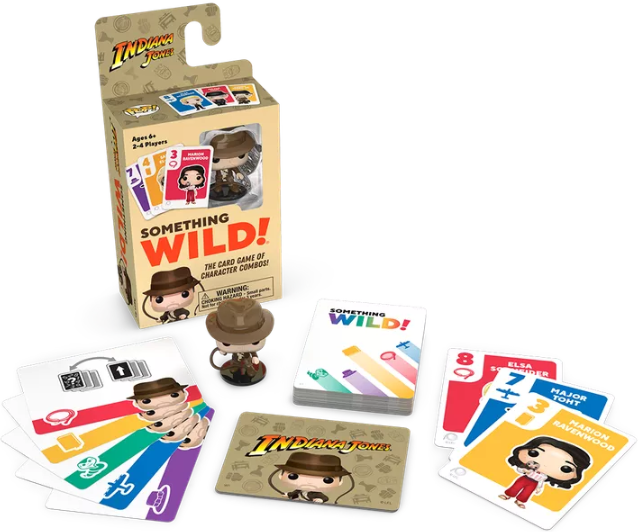
Friday Filler: Something Wild!

Something Wild! The Card Game of Character Combos! is actually a whole family of card games published by Funko Games, all of which share the same simple mechanics, but each of which involves a different Intellect property. So, there are versions of Something Wild! devoted to Disney’s Aladdin, Tim Burton’s The Nightmare before Christmas, Dr. Seuss, Marvel Spiderman, Star Wars’ Boba Fett, Disney’s Steamboat Willy. Thus there is a version of Something Wild! for just about everyone and in each case, the version of the game, it includes a miniature Funko Pop figure. So, for example, in the Indiana Jones version—a new addition in 2023—the game includes a figure of that character. The fun thing is, that the various versions of Something Wild! are compatible with each other, and two or more sets can be combined for both more players and variation in theme. Something Wild! The Card Game of Character Combos! is designed for two to four players, aged six and above, and can be played in fifteen minutes or so.

Something Wild! consists of forty-five Character Cards, ten Power Cards, a Funko Pop! mini-figure, and the rules sheet. For the Indiana Jones version of Something Wild! The Card Game of Character Combos! the mini-Funko Pop figure is of Indiana Jones and all of the characters on the Character Cards come from the Indiana Jones franchise—in particular from Raiders of the Lost Ark, The Temple of Doom, and The Last Crusade, but not from Crystal Skull. The characters on the numbered cards include Marcus Brody, Marion Ravenwood, Indiana Jones, Short Round, Major Toht, Sallah El-Kahir, Captain Katanga, Elsa Schneider, and Henry Jones, Sr. The Character Cards are divided into five colour suits, numbered between one and nine, and the characters are the same on each number across the five suits. The ten Power Cards are also divided into five colours. Power Cards give a player an advantage or ability in play. For example, a Power Card might allow six cards to be played as any colour or swap a card a player in play with a card in play belonging to another player.

The aim in Something Wild! is to score or win three Power Cards. The first player to do wins the game. To win a Power Card, a player must create a set or run of cards. A set is three cards of any colour with the same number. A run is three cards of the same colour with numbers in order. This is done one card at a time and when a set or run is formed, the player takes the Power Card and discards the cards played.

Play of Something Wild! is simple. At the start of the game, each player receives a hand of three Character Cards and a single Power Card is played face up in the centre of the table. On his turn, a player draws a Character Card and adds it to his hand, then places a Character Card down in front of him on the table. If the colour of the Character Card played matches the colour of the Power Card currently, the player gets to take the Funko Pop! mini-figure. When a player has the Funko Pop! mini-figure in front of him, he can use the ability of a Power Card he has already in front of him or the ability of the Power Card face up on the table in the centre of the table. If a player has either a set or run of cards in front of him, then he can take the Power Card on the table.

Physically, Something Wild! The Card Game of Character Combos! is a solidly presented card game. Both the Character Cards and Power Cards are done in bright, solid colours and the rules sheet is easy to read. The Character Cards and Power Cards are language independent, whereas the rules are not. The rules are easy to read and understand, but younger players will need a hand. Of course, the Funko Pop! mini-figure is cute.

Something Wild! The Card Game of Character Combos! is not a difficult game to play and being aimed at players aged six and up, it is not a difficult game to teach. The latter is likely necessary because the rules are likely to be too difficult to read and understand for the six-year-old player. Another issue is that the game’s cards are language independent and so reference needs to be made to the rules to understand how each Power Card works. That is, until either the players have remembered or been successfully taught what each does. With younger players then, Something Wild! will require some supervision by older or adult players—at least initially.

In addition, whilst Something Wild! is a decent family game—especially if the edition they are playing has a Funko Pop! mini-figure that everyone likes—it actually gets better with the addition of a second set. This gives the players the chance to take control of two—or more—Funko Pop! mini-figures, as well as giving them a wider range of Power Cards, though this of course, means learning what the extra Power Cards do.

Something Wild! The Card Game of Character Combos! is simple, clean, and fast-playing. There is a little bit of ‘take that’ as players vie to take or keep control of the Funko Pop! mini-figure, but it is by no means a vicious game and with a fifteen-minute playing time, it never outstays its welcome. Overall, Something Wild! The Card Game of Character Combos! is a solid family card, easy to teach and easy to play, with some nice variations in its Power Cards to keep it interesting, but still light.