Every Week It's Wibbley-Wobbley Timey-Wimey Pookie-Reviewery...
Showing posts with label Judge Dredd & The Worlds of 2000 AD Roleplaying Game. Show all posts

Sunday, 4 January 2026

Strontium Dog I

In 1988, Games Workshop would have published its fourth home grown roleplaying game. Like its second, Judge Dredd: The Role-Playing Game, this would have been drawn from the pages of Britain’s longest running Science Fiction comic, 2000 AD. Strontium Dog: The Role-Playing Game was based on the comic strip of the same name, telling the exploits of Johnny Alpha, an ‘S/D’ or Search/Destroy agent forced to live off Earth because he was a mutant and work collecting bounties on some of the worst criminals in the galaxy. Working Typically accompanied by one or more of his partners—Wulf Sternhammer, the Gronk, and Middenface McNulty, Johnny Alpha dealt with prejudice against mutants—the worst of which came from within his own family, rival bounty hunters, revenge-seeking criminals, and worse. The stories were essentially Spaghetti Westerns in space and the comic strip, which originally appeared in the pages of Starlord in 1978 before transferring to 2000 AD in 1980 ran until 2018 with the death of its artist, Carlos Ezquerra, was very popular. It has since been revived with stories exploring other characters and the wider setting. Had Strontium Dog: The Role-Playing Game been published by Games Workshop, it would have no doubt sold well. After all, in the mid-eighties, Strontium Dog was one of 2000 AD’s most popular series, as was Judge Dredd, and its familiarity to the British roleplaying game hobby would have given it as firm a fan base as Judge Dredd: The Role-Playing Game. Plus, there were fewer stories for Strontium Dog and its setting was more open—the whole of galaxy, plus time travel—so there was more space in which to create and tell adventures, and then, of course, the set-up was simple. Play a Mutie ‘S/D’ Agent, overcome the prejudice he faces, travel the galaxy, capture or kill criminals, collect their bounties, make a living.

Alas, it was not to be. In 1987, following the release of Warhammer 40,000: Rogue Trader, Games Workshop pivoted away from supporting intellectual properties that were not its own, dropping board games and roleplaying games in favour of miniatures and wargames. This included what would have been Strontium Dog: The Role-Playing Game.

This is not a review of Strontium Dog: The Role-Playing Game as released, for that did not come to pass, but a review of what could have been. This is a review of the playtest version that was very close to completion and came with everything necessary to play, including a beginning scenario.

—oOo—

Strontium Dog: The Role-Playing Game would, like the Judge Dredd: The Role-Playing Game, have appeared as boxed set. Inside there would have been three books—‘The Player’s Book’, ‘Equipment Manual’, and ‘The Game Master’s Book’. In addition to this, there would probably have been a set of percentile dice and some cardboard standees. The latter, along with the box itself and the book covers would have been the only things in colour. The books would have otherwise been black and white, but exactly like Judge Dredd: The Role-Playing Game had its artwork by various artists to draw upon to illustrate its pages, so to would have Strontium Dog: The Role-Playing Game with the artwork of Carlos Ezquerra. This would have imparted the rough, working and frontier nature of the Strontium Dog setting as well as its action.

‘The Player’s Book’ introduces the setting and details both the means to create characters and the rules for Strontium Dog: The Role-Playing Game. There are some suggestions as to how it might be played using miniatures, and no doubt, Games Workshop would have made a set of miniatures available. Everyone plays a Mutant ‘S/D’ Agent, operating out of an orbital base nicknamed the ‘Doghouse’. He is defined by his Attributes, Special Abilities, and Mutations, and will also have some equipment and weapon proficiencies. The six attributes consist of Strength, Initiative, Combat Skill, Technical Skill, Street Skill, and Psi Skill. Of these, Strength is both an ‘S/D’ Agent’s ability to both inflict and suffer damage, Initiative is both his speed and his agility, and the Psi skill is his ability to withstand psionic attacks and if he has a special Mutant Power, use that as well. These are all percentile values and are created by rolling ‘2d10+30’. He will definitely have a mutation of some kind, including minor, major, and extreme physical mutations, animal mutations, and Mutant Powers. If an ‘S/D’ Agent has a Mutant Agent he will still have a physical or animal mutation, and in all cases, the mutation also imparts a negative Reaction Check modifier. The more extreme the type of mutation, the more negative the Reaction Check modifier. ‘The Player’s Book’ includes multiple tables for determining an ‘S/D’ Agent’s mutation and its extent, providing for a lot of detail whilst still leaving room for the player to detail the specifics. This can lead to the creation of grotesques, but this is not out of keeping with the source material.

The Mutant Powers consist of a range of psionic powers, such as Absorb Energy, Chameleon, Illusions, Mind Control, Psychic Attack, Pyrokinesis, Telepathy, and Teleportation. They also include Johnny Alpha’s Alpha Ray Vision. Special Abilities consist of a mix of what would be abilities and skills in another roleplaying game. They are categorised under Initiative, Combat Skill, Technical Skill, and Street Skill. For example, Initiative-based Special Abilities include ‘Ambidextrous’, ‘Dodge’, and ‘Target Tracking’; Combat Skill-based Special Abilities include ‘Fast Aim’, ‘Hammerfist’, and ‘Weapon Specialist’; Technical Skill-based Special Abilities include ‘Computer Use’, ‘Drive’, and ‘Medtech’; and Street Skill-based Special Abilities include ‘Detect Traps’, ‘Intimidation’, and ‘Smooth Talker’. These Abilities provide a range of effects, including simply being able to undertake a particular task, grant a bonus to the associated Ability, or change when an ‘S/D’ Agent acts in combat. They typically require a roll against the associated Ability to activate. Penultimately, the ‘S/D’ Agent receives the standard equipment for an ‘S/D’ Agent and an advance to spend on extra arms, armour, and gear, which will be paid back from his first successful bounty. Lastly, the player rolls for his ‘S/D’ Agent’s weapon proficiencies. These represent some training and the weapons the ‘S/D’ Agent used during the Mutant Uprising.

To create a ‘S/D’ Agent, a player rolls for his Abilities and his Mutations and their depth and detail. Having generated his ‘S/D’ Agent’s Abilities, he receives points to spend on their associated Special Abilities. This is equal to the number of points above thirty for each Ability or equal to the die roll used to generate each Ability. Any excess points are saved to be spent later. He will also purchase further equipment. By the end of it, the player should have a very good idea of what his ‘S/D’ Agent looks like and what the extent of his mutations are. The process is not difficult, but slightly fiddly when it comes to determining the nature and extent of his mutations. It helps that there is a full example of ‘S/D’ Agent creation. Plus, at the end of the process, there is an engaging in-game briefing that the ‘S/D’ Agent would receive that sets the scene for his reception of his first bounty.

Raggedy Ann O’Riley

Strength 44
Initiative 47 (1)
Combat Skill 38 (0)
Technical Skill 36 (0)
Street Skill 40 (0)
Psi Skill 43

SPECIAL ABILITIES
Dodge (Initiative), Target Tracking (Initiative), Weapon Specialist (Combat skill), Drive (Technical Skill), Pursue (Street Skill), Sign Language (Street Skill)

Reaction Check Modifier: -05
Security Rating: CCC

MUTATIONS
Skin colouring is quartered (indigo, magenta, dark brown, normal flesh)
Skin is like coarse fabric
Eyes have strange colour (wheat yellow iris)

WEAPON PROFICIENCIES
GCC Standard Issue Single Cartridge Blaster, Skatta Gun, Lazooka

EQUIPMENT
GCC Standard Issue Single Cartridge Blaster
No. 1 Cartridges (3)
Wanted Meter
Custom-Fit Chest Armour, Upper Back Armour, Arm Protectors (pair)
GCC Standard Issue Jumpsuit, Black
GCC Standard Issue Combat Boots, Pair, Black
GCC Search/Destroy ID Badge with CCC Security Rating
GCC Standard Issue Pouch Belt with eight Pouches
2,500 cr

Mechanically, Strontium Dog: The Role-Playing Game is a percentile system. To have his ‘S/D’ Agent undertake an action, his player rolls the percentile dice and compares the result against the appropriate Ability. If the result is equal to, or under, the Ability, the action is a success, but if over, a failure. A roll of ‘01’ is always a success and a roll of ‘00’ is always a failure.

Combat, a major aspect of the roleplaying game, is played on a timescale of one Round equals five seconds in which there are five Phases. A combatant can act in one or more of those Phases, the number determined his current Initiative. All ‘S/D’ Agents begin play being able to act in two Phases, but their Initiative can go up and down. Up due to improvement, down due to injury. Most actions take a single Phase. Firing a weapon involves aiming, weapon proficiency (halved if the ‘S/D’ Agent lacks the appropriate weapon proficiency), size, distance, movement, and illumination. Combatants can target specific locations, but weapons can jam if a ‘00’ is rolled. A jam might simply be that, but it could also be a misfire or even the weapon exploding!

The combat rules also cover thrown weapons—a lot of different types of grenades are available and thrown in Strontium Dog, hand-to-hand, and so on, all supported by examples. Damage is determined by the attack type and for missile weapons, the base damage is modified by range. More damage is inflicted at close range, less at long range. Damage itself is applied to hit locations, which can be a challenge because not every mutant is going to have the same body parts, the same number of body parts, or the same bodily arrangement as other mutants or normal humans. The rules include advice on this, but ultimately in such cases, it is down to the Game Master to decide upon what part of the body that the damage is inflicted. Armour, if worn on a particular location, has a percentage chance of stopping the damage completely equal to its Armour Rating. If this Armour Roll is successful, the damage is stopped, but it damages the armour and reduces its Armour Rating. Damage is deducted from a target’s Strength and Initiative Abilities, potentially reducing his speed and capacity to act. Strontium Dog: The Role-Playing Game does include rules for critical hits, which occur when an ‘01’ is rolled, or an ‘01’ or ‘02’ if the combatant has the ‘Weapon Specialist’ Special Ability. The list of effects is not extensive, but range from loss of an eye or ear and permanent Initiative to extra damage and temporary unconsciousness. It can every result in the target being killed outright. This is rare though. There are Critical Hit Tables for each location. ‘The Player’s Book’ makes clear that the Critical Hit rules are optional.

The rules also cover movement, pursuit and fleeing, tracking, sneaking and searching, listening and observing, driving and flying, and more. Traps are covered too, as criminals not infrequently lay them for nosy ‘S/D’ Agents. What Strontium Dog: The Role-Playing Game makes clear though, is that combat is an option. An ‘S/D’ Agent can attempt persuade or intimidate a bounty into giving himself up and may well need to do so, since the terms of a bounty may require the apprehension of a fugitive or criminal rather than execute him. To that end, particular attention is paid to intimidation. The Intimidation Special Ability will give an ‘S/D’ Agent an advantage here, as will Persuasion and Smooth-Talker. That said, the negative Reaction Check Modifier from being a mutant and an ‘S/D’ Agent will counteract that.

‘The Player’s Book’ comes to close with a discussion of warrant types—‘Apprehend & Return’, ‘Dead or Alive’, and ‘Termination’—and the crimes that lead to their being issued and what sort of bounty an ‘S/D’ Agent can expect to be paid for completing each type. Presented here too, is discussion of the regulations as they pertain to each warrant type, how to use the Wanted Meter, and lastly, the rights of criminal once he has surrendered. This is all useful information as it underpins the structure of how the game is played from one scenario to the next. There are similarities here between Judge Dredd: The Role-Playing Game and Strontium Dog: The Role-Playing Game with the lists of crimes and associated values. Of course, in the former, the Judge is apprehending perps and sending them to the isoblocks for years, whilst in the latter, the ‘S/D’ Agent is apprehending criminals and bringing them back for money. Both are dispensing the law, if not justice, and there are situations where both can be regarded as executioners.

The ‘Equipment Manual’ is an extensive guide to the guns and gear used by ‘S/D’ Agents that appears in Strontium Dog. From signature blasters and blaster cartridges to mini-nukes and planet-busters, the list of equipment is lengthy and detailed. Lasers, grenades, bombs, hand-to-hand weapons, vehicles, and more are all described. The miscellaneous section covers bleepers (or tracking beacons) and com-units of various ranges), jetpaks, maps, medi-paks, toolkits of various kinds, security devices, and a lot more, including Plastiflesh for disguising oneself. The vehicle section gives profiles for various models and types along with rules for driving, crashing, and vehicular combat. These are comparatively more detailed than those for man-to-mutant combat, and so require more attention and study to bring them into play. The last entries in the ‘Equipment Manual’ explain the workings of the ‘AAA Security Weapons’ that Johnny Alpha is occasionally issued with in the comic series. Things such as ‘Stasis Grenades’, ‘Time Bombs’, ‘Time Traps’, and ‘Time Shrinkers’. Developed by the Galactic Crime Commission that the ‘S/D’ Agents ultimately work for, they are issued only to the most trusted agents and their unsanctioned use is a crime. Essentially, these are only to be issued by the Game Master and only for specific missions, their use serving the story rather than anything else.

‘The Player’s Book’ begins by giving the advice that the reader work through the examples included in its pages and create some examples of the ‘S/D’ Agents before running them through the rules to grasp how Strontium Dog: The Role-Playing Game is designed to work. This element of advice continues for the reader in ‘The Game Master’s Book’, suggesting she skim it more than once to gain an idea of where everything is in its pages, before examining its different elements in more detail. The specific advice focuses on the creation of scenarios and on running the game itself, discussing in turn, plot, settings, and encounters, all leading to the climax. It also provides Game Master with advice on various aspects of the roleplaying game, including mutations and Special Abilities, skill checks, combat and damage, as well as adding more details for criminals surrendering, including even the possibility of a reversal of any such surrender!

‘The Game Master’s Book’ includes the introductory scenario, ‘Doggy in the Middle’. This is specifically designed for beginning characters who are ready for their first bounty. It opens with the ‘S/D’ Agents in the Capitol on the planet of Sleaz, assigned a warrant from the Doghouse raised by the Sleaz Police. It wants the ‘S/D’ Agents apprehend several members of the Pleasant Street Gang. The ‘S/D’ Agents are told where the bounties can be found and told that they cannot use firearms of any kind. Fists and clubs are okay. The gang members are in Sammy’s Bar and the ‘S/D’ Agents are to apprehend them without causing too much collateral damage or killing anyone. There are about thirty staff and patrons in the bar and the ‘S/D’ Agents must sort the bounties from the innocent civilians. ‘Doggy in the Middle’ is fine for a single evening’s worth of play, but it is disappointing at the very least. It only showcases limited aspects of the roleplaying game, with no scope for the use of blasters and other ranged weapons, for investigating a bounty, and for action beyond the confines of the bar. For a barroom brawl, it is not a terrible scenario, but for an introductory scenario, it only does half the job. This would have been disappointing had Strontium Dog: The Role-Playing Game actually been published, but its failure to fully support the rules and showcase what an actually showcase what a Strontium Dog: The Role-Playing Game would actually look like is compounded by an editorial note deleting the mention and thus possible inclusion of a longer adventure.

‘Doggy in the Middle’ does show what an NPC looks like in Strontium Dog: The Role-Playing Game and in addition, the roleplaying game gives rules and tables for creating a variety of NPCs, including mercenaries, police, engineers, scientists, and aliens. Naturally, particular attention is paid to the creation of criminal NPCs since they will be the target the bounties in play. It includes minor criminals, criminal henchmen, and major criminals, and their equipment and their crimes. The most interesting addition here is for ‘Security’, specifically the ‘Security Rating’ for ‘S/D’ Agents. An ‘S/D’ Agent’s Security Rating consists of three letters such as ‘CCC’, ‘BCC’, and ‘BAC’. The first letter indicates the amount of bounty that an ‘S/D’ Agent has brought in, the second how well an ‘S/D’ Agent pursues warrants, and the third a general assessment of the ‘S/D’ Agent’s capability. The ratings can go down as well as up, and in the game, it represents an ‘S/D’ Agent’s access to equipment, which at a Security Rating of ‘CCC’, this could be Pressure Sensitive Device or Magnetic Decoder; for ‘BBB’, some Plastiflesh or a Retina Printer; and for ‘AAA’, the aforementioned special devices that the Galactic Crime Commission only assigns to its more trusted ‘S/D’ Agents.

Rounding out ‘The Game Master’s Book’ are sections on space travel, including vessels and hazards, and then time distortions. Time travel is known in Strontium Dog, indeed, one of the first stories sees Johnny Alpha going back in time to collect the bounty on a certain Adolf Schicklegruber! Dimensional travel is also possible as the universe is not stable, both being intended for use as narrative devices. There are some details given too on various galactic organisations, galactic and planetary law, crime and punishment and the legal process, as well as the means to create planets where criminals might be operating or hiding.

Overall, as a playtest version of what would have been the Strontium Dog: The Role-Playing Game, the files are very, very close to being complete. Everything necessary is included in its pages to be a playable, fully rounded roleplaying game. Character generation, core rules, combat rules, objectives of play, background, advice for the Game Master. It is all there. Of course, there are things missing. One is a fuller, more sophisticated, and more detailed scenario. The other is details of the cast of the source comics translated into game form. The latter though is something that the manuscript does acknowledge it as needing.

Physically, Strontium Dog: The Role-Playing Game in its playtest form is plain and simple. Literally plain, simple text. Further, it actually consists of over two hundred pages of printout from a late eighties dot matrix printer, which has then been marked up with red pen. Not extensively, but some. This means that it is not an easy manuscript to read physically and there is a degree of fragility to it.

Strontium Dog: The Role-Playing Game is a lost, forgotten roleplaying game. As an artefact, it is a possibility of what could have been. Another roleplaying game based on the pages of 2000 AD, supported with scenarios, miniatures, and content in the pages of White Dwarf. As a design, it is not ground-breaking, but it is a sound adaptation of the source material and it is more sophisticated than Judge Dredd: The Role-Playing Game, but not as complex as Warhammer Fantasy Roleplay, sitting somewhere between. It is easy to understand and easy to play and doubtless, it would have been a popular roleplaying game had it been published and supported. And likely, it would go on to be held in as high an affection just as Judge Dredd: The Role-Playing Game is held today.

—oOo—

Strontium Dog: The Role-Playing Game is a very playable roleplaying game because I have played it twice—thirty years apart. In the September of 1986, we made the trip from Dorset to London for Games Day ’86 held in the Royal Agricultural Hall. It was notable for several reasons. As our first trip to a gaming convention. As where we met gamers outside of our gaming circles. As where we first encountered the roleplaying game, SkyRealms of Jorune. As where I sat down and played a playtest version of Strontium Dog: The Role-Playing Game. My ‘S/D’ Agent was striped green and brown so had the name Esmeralda Brown. Somewhere I still have that character sheet for her. It was a fun game and in the months that followed, I awaited the publication of Strontium Dog: The Role-Playing Game. Of course, it never appeared and that character sheet remained the only proof of such a game actually existing. Games Workshop moved on and that Saturday afternoon experience became a memory.

Fast forward three decades and a Strontium Dog roleplaying experience was offered at the Manchester convention, GrogMeet. Not the versions based on Traveller, First Edition from Mongoose Publishing or Judge Dredd & The Worlds of 2000 AD from EN Publishing, but using the original ruleset. The ruleset that had never been published. I was both flabbergasted and intrigued and could not wait to speak to the Game Master. I wanted to find out how he had got hold of them and tell him about my connection to them, however tangential that was. I got to play them too and they still worked. I said at the time, that I was interested in reading them and reviewing them. I also said I understood that was not possible. After all, the three folders that hold the printouts of the rules are a singular artefact, a piece of roleplaying, Games Workshop, and 2000 AD history which never came to pass. It was very unlikely that anyone else had a copy and unlikely that Games Workshop had an accessible copy in its extensive archive. Of course, the Game Master wanted to ensure that they remained safe. 
Then in 2024, the Game Master turned up a convention and handed me the folders, saying that he trusted me to look after them and write the review that I wanted to. The review is late, but it is the review that I wanted to write and now, the files are going back to the Game Master next week at GrogMeet 2026.

—oOo—

With heartfelt thanks to Sam Vail for his patience and trust and generosity without which this review would not have been possible.

With thanks to the late, much missed John Amos, and Alex Blair without which that first trip to a national gaming convention would not have been possible.

Saturday, 21 May 2022

Luna Larceny

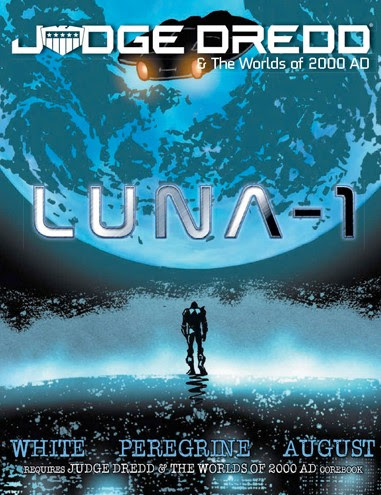
Luna-1 is a supplement for Judge Dredd and the Worlds of 2000 AD. Like The Robot Wars before it, it is as different a supplement as there has been for any of the four roleplaying games based on the Judge Dredd comic strip from the pages of 2000 AD, and that is all down to its focus. Traditionally, supplements for a Judge Dredd roleplaying game have concentrated on particular aspects of the setting—criminal organisations, crazes, psi-talents, block wars, and more—but Luna-1 focuses upon the one storyline, examining its episodes or Progs, and exploring their ramifications in detail. In Luna-1, this is the six months in which Judge Dredd is assigned to serve as Judge Marshall of Luna-1, a colony on Earth’s moon governed by judges from all three Mega-Cities. Told in Progs 42-59, this storyline thus takes Judge Dredd off Earth and onto the oxygen-short, crowded, and lawless and often wild frontier of the Moon. Here gangs and perps can escape the Mega-Cities to hide out and continue their criminal activities; corporations shorn of the scrutiny and regulations of Earth, build and hold more power and influence; resources are poor—especially oxygen, which needs to be paid for; even though they might hate each other, the Mega-Cities of North America and the Soviet East-Meg cities, will come together to participate in the Lunar Olympics; and criminal conspiracies work behind the scenes to take over the Moon! The supplement includes a Prog by Prog guide to the storyline with story hooks which the Game Master can develop as part of her campaign; descriptions of the Moon’s most notable locations and events, as well as what it like to both live and enforce the law there; new Exploits and Careers for Judges, Perps, and Civilians; an examination of a Moon-set campaign inspired by the ‘Luna-1’ storyline; stats and write ups for numerous NPCs; and more. 

LUNA-1 opens with a description of the Moon and a history of its settlement, including its important locations, such as the famous Armstrong Monument or Moonie’s Ranch, home to the reclusive corporate boss, C.W. Moonie, where he has ranchers raise genuine protein cake-fed, bio-engineered cattle on actual grass, their meat being highly prized by gourmets. The inhabitants of the Moon reside in domed settlements, ranging in size from urban sprawls to classic frontier towns. The maintenance of these domes is vital to everyone’s survival, as is a supply of oxygen, which of course, the inhabitants of the Moon have to pay for! The Oxygen Board has a monopoly on the supply. So it can be expensive! The Mega-Cities’ Justice Departments sometimes use Safe Houses on the Moon to keep witnesses safe. The Moon is also home to colonies from the other Mega-Cities beyond North America, including Shi-Shen Territories and Sov-Cities Territory, the closest they get to territories of the Mega-Cities. Locations important to the Moon, but back on Earth are detailed too, such as Moonray Tower and Temple of Lunar Light, a cult often described as being full of ‘loonies’. Events, like the Land Race—a race to grab new opened up territory, and the Lunar Olympiad are covered as well. They are all accompanied by adventure seeds.

In terms of mechanics, LUNA-1 provides numerous new options for Player Characters and NPCs of all types. New Judge Careers include Luna Judge, Zero Squad Judge (trained to work in zero gravity), Customs Judge, and more. STAR Judges or ‘Special Target Attack Retaliation’ Judges are drawn from all three North American Mega-Cities and their allies and assigned to police Earth’s off-world colonies, so the Player Characters could actually be a mixed group from various cities, not just Mega-City One. New Civilian Careers include Xenodiplomat, Corporate Executive, and Settler, whilst Perp ones include Luna Raider, Gunslinger, and Smuggler. They all include their own Exploits which can be gained by choosing them as Careers during character creation, and all provide interesting options for both Player Characters and NPCs. As expected, all of the characters from the ‘LUNA-1’ storyline are included in LUNA-1, from simple Badlands Gang Member and Futsie to Deputy Luna Marshal Tex, Judge Mex (complete with lasso for reigning in Perps), Elvis the Killer Car, and Judge Dredd himself. These can be used as is, if the Game Master wants to run the ‘LUNA-1’ storyline for her players and their characters, or simply used as inspiration for a campaign set on the Moon.

The campaign advice for the Game Master examines the how and the why of setting and running stories for Judge Dredd and the Worlds of 2000 AD. This should not just be because the setting itself is cool, but rather because there are particular types of stories which can be set there, which in this case might involve the Lunar Olympics or the looser regulations applied to corporations. It also highlights the differences between Mega-City One and the Moon—as well as colony frontiers, and how that will change game play. Smaller communities means fewer places to hide and everyone knows everyone’s business, including that of Perps, plus colonies like the Moon rely much more on technology for everyone’s survival. Only light synopsises are given for the fourteen Progs which make up the ‘LUNA-1’ storyline, more attention being paid to the whole storyline as a roleplaying campaign with a beginning, middle, and end. There is advice here on how to use Dredd, for it might be that the Player Character Judges are actually seconded to the unrelenting lawkeeper as his deputies.

The full adventure in LUNA-1 is ‘Sundance Rising’, an unashamed space western. It is set further on the frontier of the Moon in the isolated toon of Grey Rock. Inspired by the film High Noon, the town’s Judge, William Kane, is gunned down by the Sundance Gang, led by the vicious Preacher Jackson and the Judges are sent into restore order. The scenario and setting of Grey Rock is nicely detailed and there are notes too to run with Civilians as inhabitants of the town taking the law into their own hands and fighting back and also as Perps attempting to impress Preacher Jackson enough to become members of the Sundance Gang. Either way, this is a good scenario with lots going on that should provide multiple sessions of play.

LUNA-1 does not just cover Judge Dredd’s six-month secondment to the Moon, although that is its primary focus. That is told in Progs 42-59, but there were stories which took place between this and the events of ‘The Robot Wars’—as detailed in the supplement of the same name, and these are detailed in LUNA-1, again Prog by Prog. Each includes a synopsis, settings and locations, villains and bystanders, how the story can be used ‘Outside the Law’ (that is, used with Perp and Civilian Player Characters rather than Judges), and suggested further adventures. Some of these can be used as part of a Moon-set campaign, some not, but either way, the Game Master is given another eleven story hooks! Lastly, an appendix takes the Game Master—and potentially, her player’s characters to Titan. This includes a complete description and history of the penal colony where corrupt Judges are sentenced and again hooks and for the Game Master’s campaign.

Unlike ‘The Robot Wars’ storyline there is perhaps less satire and less social commentary in LUNA-1. Obviously, there is the rampant commercialism, but the Moon-set storyline is more of a means to tell stories away from Mega-City One and on the frontier in the style of the Wild West than anything else. The writing style has settled down a bit and there is more of the comic strip’s humour coming through than there was in The Robot Wars.

Physically, LUNA-1 is a slim, but nicely presented book. It is an engaging read and it is liberally illustrated with artwork from the ‘LUNA-1’ story and the other Progs it details in its pages. This is all black and white artwork and it is drawn from the very early issues of 2000 AD so there is certain quaintness to it since it dates from before the character of Judge Dredd evolved into the way he looks today.

Luna-1 picks up where The Robot Wars left off, continuing its fantastic approach to turning episodic source material into gameable content. The humour is stronger, even if the satire is not, but this is thoroughly excellent sourcebook on the ‘LUNA-1’ story, for the stories which can be told in and around it, and of course on the Moon (and other frontier settings) for Judge Dredd and the Worlds of 2000 AD (or in fact, any roleplaying game based on Judge Dredd).

—oOo


En Publishing will be at UK Games Expo which takes place from Friday, June 3rd to Sunday, June 5th, 2022.

Sunday, 27 February 2022

Strontium Dog III

In the year 2150, the Great Nuclear War wipes out 70% of Britain’s population and results in a huge increase of mutant births due to exposure to the nuclear fallout of strontium-90, the children typically afflicted with one or more physical deformities. As the number of mutant births grows, so does the adverse reaction to them until the prejudice against them is open and adverse, with politicians, in particular, Nelson Bunker Kreelman of New Britain and his anti-mutant police force known as the ‘Kreelers’, actively campaigning on an anti-mutant platform. The prejudice would grow to the point where the Mutants banded together and formed a Mutant Army that would lead a Mutant Uprising in 2167. Although the rebellion fails, Kreelman is forced to resign and the Kreelers disband and whilst they continue to face prejudice, there are no pogroms against them. Most either move into the segregated ghettos set up for them, such as the large settlement of Milton Keynes, or because their work and business opportunities are severely limited, leave Earth all together.

The surviving members of the Mutant Army are also forced to leave Earth. They are also given a pardon in return for their joining the Search/Destroy Agency as galactic bounty hunters, tasked with hunting down criminals and threats deemed too dangerous to be handled by ‘norms’. The combination of their mutations being the result of strontium-90 radiation and the distinctive ‘S/D’ (for ‘Search/Destroy’) badges they wear, means that they are nicknamed Strontium Dogs, and their orbital base the Doghouse. This is set-up for the Strontium Dog comic strip from the pages of 2000 AD, which tells the tales of one of the most famous S/D bounty hunters, Johnny Alpha, a former leader of the 2167 Mutant Uprising, including going back in time to collect a bounty on one Adolf Schicklegruber! The comic strip, which originally appeared in the pages of Starlord in 1978 before transferring to 2000 AD in 1980 ran until 2018 with the death of its artist, Carlos Ezquerra. It is also the basis for Strontium Dog, a roleplaying supplement for Judge Dredd & The Worlds of 2000 AD.

Strontium Dog, published by En Publishing, is not the first roleplaying treatment for Strontium Dog. Mongoose Publishing released a version using the Traveller mechanics, and before that, there was a version from Games Workshop based on Judge Dredd: The Role-Playing Game, but which was never published. In Strontium Dog for Judge Dredd & The Worlds of 2000 AD the players take the role of Mutant Search/Destroy Agents, collecting bounties on the scum of the universe, travelling in the cargo hold from system to system, and suffering prejudice against Mutants along way—and not just from Norms, but from other Muties too. This can be because the Muties are criminals or simply because they hate the idea of Muties acting against other Muties. And although Strontium Dog is all about bringing in the scum of universe—dead or alive—and sometimes of the scum of other dimensions and other time periods, it is also possible for the players to take the roles of the scum of the universe and play criminals rather than bounty hunters! This would use the rules for creating criminals from Judge Dredd & The Worlds of 2000 AD, which can also be used for potential Strontium Dog/Judge Dredd crossovers—just like the comic—as they share the same universe.

Strontium Dog leaps straight into creating a character for the setting, beginning with options for Species. These include Humans and Mutants as well as Gronks, the intrepidly cowardly aliens known for their timidity and medical skills, whilst the Mutants, there are tables for physical, cosmetic, and metabolic/metaphysical mutations. Thus it is possible to play a mutant with boils or warts, tentacles, a rubberised body, acidic blood, an ice-cold metabolism, shimmering skin, a rash of fake eyes, a face full of teeth, and more. All of these individualise a mutant and should suggest a possible nickname, not necessarily a serious one, in addition to their skills and exploits. An option is included for the selecting the cruel and identical Strix as a species, and there is a guide to including robots in the setting too (although they do not appear in the comic strip as bounty hunters). Outlaw and Civilian careers includes everything from the Animal Rights Activist, Anti-Mutant Enforcer, and Bandit to the Theme Park Staffer, Vis Presenter, and Xenodiplomat, whilst specific Mutant Careers include Mutant Cultist, Mutant Stalker, and Sideshow Freak. Many of these could be used in the Judge Dredd and other settings for Judge Dredd & The Worlds of 2000 AD. Less easily adapted are the S/D Careers, which cover both recruitment and actual careers with the agency. The former include Born to It, mentored by an Older Dog, and Score to Settle, whilst the path for every S/D Agent is the same from Rookie S/D Agent to Veteran S/D Agent, with a choice of Agent in Time, Dimensional Agent, and S/D Agent in between. These are accompanied by a choice of Exploits such as ‘Nux for All’, which causes extra damage when using Electronux, ‘Making a Name for Yourself’ which grants a bonus to REP (reputation) checks because the rookie is trying to make a name for himself, and ‘I’ve SEEN Things’ (in other dimensions) enables an S/S Agent to initially ignore the Afraid condition!

The life of an S/D Agent means collecting bounties and making, hopefully big, money, but it also means paying out too. A Mutant gets nothing for free, and that includes his equipment. Strontium Dog includes a lengthy list of guns, grenades, and gadgets. These start off with the ubiquitous Westinghouse Variable-Cartridge Blaster and the dreaded ‘Der Happy Sick’ Warhammer wielded by Johnny Alpha’s friend, Wulf Sternhammer, and go from there… Some of the devices and bombs are extremely powerful, such as Dimension Warp which opens up a rift to another dimension, the Pocket Nuke (Throwing) capable of levelling a city, the Time Drogue for rewinding time on a victim or target, interrogating them, and then letting them die a second time, and the Time Shrinker, which speeds up time for the target to the point of death and beyond. It is suggested that the Player Characters only have access to these as plot devices rather than being readily available, but in general, they will have access to a lot of the gear and guns presented—if they have the credits, but then so are the criminals!

For the Game Master, there is a lot of support in the pages of Strontium Dog. This begins with advice about setting the tone, which is very much that of a Sci-Fi Spaghetti Western with blasters, mutant powers, and heavy prejudice. The latter runs throughout the setting and the players will need to have a thick skin when playing a campaign set in this twenty-second century. That said, their characters are armed—often heavily armed—and they have a lot of agency. Similarly, this future is not one in which there is a lot of trust, not even with the Player Characters’ fellow Muties, especially if they are rival bounty hunters. The notes on describing the world of Strontium Dog are pleasingly evocative, and this is backed up with descriptions of typical locations and then the various locations visited by Johnny Alpha in the pages of the comic strip. Both are really quite detailed and give the Game Master plenty to work with when taking her Player Characters there. Plus, there is a timeline for Johnny Alpha and the comic strip running from 793 AD to the 37th Century.

Almost a fifth of Strontium Dog is devoted to a series of Bounty Contracts. There are six of these, which can either run standalone, but they really work as a full campaign—the ‘En System’ Campaign. The campaign begins on Weaver’s Rock with a bounty of the Wispa gang, who have gone from robbing cargo trucks to murder! The first bounty is fairly simple and once completed, there are plenty of hooks if the Game Master wants to expand the Player Characters’ time in the backwaters of Weaver’s World. The second bounty takes the Player Characters to the planet’s big settlement, Paradise City, where they can continue tracking down the remaining members of the Wispa gang. Besides the main bounty, the Game Master is given another list of bounties available in the city, but once on the main trail, they become involved in a big chase across the city skyline. The third takes a darker turn when on the trail of an assassin, the Player Characters are inadvertently diverted—or are they?—to another planet and probably the best pun in what is a campaign packed with puns as they have to assault the ‘Merlock of Firestop Mountain’! The final encounter turns up the gonzo and the Merlock theme for an underwater, shark-infested big fight. In the fourth part it quickly becomes clear that the authors are really big fans of Doctor Who as the names and references fly thick and fast when the Player Characters are tasked with tracking down the creator of a gas which quickly grows anyone who breathes it into a zombie! They accidentally get dumped into an alternate dimension in the fifth part after they have to deal with a Mutie who has been terrorising Gronks—there is a bonus if no Gronks die during the apprehension of this bounty, so good luck with that!—and then fight their way out of it in readiness for the final showdown in the last part of the campaign. As the Player Characters have bounced from one bounty to the next, it has become clear that someone has been monitoring their actions and there they learn that it has been much more than that—the real villain has been broadcasting them across the galaxy! Cue lots of television jokes and shenanigans which bring the campaign to an entertaining close.

The ‘En System’ Campaign is not just a lot of fun, but it is clear that the authors had a lot of fun writing it. The jokes are as silly and as groanworthy as you would expect and they should be, and both Game Master and her players will appreciate the campaign even more if they get them. The Strontium Dog supplement is rounded with a lengthy section of Allies and Enemies, including Johnny Alpha, Wulf Sternhammer, the Gronk, Durham Red, Middenface McNulty, and a whole cast of criminals. This is the only section where the black and white artwork from the comic strip’s early days is seen, which is a pity. However, it is the ‘En System’ Campaign which pulls everything together and gives a playing group something to get started with.

Physically, Strontium Dog is a bright and breezy affair, which lots colour artwork drawn from the comic strip. It needs a slight edit in places, but is an easy read otherwise.

Strontium Dog is an impressive supplement for Judge Dredd & The Worlds of 2000 AD that with the addition of the ‘En System’ Campaign the Strontium Dog feels complete and succinct. It gives the Game Master and her players everything necessary to play an entertainingly gonzo, over the top game of hunting bounty on the scum of the universe and more!

Friday, 25 February 2022

A Collection of Crimes

Judge Dredd: Case File Compendium 1 is an anthology of investigations, scenarios, and adventures for Judge Dredd & The Worlds of 2000 AD, the fourth roleplaying to be based on the famous character from the long running weekly comic, 2000 AD. Published by En Publishing, it compiles the five previously available titles in the Judge Dredd Case File series—named after the compilations of the comic strips—and adds two new ones for a total of seven. Some come ready to play, some need a bit of preparation, some are full scenarios, other vignettes, but all are relatively easy to slot into a campaign. All can be run as scenarios for the other options in Judge Dredd & The Worlds of 2000 AD that have the Player Characters as either Civilians or Perps in Mega-City One, but primarily, the contents of Judge Dredd: Case File Compendium 1 are intended to be played using Judges, typically of Grade 5 and above.

The analogy opens with Judge Dredd Case File #1: Monkey Business by Russ Morrissey. This is a fairly uncomplicated affair, intended to be run as a one-shot or convention scenario, preferably with the pregenerated Player Characters from the core rulebook. That said, it is easy to run with Judges of the players’ own creation, or even with Civilians dealing with the problem because the Judges are busy or with a gang of Perps looking to take down their rivals. Bronson & Sons, a small and not very modern department store, has been taken over by a gang of apes. One is atop the roof, armed with a bazooka and causing mayhem, whilst the rest are inside awaiting the rival of the Judges (or their rivals). This includes a Gorilla ready and waiting in full football gear to bat up, and the rest of the gang all in Prohibition-era suits and fedoras. There is a wrinkle or two, and the Game Master will have fun hamming it up with the Ape gang, but otherwise, this is easy to run and drop into an ongoing campaign.

Judge Dredd Case File #2: Nobody Expects the SJS! by Benjamin Rogers is intended as an interlude. The totalitarian nature of the regime governing Mega-City One comes to the fore when the Judges are pulled from an investigation, whether in the middle or at the end of a shift and told to report to another station house. The Judges are stripped of their equipment and interviewed and interrogated by Judge Mordant of the Special Judge Squad to determine if they are guilty of misconduct. Several methods of interrogations are provided for Judge Mordant, up to and including ‘The Random Physical Coercion Test’ or Corporal Punishment. Consequently the scenario includes warnings about the content and rightfully so. The scenario is highly adversarial, involving harsh interrogation and psychological and physical abuse, with essentially the Game Master acting directly against the players’ Judges, who depending upon if they are guilty of misconduct, may end up sentenced to Titan and thus out of the campaign. Other outcomes are also discussed and both these and the situation itself, are interesting to roleplay if the group is not too uncomfortable with it. Lastly, ‘Judge Dredd Case File #2: Nobody Expects the SJS!’ does feel too early to run in campaign.

Judge Dredd Case File #3: Night of the Living Dredd by Richard August has a lovely pun for a title and takes the Judges (or other character types) below Mega-City One and onto the banks of the Big Smelly. Occasionally, the Justice Department sends Judges down below of a sweep of the underground area and the player Judges might be on such a sweep or another case, when they are best by a horde of zombies and forced to take refuge in the dilapidated remains of a suburban house. This is the end of Night of the Living Dead played out with daysticks and Lawgivers in which the Judges have to survive a terrible night in hope of rescue, all the while wondering what was the cause of the corpse cortege.

Judge Dredd Case File #4: Obstructing the Law by Benjamin Rogers presents a big challenge for the Judges when a Citi-Block is thrown into disarray when the local eating champion gets stuck on the way out of his apartment in Gordon Ramsay Block on the way to a local eating competition. This is fantastic situation which requires careful intervention by the Judges, not just in freeing the Fattie from where his stuck, but in dealing with the consequences if they fail. This includes dealing with citizens from the rival Jamie Oliver Block, the chances of the situation escalating into a Block War, Gordon Ramsay Block residents rioting, and more. This is a fun roleplaying situation which makes inventive use of the Judge Dredd setting.

Judge Dredd Case File #5: Red Dredd Redemption by Richard August is more of a set-up than an actual adventure or investigation. It is, however, a classic set-up. A Perp whom the Judges previous put away has been released from the Iso-Cubes and wants to revenge. To do this, the Perp conducts a reign of terror against the Judge (or his family if he has one), which should culminate in the kidnapping of an ally or a family member, perhaps a particularly reliable informant. For the Judges, the scenario should start with them coming to the rescue of the victim and the apprehension of the Perp. There are some nice suggestions as where this should take place, but it should be isolated and it will require some development upon the part of the Game Master. Like the earlier ‘Judge Dredd Case File #2: Nobody Expects the SJS!’, the set-up for ‘Judge Dredd Case File #5: Red Dredd Redemption’ means that it is better suited for Judges with more than a few cases and arrests on their record.

‘Judge Dredd Case File #6: All Boxed Up’ by Shaun Cook is a longer scenario in which the philanthropist Quququey, an alien trader, wants to redevelop one of Mega-City One’s shanty towns, Cardboard City, as part of a trade deal. The Judges are tasked with assisting him and keeping him safe, which means checking the area prior to his visit. There are lots of opportunities for investigation into minor crime, dealing with members of the Anti-Alien League who object to Quququey’s presence, and interacting with the citizens of Cardboard City. The Game Master will certainly have a lot of fun portraying the ordinary citizenry and oddballs that the Judges run into. There is scope also for Perp Player Characters in particular, their objectives being at odds with those of the Judges, of course. This will require a little adjustment upon the part of the Game Master. This is another solid slice of Judges working the streets and will probably take a session or two to play. If there is an issue with the scenario, it is that it could have done with better organising to make the various plots and motivations clearer.

‘Judge Dredd Case File #7: The Future of Law Enforcement’ by Marc Langworthy is the last scenario in the anthology. Where many a Judge Dredd campaign begins with the Player Characters as Cadet Judges on their Hot Dog Run or Eagle Day, here the Judges are summoned by Judge Dredd himself and assigned to oversee the latest batch of Cadets on their Hot Dog Run, a test run of their capabilities and training into the Cursed Earth. In particular, this Hot Dog Run is targeting a band of mutant raiders, ‘Cherpo’s Crusaders’, which has been active recently in the Alabama Morass. The Judges, accompanied by the Cadets, will need to search the area around Sausage Tree Farm, which is where most of the convoys that ‘Cherpo’s Crusaders’ has targeted, has come from. Along the way there are random encounters and the Cadets to keep an eye on. They take a supporting role mechanically and there is a random chance that they will mess up in one encounter. Each Player Character Judge is expected to take charge of one Cadet and it is suggested that each player also roleplay one of the other Cadets. The scenario includes rules and guidelines for this. This is solid, meaty little scenario which will culminate in the Judges giving assessments of their charges.

Physically, Judge Dredd: Case File Compendium 1 is nicely presented and well written. The scenarios do vary in quality and some of them do require development upon the part of the Game Master. Some though really are good and will be fun to both run and play as part of your Judge Dredd & The Worlds of 2000 AD campaign.

Sunday, 30 January 2022

Wobot Wars

The Robot Wars is a supplement for Judge Dredd and the Worlds of 2000 AD. It is as different a supplement as there has been for any of the four roleplaying games based on the Judge Dredd comic strip from the pages of 2000 AD, and that is all down to its focus. Traditionally, supplements for Judge Dredd roleplaying game have concentrated on particular aspects of the setting—criminal organisations, crazes, psi-talents, block wars, and more—but The Robot Wars focuses upon the one storyline, examining its episodes or Progs, and their ramifications in detail. This includes the nature, role, and creation of robots in 2000 AD and thus Judge Dredd and the Worlds of 2000 AD, new Careers for Human characters, a complete summary of ‘The Robot Wars’ storyline and guide on how to run it as a campaign, a complete self-contained campaign for non-Judge Player Characters, other campaign concepts, further Case Files, and then personalities and robots of The Robot Wars. This comprehensive examination sets the format for future supplements Judge Dredd and the Worlds of 2000 AD which will go on to explore some of the eminent lawman of the twenty-first century’s most amazing cases!

‘The Robot Wars’ is the first big storyline for Judge Dredd, consisting of nine Progs, running from 2000 AD Progs #9 to #17. It first recounts how robots are sold, showcased, and treated at the Robot of the Year Show before a newly built carpentry robot, Call-Me-Kenneth, runs amok killing people until it is destroyed by Judge Dredd. However, before he could be reprogrammed, he reactivates and calls upon the robots of the city to rise up against their masters. This sparks a war across Mega-City One, the deaths of thousands of Humans and destruction of thousands of Robots, and a civil war between the robots loyal to Call-Me-Kenneth and the robots loyal to Humanity. Many of the robots loyal to Call-Me-Kenneth find that their conditions are no better, and even worse, under his rule. Judge Dredd is able to work with the robot resistance against Call-Me-Kenneth and ultimately defeat the mechanical tyrant.

The Robot Wars opens with a deep examination of the place and role of the robot in the societies of the twenty-first century. ‘We Who Serve’ is a systems agnostic essay which highlights how robots are ubiquitous in Mega-City One, performing all manner of tasks and roles, often to varying degrees of hostility and Robophobia, how they are limited by their programming—in a good way by the Asimov Circuits and the Three Laws of Robotics and a bad way because it means they can be literal and single-minded, their construction, and their various types. The latter includes service robots, heavy labour robots, social robots, professional robots, expert robots, and more. It includes pleasure robots—fewer than you would think, and illegal robots—which can perform criminal tasks doggedly, but not necessarily be able to adapt to changing circumstances once a crime goes wrong, or if actually programmed for crime, decide that Human criminals are not as good and simply take over. An interesting aspect of robot society is that they do have emotions, most of which they suppress when around humans as part of their subservience, but in private they do share them with other robots and they do so as a form of therapy.

The supplement provides options for both Robot characters and Human characters—the ‘Fleshy Ones’, both expanding upon the character design rules in Judge Dredd and the Worlds of 2000 AD. Robot characters start with six intrinsic Exploits (the equivalent of abilities, talents, and flaws) of Asimov Circuits, Automation, Augmented, Deterministic, Electronic Vulnerability, and Mindless. The Robot Careers fall into the same types discussed earlier and it is suggested that to best reflect robot design in the twenty-first century, each Player Character Robot should be relatively specialised. A player has plenty of options when it comes to form and design of his Robot and these will be expanded and developed through Careers such as Administrator, Bounty Hunter, Delivery Robot, Domestic, Host/Hostess, and more. In conjunction with the core rules in Judge Dredd and the Worlds of 2000 AD, what the Game Master is given here is a means to create detailed robot NPCs as well as players to create Robot characters. In the main, Humans are just given new Careers and Exploits which relate to robots in the twenty-first century. Thus, Robo-Tech, Robot Rights Agitator, and Robot Hate Activist, with both of the latter including lists of groups campaigning for and against robot rights respectively. There are lots of roleplaying opportunities in both of these, as there is in the Resurrection Man—named after the body snatchers of the Victorian Era, who specialises in the theft and reprogramming of robots. Rules are also provided for both cybernetics and Robophobia, the latter designed to model the fear and ultimately the hatred of robots. This is primarily intended for use with NPCs, but guidance is included for its use by a Player Character.

A good half of The Robot Wars is dedicated to playing through ‘The Robot Wars’. The first of these is as Judges, sometimes serving alongside Judge Dredd himself and sometimes not. Each of the series’ nine Progs is given a detailed breakdown and guidance on getting the Player Characters involved. They vary in complexity, but each should provide a good session’s worth of play each. This is contrasted by the mini-campaign, ‘Saving Matt Damon Block’ which is set in a high-security block of the same name where the Player Characters are residents who are caught up in the robot rebellion. This is for Civilian, Perp, or Robot Player Characters—or a mixture of all three—and is more of a detailed outline than necessarily a full campaign. It even discusses an alternative campaign in which the Player Characters, probably Robots, actually decide that Call-Me-Kenneth is right and side with the robot rebellion! Of the campaign options in The Robot Wars, this has the greater roleplaying potential and is the more personal, even intimate, and consequently more interesting of the two, even though it is the shorter of the two.

Besides the two campaigns, The Robot Wars also gives advice for running campaigns structured around ‘The Robot Wars’ and it also provides a breakdown of the Cases setting during the same period, that is, from the early Judge Dredd stories from the pages of 2000 AD. There are six of these, and they all include a synopsis, a guide to running the Prog as an adventure with Judge and non-Judge Player Characters, further suggestions for expanding upon the Prog, and descriptions of the settings, locations, villains, and bystanders they involve. These are all very nicely done, gameable summaries which the Game Master can again use to provide a session’s worth of play, if not more. Like the two campaigns earlier in the book, they will all need some development upon the part of the Game Master, but they do include much more than the basic outline. Lastly, the ‘Nuts and Bolts’ chapter is a robotic bestiary giving all the stats of the important robots involved in ‘The Robot Wars’, starting with Walter the Wobot, Call-Me-Kenneth, and the Heavy Metal Kids, which the Game Master will need.

Where The Robot Wars disappoints is that it never takes a moment to step back from the story itself and examine what the story is about. As exciting as the action is in Judge Dredd—and it always is—the character and its setting has always been a satire too, and in ‘The Robot Wars’ the satire is upon racism and slavery, and the treatment and the liberation of slaves. A commentary upon the story and its satire, as well as how to highlight those elements in play, would have been a welcome inclusion in The Robot Wars. The other issue is that The Robot Wars does not always bring the humour of the comic into its pages. There are moments certainly, like the naming of the criminal gangs in the Matt Damon Block in the scenario, ‘Saving Matt Damon Block’, which are genuinely humorous, but it feels as if there should have been more. To be fair, translating the humour of the comic to the supplement was always going to be challenging.

Physically, The Robot Wars is a slim, but nicely presented book. It is an engaging read and it is liberally illustrated with artwork from the ‘The Robot Wars’ story and the other Progs it details in its pages. This is all black and white artwork and it is drawn from the very early issues of 2000 AD so there is certain quaintness to it since it dates from before the character of Judge Dredd evolved into the way he looks today.

The Robot Wars showcases a fantastic approach to turning episodic source material into gameable content. Whilst it does not develop that approach fully in terms of what the source material or Progs, are really about or their satire, it is a good start and hopefully, more of that will come in the future supplements which in turn focus on the some of the epic Judge Dredd storylines which appeared in the early 2000 AD Progs. Nevertheless, The Robot Wars is a great start for Judge Dredd and the Worlds of 2000 AD. It is a good sourcebook on ‘The Robot Wars’ story, for the stories which can be told in and around it, and for creating robot characters in Judge Dredd and the Worlds of 2000 AD (or in fact, any roleplaying game based on Judge Dredd).

Sunday, 8 November 2020

Judge Dredd IV

Judge Dredd and the Worlds of 2000 AD is the fourth roleplaying game to explore the world of Judge Dredd and Mega-City One as depicted in 2000AD. Not only that, it lays the groundwork and the core rules for any number of comic strips to appear in the pages of the long running British weekly comic, including ABC Warriors, Rogue Trooper, Strontium Dog—and more. The focus of Judge Dredd and the Worlds of 2000AD though, is firmly on the post-apocalyptic, dystopic satire of the police state—or ‘Judge state’—that is the setting of Judge Dredd. Published by EN Publishing following a successful Kickstarter campaign, Judge Dredd and the Worlds of 2000 AD shares some comparisons to earlier iterations of roleplaying games based on the Judge Dredd licence. Like Judge Dredd: The Role-Playing Game from Games Workshop, it uses its own mechanics, in this case being powered by the W.O.I.N.—or ‘What’s OLD is NEW’—dice pool mechanics. Like The Judge Dredd Role-Playing Game, the d20 System version from Mongoose Publishing, that it allows players to create ordinary citizens and perps, as well as Judges, and like Judge Dredd, the Traveller version also from Mongoose Publishing, it allows the creation of Psi-Judges, Tek-Judges, and Med-Judges as well as Street Judges from the start. Another difference between Judge Dredd and the Worlds of 2000AD the previous iterations is that it is set in 2099, so a few years earlier in the timeline of Mega-City One.

A Player Character in Judge Dredd and the Worlds of 2000AD is defined by a fair number of factors. At the narrative level, this factor is a descriptor, ‘A[n] [Age] [Trait] [Species] [Career] who [Hook]’ which sums up the character, for example, ‘An elderly egotistical Orangutan Fence who enjoys a real cigar’. On a mechanical level, a character has eight attributes—Strength, Agility, Endurance, Willpower, Intuition, Logic, Charisma, and Luck, as well as two secondary attributes, Reputation and Psionics. He will have any number of skills, ranging from Accounting, Light Armour, and Insight to clairsentience, boinging, and flirtation. Now all of these have a rating, typically four for the average Human and each has an associated dice pool of six-sided dice, typically two six-sided dice for the rating for four, which a player or the Referee rolls for character or NPC to undertake an action. A character will also have various Exploits, essentially talents and abilities gained from a character’s species and various careers, such as Pacification from the Applied Violence course a Cadet Judge can take at the Academy of Law which grants bonus baton damage or Art Savant from the Scrawler (graffiti artist) career which improves his Reputation with fellow Scrawlers. Lastly, a character has a Grade, which is a measure of the number of Careers a character can have. Typically, this is set at five for beginning characters, and besides limiting the number of careers a character have, it also limits the size of the dice pool a player can roll for his character.

To create a character, a player selects a species and its exploits, then three species skills. He then chooses five careers. From each he chooses two of the listed skills, either the Aim or Feint Exploit, and one more universal Exploit. Adjustments are made to Attribute and Skill rating as the player makes his choices. Each Career also adds one or more years to a character’s age. The process takes a little time and is slightly fiddley, but a player is given a lot of options to create an interesting character and a Referee to create interesting NPCs.

Our sample Player Character is Ookie Whithers, a Chimpanzee who grew up and lives in Apetown. Since he was a Juve he has been an associate of the Chimpolini crime family, but never rose high in its ranks because of his love of gambling. He has a minor record as a Juve and in more recent years has become a nark for the Department of Justice. He always has a book running on all manner of events and is never seen in the same waistcoat twice.

Ookie Whithers
A Suave Chimp Fence who can never turn down a bet
Age: 23
Grade: Five
Careers: Juve Gang, Gamer, Pongo, Fence, Nark

Strength 5 (2d6) Agility 5 (2d6) Endurance 3 (2d6) Willpower 2 (1d6) Intuition 8 (3d6) Logic 5 (2d6) Charisma 9 (3d6) Luck 7 (3d6)
Reputation 3 (2d6) Psionics 0 (0d6)

Health 11 Speed 19 Jump 10’/5’ Carry 80 lbs. Initiative 3d6
Melee Defence 11 Ranged 7 Mental Defence 11 Vital Defence 7

Skills
Accounting 1 (1d6), Appraisal 1 (1d6), Bluffing 2 (1d6), Brawling 1 (1d6), Carousing 1 (1d6), Forgery 2 (1d6), Gambling 3 (2d6), Insight 1 (1d6), Movies 1 (1d6)

Exploits
Agile, Beguiling, Feint, Great Leap, Lucky Escape, Natural Climber, Profit, Stone Cold Stare, Thrower, Weak-willed, What’s the Plan?, Where the Action is, Zero-g

Where creating a citizen or perp type character is supported by a wide range of options—though there is no equivalent of the ex-prisoner who has done time, the options for creating a Judge are more proscribed. A Judge has to be Human or a Clone, must take Cadet followed by two advanced courses, such as Basic Psionics or Citizen Manipulation, and then Rookie. The last Career is a Judge Career such as Med Judge, Psi-Judge, Street Judge, or Tek-Judge. More options are available in terms of Speciality Judge Career, which include Block Judge, Crime Scene Processor, Interrogator, Wally Squad, and more. These become available if the Referee is planning a game with more experienced Player Characters, and equally, a Referee could reduce the number of Careers to just four if she wants to start a campaign with Rookie Judges.

Our sample Judge is a clone taken from the same biological material as Judge Dredd. He wants to emulate his genetic stock and be a Judge worthy of his forebears. On the streets he relies upon his presence and his intimidating manner, and when that does not work, is a dab hand at pacification.

Judge Leonov
An Alert Street Judge who wants to be worthy of his clone source
Age: 24
Grade: Five
Careers: Cadet, Citizen Manipulation, Applied Violence, Rookie, Street Judge

Strength 7 (3d6) Agility 5 (2d6) Endurance 7 (3d6) Willpower 6 (3d6) Intuition 8 (3d6) Logic 6 (3d6) Charisma 5 (2d6) Luck 3 (2d6)
Reputation 2 (1d6) Psionics 0 (0d6)

Health 34 Speed 19 Jump 10’/7’ Carry 140 lbs. Initiative 10d6
Melee Defence 18 Ranged 7 Mental Defence 11 Vital Defence 11

Skills
Bravery 1 (1d6), Boxing 1 (1d6), Clubs 2 (1d6), Hardy 1 (1d6), Insight 1 (1d6), Interrogation 1 (1d6), Intimidate 3 (2d6), Law 3 (2d6), Light Armour 1 (1d6), Perception 1 (1d6), Pistols 1 (1d6), Riding 1 (1d6), Running 1 (1d6), Tactics 2 (1d6)

Exploits
Ingrained Skill Package, Fast Healing, Academy of Law Curriculum, Voice of the Law, Pacification, Obey the Law, Freeze!, Feint, Knockdown

Mechanically, Judge Dredd and the Worlds of 2000AD uses W.O.I.N., or ‘What’s OLD is New’. This is a dice pool system which uses six-sided dice, the size of the dice pool being determined by a character’s attribute, skill, and the quality of equipment used. This is then rolled and the results totalled to beat a Difficulty Score, which can range from Easy or seven all the way up to Mythic or forty-five. A typical Difficulty Score will be Routine or ten, Difficult or sixteen, and Demanding or twenty-one. If three or more of the dice rolled are sixes, then a critical result has been achieved. The number of dice rolled can be adjusted by Complications , such as shooting at someone behind cover, scaling the side of a building in a snowstorm, or simply not having the right equipment.

However, whatever the size of the dice pool a player or Game Master has built, the maximum number of dice rolled is determined by a Player Character or NPC’s Grade. For most Player Characters, this will be five. Further, the player or Referee can spend dice for various effects. In combat, this will typically be to increase damage, at a cost of two dice from the pool to add an extra die to the damage roll, but many Exploits also require dice to be spent. For example, Blind Shot enables a character in cover to shoot at an opponent without looking at them at a cost of two dice.

The mechanics also cover common situations like chases, engineering problems, hacking and computing, tailing, and more. Countdown situations, such as a Judge being critically injured and in danger of dying or picking a lock before a guard patrol comes in sight, are handled by dice pools. The dice pool is rolled from turn to turn, each roll of a six reducing the size of the pool, until the pool is depleted and the effect of the countdown counting down is triggered.

Each Player Character also has a Luck pool of dice equal to the number of dice derived from his Luck attribute. These dice are spent on a one for one basis to add to an attribute check or to reduce the size of an opponent’s attribute check, reduce damage dice suffered or increase damage dice inflicted, and to trigger Exploits. The expenditure of one Luck will also grant a character an extra action, buy off a Condition (typically suffered in combat, but it may also come from an environment), and so on. Luck dice do need to be of a different colour as unlike ordinary dice, they explode on a result of six or more. Luck dice can typically be replenished once per day.

Combat in Judge Dredd and the Worlds of 2000AD is designed to be a tactical skirmish system, ideally using miniatures and a combat map, although it need not be run that way. The rules cover position, overwatch, flanking and crossfire, dual-wielding, and more. As well as accounting for the environment and its effects, such as a snowy street or underwater, the rules also add Stunt Areas, like a hanging cable, a patch of ice, or a banister, which a character can take advantage of. Using a Stunt Area not only grants a bonus to a character, often a bonus to a damage roll, but also nicely captures the comic book feel action of Judge Dredd.

Psionics are covered through the Psionic attribute and its dice pool, plus skills such as Biopsionics, Clairvoyance, Telepathy, and Teleportation and their associated abilities. So Clairsentience covers Hypcognition, Necrophony, Combat Precognition, and Retrocognition, whilst Telepathy covers Empathy, Mind Control, Mindprobe, Mindread, Mindwipe, and a whole lot more. These are powered by Psionic Power Points—derived from the Willpower and Psionic dice pools, and are learned through taking a career like a Psi-Judge or a Psyker. The rules themselves are workable, but being covered in just three pages feel brief as if waiting for the full supplement on the subject.

Overall, the mechanics are workable and at their core, are easy enough to understand. Obviously, situations like combat or handling chases or psionic encounters will complicate things, but not overly so. In play, a player will need to need to pay attention to what his character’s Exploits can do to get the most out of W.O.I.N., whilst in general, W.O.I.N. does feel as if it should be more cinematic than it necessarily is, but elements of the mechanics, such as various Exploits and Stunt Zones do push Judge Dredd and the Worlds of 2000AD towards a comic book style of play. Rules are provided should the Game Master want a cinematic style of game.

The list of equipment for Judge Dredd and the Worlds of 2000AD covers everything that a Judge would use, from the Birdie lie detector to Riot Foam Cutters, as well as civilian and criminal gear, including Bat Glider Suit and Spray Paint Aerosol. It would have perhaps been useful if the equipment issued or available to Judges had been more clearly marked.

The setting of Judge Dredd and the Worlds of 2000AD—Mega-City One and beyond, is given a good overview before focusing on particular locations in the metropolis, each of which is pleasingly accompanied by suggestions as to how to use that location. However, for a roleplaying game which focuses on law enforcement, the section on crime and punishment and the list of crimes and their typical sentences is at best brusque. It does not help that this section is hidden in the book or that the list is not repeated in the appendix of tables at the back of the book.

For the Game Master, there is solid advice on running scenarios and campaigns set in Mega-City One, as well as capturing the atmosphere of the setting, types of campaign and scenario, and handling opponents and rewards. Suggested campaign types include Citizen- and Perp-based campaigns as well as Judge-based campaigns. Rules are provided for the Game Master to create her own foes, monsters, and other NPCs, as well as listing typical foes, ranging from Blitz Agents, Citizens, and members of Citi-Def to Tek-Judges, Vagrants, and Workers. Sadly, the selection of foes does not include any of the classic criminals and enemies faced by Judge Dredd himself, which is undeniably disappointing. 

Judge Dredd and the Worlds of 2000AD includes a starting scenario or ‘Crime Blotter’. This is ‘State of the Empire’ and revisits the very first Judge Dredd comic strip back in Prog #2 of 200AD when Judge Dredd went into the ruins of the Empire State Building to arrest ‘Whitey’, the vicious leader of a gang of perps who killed Judge Alvin. It can be run with a team of Judges going into apprehend the perp, but it could also be run with a group of perps doing a retrieval job for a local hoodlum or ordinary citizens who go in search of a missing child at the wrong time. It is primarily an exploration and combat scenario designed to showcase the rules more than the satire and humour of the setting. However, that aside, it works well enough.

Fortunately, Judge Dredd and the Worlds of 2000AD also provides a number of further Crime Blotters for the Game Master to develop. Whether it is investigating a break in at a Munce foodstuffs laboratory or a potential block-war, all five are nicely detailed and include guidelines on how to run them for Judges, perps, or citizens. The quintet also delve further into the setting of Mega-City One and provide some great action for all character types.

Rounding out Judge Dredd and the Worlds of 2000AD is an appendix of various tables for the game. The appendix also includes a set of pregenerated Judges ready to play ‘State of the Empire’ and the other Crime Blotters. The Lawmaster and the Lawgiver, the famous motorbike driven by all Judges and feared handgun wielded by all Judges retrospectively, are also given their character sheets of their own here. Fans of Judge Dredd as a roleplaying game will be pleased to note that the Lawmaster is designed to complement a Judge rather than outperform him.

Physically, Judge Dredd and the Worlds of 2000AD is breezily and brightly presented. It needs an edit in places, but one clever feature is that each chapter is colour-coded for easy reference and access. Another enjoyable feature of the design is that comic strips are used to illustrate aspects of the rules, including a sample of play and character creation. The use and choice of artwork taken from the Judge Dredd comic is also well done, capturing a lot of its action and tone. However, the layout of Judge Dredd and the Worlds of 2000AD is just a little too busy and fussy in places and it is difficult to find things despite the inclusion of an index.

There are a trio of omissions from Judge Dredd and the Worlds of 2000AD. One is the aforementioned menagerie of criminals, enemies, and foes faced by Judge Dredd. Another is rules for vehicle combat, which really would have complemented the guidelines for handling chases, their lack meaning that the Game Master will have to improvise in order to bring the Lawmaster into play, something that happens often in the comic strip. Lastly, there are no rules for handling arrests, which feels really, really weird given how intrinsic that is to the setting of Mega-City One and what a Judge will be doing from one shift to the next. Now, there are skills which can be used, such as Intimidate and Exploits, to handle arrests, but really, not having a discussion of it is a major omission.

Ultimately, the omissions in Judge Dredd and the Worlds of 2000AD mean that it is not the best treatment of Judge Dredd in a roleplaying game. Not all of those omissions are insurmountable, and it is likely that there will be supplements which will address them in the future, but their absence just does not feel right. However, there is a great deal to like about Judge Dredd and the Worlds of 2000AD. It presents three different campaign options—Citizen, Perp, or Judge, and supports all three with the means to create a wide range of character types and multiple scenarios which can be used in all three campaign types. The W.O.I.N. mechanics are serviceable, and the rulebook brightly and breezily captures the tone and energy of the comic strip. Judge Dredd and the Worlds of 2000AD might need more fleshing out than a core rulebook really should, but as an introduction to the setting and the first few games in the setting, it more than adequately lays the groundwork and sets everything up for roleplaying in Mega-City One of the Judge Dredd comic strip and the various roleplaying treatments of 2000AD comic strips to come.

Saturday, 7 November 2020

Judge Dredd III

Almost a quarter of century after Games Workshop published Judge Dredd: The Role-Playing Game, Mongoose Publishing would revisit the licence based upon the famous 2000AD titular character—the third time for the licence and the second time for the publisher. Mongoose Publishing had already released The Judge Dredd Role-Playing Game in 2002 for the then system de jour—the d20 System, but by 2009, the d20 System had run its course. In response, the publisher turned to another of its licences, its first edition of its version of the venerable Science Fiction roleplaying game, Traveller, to power its other licences, the results being the Universe of Babylon 5, Strontium Dog, and of course, Judge Dredd.

Like The Judge Dredd Role-Playing Game before it, Judge Dredd was published as a full colour hardback which contained the means to play in its milieu. Actually, it was published as a more colour hardback, for it does not make use of the black and white artwork which long graced the pages of 2000AD. Its setting remains a future America (and beyond) after a nuclear war which irradiated much of the Earth and forced most of the world’s population to live in a number of megalopolises—or supercities. Each is home to millions and millions living in great city-blocks, most of whom are unemployed and turn to hobbies, brand new trends or crazes, or even crime to keep themselves sane. The teeming masses are difficult to police and it takes a special dedicated individual, one who has trained for nearly all of his or her childhood to patrol and enforce the law in these great cities. These are the Judges, trained to be the best, armed with the best equipment, and ready to patrol the streets as combined policeman, judge, jury, and executioner. They enforce the law and do so fairly—and none no more fairly than Judge Dredd himself, a figure who is both authoritarian and an anti-hero, the most well-known and feared Judge in Mega-City One on the eastern seaboard of what was once the United States of America. On a daily basis, Judge Dredd has to deal with litterers and jaywalkers, slowsters and sponts, robbers and murderers, smokers and boingers, illegal comic book dealers and gangster apes, and even Judge Death from a parallel earth. Over the years, the Judge Dredd comic has presented a carnival of crazy crimes and criminals, certainly more than enough to provide a rich, bonkers background, just as it did for Judge Dredd: The Role-Playing Game when it was published in 1985 and then again for The Judge Dredd Role-Playing Game when it was published in 2002. However, Judge Dredd pushes the timeline on seven years to the year 2131 with the appointment Chief Judge Dan Francisco, a former Street Judge made famous by his starring in a twenty-four-hour reality television show following his exploits, who would reinstitute the anti-mutant acts.

Besides being from the same publisher, what both The Judge Dredd Role-Playing Game and Judge Dredd have in common is that they require core rules books to play. Being a d20 System supplement, Judge Dredd required the Player’s Handbook for Dungeons & Dragons, Third Edition, whilst Judge Dredd requires the Traveller rulebook to run and play. However, there are a number of major differences between The Judge Dredd Role-Playing Game and Judge Dredd. Notably, the former allows players to take the roles of citizens and perps (perpetrators) instead of Judges, enabling a very different, crime or resistance-driven campaign in Mega-City One, whereas the latter does not. At the beginning of the game, The Judge Dredd Role-Playing Game only allows players to create Street Judges and Psi-Judges, whereas in Judge Dredd, a player can create a Street Judge, a Psi-Judge, a Tek-Judge, or a Med-Judge. Where The Judge Dredd Role-Playing Game uses the spells of Dungeons & Dragons, Third Edition to model the psionic abilities of the Psi-Judge and threats capable of using psionics, Judge Dredd uses the Psionics rules and abilities of Traveller. Where The Judge Dredd Role-Playing Game uses the skills and Feats of Dungeons & Dragons, Third Edition to model both Player Character Judges and NPCs, Judge Dredd uses the skills of Traveller—though with a few new additions, and adds Feat-like abilities called Techniques. And where The Judge Dredd Role-Playing Game simply has a player roll his character’s attributes, assign skill points, and choose a Feat or two, Judge Dredd has a player roll his character’s attributes, and then take along a lifepath that tracks his time at the Academy of Law. The result is a Rookie Judge with a bit of a history and a background, rather than someone faceless and anodyne, which would result from the character creation rules in both Judge Dredd and The Judge Dredd Role-Playing Game.

A Judge is defined by six attributes—Strength, Dexterity, Endurance, Intelligence, Education, and Influence (see below). Of these, Influence, the measure of a Judge’s commanding presence when dealing with the innumerable criminals and perps of Mega-City One, is something that only Judges have. Normal NPCs do not have it and instead have Social Standing as they would in Traveller. A Judge does not have the Social Standing attribute. All are initially rated between two and twelve, but can go higher. To create a Judge, a player randomly generates his Judge’s attributes—except for Education and rolls on a series of tables for each of the four terms his Judge serves at the Academy of Law. Normally four years long, one of the terms is only three years long and the Judge also has to undertake the Hot Dog Run, mandatory trip into the Cursed Earth to test the cadet’s skills, tenacity and to educate him in the hellish wilderness beyond limits of the city walls, as well as Full Eagle Day, when the Rookie Judge spends a day on the streets with a seasoned Judge to see if he is suitable for graduation. A cadet enters the Academy of Law at age five and graduates at the age of twenty.

Tek-Judge Gagarin
Judge Gagarin’s technical aptitude was spotted during his second term and he was transferred into the Tek Branch during his third term, studying the Robot War in particular. He also passed the flight simulator course. However, despite passing his Hot Dog Run, Tek-Judge Gagarin returned with a case of Recurring Radiation Sickness.

Str 04 (-1) Dex 11 (+2) End 10 (+1)
Int 13 (+3) Edu 10 (+1) Inf 09 (+1)

Skills
Athletics (Co-ordination) 1, Athletics (Endurance) 1, Combat Engineering 1, Computers 2, Drive (Lawmaster) 1, Engineer (Electronics) 2, Flyer (Grav) 0, Gun Combat (Lawgiver) 1, Jack of All Trades 1, Law 2, Mega-City One 1, Geography 1, Mechanic 1, Melee (Unarmed Combat) 1, Space Sciences (Robotics) 2, Street Perception 1, Survival 1, Tactics 1

Special Techniques
Data Access, Jerry-Rig

Rules are also provided for creating more experienced Judges, but not civilians, and the Referee is advised to use the standard Traveller rules to create them—though of course, this would be without the benefit of any of the weirdness and wackiness to be found in Mega-City One. Nevertheless, the rules are creating a Judge are undeniably engaging and a whole lot more fun than in previous roleplaying games based on Judge Dredd, plus they help a player build a rapport with his Judge. The rules add a few new skills such as Combat Engineering and its Specialities of Fortifications, Camouflage, and IEDs and Mines, Gun Combat (Lawgiver)—which a Judge trains in exclusively, Law, Street Perception, and more. All of the new skill descriptions include examples of their use. Special Techniques—essentially the equivalent of Feats from the d20 System—are talents and abilities that give a Judge the edge over a perp. So Dead Halt enables a Judge to bring his Lawmaster or other vehicle to a sharp stop safely and under control, Formidable Presence grants a Judge the full weight of the law in his stance and attitude such that ordinary citizens are rooted to the spot in fear, and Rapid Aim enables a Judge to get a bead on a perp with incredible precision.

Mechanically, Judge Dredd uses the Traveller system. In general, this is a straightforward set of rules designed to handle Science Fiction settings. Which means it can handle technical aspects, like computers and vehicles as well as the action and the interpersonal. The first mechanic that Judge Dredd adds is that for making an arrest. To do this the Judge’s player makes an influence roll, aiming to  get eight or more, modified by the Judge’s Influence modifier and the arrestee’s Desperation value. This ranges from minus six to plus six, any perp with a level of minus four or below prepared to do anything to escape, whilst at plus four and above, the perp is desperate to get arrested. The rule for handling arrests is accompanied by a guide to sentencing and the types of back-up and support a Judge can expect.

In terms of background information, Judge Dredd provides quite a lot. This covers not just the history of Mega-City One and a timeline, but also its transit systems, various types of habitat from city blocks and cardboard cities to Luxy-Blocks and the Jungle—home to genetically modified primates, and notable landmarks like the Big Smelly (concreted over Hudson River), the transported White Cliffs of Dover (complete with ‘genuine’ Brit-Citters including dancing chimney sweeps, singing academics, and Pearly Kings and Queens), and Moonray Tower from which lasers beam advertisements onto the lunar surface. Sport, leisure, and fun is also covered, as crazes, organisations, and more. Judge Dredd also provides a brief introduction to places beyond the walls of Mega-City one. Extensive equipment lists detail everything that a Judge would routinely carry on him or might have access to, whilst the rest will equip potential perps. This also includes numerous vehicles, but not spaceships, the Referee being advised to check out Traveller and High Guard for more information.

Psi Division and Psi-Judges get a chapter all of their very own. As with the rest of Judge Dredd, it expands upon rules given in the core Traveller rulebook. It adds Advanced Talents particular to the setting of Judge Dredd, for example Aura Perception and Energy Kinesis, but these are the least powerful. Dimensional Manipulation and Temporal Manipulation are powerful abilities in themselves, but they are also powerful in terms of narrative, able to affect the flow and status of a story during play far more than most other powers. However, such powers are rare and are not available during Judge generation. They are accompanied by some guidance on handling the effects and consequences of temporal travel. As powerful as psionics can be, their use is not without its consequences and psionic trauma can be suffered for overusing powers and psionic strength, and being exposed to mental or emotional stress. Suffer too much psionic trauma and a Judge may fall victim to mental instability or even insanity. The rules cover the potential effects of all of these as well the means to recover from them, plus a range of psionic equipment.

The Judge Dredd comic strip is of course known for the wonderfully weird and wacky nature of its perps, from the Angel Gang to Judge Death—and back again. Judge Dredd has rules for rolling up perps, as well as aliens and mutants, but the ‘Most Wanted’ list of classic criminals faced by Judge Dredd himself over the years is here kept to just a handful or two. And so few of them are actually illustrated. This is perhaps one of the more disappointing aspects of Judge Dredd as a roleplaying game.

For the Referee there is some decent advice on running campaigns and the types of crimes and story-arcs which work together, and in addition to the general background and the timeline, Judge Dredd includes a description of Sector 13, an individual sector of Mega-City One and its features. It pays particular attention to Sector 13’s seven major city blocks, two of which follow a heavy theme of twentieth century rock music—Jon Bon Jovi Block and Bruce Springsteen Block, both of whose citizens hate each other and typically war against the other using very loud music. The contemporary references of Judge Dredd are, of course, very contemporary to 2009, but many still work today. This takes the place of a traditional scenario in any other roleplaying game, but there are lots of details and roleplaying hooks which the Referee can develop into running a campaign of her own in Sector 13.

Physically, Judge Dredd is well presented and as expected uses a full colour artwork drawn from the comic strip. It is not always the most evocative artwork and it often feels a bit dark. The other issue with the presentation is that although there is a map of the world inside the front cover, there are no other maps in the book. So no map of Mega-City One and no map of Sector 13. To some extent, the map for Sector 13 is not quite as important as that of Mega-City One, primarily because the geography of Sector 13 is not as tightly defined, and the Referee can easily create it if necessary.

If there is a disappointment to Judge Dredd, it is in its treatment of the criminals and perps that are fundamentally intrinsic to the setting, their lack of entries just feeling mean-spirited. Similarly, the lack of illustrations for the criminals and perps who are included feels the same way and is actually unhelpful for the Referee. Yet as a consequence of using the Traveller core rules, Judge Dredd feels far more competent in handling the technical aspects of the setting—vehicles and vehicle combat, psionics, and more, than the previous iterations of roleplaying games based on Judge Dredd. Similarly, whilst character generation feels technical in nature, the process is actually fun, and it produces Judges who are both competent and possess a degree of backstory that a player can bring to the roleplaying of his Judge. Judge Dredd may not have quite the charm of Games Workshop’s Judge Dredd: The Role-Playing Game, but it definitely has more character than Mongoose Publishing’s earlier The Judge Dredd Role-Playing Game, and the technical efficiency of its design makes it playable and engaging.