Every Week It's Wibbley-Wobbley Timey-Wimey Pookie-Reviewery...
Showing posts with label Judge Dredd. Show all posts

Sunday, 4 January 2026

Strontium Dog I

In 1988, Games Workshop would have published its fourth home grown roleplaying game. Like its second, Judge Dredd: The Role-Playing Game, this would have been drawn from the pages of Britain’s longest running Science Fiction comic, 2000 AD. Strontium Dog: The Role-Playing Game was based on the comic strip of the same name, telling the exploits of Johnny Alpha, an ‘S/D’ or Search/Destroy agent forced to live off Earth because he was a mutant and work collecting bounties on some of the worst criminals in the galaxy. Working Typically accompanied by one or more of his partners—Wulf Sternhammer, the Gronk, and Middenface McNulty, Johnny Alpha dealt with prejudice against mutants—the worst of which came from within his own family, rival bounty hunters, revenge-seeking criminals, and worse. The stories were essentially Spaghetti Westerns in space and the comic strip, which originally appeared in the pages of Starlord in 1978 before transferring to 2000 AD in 1980 ran until 2018 with the death of its artist, Carlos Ezquerra, was very popular. It has since been revived with stories exploring other characters and the wider setting. Had Strontium Dog: The Role-Playing Game been published by Games Workshop, it would have no doubt sold well. After all, in the mid-eighties, Strontium Dog was one of 2000 AD’s most popular series, as was Judge Dredd, and its familiarity to the British roleplaying game hobby would have given it as firm a fan base as Judge Dredd: The Role-Playing Game. Plus, there were fewer stories for Strontium Dog and its setting was more open—the whole of galaxy, plus time travel—so there was more space in which to create and tell adventures, and then, of course, the set-up was simple. Play a Mutie ‘S/D’ Agent, overcome the prejudice he faces, travel the galaxy, capture or kill criminals, collect their bounties, make a living.

Alas, it was not to be. In 1987, following the release of Warhammer 40,000: Rogue Trader, Games Workshop pivoted away from supporting intellectual properties that were not its own, dropping board games and roleplaying games in favour of miniatures and wargames. This included what would have been Strontium Dog: The Role-Playing Game.

This is not a review of Strontium Dog: The Role-Playing Game as released, for that did not come to pass, but a review of what could have been. This is a review of the playtest version that was very close to completion and came with everything necessary to play, including a beginning scenario.

—oOo—

Strontium Dog: The Role-Playing Game would, like the Judge Dredd: The Role-Playing Game, have appeared as boxed set. Inside there would have been three books—‘The Player’s Book’, ‘Equipment Manual’, and ‘The Game Master’s Book’. In addition to this, there would probably have been a set of percentile dice and some cardboard standees. The latter, along with the box itself and the book covers would have been the only things in colour. The books would have otherwise been black and white, but exactly like Judge Dredd: The Role-Playing Game had its artwork by various artists to draw upon to illustrate its pages, so to would have Strontium Dog: The Role-Playing Game with the artwork of Carlos Ezquerra. This would have imparted the rough, working and frontier nature of the Strontium Dog setting as well as its action.

‘The Player’s Book’ introduces the setting and details both the means to create characters and the rules for Strontium Dog: The Role-Playing Game. There are some suggestions as to how it might be played using miniatures, and no doubt, Games Workshop would have made a set of miniatures available. Everyone plays a Mutant ‘S/D’ Agent, operating out of an orbital base nicknamed the ‘Doghouse’. He is defined by his Attributes, Special Abilities, and Mutations, and will also have some equipment and weapon proficiencies. The six attributes consist of Strength, Initiative, Combat Skill, Technical Skill, Street Skill, and Psi Skill. Of these, Strength is both an ‘S/D’ Agent’s ability to both inflict and suffer damage, Initiative is both his speed and his agility, and the Psi skill is his ability to withstand psionic attacks and if he has a special Mutant Power, use that as well. These are all percentile values and are created by rolling ‘2d10+30’. He will definitely have a mutation of some kind, including minor, major, and extreme physical mutations, animal mutations, and Mutant Powers. If an ‘S/D’ Agent has a Mutant Agent he will still have a physical or animal mutation, and in all cases, the mutation also imparts a negative Reaction Check modifier. The more extreme the type of mutation, the more negative the Reaction Check modifier. ‘The Player’s Book’ includes multiple tables for determining an ‘S/D’ Agent’s mutation and its extent, providing for a lot of detail whilst still leaving room for the player to detail the specifics. This can lead to the creation of grotesques, but this is not out of keeping with the source material.

The Mutant Powers consist of a range of psionic powers, such as Absorb Energy, Chameleon, Illusions, Mind Control, Psychic Attack, Pyrokinesis, Telepathy, and Teleportation. They also include Johnny Alpha’s Alpha Ray Vision. Special Abilities consist of a mix of what would be abilities and skills in another roleplaying game. They are categorised under Initiative, Combat Skill, Technical Skill, and Street Skill. For example, Initiative-based Special Abilities include ‘Ambidextrous’, ‘Dodge’, and ‘Target Tracking’; Combat Skill-based Special Abilities include ‘Fast Aim’, ‘Hammerfist’, and ‘Weapon Specialist’; Technical Skill-based Special Abilities include ‘Computer Use’, ‘Drive’, and ‘Medtech’; and Street Skill-based Special Abilities include ‘Detect Traps’, ‘Intimidation’, and ‘Smooth Talker’. These Abilities provide a range of effects, including simply being able to undertake a particular task, grant a bonus to the associated Ability, or change when an ‘S/D’ Agent acts in combat. They typically require a roll against the associated Ability to activate. Penultimately, the ‘S/D’ Agent receives the standard equipment for an ‘S/D’ Agent and an advance to spend on extra arms, armour, and gear, which will be paid back from his first successful bounty. Lastly, the player rolls for his ‘S/D’ Agent’s weapon proficiencies. These represent some training and the weapons the ‘S/D’ Agent used during the Mutant Uprising.

To create a ‘S/D’ Agent, a player rolls for his Abilities and his Mutations and their depth and detail. Having generated his ‘S/D’ Agent’s Abilities, he receives points to spend on their associated Special Abilities. This is equal to the number of points above thirty for each Ability or equal to the die roll used to generate each Ability. Any excess points are saved to be spent later. He will also purchase further equipment. By the end of it, the player should have a very good idea of what his ‘S/D’ Agent looks like and what the extent of his mutations are. The process is not difficult, but slightly fiddly when it comes to determining the nature and extent of his mutations. It helps that there is a full example of ‘S/D’ Agent creation. Plus, at the end of the process, there is an engaging in-game briefing that the ‘S/D’ Agent would receive that sets the scene for his reception of his first bounty.

Raggedy Ann O’Riley

Strength 44
Initiative 47 (1)
Combat Skill 38 (0)
Technical Skill 36 (0)
Street Skill 40 (0)
Psi Skill 43

SPECIAL ABILITIES
Dodge (Initiative), Target Tracking (Initiative), Weapon Specialist (Combat skill), Drive (Technical Skill), Pursue (Street Skill), Sign Language (Street Skill)

Reaction Check Modifier: -05
Security Rating: CCC

MUTATIONS
Skin colouring is quartered (indigo, magenta, dark brown, normal flesh)
Skin is like coarse fabric
Eyes have strange colour (wheat yellow iris)

WEAPON PROFICIENCIES
GCC Standard Issue Single Cartridge Blaster, Skatta Gun, Lazooka

EQUIPMENT
GCC Standard Issue Single Cartridge Blaster
No. 1 Cartridges (3)
Wanted Meter
Custom-Fit Chest Armour, Upper Back Armour, Arm Protectors (pair)
GCC Standard Issue Jumpsuit, Black
GCC Standard Issue Combat Boots, Pair, Black
GCC Search/Destroy ID Badge with CCC Security Rating
GCC Standard Issue Pouch Belt with eight Pouches
2,500 cr

Mechanically, Strontium Dog: The Role-Playing Game is a percentile system. To have his ‘S/D’ Agent undertake an action, his player rolls the percentile dice and compares the result against the appropriate Ability. If the result is equal to, or under, the Ability, the action is a success, but if over, a failure. A roll of ‘01’ is always a success and a roll of ‘00’ is always a failure.

Combat, a major aspect of the roleplaying game, is played on a timescale of one Round equals five seconds in which there are five Phases. A combatant can act in one or more of those Phases, the number determined his current Initiative. All ‘S/D’ Agents begin play being able to act in two Phases, but their Initiative can go up and down. Up due to improvement, down due to injury. Most actions take a single Phase. Firing a weapon involves aiming, weapon proficiency (halved if the ‘S/D’ Agent lacks the appropriate weapon proficiency), size, distance, movement, and illumination. Combatants can target specific locations, but weapons can jam if a ‘00’ is rolled. A jam might simply be that, but it could also be a misfire or even the weapon exploding!

The combat rules also cover thrown weapons—a lot of different types of grenades are available and thrown in Strontium Dog, hand-to-hand, and so on, all supported by examples. Damage is determined by the attack type and for missile weapons, the base damage is modified by range. More damage is inflicted at close range, less at long range. Damage itself is applied to hit locations, which can be a challenge because not every mutant is going to have the same body parts, the same number of body parts, or the same bodily arrangement as other mutants or normal humans. The rules include advice on this, but ultimately in such cases, it is down to the Game Master to decide upon what part of the body that the damage is inflicted. Armour, if worn on a particular location, has a percentage chance of stopping the damage completely equal to its Armour Rating. If this Armour Roll is successful, the damage is stopped, but it damages the armour and reduces its Armour Rating. Damage is deducted from a target’s Strength and Initiative Abilities, potentially reducing his speed and capacity to act. Strontium Dog: The Role-Playing Game does include rules for critical hits, which occur when an ‘01’ is rolled, or an ‘01’ or ‘02’ if the combatant has the ‘Weapon Specialist’ Special Ability. The list of effects is not extensive, but range from loss of an eye or ear and permanent Initiative to extra damage and temporary unconsciousness. It can every result in the target being killed outright. This is rare though. There are Critical Hit Tables for each location. ‘The Player’s Book’ makes clear that the Critical Hit rules are optional.

The rules also cover movement, pursuit and fleeing, tracking, sneaking and searching, listening and observing, driving and flying, and more. Traps are covered too, as criminals not infrequently lay them for nosy ‘S/D’ Agents. What Strontium Dog: The Role-Playing Game makes clear though, is that combat is an option. An ‘S/D’ Agent can attempt persuade or intimidate a bounty into giving himself up and may well need to do so, since the terms of a bounty may require the apprehension of a fugitive or criminal rather than execute him. To that end, particular attention is paid to intimidation. The Intimidation Special Ability will give an ‘S/D’ Agent an advantage here, as will Persuasion and Smooth-Talker. That said, the negative Reaction Check Modifier from being a mutant and an ‘S/D’ Agent will counteract that.

‘The Player’s Book’ comes to close with a discussion of warrant types—‘Apprehend & Return’, ‘Dead or Alive’, and ‘Termination’—and the crimes that lead to their being issued and what sort of bounty an ‘S/D’ Agent can expect to be paid for completing each type. Presented here too, is discussion of the regulations as they pertain to each warrant type, how to use the Wanted Meter, and lastly, the rights of criminal once he has surrendered. This is all useful information as it underpins the structure of how the game is played from one scenario to the next. There are similarities here between Judge Dredd: The Role-Playing Game and Strontium Dog: The Role-Playing Game with the lists of crimes and associated values. Of course, in the former, the Judge is apprehending perps and sending them to the isoblocks for years, whilst in the latter, the ‘S/D’ Agent is apprehending criminals and bringing them back for money. Both are dispensing the law, if not justice, and there are situations where both can be regarded as executioners.

The ‘Equipment Manual’ is an extensive guide to the guns and gear used by ‘S/D’ Agents that appears in Strontium Dog. From signature blasters and blaster cartridges to mini-nukes and planet-busters, the list of equipment is lengthy and detailed. Lasers, grenades, bombs, hand-to-hand weapons, vehicles, and more are all described. The miscellaneous section covers bleepers (or tracking beacons) and com-units of various ranges), jetpaks, maps, medi-paks, toolkits of various kinds, security devices, and a lot more, including Plastiflesh for disguising oneself. The vehicle section gives profiles for various models and types along with rules for driving, crashing, and vehicular combat. These are comparatively more detailed than those for man-to-mutant combat, and so require more attention and study to bring them into play. The last entries in the ‘Equipment Manual’ explain the workings of the ‘AAA Security Weapons’ that Johnny Alpha is occasionally issued with in the comic series. Things such as ‘Stasis Grenades’, ‘Time Bombs’, ‘Time Traps’, and ‘Time Shrinkers’. Developed by the Galactic Crime Commission that the ‘S/D’ Agents ultimately work for, they are issued only to the most trusted agents and their unsanctioned use is a crime. Essentially, these are only to be issued by the Game Master and only for specific missions, their use serving the story rather than anything else.

‘The Player’s Book’ begins by giving the advice that the reader work through the examples included in its pages and create some examples of the ‘S/D’ Agents before running them through the rules to grasp how Strontium Dog: The Role-Playing Game is designed to work. This element of advice continues for the reader in ‘The Game Master’s Book’, suggesting she skim it more than once to gain an idea of where everything is in its pages, before examining its different elements in more detail. The specific advice focuses on the creation of scenarios and on running the game itself, discussing in turn, plot, settings, and encounters, all leading to the climax. It also provides Game Master with advice on various aspects of the roleplaying game, including mutations and Special Abilities, skill checks, combat and damage, as well as adding more details for criminals surrendering, including even the possibility of a reversal of any such surrender!

‘The Game Master’s Book’ includes the introductory scenario, ‘Doggy in the Middle’. This is specifically designed for beginning characters who are ready for their first bounty. It opens with the ‘S/D’ Agents in the Capitol on the planet of Sleaz, assigned a warrant from the Doghouse raised by the Sleaz Police. It wants the ‘S/D’ Agents apprehend several members of the Pleasant Street Gang. The ‘S/D’ Agents are told where the bounties can be found and told that they cannot use firearms of any kind. Fists and clubs are okay. The gang members are in Sammy’s Bar and the ‘S/D’ Agents are to apprehend them without causing too much collateral damage or killing anyone. There are about thirty staff and patrons in the bar and the ‘S/D’ Agents must sort the bounties from the innocent civilians. ‘Doggy in the Middle’ is fine for a single evening’s worth of play, but it is disappointing at the very least. It only showcases limited aspects of the roleplaying game, with no scope for the use of blasters and other ranged weapons, for investigating a bounty, and for action beyond the confines of the bar. For a barroom brawl, it is not a terrible scenario, but for an introductory scenario, it only does half the job. This would have been disappointing had Strontium Dog: The Role-Playing Game actually been published, but its failure to fully support the rules and showcase what an actually showcase what a Strontium Dog: The Role-Playing Game would actually look like is compounded by an editorial note deleting the mention and thus possible inclusion of a longer adventure.

‘Doggy in the Middle’ does show what an NPC looks like in Strontium Dog: The Role-Playing Game and in addition, the roleplaying game gives rules and tables for creating a variety of NPCs, including mercenaries, police, engineers, scientists, and aliens. Naturally, particular attention is paid to the creation of criminal NPCs since they will be the target the bounties in play. It includes minor criminals, criminal henchmen, and major criminals, and their equipment and their crimes. The most interesting addition here is for ‘Security’, specifically the ‘Security Rating’ for ‘S/D’ Agents. An ‘S/D’ Agent’s Security Rating consists of three letters such as ‘CCC’, ‘BCC’, and ‘BAC’. The first letter indicates the amount of bounty that an ‘S/D’ Agent has brought in, the second how well an ‘S/D’ Agent pursues warrants, and the third a general assessment of the ‘S/D’ Agent’s capability. The ratings can go down as well as up, and in the game, it represents an ‘S/D’ Agent’s access to equipment, which at a Security Rating of ‘CCC’, this could be Pressure Sensitive Device or Magnetic Decoder; for ‘BBB’, some Plastiflesh or a Retina Printer; and for ‘AAA’, the aforementioned special devices that the Galactic Crime Commission only assigns to its more trusted ‘S/D’ Agents.

Rounding out ‘The Game Master’s Book’ are sections on space travel, including vessels and hazards, and then time distortions. Time travel is known in Strontium Dog, indeed, one of the first stories sees Johnny Alpha going back in time to collect the bounty on a certain Adolf Schicklegruber! Dimensional travel is also possible as the universe is not stable, both being intended for use as narrative devices. There are some details given too on various galactic organisations, galactic and planetary law, crime and punishment and the legal process, as well as the means to create planets where criminals might be operating or hiding.

Overall, as a playtest version of what would have been the Strontium Dog: The Role-Playing Game, the files are very, very close to being complete. Everything necessary is included in its pages to be a playable, fully rounded roleplaying game. Character generation, core rules, combat rules, objectives of play, background, advice for the Game Master. It is all there. Of course, there are things missing. One is a fuller, more sophisticated, and more detailed scenario. The other is details of the cast of the source comics translated into game form. The latter though is something that the manuscript does acknowledge it as needing.

Physically, Strontium Dog: The Role-Playing Game in its playtest form is plain and simple. Literally plain, simple text. Further, it actually consists of over two hundred pages of printout from a late eighties dot matrix printer, which has then been marked up with red pen. Not extensively, but some. This means that it is not an easy manuscript to read physically and there is a degree of fragility to it.

Strontium Dog: The Role-Playing Game is a lost, forgotten roleplaying game. As an artefact, it is a possibility of what could have been. Another roleplaying game based on the pages of 2000 AD, supported with scenarios, miniatures, and content in the pages of White Dwarf. As a design, it is not ground-breaking, but it is a sound adaptation of the source material and it is more sophisticated than Judge Dredd: The Role-Playing Game, but not as complex as Warhammer Fantasy Roleplay, sitting somewhere between. It is easy to understand and easy to play and doubtless, it would have been a popular roleplaying game had it been published and supported. And likely, it would go on to be held in as high an affection just as Judge Dredd: The Role-Playing Game is held today.

—oOo—

Strontium Dog: The Role-Playing Game is a very playable roleplaying game because I have played it twice—thirty years apart. In the September of 1986, we made the trip from Dorset to London for Games Day ’86 held in the Royal Agricultural Hall. It was notable for several reasons. As our first trip to a gaming convention. As where we met gamers outside of our gaming circles. As where we first encountered the roleplaying game, SkyRealms of Jorune. As where I sat down and played a playtest version of Strontium Dog: The Role-Playing Game. My ‘S/D’ Agent was striped green and brown so had the name Esmeralda Brown. Somewhere I still have that character sheet for her. It was a fun game and in the months that followed, I awaited the publication of Strontium Dog: The Role-Playing Game. Of course, it never appeared and that character sheet remained the only proof of such a game actually existing. Games Workshop moved on and that Saturday afternoon experience became a memory.

Fast forward three decades and a Strontium Dog roleplaying experience was offered at the Manchester convention, GrogMeet. Not the versions based on Traveller, First Edition from Mongoose Publishing or Judge Dredd & The Worlds of 2000 AD from EN Publishing, but using the original ruleset. The ruleset that had never been published. I was both flabbergasted and intrigued and could not wait to speak to the Game Master. I wanted to find out how he had got hold of them and tell him about my connection to them, however tangential that was. I got to play them too and they still worked. I said at the time, that I was interested in reading them and reviewing them. I also said I understood that was not possible. After all, the three folders that hold the printouts of the rules are a singular artefact, a piece of roleplaying, Games Workshop, and 2000 AD history which never came to pass. It was very unlikely that anyone else had a copy and unlikely that Games Workshop had an accessible copy in its extensive archive. Of course, the Game Master wanted to ensure that they remained safe. 
Then in 2024, the Game Master turned up a convention and handed me the folders, saying that he trusted me to look after them and write the review that I wanted to. The review is late, but it is the review that I wanted to write and now, the files are going back to the Game Master next week at GrogMeet 2026.

—oOo—

With heartfelt thanks to Sam Vail for his patience and trust and generosity without which this review would not have been possible.

With thanks to the late, much missed John Amos, and Alex Blair without which that first trip to a national gaming convention would not have been possible.

Friday, 23 June 2023

1982: Judge Dredd: The Game of Crime-Fighting in Mega-City One

1974 is an important year for the gaming hobby. It is the year that Dungeons & Dragons was introduced, the original RPG from which all other RPGs would ultimately be derived and the original RPG from which so many computer games would draw for their inspiration. It is fitting that the current owner of the game, Wizards of the Coast, released the new version, Dungeons & Dragons, Fifth Edition, in the year of the game’s fortieth anniversary. To celebrate this, Reviews from R’lyeh will be running a series of reviews from the hobby’s anniversary years, thus there will be reviews from 1974, from 1984, from 1994, and from 2004—the thirtieth, twentieth, and tenth anniversaries of the titles. These will be retrospectives, in each case an opportunity to re-appraise interesting titles and true classics decades on from the year of their original release.

—oOo—

Judge Dredd: The Game of Crime-Fighting in Mega-City One is back! Originally designed by Sir Ian Livingstone and published by Games Workshop in 1982, it was the very first board game to be inspired by the Judge Dredd comic strip from the pages of 2000 AD. In the original game, the players control Judges patrolling the streets of Mega-City One, the vast twenty-second century metropolis on the Atlantic coast of North America, home to eight hundred million citizens and all of them potential lawbreakers. Every Judge is trained from the age of five to arrest criminals, pass sentence, and carry out the sentence—even if that means a death sentence!—all in the name of keeping the city and its inhabitants safe. Every turn a player sends his Judge to the scene of a reported crime, perhaps the Palais De Boing—the only place in the city where it is legal to go Boinging, Otto Sump’s Ugly Clinic for the very best in uglification surgery, or the Alien Zoo where wonders and weird creatures from across the universe can be seen— and attempts to arrest the perpetrator. Perhaps Joseph ‘Mad Tooth’ McKill for Tobacco Smoking, Ma Jong for Stookie Glanding, or Dobey Queeg for Robot Smashing. Notoriously, this is the board game where you could be arresting Judge Death for Littering, or Ma ‘Green Fingers’ Mahaffy for Murder. Unfortunately, only one Judge gets be top dog in Mega-City One, and that is Judge Dredd. Which means the player with greatest total strength of Crime and Perp cards in his score pile at the end of the game is the winner and thus next top dog.

Much like the later Block Mania, the good news is that Judge Dredd: The Game of Crime-Fighting in Mega-City One has returned to the fold of 2000 AD and is now published by Rebellion Unplugged. Like Block Mania, it has undergone a redesign and makeover, but not by very much, and the game play remains very much the same. What has been added are clearer rules for ending the game and a simple expansion to make play a little more interesting and worth revisiting. Everything else remains the same. Same game rules, same art style, same set of perps and crimes, and same take that style of play. So, although a classic, Judge Dredd: The Game of Crime-Fighting in Mega-City One is still a game from 1982. What that means is that the game is easy to learn and easy to play, has bags and bags of theme—even if that theme dates back between 1977 and 1982, a degree of players acting against each other, and a high degree of luck. Judge Dredd: The Game of Crime-Fighting in Mega-City One is by any definition, an ‘Ameritrash’ board game. That by no means is necessarily a bad thing as the game can also be funny and silly, and it is playable by anyone—not just those who played it first time around in 1982 and are noshing down on the nostalgia.

Judge Dredd: The Game of Crime-Fighting in Mega-City One is designed to be played by two to six players aged fourteen plus and has a playing time of between an hour and an hour-and-a-half. The board depicts twenty-eight locations in Mega-City One. Over the course of the game, each sector will be seeded with a reported Crime and Perp. The Judges will proceed to the Sectors where these Crimes and Perps have been reported, reveal them, and attempt to arrest the Perp. Failing that, they may be able to stop the Crime in progress. At the end of the game, the player who has scored the most points from Perps arrested and Crimes stopped, wins the game.

Set-up first requires the group to choose a game length—‘Hotdog Run’, ‘Day Shift’, or ‘Night Shift’—and decide whether or not to use the Specialist Judges expansion. Each player receives six Action cards, and the Crime, Perp, and Sector cards are shuffled. Sector cards are drawn and these indicate where reports of crimes have been made, Perp cards and Crime cards being drawn and placed face down in the indicated Sectors. Each round consists of three phases. In the Movement Phase, the Judges move two Sectors in a direction, taking accounting of bridges to cross the river, but primarily to the nearest Sector containing Perp and Crime cards. When a Judge moves into a Sector Perp and Crime cards, both are turned over and revealed. In the Arrest Phase, a Judge attempts to bring a Perp and his Crime to justice. To do this, his player rolls the game’s black Judge die and adds his Judge’s Strength. Another player roll’s the game red Perp die and adds the result to Perp’s Strength, a total of the value on the Perp card plus the value on the Crime card. Highest total wins. If the Judge’s result is higher, he arrests the Perp and his player takes both Perp and Crime cards and adds it to his score pile. If the Judge’s result is lower, the Judge has failed, is knocked out, and has to discard and refresh his hand of Action cards. If the result is a draw, the crime is stopped and the Crime is added to the player’s score pile, but the Perp runs away, ready to be arrested by another Judge! In the third Refill Phase, new Sector cards and Crime and Perp cards are drawn to bring the number in play back up to six, any Judges knocked out go to the Justice Department Hospital, and each player receives a new Action card, more if their Judge is in certain sectors.

Of course, it is not always possible for a Judge to beat a Perp and a Crime on a singe roll. For example, if Fink Angel And Ratty with a Strength of eight was Body Sharking, which has a value of five, the total Strength the player has to roll higher than is thirteen. Which is not possible with the addition of a Judge’s Strength of six plus a die roll. Fortunately, a Judge has access to Action cards. Most are Support cards, which add a bonus to the arresting Judge’s Strength. For example, ‘Judge Hershey is with you today’ adds three and ‘The Perp is Kill Crazy. You send in the Sonic Cannon.’ adds five. Others though, are Sabotage cards, and can be used by a player to make an arrest attempt by another player’s Judge even harder. For example, ‘Your breakfast of plasti-flakes and synthi-lix is giving you chronic indigestion. You are not in tip-top fighting condition’ levies a -2 penalty or ‘The Perp you are fighting is secretly an East-Meg spy. Add an Extra Die to their Strength’. The worst of these cards, of course, the Escape card, which reveals the Perp to be the notorious Edwin Parsey, notorious confessor of other people’s crimes, which forces all Support cards used in the arrest attempt to be discarded and the attempt be treated as a tie. Other Action cards allow extra movement, send the Judge to a particular Sector, grants on the spot healing, and so on.

Judge Dredd: The Game of Crime-Fighting in Mega-City One adds one expansion—Specialist Judges. There are six of these—or seven if the Judge Fish from ‘The Day the Law Died’ storyline promo is included—and each Judge has a different ability. They include Chief Judge, SJS Judge, Psi-Judge, Wally Squad, Cadet, and Mechanismo. For example, the Cadet Judge only has a Strength of four, but begins play with and can hold seven Action cards, and draws an extra card; the SJS Judge can look at another player’s Actions each turn and wins ties in combat; and the Wally Squad Judge can move through Sectors containing revealed Perps, but does not have to arrest them. All six are nicely thematic and give a player a good little edge in play. The mix means that the players can come back to the game, try another Specialist Judge and a slightly style of play.

Physically, Judge Dredd: The Game of Crime-Fighting in Mega-City One is well presented. The artwork on the board is in colour, whilst the cards is black and white, but also is sharply and crisply handled. The rulebook is clearly written, easy to read, and supported with examples of the rules. In addition, the rulebook includes all of the UMPTY CANDY CARDs from the Jack Caldwell’s Old-fashioned Umpty Candy packs. All three series—‘SECTORS of Mega-City One’, ‘CRIMES of Mega-City One’, and ‘PERPS of Mega-City One’ explain the three sets of cards in the game, giving background for each of them.

Judge Dredd: The Game of Crime-Fighting in Mega-City One is not a perfect game by modern standards. It is too luck driven, the game allows one player to directly hamper another with the Sabotage cards, and towards the end of play, players can congregate around the remaining Sectors that have not yet been drawn if they have been keeping an eye on the cards that have been drawn to date. That said, they were part of the game’s design in 1982 and they should be there also in 2022 because the new edition is intended as a nostalgia piece and to change the game’s design too radically would break from that. Another issue is that the game only draws from the first five or so years of the Judge Dredd strips in 2000 AD—1977 to 1982—so that means forty-year-old stories which may not be as familiar to younger players. Perhaps yet, there is room for further expansions involving the more recent stories and thus more Crimes and Perp cards?

Judge Dredd: The Game of Crime-Fighting in Mega-City One is a fun game, easy to play and all the more enjoyable if the players know the lore, know the crimes, and know the Perps. Rebellion Unplugged have done a fantastic job of updating the quality of the game whilst both retaining the same game play and adding an expansion for more varied play. Judge Dredd: The Game of Crime-Fighting in Mega-City One marks the welcome return of a beloved classic, British in both design and inspiration, in turns funny, frustrating, and evocative of our gaming youth and another age.

Sunday, 1 January 2023

Reviews from R’lyeh Post-Christmas Dozen 2022

Since 2001, Reviews from R’lyeh have contributed to a series of Christmas lists at Ogrecave.com—and at RPGaction.com before that, suggesting not necessarily the best board and roleplaying games of the preceding year, but the titles from the last twelve months that you might like to receive and give. Continuing the break with tradition—in that the following is just the one list and in that for reasons beyond its control, OgreCave.com is not running its own lists—Reviews from R’lyeh would once again like present its own list. Further, as is also traditional, Reviews from R’lyeh has not devolved into the need to cast about ‘Baleful Blandishments’ to all concerned or otherwise based upon the arbitrary organisation of days. So as Reviews from R’lyeh presents its annual (Post-)Christmas Dozen, I can only hope that the following list includes one of your favourites, or even better still, includes a game that you did not have and someone was happy to hide in gaudy paper and place under that dead tree for you. If not, then this is a list of what would have been good under that tree and what you should purchase yourself to read and play in the months to come.

—oOo—

Dice Men: The Origin Story of Games Workshop
Unbound ($40/£30)
Written by Sir Ian Livingstone with Steve Jackson, Dice Men is not a history of Games Workshop, but rather a memoir of its founding and first decade or so by the founders of the company, whose dedication and hard work would propel the both of them and the company to the forefront of the gaming hobby in the United Kingdom. The company went from producing wooden puzzles and games and importing the first copies of Dungeons & Dragons direct from E. Gary Gygax to a licensee for numerous roleplaying games, including Call of Cthulhu, MERP, and Stormbringer, and publishing its own titles such as Golden Heroes and Judge Dredd the Roleplaying Game—plus of course, Warhammer Fantasy Roleplay. The authors have delved deep into their archives and their memories to bring forth a fantastic array of photographs and treasures, and thus the book is a lavishly illustrated coffee table book that will bring back memories of a certain age.

Frontier Scum: A Game About Wanted Outlaws Making Their Mark on a Lost Frontier
Games Omnivorous ($25/£19.99)
This Old School Renaissance-style roleplaying game takes criminals to the Lost Frontier, an Acid West hallucination of the Wild West, in which the Player Characters must survive the weirdness, uncertainty, and loss, all of which infuses the landscape and its promise of renewal subverted by avarice and ambition. The Player Characters are desperate outlaws, at best searching for redemption, at worst trying to survive in what is a deadly game—especially gunfights. Fortunately, every Player Character can survive at least one gunshot by having his hat shot off! The roleplaying game includes the full rules and a setting, more enough for a mini-campaign. The Frontier Scum book itself is brilliantly done as a plain matte board book and a spine with no cover that makes the glue visible. The layout inside is thematically done as a Sears, Roebuck and Co. catalogue, which is absolutely perfect for the look and feel for Frontier Scum. This is a startlingly different version of the Wild West and Frontier Scum brilliantly brings it alive!

Regency Cthulhu: Dark Designs in Jane Austen’s England
Chaosium, Inc. ($44.99/£39.99)
Regency Cthulhu takes Call of Cthulhu into the late Georgian period and an age of manners and propriety when everyone—including the Investigators—is expected to conform to societal norms, and woe betide to anyone who does not, including those prepared to investigate the Mythos and cosmic horror. The supplement provides a good introduction to the period and a guide to playing good gentlemen and good gentlewomen, including rules for new Occupations, place in society, and Reputation, the latter actually working as the equivalent of Social Sanity! It supports this with a complete setting in the form of a rural Wiltshire town with lots of secrets and two good scenarios set in and around the town, which invite the Investigators to various social events and then hint at strange things going on in and round the town. Both setting and rules highlight the tension between a highly conservative and stratified society and the need to investigate the Mythos and the consequences of doing so, all of which serves to bring out the Regency period’s roleplaying and storytelling potential.

The Electrum Archive Issue #1
Emiel Boven & CULT OF THE LIZARD KING ($26/£20)
The Electrum Archive Issue #1 introduces us to the Science Fantasy world of Orn where the descendants of survivors transplanted by the ancient starfaring civilisation known as the Elders (who have long since disappeared) survive and explore the Elder ships which crashed to the surface and buried themselves in the surface of the planet long ago. The Player Characters—Fixers, Vagabonds, and Warlocks—search the wilderness for signs of Elder technology and Elder Ink. As Elder Drops, Elder Ink is a currency, but when vaporised and inhaled by Warlocks, it expands the mind and enables users to enter the Realm Beyond and cast spells known by the Spell Spirits. And the spells themselves are entirely random in their name and effect, so every Warlock’s spells will be different. The Electrum Archive Issue #1 comes with lots of flavour and detail, and includes six detailed regions complete with the plot hooks and events that will keep a gaming group busy for multiple sessions. The Electrum Archive Issue #01 is a great introduction to what is a weirdly inky, baroque, and alien planetary romance.

Heat: Pedal to the Metal
Days of Wonder ($80/£60)
From the designers of Flamme Rouge, the board game of cycling ‘Grand Tours’, Heat: Pedal to the Metal is a board game of tense car races in which drivers jockey for position, manage their car’s speed and energy, requiring careful hand management of movement cards to ensure they can keep ahead of the pack and if not that, then at least, keep up. The base game is fast and furious, with a real sense of speed as the cars career around corners and accelerate onto the straights, but expansions and advanced rules add weather, road conditions, and events, which can make even a single race more challenging, let alone a whole championship. Designed for solo play or up to six players, Heat: Pedal to the Metal can be played by the family, but the expansions will appeal to petrolheads and board gamers alike as it lets the players race like it was in the sixties!

The One Ring: Roleplaying in the World of Lord of the Rings
Free League Publishing ($49.99/£45)
The new edition of The One Ring moves the highly-regarded roleplaying game set in Tolkien’s Middle-earth two decades on and the focus from Rhovanion, the region to the East of the Misty Mountains, to Eriador, the region to the West of the Misty Mountains. The One Ring Starter Set began with The Shire, but the new rulebook explores far and wide beyond its borders as well as tidying and streamlining the mechanics. The Player Characters step out into the wilderness to find adventure and perhaps curb the influence of the Shadow which threatens to sow chaos and undermine society as its forces search for signs of the One Ring. This has all been redesigned in a style and look that echoes that of the classic editions of The Lord of the Rings trilogy published by Allen & Unwin, and has a more scholarly feel as if Bilbo himself sat down to write it himself.

Everybody Wins: Four Decades of the Greatest Board Games Ever Made
Aconyte Books ($29.95/£24.95)
Board games have come a very long way in the last quarter of a century, but as authors James Wallis and Sir Ian Livingstone explored in Board Games in 100 Moves, their history goes much further back than that. Now James Wallis returns to explore the history of board games from a different angle—through the boxes, boards, cards, and meeples of the annual Spiel des Jahres winners in Everybody Wins: Four Decades of the Greatest Board Games Ever Made. This is a history of some of the best games ever published—as well as some of the near misses—that tracks the massive rise in popularity of the board game as well as the themes, the changes in design, and trends in the hobby in that time. This is a great read for anyone who loves board games and wants to know more about them and the genesis of the hobby. Beautifully illustrated with many titles from the author’s own collection and engagingly written, this is the history book that board gamers will want on their shelves.

Gran Meccanismo: Clockpunk Roleplaying in da Vinci’s Florence
Osprey Games (£25/$35)
What if by 1510, Niccolò Machiavelli, the military commissioner of the Republic of Florence, had persuaded Leonardo da Vinci to stick to engineering rather than painting? What use could the genius’ designs have been put to in the defence of the republic? Now armed with primitive computers run on water clocks, spring-powered tanks capable of withstanding any cavalry charge, their canons blasting way left and right, and gliders flit across the perfectly blue Tuscan skies delivering messages, intelligence, and reports of troop movements to the city and her military commanders. The Republic of Florence is once again a growing power, but her neighbours are jealous of the new technology and the question is, just how much information is being controlled and compute by the calculating devices. Gran Meccanismo is a Clockpunk roleplaying game of intrigue, invention, and war—no surprise since the Player Characters might find themselves crossing wits with Machiavelli, avoiding the charms of Lucretia Borgia, and entering into philosophical discussions with da Vinci himself! Gran Meccanismo: Clockpunk Roleplaying in da Vinci’s Florence combines fast-playing, easy to grasp rules with a setting that not only can genuinely be called unique, but one to which your first response should be, “That’s a cool idea!”

Bones Deep
Technical Grimoire Games ($30/£30)
Bones Deep begins with a genuinely weird premise—that after you die your skeleton hatches from your corpse and goes in search of a near life and to find itself as far away as possible, on the sea floor. Literally, ‘bones deep’. Together the skeletons explore the strange, often lightless realms of the sea floor, armed with a few skills, a little magic, and a desire to both own and create some memories of their own. Bones Deep is packed full with a briny bestiary and descriptions of some twenty locations, including ‘The Bottom of the Barrel’, a meeting place for undersea creatures specially constructed with an air half and a water half so that crabs, fish, wizards, witches, skeletons, and any other creatures can meet in safety, stories, and more. This is a fantastic undersea sand crawl which uses the simple mechanics of Troika!, but takes into account the very different physics of the bottom of the ocean. 

Judge Dredd: The Game of Crime-Fighting in Mega-City One
Rebellion Unplugged (£40)
Remember the good old days when you could arrest Judge Death for the crime of Littering? It was possible in the classic Judge Dredd board game designed by Ian Livingstone and published by Games Workshop in 1982. Rebellion Unplugged brought this fondly remembered game back in 2022 allowing players to return to the streets of Mega-City One and bring the law to its 800 million citizens. Their task is to respond to crimes and their perpetrators, making arrests, and proving themselves to be the most productive Judge—and so win the win. The original game involved lots of luck and plenty of intervention by the other players in an attempt to stop a player and his Judge from arresting high value criminals and crimes. The original game has bags of theme, but its high luck and high player intervention make it very much an Ameritrash design. The new edition—some forty years on since the release of the original—keeps the same game play, but adds extra rules which bring more detail and depth to game, including Specialist Judges such as Cadets, Special Judge Squad, PSI-Judge, and more. The result is that players can play the game like they remember or use the new rules for a new experience. Either way, Judge Dredd: The Game of Crime-Fighting in Mega-City One is a light, highly thematic, and most of all, fun board game that fans of the iconic law man of the future will thoroughly enjoy.

Slaying the Dragon: A Secret History of Dungeons & Dragons
St. Martin’s Griffin ($29.95/£22.99)
If one of the most interesting histories of roleplaying and TSR, Inc. in particular, was 2021’s The Game Wizards by Jon Peterson, then arguably its counterpart and equal was 2022’s Slaying the Dragon by Ben Riggs. The Game Wizards charted the first half of the TSR, Inc.’s history and Slaying the Dragon explored the second half from the ousting of E. Gary Gygax and takeover by Lorraine Williams through to the company’s purchase by Wizards of the Coast. It is a fascinating tale of missed opportunities and mismanagement of property after property in a failed search to find that one thing that would transcend the publisher beyond its roleplaying origins. It is not a definitive history of the company during this period, since Lorraine Williams is not interviewed, but nevertheless this is an engaging read from start to finish, providing anecdotes and insight down the path to TSR, Inc.’s sad ending.

Odd Jobs: RPG Micro Settings Volume I
MacGuffin & Co. (£34)
Technically, if you are going to cheat on a list of the best games of 2022, then you had better make sure that the  recommendation you cheat with, is worth it—and Odd Jobs: RPG Micro Settings Volume I is definitely worth it. This hidden gem is contains not one, not two, but eleven, fully supported, mini-campaigns, all systems agnostic and all lasting no more than four sessions (but can go on longer if you want). Covering a diverse range of genres, including Science Fiction, Fantasy, Horror, Christmas campiness, and all sorts of weirdness. Religions done as start-ups, complete with a OSE or ‘Oracle Spiritual Exchange’ tracking the number of worshippers, essentially The Big Short, but literally with faith. Soul retrieval from the dead across the Solar System in Ghostbusters meets Office Space. Evil Wizard’s staff and familiars filling in for him after the wizard is killed. Nuns seconded in disgrace to an abbey in France which might just stand over a pit or it might stand over a hell pit in Seventies hellish horror. And what if Atlantis, after it sunk, became the Las Vegas of under the sea? Deep One mobsters anyone? Odd Jobs: RPG Micro Settings Volume I is a superb collection of ideas and set-ups, offering shorter, more focused, and engaging campaigns that can go on for as quick as you or as long as you want, and for the game system you want.

Saturday, 21 May 2022

Luna Larceny

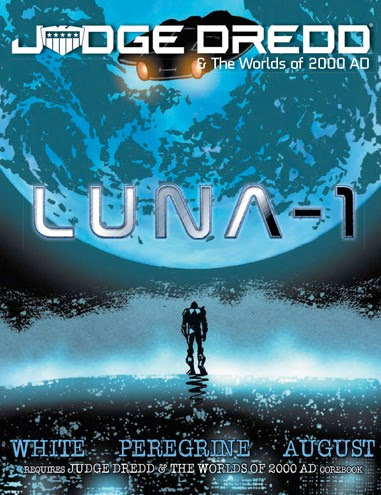
Luna-1 is a supplement for Judge Dredd and the Worlds of 2000 AD. Like The Robot Wars before it, it is as different a supplement as there has been for any of the four roleplaying games based on the Judge Dredd comic strip from the pages of 2000 AD, and that is all down to its focus. Traditionally, supplements for a Judge Dredd roleplaying game have concentrated on particular aspects of the setting—criminal organisations, crazes, psi-talents, block wars, and more—but Luna-1 focuses upon the one storyline, examining its episodes or Progs, and exploring their ramifications in detail. In Luna-1, this is the six months in which Judge Dredd is assigned to serve as Judge Marshall of Luna-1, a colony on Earth’s moon governed by judges from all three Mega-Cities. Told in Progs 42-59, this storyline thus takes Judge Dredd off Earth and onto the oxygen-short, crowded, and lawless and often wild frontier of the Moon. Here gangs and perps can escape the Mega-Cities to hide out and continue their criminal activities; corporations shorn of the scrutiny and regulations of Earth, build and hold more power and influence; resources are poor—especially oxygen, which needs to be paid for; even though they might hate each other, the Mega-Cities of North America and the Soviet East-Meg cities, will come together to participate in the Lunar Olympics; and criminal conspiracies work behind the scenes to take over the Moon! The supplement includes a Prog by Prog guide to the storyline with story hooks which the Game Master can develop as part of her campaign; descriptions of the Moon’s most notable locations and events, as well as what it like to both live and enforce the law there; new Exploits and Careers for Judges, Perps, and Civilians; an examination of a Moon-set campaign inspired by the ‘Luna-1’ storyline; stats and write ups for numerous NPCs; and more. 

LUNA-1 opens with a description of the Moon and a history of its settlement, including its important locations, such as the famous Armstrong Monument or Moonie’s Ranch, home to the reclusive corporate boss, C.W. Moonie, where he has ranchers raise genuine protein cake-fed, bio-engineered cattle on actual grass, their meat being highly prized by gourmets. The inhabitants of the Moon reside in domed settlements, ranging in size from urban sprawls to classic frontier towns. The maintenance of these domes is vital to everyone’s survival, as is a supply of oxygen, which of course, the inhabitants of the Moon have to pay for! The Oxygen Board has a monopoly on the supply. So it can be expensive! The Mega-Cities’ Justice Departments sometimes use Safe Houses on the Moon to keep witnesses safe. The Moon is also home to colonies from the other Mega-Cities beyond North America, including Shi-Shen Territories and Sov-Cities Territory, the closest they get to territories of the Mega-Cities. Locations important to the Moon, but back on Earth are detailed too, such as Moonray Tower and Temple of Lunar Light, a cult often described as being full of ‘loonies’. Events, like the Land Race—a race to grab new opened up territory, and the Lunar Olympiad are covered as well. They are all accompanied by adventure seeds.

In terms of mechanics, LUNA-1 provides numerous new options for Player Characters and NPCs of all types. New Judge Careers include Luna Judge, Zero Squad Judge (trained to work in zero gravity), Customs Judge, and more. STAR Judges or ‘Special Target Attack Retaliation’ Judges are drawn from all three North American Mega-Cities and their allies and assigned to police Earth’s off-world colonies, so the Player Characters could actually be a mixed group from various cities, not just Mega-City One. New Civilian Careers include Xenodiplomat, Corporate Executive, and Settler, whilst Perp ones include Luna Raider, Gunslinger, and Smuggler. They all include their own Exploits which can be gained by choosing them as Careers during character creation, and all provide interesting options for both Player Characters and NPCs. As expected, all of the characters from the ‘LUNA-1’ storyline are included in LUNA-1, from simple Badlands Gang Member and Futsie to Deputy Luna Marshal Tex, Judge Mex (complete with lasso for reigning in Perps), Elvis the Killer Car, and Judge Dredd himself. These can be used as is, if the Game Master wants to run the ‘LUNA-1’ storyline for her players and their characters, or simply used as inspiration for a campaign set on the Moon.

The campaign advice for the Game Master examines the how and the why of setting and running stories for Judge Dredd and the Worlds of 2000 AD. This should not just be because the setting itself is cool, but rather because there are particular types of stories which can be set there, which in this case might involve the Lunar Olympics or the looser regulations applied to corporations. It also highlights the differences between Mega-City One and the Moon—as well as colony frontiers, and how that will change game play. Smaller communities means fewer places to hide and everyone knows everyone’s business, including that of Perps, plus colonies like the Moon rely much more on technology for everyone’s survival. Only light synopsises are given for the fourteen Progs which make up the ‘LUNA-1’ storyline, more attention being paid to the whole storyline as a roleplaying campaign with a beginning, middle, and end. There is advice here on how to use Dredd, for it might be that the Player Character Judges are actually seconded to the unrelenting lawkeeper as his deputies.

The full adventure in LUNA-1 is ‘Sundance Rising’, an unashamed space western. It is set further on the frontier of the Moon in the isolated toon of Grey Rock. Inspired by the film High Noon, the town’s Judge, William Kane, is gunned down by the Sundance Gang, led by the vicious Preacher Jackson and the Judges are sent into restore order. The scenario and setting of Grey Rock is nicely detailed and there are notes too to run with Civilians as inhabitants of the town taking the law into their own hands and fighting back and also as Perps attempting to impress Preacher Jackson enough to become members of the Sundance Gang. Either way, this is a good scenario with lots going on that should provide multiple sessions of play.

LUNA-1 does not just cover Judge Dredd’s six-month secondment to the Moon, although that is its primary focus. That is told in Progs 42-59, but there were stories which took place between this and the events of ‘The Robot Wars’—as detailed in the supplement of the same name, and these are detailed in LUNA-1, again Prog by Prog. Each includes a synopsis, settings and locations, villains and bystanders, how the story can be used ‘Outside the Law’ (that is, used with Perp and Civilian Player Characters rather than Judges), and suggested further adventures. Some of these can be used as part of a Moon-set campaign, some not, but either way, the Game Master is given another eleven story hooks! Lastly, an appendix takes the Game Master—and potentially, her player’s characters to Titan. This includes a complete description and history of the penal colony where corrupt Judges are sentenced and again hooks and for the Game Master’s campaign.

Unlike ‘The Robot Wars’ storyline there is perhaps less satire and less social commentary in LUNA-1. Obviously, there is the rampant commercialism, but the Moon-set storyline is more of a means to tell stories away from Mega-City One and on the frontier in the style of the Wild West than anything else. The writing style has settled down a bit and there is more of the comic strip’s humour coming through than there was in The Robot Wars.

Physically, LUNA-1 is a slim, but nicely presented book. It is an engaging read and it is liberally illustrated with artwork from the ‘LUNA-1’ story and the other Progs it details in its pages. This is all black and white artwork and it is drawn from the very early issues of 2000 AD so there is certain quaintness to it since it dates from before the character of Judge Dredd evolved into the way he looks today.

Luna-1 picks up where The Robot Wars left off, continuing its fantastic approach to turning episodic source material into gameable content. The humour is stronger, even if the satire is not, but this is thoroughly excellent sourcebook on the ‘LUNA-1’ story, for the stories which can be told in and around it, and of course on the Moon (and other frontier settings) for Judge Dredd and the Worlds of 2000 AD (or in fact, any roleplaying game based on Judge Dredd).

—oOo—


En Publishing will be at UK Games Expo which takes place from Friday, June 3rd to Sunday, June 5th, 2022.

Sunday, 10 April 2022

Judge Dredd V

Just as we wave goodbye to one roleplaying based on the Judge Dredd comic strip from the pages of 2000 AD, En Publishing’s Judge Dredd and the Worlds of 2000 AD, we are surprised by the arrival of another—and this one is almost entirely different to all four of the Judge Dredd roleplaying games which have come before it. Announced at The Galaxy’s Greatest: 2000 AD at 45, the event to celebrate the long running comic’s sapphire anniversary, Dread: Dredd is a storytelling game rather than a traditional roleplaying game. Dread: Dredd is a storytelling game in which you do not take the roles of Judges enforcing the harsh laws of Mega-City One, but of those opposed to both the Judges and their strident legal enforcement. Previous roleplaying games based on Judge Dredd have presented options to play Perps and citizens rather than  Judges, but in Dread: Dredd players take the roles of activists and subversives campaigning for the restoration of democracy to Mega-City One. Dread: Dredd is a storytelling game with a physical component to its play requiring a Jenga Tower to play, and this is because it is based upon Dread, the roleplaying game of existential, psychological horror that was the Winner of the 2006 Gold ENNIE for Innovation.

Dread: Dredd is a one-shot storytelling game in which events of the scenario, ‘The Power of the Crowd’, are narrated and played out. In ‘The Power of the Crowd’, pro-democracy agitators have the direct chance to strike a blow for self-governance. They have gained possession of Walter, a former Justice Department droid and somewhat reluctant co-conspirator who has damaging information about the judges. This is information the public must hear. Working together, the democracy activists will ensure that the public hears it today at the opening game of the first Aeroball season in decades. This is such a big event that all of Mega-City One will be watching, and the judges will be unable to pre-emptively shutdown the broadcast for fear of citywide riots. It is the perfect opportunity. There is no better time like now, but there is one judge whose intervention will stop their efforts—Judge Dredd. He is inbound, there is forty-eight minutes until he arrives, and he is the law!

At the heart of Dread: Dredd—and the centre of the table—is the tower of blocks. In a standard game of Jenga this is stacked into one block, but in Dread: Dredd, it is divided into two. The taller of the two is the Justice Tower, the shorter the Liberty Tower. As the game proceeds, whenever a player wants his Democrat to undertake a task, he pulls out a block and adds it to the top of the tower it was pulled from. If he wants the action to be inspiring, dignified, go unnoticed, showy, done safely, or done quickly, he can pull out another block for each. If the block is removed and added to the top of the tower, he succeeds. However, if the player decides not to pull a block or begins to pull a block and then stops halfway through, the action fails. Worse, if the tower is knocked over as a result of the block being pulled, whether the Justice Tower or the Liberty Tower, the Democrat not only fails, but dies.

The Host—as the Game Master in Dread: Dredd is known—narrates the outcome of the pull of the block. If the attempt is a failure, especially if the tower falls and the Democrat dies, the Host has the scope for no little invention. If a Judge is present, then he executes the Democrat, if not, he dies in some other fashion. The setting of Judge Dredd is darkly satirical and the death of a Democrat should reflect that. When a tower falls, it is rebuilt and play continues. Even if a Democrat dies, he can continue to inspire his fellow subversives from beyond the Resyk Center (which also keeps a player in the game even if his Democrat is dead).

In Dread: Dredd, the players and their Democrats have three objectives. The first is get Walter the Wobot to spill the beans on-air before an audience of millions. The second is to build the Liberty Tower is taller than the Justice Tower. The third is to do both before the arrival of Judge Dredd.

The Democrats lose in Dread: Dredd and ‘The Power of the Crowd’ if they fail to achieve all three of their objectives before the arrival of Dredd. They also lose if they all die in the attempt, though as martyrs, they might inspire others to make an attempt to expose damaging information about the Judges.

Getting Walter the Wobot to reveal all is a storytelling objective and it is up to the Host to determine when exactly this happens. When a player pulls a block, it is added to the top of the tower it is pulled from, but the Democrats need to shift the blocks from the Justice Tower to the Liberty Tower to succeed and in this, they have several advantages in their elbow pads here. One is that they have Democratic and personal abilities that will help the players shift blocks. One is making their actions Inspiring and pulling out blocks and adding them to the Liberty Tower. Each Democratic has three abilities, a Dodge, Spend, and Stash ability, each different in flavour for the various Democrats. A Dodge ability enables a free pull, a Spend to use blocks from a player’s Reserve—each player begins with three—and place them on a tower, and Stash to store a newly pulled block in a player’s Reserve. Lastly, Dredd arrives in forty-eight minutes of game time, with every three minutes of actual time representing one of game time (so ‘The Power of the Crowd’ is actually intended to be played in two hours and twenty-four minutes), and the Host has a ‘Countdown And Encounter Track’ with which to tick off time and throw some challenges in the Democrats’ paths.

The five Democrats include ‘The Perp From The Judge’s Tree’, ‘The Psychic Celebrity With A Grudge’, ‘The Dilettante On A Mission’, ‘The Wheel-Ape’, and ‘The Gearhead With A Secret’. Each of the quintet includes their own Dodge, Spend, and Stash Abilities, and a set of questions about the Democrat’s background and subversively democratic actions. One issue here is that some of the Democrats do share the same questions. So they may not necessarily be quite as personal or individual as perhaps the designer intended.

For the Host, there is advice for running ‘The Power of the Crowd’ and Dread: Dredd, which is primarily to follow the players’ lead, how to handle the countdown, and roleplaying Walter the Wobot. There is a complete description of the Hellcat Memorial Stadium, inside and out (though no map), plus excerpts from 2000 AD depicting the Harlem Heroes and their power gear, Harlem Heroes Super Liner, and blueprints of Walter the Wobot to add extra detail and flavour.

Physically, Dread: Dredd is cleanly laid out, easy to read, and illustrated with a range of artwork taken from 2000 AD. This is drawn from all eras of the Judge Dredd comic strip as well as the Harlem Heroes, so it includes both black and white, and colour artwork, all crisply presented and showcasing just how good the artwork has been in the pages of 2000 AD over the course of forty-five years.

Dread: Dredd and ‘The Power of the Crowd’ works as both a one-shot and a convention scenario, though for the traditional four-hour slot for a convention, it does need extending in terms of time, and advice is included to that end. Dread: Dredd and ‘The Power of the Crowd’ provides a different perspective upon roleplaying in the world of Judge Dredd and the setting of Mega-City One, operating under the threat of arrest or even execution by the fascistic Judges, rather than being the bully boys handing out the justice. It makes for a tense, desperate situation, all exacerbated by the pulling blocks from the towers, which together gives Dread: Dredd a nervous physicality and a sense of Dredd/Dread.

Sunday, 27 February 2022

Strontium Dog III

In the year 2150, the Great Nuclear War wipes out 70% of Britain’s population and results in a huge increase of mutant births due to exposure to the nuclear fallout of strontium-90, the children typically afflicted with one or more physical deformities. As the number of mutant births grows, so does the adverse reaction to them until the prejudice against them is open and adverse, with politicians, in particular, Nelson Bunker Kreelman of New Britain and his anti-mutant police force known as the ‘Kreelers’, actively campaigning on an anti-mutant platform. The prejudice would grow to the point where the Mutants banded together and formed a Mutant Army that would lead a Mutant Uprising in 2167. Although the rebellion fails, Kreelman is forced to resign and the Kreelers disband and whilst they continue to face prejudice, there are no pogroms against them. Most either move into the segregated ghettos set up for them, such as the large settlement of Milton Keynes, or because their work and business opportunities are severely limited, leave Earth all together.

The surviving members of the Mutant Army are also forced to leave Earth. They are also given a pardon in return for their joining the Search/Destroy Agency as galactic bounty hunters, tasked with hunting down criminals and threats deemed too dangerous to be handled by ‘norms’. The combination of their mutations being the result of strontium-90 radiation and the distinctive ‘S/D’ (for ‘Search/Destroy’) badges they wear, means that they are nicknamed Strontium Dogs, and their orbital base the Doghouse. This is set-up for the Strontium Dog comic strip from the pages of 2000 AD, which tells the tales of one of the most famous S/D bounty hunters, Johnny Alpha, a former leader of the 2167 Mutant Uprising, including going back in time to collect a bounty on one Adolf Schicklegruber! The comic strip, which originally appeared in the pages of Starlord in 1978 before transferring to 2000 AD in 1980 ran until 2018 with the death of its artist, Carlos Ezquerra. It is also the basis for Strontium Dog, a roleplaying supplement for Judge Dredd & The Worlds of 2000 AD.

Strontium Dog, published by En Publishing, is not the first roleplaying treatment for Strontium Dog. Mongoose Publishing released a version using the Traveller mechanics, and before that, there was a version from Games Workshop based on Judge Dredd: The Role-Playing Game, but which was never published. In Strontium Dog for Judge Dredd & The Worlds of 2000 AD the players take the role of Mutant Search/Destroy Agents, collecting bounties on the scum of the universe, travelling in the cargo hold from system to system, and suffering prejudice against Mutants along way—and not just from Norms, but from other Muties too. This can be because the Muties are criminals or simply because they hate the idea of Muties acting against other Muties. And although Strontium Dog is all about bringing in the scum of universe—dead or alive—and sometimes of the scum of other dimensions and other time periods, it is also possible for the players to take the roles of the scum of the universe and play criminals rather than bounty hunters! This would use the rules for creating criminals from Judge Dredd & The Worlds of 2000 AD, which can also be used for potential Strontium Dog/Judge Dredd crossovers—just like the comic—as they share the same universe.

Strontium Dog leaps straight into creating a character for the setting, beginning with options for Species. These include Humans and Mutants as well as Gronks, the intrepidly cowardly aliens known for their timidity and medical skills, whilst the Mutants, there are tables for physical, cosmetic, and metabolic/metaphysical mutations. Thus it is possible to play a mutant with boils or warts, tentacles, a rubberised body, acidic blood, an ice-cold metabolism, shimmering skin, a rash of fake eyes, a face full of teeth, and more. All of these individualise a mutant and should suggest a possible nickname, not necessarily a serious one, in addition to their skills and exploits. An option is included for the selecting the cruel and identical Strix as a species, and there is a guide to including robots in the setting too (although they do not appear in the comic strip as bounty hunters). Outlaw and Civilian careers includes everything from the Animal Rights Activist, Anti-Mutant Enforcer, and Bandit to the Theme Park Staffer, Vis Presenter, and Xenodiplomat, whilst specific Mutant Careers include Mutant Cultist, Mutant Stalker, and Sideshow Freak. Many of these could be used in the Judge Dredd and other settings for Judge Dredd & The Worlds of 2000 AD. Less easily adapted are the S/D Careers, which cover both recruitment and actual careers with the agency. The former include Born to It, mentored by an Older Dog, and Score to Settle, whilst the path for every S/D Agent is the same from Rookie S/D Agent to Veteran S/D Agent, with a choice of Agent in Time, Dimensional Agent, and S/D Agent in between. These are accompanied by a choice of Exploits such as ‘Nux for All’, which causes extra damage when using Electronux, ‘Making a Name for Yourself’ which grants a bonus to REP (reputation) checks because the rookie is trying to make a name for himself, and ‘I’ve SEEN Things’ (in other dimensions) enables an S/S Agent to initially ignore the Afraid condition!

The life of an S/D Agent means collecting bounties and making, hopefully big, money, but it also means paying out too. A Mutant gets nothing for free, and that includes his equipment. Strontium Dog includes a lengthy list of guns, grenades, and gadgets. These start off with the ubiquitous Westinghouse Variable-Cartridge Blaster and the dreaded ‘Der Happy Sick’ Warhammer wielded by Johnny Alpha’s friend, Wulf Sternhammer, and go from there… Some of the devices and bombs are extremely powerful, such as Dimension Warp which opens up a rift to another dimension, the Pocket Nuke (Throwing) capable of levelling a city, the Time Drogue for rewinding time on a victim or target, interrogating them, and then letting them die a second time, and the Time Shrinker, which speeds up time for the target to the point of death and beyond. It is suggested that the Player Characters only have access to these as plot devices rather than being readily available, but in general, they will have access to a lot of the gear and guns presented—if they have the credits, but then so are the criminals!

For the Game Master, there is a lot of support in the pages of Strontium Dog. This begins with advice about setting the tone, which is very much that of a Sci-Fi Spaghetti Western with blasters, mutant powers, and heavy prejudice. The latter runs throughout the setting and the players will need to have a thick skin when playing a campaign set in this twenty-second century. That said, their characters are armed—often heavily armed—and they have a lot of agency. Similarly, this future is not one in which there is a lot of trust, not even with the Player Characters’ fellow Muties, especially if they are rival bounty hunters. The notes on describing the world of Strontium Dog are pleasingly evocative, and this is backed up with descriptions of typical locations and then the various locations visited by Johnny Alpha in the pages of the comic strip. Both are really quite detailed and give the Game Master plenty to work with when taking her Player Characters there. Plus, there is a timeline for Johnny Alpha and the comic strip running from 793 AD to the 37th Century.

Almost a fifth of Strontium Dog is devoted to a series of Bounty Contracts. There are six of these, which can either run standalone, but they really work as a full campaign—the ‘En System’ Campaign. The campaign begins on Weaver’s Rock with a bounty of the Wispa gang, who have gone from robbing cargo trucks to murder! The first bounty is fairly simple and once completed, there are plenty of hooks if the Game Master wants to expand the Player Characters’ time in the backwaters of Weaver’s World. The second bounty takes the Player Characters to the planet’s big settlement, Paradise City, where they can continue tracking down the remaining members of the Wispa gang. Besides the main bounty, the Game Master is given another list of bounties available in the city, but once on the main trail, they become involved in a big chase across the city skyline. The third takes a darker turn when on the trail of an assassin, the Player Characters are inadvertently diverted—or are they?—to another planet and probably the best pun in what is a campaign packed with puns as they have to assault the ‘Merlock of Firestop Mountain’! The final encounter turns up the gonzo and the Merlock theme for an underwater, shark-infested big fight. In the fourth part it quickly becomes clear that the authors are really big fans of Doctor Who as the names and references fly thick and fast when the Player Characters are tasked with tracking down the creator of a gas which quickly grows anyone who breathes it into a zombie! They accidentally get dumped into an alternate dimension in the fifth part after they have to deal with a Mutie who has been terrorising Gronks—there is a bonus if no Gronks die during the apprehension of this bounty, so good luck with that!—and then fight their way out of it in readiness for the final showdown in the last part of the campaign. As the Player Characters have bounced from one bounty to the next, it has become clear that someone has been monitoring their actions and there they learn that it has been much more than that—the real villain has been broadcasting them across the galaxy! Cue lots of television jokes and shenanigans which bring the campaign to an entertaining close.

The ‘En System’ Campaign is not just a lot of fun, but it is clear that the authors had a lot of fun writing it. The jokes are as silly and as groanworthy as you would expect and they should be, and both Game Master and her players will appreciate the campaign even more if they get them. The Strontium Dog supplement is rounded with a lengthy section of Allies and Enemies, including Johnny Alpha, Wulf Sternhammer, the Gronk, Durham Red, Middenface McNulty, and a whole cast of criminals. This is the only section where the black and white artwork from the comic strip’s early days is seen, which is a pity. However, it is the ‘En System’ Campaign which pulls everything together and gives a playing group something to get started with.

Physically, Strontium Dog is a bright and breezy affair, which lots colour artwork drawn from the comic strip. It needs a slight edit in places, but is an easy read otherwise.

Strontium Dog is an impressive supplement for Judge Dredd & The Worlds of 2000 AD that with the addition of the ‘En System’ Campaign the Strontium Dog feels complete and succinct. It gives the Game Master and her players everything necessary to play an entertainingly gonzo, over the top game of hunting bounty on the scum of the universe and more!