Every Week It's Wibbley-Wobbley Timey-Wimey Pookie-Reviewery...
Showing posts with label Days of Wonder. Show all posts

Friday, 13 March 2026

Peninsular Peregrinations

Since 2007, the 2004 Spiel des Jahres award-winning board game Ticket to Ride from Days of Wonder, has been supported with new maps, beginning with Ticket to Ride: Switzerland. That new map would be collected in the Ticket to Ride Map Collection: Volume 2 – India & Switzerland, the second entry in the Map Collection series begun in Ticket to Ride Map Collection: Volume 1 – Team Asia & Legendary Asia. Both of these have proved to be worthy additions to the Ticket to Ride line, whereas Ticket to Ride Map Collection vol. 3: The Heart of Africa and Ticket to Ride Map Collection: Volume 4 – Nederland have proved to add more challenging game play, but at a cost in terms of engaging game play. Further given that they included just the one map in the third and fourth volumes rather than the two in each of the first two, neither felt as if they provided as much value either. Fortunately, Ticket to Ride Map Collection Vol. 5: United Kingdom + Pennsylvania came with two maps and explored elements more commonly found in traditional train games—stocks and shares in railroad companies and the advance of railway technology. This was followed by Ticket to Ride Map Collection Vol. 6: France + Old West, which provided two maps exploring a common theme—telegraphing each player’s intended placement of their trains; then by Ticket to Ride Map Collection Vol. 6½: Poland, which focused on borders and connecting them; and lastly, by Ticket to Ride Map Collection Vol. 7: Japan + Italy which examines two ways in which long routes affect game play. Thematically, the next entry in the series is connected by peninsulas.

Ticket to Ride Map Collection 8: Iberia + South Korea gives the Ticket to Ride fan with another Asian map and another European map, both of them depicting peninsulas and offering two new, and quite different ways to play Ticket to Ride. The standard game play remains—draw Destination Tickets and attempt to connect them via various routes between cities using sets of Train Cards that match the route colour, scoring points for both claiming routes completing the Destination Tickets. On each turn a player can still draw two Train Car Cards, either from those face up or from the deck, play Train Car Cards to claim a route, or draw new Destination Tickets. Or not, because in this expansion, there are limits placed upon when a player can draw Destination Tickets, and this is not the only way in which Ticket to Ride Map Collection 8: Iberia + South Korea differs from either the base game for Ticket to Ride or other map sets.

Of course, Ticket to Ride Map Collection 8: Iberia + South Korea requires the base game for its train pieces and scoring tokens, and both of its maps are designed to be played by between two and five players. The Iberia map includes one-hundred-and-ten Train Car Cards, fifty-four Festival Cards, a Ticket Draft Card, and fifty Destination Ticket Cards. The map itself depicts the Iberian Peninsula, primarily Spain and Portugal, but routes over the Pyrenees into southwestern France and ferry routes across the western Mediterranean to Palma, capital of the Spanish island of Mallorca. There is nothing radical or different about the map. Rather, the game play is different. This begins with the set-up. After the standard number of Train Car Cards are dealt to the players, the fifty-four Festival Cards are shuffled into the deck of Train Car Cards and the Ticket Draft Card is inserted into the combined deck. The players are dealt a total of Destination Ticket Cards. Instead of deciding to keep several of them and discard the rest, each player drafts on passes the remaining Destination Ticket Cards to the player on his left. This is done until each player has six Destination Ticket Cards, at which point, he can chose to discard two. This will mean that a player will get to see most of the Destination Ticket Cards that the other players have rejected and have some idea as what they have kept. There is the luck of the draw in drawing Destination Ticket Cards in any version of Ticket to Ride, but this draft mechanic randomises the draw even further, and it makes it difficult for a player to tailor his Destination Ticket Cards so that they fall along similar routes. Yet, Ticket to Ride Map Collection 8: Iberia + South Korea adds an extra twist to this.

When the Ticket Draft Card is drawn from the deck of Train Car Cards, a second draft takes exactly like the first, but going in the opposite direction. This has a player draft six new Destination Ticket Cards and keep four. It forces a player to consider eight new destinations that he has to connect and again they may not fall along similar routes. It also forces a player to marshal his train pieces since he knows will need some in the latter half of the game to complete the new Destination Ticket Cards. This also has another effect, which is to prevent a player from claiming as many routes as he can to speed up the end of the game. Up until this point, the players have not been allowed to draw new Destination Ticket Cards, but the other effect of the Ticket Draft Card is that now they can. However, with eight Destination Ticket Cards in hand, there is going to be less diving for new Destination Ticket Cards in the hope of scoring big.

The other means of scoring that Ticket to Ride Map Collection 8: Iberia + South Korea adds is Festival Cards. When drawn from the Train Car Card deck, a Festival Card is placed on the edge of the board nearest to the Festival City mentioned on the Festival Card. Many of the cities have multiple associated Festival Cards and when drawn these placed in a stack. When player claims a Route that connects to a Festival City, he can take all of the available Festival Cards for that city. At the end of the game, a player scores points for each set of Festival Cards he has for each city. This is a set collection mechanic similar to the railroad shares for the Pennsylvania map from Ticket to Ride Map Collection Vol. 5: United Kingdom + Pennsylvania.

Of the two new mechanics in Ticket to Ride Map Collection 8: Iberia + South Korea, for the Iberia map, the draft mechanic and the Ticket Draft Card are better than the Festival Cards mechanic. The draft mechanic alters some of the fundamentals of play and forces a player to think in the long term, husbanding his train pieces as important resources not knowing how many he will need towards the end of the game, and knowing that at some point the scoring opportunities are going to get more complicated. The Festival Cards does offer extra scoring opportunities that are easier because a player can claim routes even if they are not on any of his Destination Ticket Cards, but is just a bit busy and adds clutter around the edges of what is a large board.

The South Korea map is noticeably different and has a direct effect on play. This is because instead of the route colours being distributed across the map, they are clumped together in zones. There are a few grey routes as you would expect, but otherwise, all of the red routes are together in a zone, all of the blue routes are together in a zone, and so on. This has an immediate effect upon drawing Train Car Cards, because no matter what colour Train Car Cards a player draws, he is signalling which zone he wants to claim a route in.

In addition to the new map, the South Korea expansion includes fifteen Express Train Cards, forty-four Destination Ticket Cars, a Province Mat, and a province Scoring Card. The first rule that the South Korea expansion adds is the same draft mechanic in the Iberia map, but not the Ticket Draft Card. The second is for the Express Train Cards. Each player is given three of these, marked ‘+1’, ‘+2’, and ‘+3’. Each can be used once per game to either increase the number of Destination Ticket Cards a player can draw or the number of Train Car Cards a player can draw. This will give a player a one-time boost when each is played.

A player has another action that he can do after claiming a route. This is to place an extra train car on the Province Board. The Province Board is marked with several lines matching the colours of the Train Car Card and numbered from one to eight. The Train Car must be placed on both the line corresponding to the colour of the route just claimed and on the number equal to the length of the route just claimed. A player can also expend extra Train Car Cards to claim a higher number. If that number has already been claimed, the Train Car is placed on next free number of a lower value instead. An Express Train Card can also be expended to claim a higher number. At the end of the game, each player totals the combined value for the numbers claimed on each line and is awarded points according to their rank.

The South Korea map is a simpler, more direct map than Iberia. It rewards faster, more efficient play because the competition to claim routes is more open. Players telegraph to each other the zones where they want to claim routes when they draw Train Car Cards of a particular colour and so the race to claim routes within a zone can become tighter. Similarly, there is a race to claim routes because having done so, a player can claim numbers on the Province Mat that will contribute towards their final score. The Express Train Cards do give players a one-off advantage each time they are used, so should not be wasted. Overall, the South Korea map is much more competitive in comparison to many other Ticket to Ride Maps.

In addition, both maps offer something to the wider Ticket to Ride family. The drafting mechanics from the Iberia map could be used with other maps as could the Province Mat from the South Korea map. The drafting mechanic would have a greater effect upon play since it counters common game play elements such as collecting Destination Ticket Cards with roughly the same routes, playing Train Cars in order to speed up the end of the game, and drawing Destination Ticket Cards late in the game to score extra points along already claimed routes. Certainly, it would be interesting to see these rules implemented elsewhere and their effects examined, perhaps in a book dedicated to new rules for Ticket to Ride?

Physically, as you would expect, the production values for Ticket to Ride Map Collection 8: Iberia + South Korea are excellent. Everything is of a high quality and both looks good and feels good in the hand. The only item that could have been a better quality is the Province Mat, which is on card and not mounted. It is a pity that there is not room on the South Korea map for it either.

Given that Ticket to Ride Map Collection 8: Iberia + South Korea changes the way in which Ticket to Ride is played—the Iberia map in particular with the far reaching, even structural effects of the drafting rules—this is not an expansion for the casual player of Ticket to Ride. Rather it is for the fan of the game who wants to be challenged in new ways and the board game player who wants to be challenged more than the standard play of Ticket to Ride offers. Of the two maps, the Iberia map is the better, but the South Korea map is still good. Ticket to Ride Map Collection 8: Iberia + South Korea continues to offer new ways to play a tried and tested, even venerable format.

Friday, 5 April 2024

Tabulating the Tricolour

The very latest entry in the Ticket to Ride franchise is Ticket to Ride: Paris. Like those other Ticket to Ride games, it is another card-drawing, route-claiming board game based around transport links and like those other Ticket to Ride games, it uses the same mechanics. Thus the players will draw Transportation cards and then use them to claim Routes and by claiming Routes, link the two locations marked on Destination Tickets, the aim being to gain as many points as possible by claiming Routes and completing Destination Tickets, whilst avoiding losing by failing to complete Destination Tickets. Yet rather than being another big box game like the original Ticket to Ride, Ticket to Ride: Europe, or Ticket to Ride: Nordic Countries, it takes its cue from Ticket to Ride: New York, Ticket to Ride: London, Ticket to Ride: Amsterdam, Ticket to Ride: San Francisco, and Ticket to Ride: Berlin. Part of the ‘City’ series for Ticket to Ride, it is thus a smaller game designed for fewer players with a shorter playing time, a game based around a city rather than a country or a continent. The entries in the series are also notably different in terms of theme and period.

Published by Days of Wonder and designed for play by two to four players, aged eight and up, Ticket to Ride: Paris is easy to learn, can be played out of the box in five minutes, and played through in less than twenty minutes. As with the other entries in the Ticket to Ride ‘City’ series, Ticket to Ride: Paris sees the players race across the city attempting to connect its various tourist hotspots. All of entries in the ‘City’ series are both set in their respective period times and have a theme representative of their city. Thus, Ticket to Ride: New York had the players racing across Manhattan in the nineteen fifties via taxis; Ticket to Ride: London had the players racing across London in the nineteen sixties aboard the classic double-decker buses; Ticket to Ride: Amsterdam took the series back to the seventeenth century and had the players fulfilling Contracts by delivering goods across the Dutch port by horse and cart and claiming Merchandise Bonus if they take the right route; Ticket to Ride: San Francisco continued the lack of trains in the series by having the players travel around ‘The City by the Bay’ aboard its icon form of transportation—the cable car and in Ticket to Ride: Berlin, the series goes across the ‘Grey City’, either by the trams that crisscross the city or the underground which encircles it—or both! And all in the nineteen sixties. Ticket to Ride: Paris takes the players back to the ‘City of Lights’ during the Roaring Twenties, along the Avenue des Champs-Élysées after a visit to Le Louvre to the Arc de Triomphe de l’Étoile and the Tour Eiffel—and they can find the Tricolour, they will be able to celebrate Fête nationale française, or Bastille Day.

Inside the small box can be found a small rectangular board which depicts the centre of Paris, from Père Lachaise Cemetery in the east to the Arc de Triomphe de l’Étoile and the Tour Eiffel in the west, and from Montmartre in the north to Montparnasse in the south.In between are numerous routes, none of them, notably, longer than three sections long. This means that a player will score no more than four points per route claimed. The scoring track, from zero to forty-nine, runs around the edge of the board and overall, the board has an art deco feel to it. Besides the board map, the box contains sixty Buses, fifteen in each colour—red, blue, white, and green, forty-six Transportation cards, twenty Destination Ticket cards, four Scoring Markers, and the rules leaflet. The Bus pieces are nicely sculpted and
come in the standard colours for Ticket to Ride, but are illustrated with a different form of transport for each colour. So black is illustrated with a motor car, white with a river cruise boat (presumably along the Seine), yellow with a tram, purple with a delivery van, orange with a Métro carriage, and the wild card with a bus. This really makes the cards stand out and easier to view for anyone who suffers from colour blindness and the range of transport options give the game a greener feel. Similarly, the Destination Tickets are bright, colourful, and easy to read. Most score either four, five, or six points upon completion and the most that any one card will score is eight points. As expected, the rules leaflet is clearly written, easy to understand, and the opening pages show how to set up the game. It can be read through in mere minutes and play started all but immediately.

Play in
Ticket to Ride: Paris is the same as standard Ticket to Ride. Each player starts the game with some Destination Tickets and some Transportation cards. On his turn, a player can take one of three actions. Either draw two Transportation cards; draw two Destination Tickets and either keep one or two, but must keep one; or claim a route between two connected Locations. To claim a route, a player must expend a number of cards equal to its length, either matching the colour of the route or a mix of matching colour cards and the multi-coloured cards, which essentially act as wild cards. Unlike many Ticket to Ride variants, the map for Ticket to Ride: Paris has no black routes and more importantly, it has no grey routes, which means that Transportation cards in the correct colour or wildcards, or a combination of the two, have to be played to claim any route.

The other difference between Ticket to Ride: Paris and other Ticket to Ride variants is that it introduces a new means of scoring points, a distinctly French means of scoring points. When a player claims a red, white, or blue Route, he can keep one of the Transportation cards that he played, except if the card played was a multi-coloured wild card or he already has a Transportation card of that colour. The Transportation card kept is placed in front of the player, face up. At the end of a player’s turn, if he has one red, one white, and one blue Transportation card in front of him, he has created the Tricolour and can celebrate Bastille Day. This scores him four points. All three cards are discarded and the player can start claiming red, white, or blue routes on subsequent turns.

However, the number of red, white, and blue routes are not equal. There are eleven white, twelve blue, and thirteen red. Both the red and the blue routes are one space in length, whilst the white routes are two spaces long. So, the former are going to be easier to claim than the latter, and white Transportation cards are a more important resource than the other colours because there are fewer routes of their colour. That said, Ticket to Ride: Paris cannot simply be won by creating the Tricolour again and again. Essentially, celebrating Bastille Day and scoring points in this way is a bonus.

Physically, Ticket to Ride: Paris is very nicely produced. Everything is produced to the high standard you would expect for a Ticket to Ride game.

As with other entries in the
‘City’ series for Ticket to Ride series, Ticket to Ride: Paris offers all of the play of Ticket to Ride in a smaller, faster playing version, that is easy to learn and easy to transport. This is one of the easiest entries in the ‘City’ series to learn and play, with the Tricolour scoring mechanic similarly being one of the easiest to learn and play. Plus it does not require any other components, such as extra tokens or multiple types of playing pieces. Of course, along with the world famous locations on the map board, the Tricolour scoring mechanic are what enforce the Parisian and the French theme of Ticket to Ride: Paris. Overall, Ticket to Ride: Paris has a Gallic simplicity that makes it a decent introduction to the ‘City’ series for Ticket to Ride and Ticket to Ride in general.

Friday, 22 September 2023

Grey City Ride

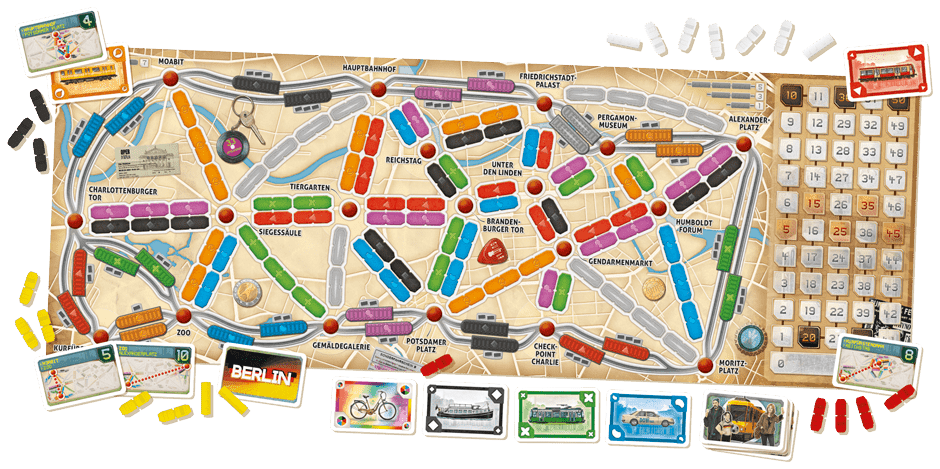
The very latest entry in the Ticket to Ride franchise is Ticket to Ride: Berlin. Like those other Ticket to Ride games, it is another card-drawing, route-claiming board game based around transport links and like those other Ticket to Ride games, it uses the same mechanics. Thus the players will draw Transportation cards and then use them to claim Routes and by claiming Routes, link the two locations marked on Destination Tickets, the aim being to gain as many points as possible by claiming Routes and completing Destination Tickets, whilst avoiding losing by failing to complete Destination Tickets. Yet rather than being another big box game like the original Ticket to Ride, Ticket to Ride: Europe, or Ticket to Ride: Nordic Countries, it takes its cue from Ticket to Ride: New York, Ticket to Ride: London, Ticket to Ride: Amsterdam, and Ticket to Ride: San Francisco. Part of the ‘City’ series for Ticket to Ride, it is thus a smaller game designed for fewer players with a shorter playing time, a game based around a city rather than a country or a continent. The entries in the series are also notably different in terms of theme and period.

Published by Days of Wonder and designed for play by two to four players, aged eight and up, Ticket to Ride: Berlin is easy to learn, can be played out of the box in five minutes, and played through in less than twenty minutes. As with the other entries in the Ticket to Ride ‘City’ series, Ticket to Ride: Berlin sees the players race across the city attempting to connect its various tourist hotspots. All of entries in the ‘City’ series are both set in their respective cities and have a theme representative of their city. Thus, Ticket to Ride: New York had the players racing across Manhattan in the nineteen fifties via taxis; Ticket to Ride: London had the players racing across London in the nineteen sixties aboard the classic double-decker buses; Ticket to Ride: Amsterdam took the series back to the seventeenth century and had the players fulfilling Contracts by delivering goods across the Dutch port by horse and cart and claiming Merchandise Bonus if they take the right route; and Ticket to Ride: San Francisco continued the lack of trains in the series by having the players travel around ‘The City by the Bay’ aboard its icon form of transportation—the cable car! In Ticket to Ride: Berlin, the players can travel from the Teirgarten to Check-Point Charlie, from Charlottenburger Tor to Alexander-Platzfrom, from the Reichstag to the Zoo, either by the trams that crisscross the city or the underground which encircles it—or both!

Inside the small box can be found a small rectangular board which depicts the centre of Berlin, from Moabit, Charlottenburger Tor, and Kurfüstendamm in the west to Alexander-platz, Humbodt Forum, and Morotz-Platz in the east. The board has a scoring track at its eastern end, running from one to fifty, instead of being placed around the edge. There are Streetcar and Subway Car pieces in four colours
(as opposed to the trains of standard Ticket to Ride), the Transportation cards drawn and used to claim routes between destinations, and the Destination Tickets indicating which two Destinations need to be connected to be completed. Both the Streetcar and the Subway Car pieces are nicely sculpted, the Streetcar pieces having a more rounded feel, as opposed to the square, more train-like Subway Car pieces. Each player begins play with eleven Streetcar pieces and five Subway Car pieces. The Transportation cards come in the standard colours for Ticket to Ride, but are illustrated with a different form of transport for each colour. So black is illustrated with a river cruise boat, blue with a taxi, green with a streetcar, purple with a bus, red with a train, orange with a subway car, and the wild card with a bicycle. This really makes the cards stand out and easier to view for anyone who suffers from colour blindness and the range of transport options give the game a greener feel. Similarly, the Destination Tickets are bright, colourful, and easy to read. As expected, the rules leaflet is clearly written, easy to understand, and the opening pages show how to set up the game. It can be read through in mere minutes and play started all but immediately.

In comparison to the boards in the other entries in the ‘City’ series, the one in Ticket to Ride: Berlin is more functional than attractive. The various routes are laid out in strong colours over a light tan streetmap of the city. It is not an unattractive board, but there is an austerity to it. Most routes are one, two, or three spaces in length, though there are three routes four spaces long, all of them grey in colour meaning that any colour can be used to claim them. The major difference with the board is that is that it is ringed by an underground system. Each only has space for one Subway Car piece, but the number of dots alongside the single space indicate the number of Transportation cards which have to be played to claim that route. These are either one, two or three Transportation cards. The board has two Route Scoring Tables, one for claiming the Streetcar routes and one for the Subway routes. In general, a player will score more points for claiming a Subway route than a Streetcar route. However, a player only has five Subway Car pieces to place as opposed to eleven Streetcar pieces.

Play in
Ticket to Ride: Berlin is the same as standard Ticket to Ride. Each player starts the game with some Destination Tickets and some Transportation cards. On his turn, a player can take one of three actions. Either draw two Transportation cards; draw two Destination Tickets and either keep one or two, but must keep one; or claim a route between two connected Locations. To claim a route, a player must expend a number of cards equal to its length, either matching the colour of the route or a mix of matching colour cards and the multi-coloured cards, which essentially act as wild cards. Some routes are marked in grey and so can use any set of colours or multi-coloured cards. If the route is a Streetcar route, the player places a number of Streetcar pieces on it equal to its length. If it is subway route, he places just the single Subway Car piece on it, though he still has to expend the indicated number of Transportation cards.

In fact, Ticket to Ride: Berlin feels so much like standard Ticket to Ride that it is not immediately obvious what makes it different from either standard Ticket to Ride or the other entries in the ‘City’ series, each of which has a strong theme and an extra mechanic. For example, in Ticket to Ride: San Francisco, the players also collect Tourist Tokens. In Ticket to Ride: Berlin, the difference is the subway network which rings the city. A player only has five Subway car pieces to place, so they are a limited resource, but when played, they tend to score more points and they tend to connect routes that are harder to connect via the Streetcar pieces. Most Destinations in the centre of the board lie just a single route’s length from the beginning and end of a Subway route. Thus, for the longer Destination Tickets, a player will likely be wanting to claim the Subway routes to get around the board, whilst claiming routes into the city using the Streetcar pieces. It is an underplayed difference in comparison to titles in the ‘City’ series and to Ticket to Ride in general.

What Ticket to Ride: Berlin is reminiscent of is the Ticket to Ride Map Collection Vol. 7: Japan + Italy and its Japan map. This introduced the ‘Bullet Train’ route, which when claimed using the indicated number of Transportation cards, only used a single Bullet Train piece to indicate that it had been claimed. The Subway routes in
Ticket to Ride: Berlin work in a similar fashion, although unlike on the Japan map, they are not shared by all of the players and nobody is penalised for not building any Subway routes.

Physically, Ticket to Ride: Berlin is very nicely produced. Everything is produced to the high standard you would expect for a Ticket to Ride game.

Like Ticket to Ride: New York, Ticket to Ride: London, Ticket to Ride: Amsterdam, and Ticket to Ride: San Francisco, what Ticket to Ride: Berlin offers is all of the play of Ticket to Ride in a smaller, faster playing version, that is easy to learn and easy to transport. The balance in the game lies between claiming two different types of route, one that feels faster and goes further, as well as scoring more when claimed, but the player is limited to claiming five of this type in total, the other shorter, more flexible, with more pieces to put down and claim routes, but not scoring quite as much. This is more demanding than the other ‘City’ series titles and in combination with the fact that Ticket to Ride: Berlin is not as strongly thematic as the rest of the ‘City’ series, the result is that Ticket to Ride: Berlin feels austere in comparison. Of course, Ticket to Ride: Berlin still offers the same quick, competitive play of Ticket to Ride, but loses theme in favour of slightly more thoughtful play.

Sunday, 1 January 2023

Reviews from R’lyeh Post-Christmas Dozen 2022

Since 2001, Reviews from R’lyeh have contributed to a series of Christmas lists at Ogrecave.com—and at RPGaction.com before that, suggesting not necessarily the best board and roleplaying games of the preceding year, but the titles from the last twelve months that you might like to receive and give. Continuing the break with tradition—in that the following is just the one list and in that for reasons beyond its control, OgreCave.com is not running its own lists—Reviews from R’lyeh would once again like present its own list. Further, as is also traditional, Reviews from R’lyeh has not devolved into the need to cast about ‘Baleful Blandishments’ to all concerned or otherwise based upon the arbitrary organisation of days. So as Reviews from R’lyeh presents its annual (Post-)Christmas Dozen, I can only hope that the following list includes one of your favourites, or even better still, includes a game that you did not have and someone was happy to hide in gaudy paper and place under that dead tree for you. If not, then this is a list of what would have been good under that tree and what you should purchase yourself to read and play in the months to come.

—oOo—

Dice Men: The Origin Story of Games Workshop
Unbound ($40/£30)
Written by Sir Ian Livingstone with Steve Jackson, Dice Men is not a history of Games Workshop, but rather a memoir of its founding and first decade or so by the founders of the company, whose dedication and hard work would propel the both of them and the company to the forefront of the gaming hobby in the United Kingdom. The company went from producing wooden puzzles and games and importing the first copies of Dungeons & Dragons direct from E. Gary Gygax to a licensee for numerous roleplaying games, including Call of Cthulhu, MERP, and Stormbringer, and publishing its own titles such as Golden Heroes and Judge Dredd the Roleplaying Game—plus of course, Warhammer Fantasy Roleplay. The authors have delved deep into their archives and their memories to bring forth a fantastic array of photographs and treasures, and thus the book is a lavishly illustrated coffee table book that will bring back memories of a certain age.

Frontier Scum: A Game About Wanted Outlaws Making Their Mark on a Lost Frontier
Games Omnivorous ($25/£19.99)
This Old School Renaissance-style roleplaying game takes criminals to the Lost Frontier, an Acid West hallucination of the Wild West, in which the Player Characters must survive the weirdness, uncertainty, and loss, all of which infuses the landscape and its promise of renewal subverted by avarice and ambition. The Player Characters are desperate outlaws, at best searching for redemption, at worst trying to survive in what is a deadly game—especially gunfights. Fortunately, every Player Character can survive at least one gunshot by having his hat shot off! The roleplaying game includes the full rules and a setting, more enough for a mini-campaign. The Frontier Scum book itself is brilliantly done as a plain matte board book and a spine with no cover that makes the glue visible. The layout inside is thematically done as a Sears, Roebuck and Co. catalogue, which is absolutely perfect for the look and feel for Frontier Scum. This is a startlingly different version of the Wild West and Frontier Scum brilliantly brings it alive!

Regency Cthulhu: Dark Designs in Jane Austen’s England
Chaosium, Inc. ($44.99/£39.99)
Regency Cthulhu takes Call of Cthulhu into the late Georgian period and an age of manners and propriety when everyone—including the Investigators—is expected to conform to societal norms, and woe betide to anyone who does not, including those prepared to investigate the Mythos and cosmic horror. The supplement provides a good introduction to the period and a guide to playing good gentlemen and good gentlewomen, including rules for new Occupations, place in society, and Reputation, the latter actually working as the equivalent of Social Sanity! It supports this with a complete setting in the form of a rural Wiltshire town with lots of secrets and two good scenarios set in and around the town, which invite the Investigators to various social events and then hint at strange things going on in and round the town. Both setting and rules highlight the tension between a highly conservative and stratified society and the need to investigate the Mythos and the consequences of doing so, all of which serves to bring out the Regency period’s roleplaying and storytelling potential.

The Electrum Archive Issue #1
Emiel Boven & CULT OF THE LIZARD KING ($26/£20)
The Electrum Archive Issue #1 introduces us to the Science Fantasy world of Orn where the descendants of survivors transplanted by the ancient starfaring civilisation known as the Elders (who have long since disappeared) survive and explore the Elder ships which crashed to the surface and buried themselves in the surface of the planet long ago. The Player Characters—Fixers, Vagabonds, and Warlocks—search the wilderness for signs of Elder technology and Elder Ink. As Elder Drops, Elder Ink is a currency, but when vaporised and inhaled by Warlocks, it expands the mind and enables users to enter the Realm Beyond and cast spells known by the Spell Spirits. And the spells themselves are entirely random in their name and effect, so every Warlock’s spells will be different. The Electrum Archive Issue #1 comes with lots of flavour and detail, and includes six detailed regions complete with the plot hooks and events that will keep a gaming group busy for multiple sessions. The Electrum Archive Issue #01 is a great introduction to what is a weirdly inky, baroque, and alien planetary romance.

Heat: Pedal to the Metal
Days of Wonder ($80/£60)
From the designers of Flamme Rouge, the board game of cycling ‘Grand Tours’, Heat: Pedal to the Metal is a board game of tense car races in which drivers jockey for position, manage their car’s speed and energy, requiring careful hand management of movement cards to ensure they can keep ahead of the pack and if not that, then at least, keep up. The base game is fast and furious, with a real sense of speed as the cars career around corners and accelerate onto the straights, but expansions and advanced rules add weather, road conditions, and events, which can make even a single race more challenging, let alone a whole championship. Designed for solo play or up to six players, Heat: Pedal to the Metal can be played by the family, but the expansions will appeal to petrolheads and board gamers alike as it lets the players race like it was in the sixties!

The One Ring: Roleplaying in the World of Lord of the Rings
Free League Publishing ($49.99/£45)
The new edition of The One Ring moves the highly-regarded roleplaying game set in Tolkien’s Middle-earth two decades on and the focus from Rhovanion, the region to the East of the Misty Mountains, to Eriador, the region to the West of the Misty Mountains. The One Ring Starter Set began with The Shire, but the new rulebook explores far and wide beyond its borders as well as tidying and streamlining the mechanics. The Player Characters step out into the wilderness to find adventure and perhaps curb the influence of the Shadow which threatens to sow chaos and undermine society as its forces search for signs of the One Ring. This has all been redesigned in a style and look that echoes that of the classic editions of The Lord of the Rings trilogy published by Allen & Unwin, and has a more scholarly feel as if Bilbo himself sat down to write it himself.

Everybody Wins: Four Decades of the Greatest Board Games Ever Made
Aconyte Books ($29.95/£24.95)
Board games have come a very long way in the last quarter of a century, but as authors James Wallis and Sir Ian Livingstone explored in Board Games in 100 Moves, their history goes much further back than that. Now James Wallis returns to explore the history of board games from a different angle—through the boxes, boards, cards, and meeples of the annual Spiel des Jahres winners in Everybody Wins: Four Decades of the Greatest Board Games Ever Made. This is a history of some of the best games ever published—as well as some of the near misses—that tracks the massive rise in popularity of the board game as well as the themes, the changes in design, and trends in the hobby in that time. This is a great read for anyone who loves board games and wants to know more about them and the genesis of the hobby. Beautifully illustrated with many titles from the author’s own collection and engagingly written, this is the history book that board gamers will want on their shelves.

Gran Meccanismo: Clockpunk Roleplaying in da Vinci’s Florence
Osprey Games (£25/$35)
What if by 1510, Niccolò Machiavelli, the military commissioner of the Republic of Florence, had persuaded Leonardo da Vinci to stick to engineering rather than painting? What use could the genius’ designs have been put to in the defence of the republic? Now armed with primitive computers run on water clocks, spring-powered tanks capable of withstanding any cavalry charge, their canons blasting way left and right, and gliders flit across the perfectly blue Tuscan skies delivering messages, intelligence, and reports of troop movements to the city and her military commanders. The Republic of Florence is once again a growing power, but her neighbours are jealous of the new technology and the question is, just how much information is being controlled and compute by the calculating devices. Gran Meccanismo is a Clockpunk roleplaying game of intrigue, invention, and war—no surprise since the Player Characters might find themselves crossing wits with Machiavelli, avoiding the charms of Lucretia Borgia, and entering into philosophical discussions with da Vinci himself! Gran Meccanismo: Clockpunk Roleplaying in da Vinci’s Florence combines fast-playing, easy to grasp rules with a setting that not only can genuinely be called unique, but one to which your first response should be, “That’s a cool idea!”

Bones Deep
Technical Grimoire Games ($30/£30)
Bones Deep begins with a genuinely weird premise—that after you die your skeleton hatches from your corpse and goes in search of a near life and to find itself as far away as possible, on the sea floor. Literally, ‘bones deep’. Together the skeletons explore the strange, often lightless realms of the sea floor, armed with a few skills, a little magic, and a desire to both own and create some memories of their own. Bones Deep is packed full with a briny bestiary and descriptions of some twenty locations, including ‘The Bottom of the Barrel’, a meeting place for undersea creatures specially constructed with an air half and a water half so that crabs, fish, wizards, witches, skeletons, and any other creatures can meet in safety, stories, and more. This is a fantastic undersea sand crawl which uses the simple mechanics of Troika!, but takes into account the very different physics of the bottom of the ocean. 

Judge Dredd: The Game of Crime-Fighting in Mega-City One
Rebellion Unplugged (£40)
Remember the good old days when you could arrest Judge Death for the crime of Littering? It was possible in the classic Judge Dredd board game designed by Ian Livingstone and published by Games Workshop in 1982. Rebellion Unplugged brought this fondly remembered game back in 2022 allowing players to return to the streets of Mega-City One and bring the law to its 800 million citizens. Their task is to respond to crimes and their perpetrators, making arrests, and proving themselves to be the most productive Judge—and so win the win. The original game involved lots of luck and plenty of intervention by the other players in an attempt to stop a player and his Judge from arresting high value criminals and crimes. The original game has bags of theme, but its high luck and high player intervention make it very much an Ameritrash design. The new edition—some forty years on since the release of the original—keeps the same game play, but adds extra rules which bring more detail and depth to game, including Specialist Judges such as Cadets, Special Judge Squad, PSI-Judge, and more. The result is that players can play the game like they remember or use the new rules for a new experience. Either way, Judge Dredd: The Game of Crime-Fighting in Mega-City One is a light, highly thematic, and most of all, fun board game that fans of the iconic law man of the future will thoroughly enjoy.

Slaying the Dragon: A Secret History of Dungeons & Dragons
St. Martin’s Griffin ($29.95/£22.99)
If one of the most interesting histories of roleplaying and TSR, Inc. in particular, was 2021’s The Game Wizards by Jon Peterson, then arguably its counterpart and equal was 2022’s Slaying the Dragon by Ben Riggs. The Game Wizards charted the first half of the TSR, Inc.’s history and Slaying the Dragon explored the second half from the ousting of E. Gary Gygax and takeover by Lorraine Williams through to the company’s purchase by Wizards of the Coast. It is a fascinating tale of missed opportunities and mismanagement of property after property in a failed search to find that one thing that would transcend the publisher beyond its roleplaying origins. It is not a definitive history of the company during this period, since Lorraine Williams is not interviewed, but nevertheless this is an engaging read from start to finish, providing anecdotes and insight down the path to TSR, Inc.’s sad ending.

Odd Jobs: RPG Micro Settings Volume I
MacGuffin & Co. (£34)
Technically, if you are going to cheat on a list of the best games of 2022, then you had better make sure that the  recommendation you cheat with, is worth it—and Odd Jobs: RPG Micro Settings Volume I is definitely worth it. This hidden gem is contains not one, not two, but eleven, fully supported, mini-campaigns, all systems agnostic and all lasting no more than four sessions (but can go on longer if you want). Covering a diverse range of genres, including Science Fiction, Fantasy, Horror, Christmas campiness, and all sorts of weirdness. Religions done as start-ups, complete with a OSE or ‘Oracle Spiritual Exchange’ tracking the number of worshippers, essentially The Big Short, but literally with faith. Soul retrieval from the dead across the Solar System in Ghostbusters meets Office Space. Evil Wizard’s staff and familiars filling in for him after the wizard is killed. Nuns seconded in disgrace to an abbey in France which might just stand over a pit or it might stand over a hell pit in Seventies hellish horror. And what if Atlantis, after it sunk, became the Las Vegas of under the sea? Deep One mobsters anyone? Odd Jobs: RPG Micro Settings Volume I is a superb collection of ideas and set-ups, offering shorter, more focused, and engaging campaigns that can go on for as quick as you or as long as you want, and for the game system you want.

Saturday, 5 November 2022

By Ferry and by Bullet

Since 2007, the 2004 Spiel des Jahres award-winning board game Ticket to Ride from Days of Wonder, has been supported with new maps, beginning with Ticket to Ride: Switzerland. That new map would be collected in the Ticket to Ride Map Collection: Volume 2 – India & Switzerland, the second entry in the Map Collection series begun in Ticket to Ride Map Collection: Volume 1 – Team Asia & Legendary Asia. Both of these have proved to be worthy additions to the Ticket to Ride line, whereas Ticket to Ride Map Collection vol. 3: The Heart of Africa and Ticket to Ride Map Collection: Volume 4 – Nederland have proved to add more challenging game play, but at a cost in terms of engaging game play. Further given that they included just the one map in the third and fourth volumes rather than the two in each of the first two, neither felt as if they provided as much value either. Fortunately, Ticket to Ride Map Collection Vol. 5: United Kingdom + Pennsylvania came with two maps and explored elements more commonly found in traditional train games—stocks and shares in railroad companies and the advance of railway technology. This was followed by Ticket to Ride Map Collection Vol. 6: France + Old West, which provided two maps exploring a common theme—telegraphing each player’s intended placement of their trains, then by Ticket to Ride Map Collection Vol. 6½: Poland, which focused on borders and connecting them.

The next entry in the Ticket to Ride Map Collection is Ticket to Ride Map Collection Vol. 7: Japan + Italy. This introduces another pair of maps, two sets of different mechanics, two different ways to score points, and of course, two gorgeous maps. Both can be distinguished by their long sweeping routes and consequently they are played out on what is a very large board for Ticket to Ride. On the Japan map, the players will take advantage of the bullet train network, which everyone can use once built to connect their routes, whilst also building into, out of, and across subnetworks of routes that represent the city of Tokyo’s subway system and the island of Kyushu. On the Italy map, the players will not only connect cities up and down the peninsula, but also regions, whilst also making use of the new Ferry cards to travel by sea to Sicily and Sardinia, and up and down the coast. 
Like other entries in the Ticket to Ride Map Collection series, it only requires a set of Train cards, train pieces, and scoring markers from a base Ticket to Ride set to play.

The first of the new maps in Ticket to Ride Map Collection Vol. 7: Japan + Italy is Japan. Its board is beautifully illustrated and introduces a new type of route—the ‘Bullet Train’. These represent Japan’s high-speed train network which run the length of the country. They are grey routes, but unlike on other maps for Ticket to Ride, when they are claimed using standard Train cards, they do not use a player’s train pieces. Instead, they use the Bullet Train pieces, of which there are sixteen. When a player builds the ‘Bullet Train’ route, he places a single Bullet Train piece on the route, and once the route is built, not only can that player use the route, but so can everyone else! This introduces an element of forced co-operation into Ticket to Ride, each player knowing that he will have to build ‘Bullet Train’ routes to connect his destinations and complete Destination Tickets at the same time as knowing he will probably share them.

A player is subtly encouraged to build ‘Bullet Train’ routes throughout the game. First, the more ‘Bullet Train’ routes a player builds, the more points he will score at the end of the game as a bonus. Second, he will receive a hefty penalty to his score at the end of the game if he does not build any ‘Bullet Train’ routes at all. Third, each player begins play with only twenty train pieces, which limits the number of coloured, non-‘Bullet Train’ routes he can claim. In effect, the ‘Bullet Train’ routes create a core network of routes that run the length of Japan, off of which the players will build.

The other feature of the Japan map is a pair of zoomed in submaps, one for Kyushu Island and one for Tokyo subway. These have Destination Tickets for destinations within their submaps, but there are also Destination Tickets which connect a destination on the submaps to a destination elsewhere in Japan. To complete one of these Destination Tickets, a player will have to build or use the various routes and ‘Bullet Train’ routes from the destination in Japan to the city of Tokyo or Kyushu Island on the main map and then into the submap itself.

The network of routes on the Japan map feels highly organised and ordered, and that is reflected in another, not so obvious feature, of this expansion. This is extra Destination Ticket-drawing, the aim being to draw Destination Tickets that a player has already completed as part of play, or nearly completed, as part of play. The shared network feature of the ‘Bullet Train’ routes encourages this, but the result is fairly underplayed in comparison to the Switzerland map of Ticket to Ride: Switzerland.

The Japan map for Ticket to Ride Map Collection Vol. 7: Japan + Italy is engaging and fun. The Bullet Trains are a great feature that both encourage a different play style and enforce the Japanese feel of the map as well as pushing the players to work together—just a little bit.  

The Italy map takes in all of the Italian peninsula, as well as the islands of Sardinia and Sicily. It also connects to the neighbouring countries of Monaco, France, Switzerland, Austria, Slovenia, and Croatia. The various cities across Italy are divided up amongst its various regions and a player will score more points for connecting more regions. The busy feel of the Italian north with this its many, compact two-train routes gives way to long sweeping routes that lead south, which are often paralleled by the long ferry routes which run from the mainland to the islands of Sardinia and Sicily, and across the Adriatic to Slovenia and Croatia. Several of these Ferry Routes are as many as seven spaces long, which even given the fact that each player begins with forty-five train pieces, means that a player will quickly be using up his train pieces.

The Ferry Routes on the Italy map do not work like the traditional Ferry Routes of Ticket to Ride. Since Ticket to Ride: Europe, a Ferry Route has required a single Locomotive or wild card as well as the indicated Train cards of the same colour to complete. On the Italy map, Ferry Routes make use of Ferry Cards. Both the Ferry Routes and the Ferry Cards are marked with ‘Wave Symbols’. The Ferry Cards have two Wave Symbols on them and instead of drawing Train Cards as normal or Destination Tickets, a player can instead draw a single Ferry Card, up to a maximum of two. The Ferry Routes have one, two, three, or four Wave Symbols on them. To claim a Ferry Route, a player must play Ferry Cards with same number of Wave Symbols on them combined, plus a number of Train cards of the same colour equal to the other spaces on the route. A Locomotive card can substitute instead of a single Wave Symbol. For example, if the player wants to claim the four-space Ferry Route between Roma and Olbia, he needs to play two cards of one colour and one Ferry Card as this will have the same number of Wave Symbols as marked on the Ferry Route. The maximum number of Ferry Cards a player can have is two. Where taking Train cards of a particular colour can indicate the routes that a player might be wanting to claim, here taking a Ferry Card definitely signals the intent to claim a Ferry Route. 

Although they feature in the Italy map, the Destination Tickets which connect to Italy neighbouring countries do not play as big a role as they do for Ticket to Ride: Switzerland or Ticket to Ride Map Collection Vol. 6½: Poland. Where they differ is that some connect from one of Italy’s regions to a country rather than from a city. The regions also figure in the scoring at the end of the game as players score more for connecting more regions together with their train networks.

The Italy map in Ticket to Ride Map Collection Vol. 7: Japan + Italy is playable, entertaining, and challenging in its own right, but it is not feel as exciting as the Japan map. It is stately and much closer to the original Ticket to Ride than the Japan map, which has an energy and excitement of building new routes and in the main competing, but also working together just a tiny little bit in the construction of the ‘Bullet Train’ routes.

Physically, Ticket to Ride Map Collection is Ticket to Ride Map Collection Vol. 7: Japan + Italy is as well produced as you would expect for a Ticket to Ride expansion. Everything is high quality and the rules are easy to understand. If there is an issue, it is that the otherwise beautiful maps, are big, and consequently, unwieldy to unfold for play and fold up to put away.

What Ticket to Ride Map Collection Vol. 7: Japan + Italy shows is that you can mix and match the old with the new in Ticket to Ride. The Japan map is modern, sweeping, with a sense of speed and energy, offering a different style of play. The Italy map provides a variation upon the standard game, but still feels very traditional. Together, Ticket to Ride Map Collection is Ticket to Ride Map Collection Vol. 7: Japan + Italy offers something old and new, and is a solid addition to the Ticket to Ride family.

Friday, 23 September 2022

Cable Cars & Souvenirs

The very latest entry in the Ticket to Ride franchise is Ticket to Ride: San Francisco. Like those other Ticket to Ride games, it is another card-drawing, route-claiming board game based around transport links and like those other Ticket to Ride games, it uses the same mechanics. Thus the players will draw Transportation cards and then use them to claim Routes and by claiming Routes, link the two locations marked on Destination Tickets, the aim being to gain as many points as possible by claiming Routes and completing Destination Tickets, whilst avoiding losing by failing to complete Destination Tickets. Yet rather than being another big box game like the original Ticket to Ride, Ticket to Ride: Europe, or Ticket to Ride: Nordic Countries, it takes its cue from Ticket to Ride: New York, Ticket to Ride: London, and Ticket to Ride: Amsterdam. Part of the cities series for Ticket to Ride, it is thus a smaller game designed for fewer players with a shorter playing time, a game based around a city rather than a country or a continent. It is also notably different in terms of theme and period.

Published by Days of Wonder and designed for play by two to four players, aged eight and up, Ticket to Ride: San Francisco is easy to learn, can be played out of the box in five minutes, and played through in less than twenty minutes. As with the other entries in the Ticket to Ride ‘City’ series, Ticket to Ride: San Francisco sees the players race across the city attempting to connect its various tourist hotspots. Ticket to Ride: New York had the players racing across Manhattan in the nineteen fifties via taxis and Ticket to Ride: London had the players racing across London in the nineteen sixties aboard the classic double-decker buses, although Ticket to Ride: Amsterdam took the series back to the seventeenth century and had the players fulfilling Contracts by delivering goods across the Dutch port by horse and cart and claiming Merchandise Bonus if they take the right route. Ticket to Ride: San Francisco continues the lack of trains in the series by having the players travel around ‘The City by the Bay’ aboard its icon form of transportation—the cable car! In Ticket to Ride: San Francisco, the players can take the ferry from Pier 39 to Alcatraz, travel to the Golden Gate Bridge, and stop off at Sunset or Potrero Hill, and if they do, collect some souvenirs too!

Inside the small box can be found a small board which depicts the centre of San Francisco, from the Golden Gate Bridge in the northwest to Potrero Hill in the southeast and Sunset in the southwest to Alcatraz in the northeast. Notably, several of the destinations are marked in red, including Alcatraz, Golden Gate Bridge, Potrero Hill, Sunset, and The Embarcadero. This is where the Tourist Tokens—representing the souvenirs collected by the players when they connect to those destinations—are placed at the start of play. There are also the expected Cable Car pieces (as opposed to the trains of standard Ticket to Ride), the Transportation cards drawn and used to claim routes between destinations, and the Destination Tickets indicating which two Destinations need to be connected to be completed. The Cable Car pieces are nicely sculpted and can actually be seen through from one side to the other. Each player has twenty of these at the start of the game. The Transportation cards come in the standard colours for Ticket to Ride, but are illustrated with a different form of transport for each colour. So black is illustrated with a bus, blue with a tram, green with a car not unlike the Ford Mustang as driven by Steve McQueen in the film Bullitt (which of course is set in the city), purple with a Volkswagen Camper, and so on. This really makes the cards stand out and easier to view for anyone who suffers from colour blindness. Similarly, the Destination Tickets are bright, colourful, and easy to read. As expected, the rules leaflet is clearly written, easy to understand, and the opening pages show how to set up the game. It can be read through in mere minutes and play started all but immediately.

The board itself is also bright and colourful. The scoring track round the edge of the board is done as a series of cable car tickets in keeping with the form of transport used in Ticket to Ride: San Francisco. Most routes are one, two, or three spaces in length, and there is one five-space route. One difference with the previous titles in the series is that it includes ferries, the slightly more complex routes first seen in Ticket to Ride: Europe, though only three of them, two of which go to Alcatraz. There is a very knowing joke on the board. 

Play in Ticket to Ride: San Francisco is the same as standard Ticket to Ride. Each player starts the game with some Destination Tickets and some Transportation cards. On his turn, a player can take one of three actions. Either draw two Transportation cards; draw two Destination Tickets and either keep one or two, but must keep one; or claim a route between two connected Locations. To claim a route, a player must expend a number of cards equal to its length, either matching the colour of the route or a mix of matching colour cards and the multi-coloured cards, which essentially act as wild cards. Some routes are marked in grey and so can use any set of colours or multi-coloured cards. Three routes are ferry routes and require a Ferry or multicolour Transportation card and the indicated number of Transportation cards in the right colour to claim. 

When a player claims a route connected with one of the cities with the Tourist Tokens on it, he takes one Tourist Token. At the end of the game, each player will be awarded a number of points depending on how many Tourist Tokens he has collected. This is reminiscent of, is the Stock Share cards of the Pennsylvania map from Ticket to Ride Map Collection Vol. 5: United Kingdom + Pennsylvania. In that expansion, every time a player claimed a route, he could in most cases, also claim a Stock Share card in a particular company. At the end of the game, a player would score bonus points depending upon the number of Stock Share cards he held in the various companies in the expansion. In that expansion though, all routes had a Stock Share reward, but in Ticket to Ride: San Francisco, they can only be gained from five Destinations on the outer edge of the map and two other locations. These other locations can be anywhere on the map and are chosen by the two players who go last in the turn order.

The number of Tourist Tokens each player has at the end of the game can tip the balance and potentially help a player win the game. However, their limited location limits access to them, as can the Destination Tickets each player draws and completes over the course of the game. Only half of the Destination Tickets in the game have Destinations with Tourist Tokens. This means that a player should take this into account when drawing and discarding Destination Tickets as it will alter his score at the end of the game. This can be offset by the placement of the Tourist Tokens by the last two players in the turn order during the set-up of the game, which adds an element of randomness. Connecting to Destinations with Tourist Tokens can counter one issue with Ticket to Ride: San Francisco and that is it is possible to draw Destination Tickets it is impossible to complete because a player can only draw two and must keep one. So a possible strategy might be to complete a fewer number of Destination Tickets and try to get more Tourist Tokens instead.

Physically, Ticket to Ride: San Francisco is very nicely produced. It is bright and breezy and has a very sunny disposition. Everything is produced to the high standard you would expect for a Ticket to Ride game.

Like Ticket to Ride: New York, Ticket to Ride: London, and Ticket to Ride: Amsterdam, what Ticket to Ride: San Francisco offers is all of the play of Ticket to Ride in a smaller, faster playing version, that is easy to learn and easy to transport. In comparison to those games, it is tighter with players needing to more carefully balance the number of Destination Tickets they attempt to complete versus the number of Tourist Tokens they can grab. Ticket to Ride: San Francisco is a great addition to the Ticket to Ride family, offering fast, competitive play, and tactical choice in an attractive, thematic box.