Now in its eighteenth year, Free RPG Day for 2025 took place on Saturday, June 21st. As per usual, Free RPG Day consisted of an array of new and interesting little releases, which are traditionally tasters for forthcoming games to be released at GenCon the following August, but others are support for existing RPGs or pieces of gaming ephemera or a quick-start. This included dice, miniatures, vouchers, and more. Thanks to the generosity of Waylands Forge in Birmingham, Reviews from R’lyeh was able to get hold of many of the titles released for Free RPG Day.
Friday, 11 July 2025
[Free RPG Day 2025] A Great Offering: An Obojima Adventure
Friday, 5 July 2024
Friday Fantasy: Melwan
It has been over a decade since the first release for Les Ombres d’Esteren or Shadows of Esteren, in English. That was Shadows of Esteren 0-Prologue, which provided us with an introduction to this low dark, humancentric fantasy setting with Lovecraftian undertones, as well as a set of player characters/NPCs and three ready-to-play scenarios. The English-speaking hobby was fascinated by this French roleplaying game with its themes of tradition versus modernity, science and industrialisation versus faith, and monotheism versus spiritualism, as well as captivated by its artwork which looked like nothing then being published. Shadows of Esteren 0-Prologue itself was subsequently made available for free to download. However, since the publication of Shadows of Esteren 0-Prologue in 2011 and its release in English in 2012, releases from the publisher, Studio AGATE, have been slow to appear. Shadows of Esteren 1-Universe introduced its setting of Tri-Kazel peninsula in more detail, introducing properly the three nations of the region—Tol-Kaer with its old tribal ways and Demorthèn spiritual cults; Gwidre which has been converted to the Temple of the One God by missionaries from the Great Theocracy from the rest of the continent to the north and adopted feudalism; and Reizh, which has taken up the science of Magience, developing and creating devices, machines, and ‘toys’ powered by ‘Flux’, an energy derived from matter itself, though not without its cost to the environment and land itself. It also provided rules for character generation and is also available as a ‘Pay What You Want’ title. The third release, Shadows of Esteren 2-Travels expanded the setting from an in-character point-of-view, as well as several ‘canvases’ or short scenarios, a longer scenario, and more NPCs as well as a bestiary. Together, these three releases form the core of Shadows of Esteren and they underpin the sixth release, Shadows of Esteren 3-Dearg, a great campaign that is divided into two parts that is culmination of what has been released to date.
Shadows of Esteren: Melwan is a supplement published between Shadows of Esteren 3-Dearg – Volume 1 and Shadows of Esteren 3-Dearg – Volume 2. This is a companion to the earlier Shadows of Esteren 1-Universe, expanding as it does the setting of Tri-Kazel and taking player and Game Leader alike into the Vale of Melwan, which lies next to the Vale of Dearg. It ties deeply into both the background and the story of the major characters explored over the course of the Shadows of Esteren roleplaying game. For example, Wailen, the grandmother of Yldiane the Varigal and Adeliane the Ionnthén, is a Demorthèn. Much of it is written as a guide by Neala the Bard which describes the small region, its inhabitants, and notable locations. It begins with a description of the Vale of Melwan, small and bucolic, quiet and isolated, but not unwelcoming of passing strangers. It visits several places in and around the village, beginning with the Old Oak Inn, the heart of the community, a plain and plainly run establishment, except for the food, which is renowned for its quality and the number of recipes adopted from outside of the vale. Touchingly, it incudes actual recipes which a gaming group could actually cook, such as duck with mushrooms and turnip mash or apple and raisin fritters. There is a rough homeliness to the inn, complete with descriptions of its owners and regulars. Melwan’s apothecary is described in less detail, focusing on what might be sale—and if it is not, then on the reasons why in a pleasingly useful table.
The influence of the Mac Lyrs, long the family rulers of the Vale of Melwan, is felt far beyond its borders, so it is nice to have the family and its history and its family seat explored within the pages of Shadows of Esteren: Melwan. Yet it takes a more personal and intimate tone when Neala the Bard explores the library of the Mac Lyrs, a refuge for him when he has no mentor and instead relies upon the books and scrolls in the library as his teachers. Perhaps the oddest place visited in Shadows of Esteren: Melwan is the laboratory of the magientist, Talacien, established in an old building with the permission of the Mac Lyrs, but much to the consternation of the inhabitants of the Vale of Melwan. When his request to interview the magientist and visit the laboratory, Neala admits to being awed by what he found and the possibilities that it represented in being able to look at the universe in a way previously unimagined, but is ultimately reviled by the insane rush of uncontrolled power and likely damage is would result in. When his request to interview the magientist and visit the laboratory, Neala admits to being awed by what he found and the possibilities that it represented in being able to look at the universe in a way previously unimagined, but is ultimately reviled by the insane rush of uncontrolled power and likely damage is would result in. Fortunately, he retreats from what he regards as insanity to recover his equanimity by losing himself in the contemplation of the vale—and that is also something that the supplement does as well.
More than a third of Shadows of Esteren: Melwan is dedicated to the flora and fauna of the vale in some fashion. In taking the reader into its dark forests and across its peaceful wetlands, Neala not only tells of the creatures and plants to be found, but also how they are put to use by the peoples of Melwan and how they feature in stories that he performs for the villagers. For adults, the ‘Tales of Fur and Feather’ are often satires on the mores of power and those that wield it, whilst for children they are heroic stories featuring their favourite animal heroes. Although no tales are included, several of the protagonists of these tales are detailed, providing a cast of characters that could be brought into play as allusions to current events and important figures in a scenario. Numerous crops are described, as are various ingredients that are gathered locally and brewed and mixed into remedies and other concoctions. The rules here for brewing potions compliment the earlier description of the village’s apothecary and detail numerous ingredients and mixtures. There is an in-world guide to how they are brewed as well as actual game mechanics, so that a knowledgeable Player Character, with a skill such as ‘Demorthèn (Traditional Medicine)’ or Science (Botany), can create various cures, including poison-based cures. All of this is very nicely done with well-balanced mix of in-game flavour and mechanics.
The ‘Bestiary of Melwan’ includes beasts such as the single-horned, goat-like Calyre, boars, the feared Mórbear, and the Caernide, a horned deer-like creature which is also domesticated as a beast of burden. In fact, the latter gets its own section, with Neala giving a guide to the creatures and their advantages as a domesticated animal compared to that of horse. This is understandable since he actually keeps a stable of them himself! There are a few skill checks listed here for both horse and Caernide, enabling a mechanical comparison of the two. There is, however, one monster included in the bestiary, a murderous Feond known as the Guilthas Man—though the inhabitants of the vale are not sure whether it truly exists and if it does, if it is an actual Feond. The misshapen humpback creature lurks in the woods, unsettling, even scaring those it encounters, but no one knows if its has killed anyone yet. So, might it not be a monster? Rounding out is a glossary, perhaps not as lengthy as it should have been.
Physically, Shadows of Esteren: Melwan is simply beautiful, in some ways more artbook than roleplaying supplement. There is some roleplaying content within the book, but it is more background and flavour rather than instantly useable content. That though suits both book and setting, very quiet and understated in describing a location on the Tri-Kazel peninsula, the setting for the Shadows of Esteren roleplaying game, often mentioned, but never fully detailed.
Sunday, 10 March 2024
An Esteren Engagement
Shadows of Esteren 3-Dearg – Volume 1 is the first part of the campaign for Shadows of Esteren. It is a highly structured campaign, specifically built around the themes of Love, Ethics, Guilt, and Adoption, which will in turn will be explored by one of the players and their character, supported by a combination of NPCs played by the Game Leader and what would otherwise be NPCs played by the other players. This together with the detailed set-up requirements—in comparison to other campaigns—makes Shadows of Esteren 3-Dearg a more demanding campaign than those other campaigns. Although it suggested that parts of the campaign can be played through in a single session or so, really every part of the campaign deserves more time and attention given its thematic and emotional depths. This includes expanding the campaign with extra content. The scenarios in Shadows of Esteren 0-Prologue can serve as prequel and The Monastery of Tuath can be added too as it further details an NPC important to the campaign. In terms of requirements, ideally, Shadows of Esteren 3-Dearg – Volume 1 should be played through by at least four players as well as the Game Leader. This enables the Game Leader and her players to explore the campaign’s four themes, each of which corresponds to a particular archetype found in Shadows of Esteren 1-Universe. These are Eoghan, a Warrior whose theme is Love; Finn, a Magientist whose theme is Ethics; Adeliane, the Demorthèn whose theme is Guilt; and Joris, a Theologian whose theme is Adoption. This part of the campaign also has four secondary narrative arcs—Ambition, Origins, Regret, Vengeance—but does not specifically focus on them or their associated archetype to be found in Shadows of Esteren 1-Universe. Although the campaign works best with these pre-generated Player Characters, there is advice for the Game Leader should a player want to play a different character type or want to roleplay against the associated theme and its narrative. This has the side effect of increasing the preparation time for the Game Leader.
Shadows of Esteren 3-Dearg – Volume 1’s themes are explored in a new type of scenario called a ‘Focus’. In Shadows of Esteren 3-Dearg – Volume 1, these are used to delve deep into the motivations, history, and relationships of an individual Player Character, essentially portraying and examining key scenes in his life. A Focus can also be used to explore different aspects of an ongoing adventure. Whilst each of the four Focuses in Shadows of Esteren 3-Dearg – Volume 1 concentrates on one particular Player Character, the other players will take the roles of NPC involved in that Focus and they will earn Experience Points for their own characters, though not as much. Mechanically, playing through a Focus will grant a Player Character both Experience Points and points in Determination. Points in Determination, together with his Passion, set the value of a new Player Character aspect introduced in Shadows of Esteren 3-Dearg – Volume 1, Drive. Drive measures a Player Character’s engagement with both the theme of his Focus and what matters to him, the higher it is, the more likely the Player Character is to act impulsively when following the Drive. A Player Character will also earn further Experience Points and even extra Advantages depending upon the value of his Determination.
There is advice in Shadows of Esteren 3-Dearg – Volume 1 for the Game Leader on running a Focus. This covers portraying NPCs, adapting existing Player Characters to the campaign, and both the opportunities and difficulties of running them. The advice is excellent, but ultimately, most of the difficulties can be avoided by players being prepared to buy into the demands of the campaign’s set-up and play style. That said, the preparation time required to set up the players with the NPCs needed for a Focus that is not for their character is more than a normal scenario requires. It should be noted that Shadows of Esteren 3-Dearg – Volume 2 will explore two further Focuses. The four Focuses in Shadows of Esteren 3-Dearg – Volume 1 can be run in any order, although a very ambitious and organised Game Leader could actually work with her players to switch back and forth between the various scenes in the four rather than playing through them in linear fashion. Either way, since NPCs can appear in more than one Focus, this is effectively troupe play and the Game Leader best work through the huge cast of characters to work out which players should be roleplaying which NPC and which Focus in order to be consistent.
Shadows of Esteren 3-Dearg – Volume 1 begins by presenting ‘The Vale of Dearg’, the setting for the bulk of the campaign. This details the various locations and factions plus NPCs, throughout the valley, in particular the village of Dearg and the Black Feathers, a gang of bandits plaguing the region that will grow to become a destabilising threat over the course of the campaign. There are rules too for hostile weather as much of the campaign takes place during winter, and also for ‘Advanced Character Generation’. This adds further steps to the process, including giving a Player Character ties to his native or adoptive homeland, Drive as detailed above, a Narrative Arc, and Relationships. Of these, Narrative Arcs are actually tied to both player and his character so that if the character dies, the new one with continue the narrative Arc. This is designed to get the new Player Character involved without any complications. There is a guide for the Game Leader on creating Narrative Arcs in Shadow of Esteren, but in Shadows of Esteren 3-Dearg – Volume 1, they are primarily explored in its four Focuses.
Another aspect of Shadows of Esteren 3-Dearg – Volume 1 which the Game leader, and her players in particular, will need to buy into, is the horror within its story and the way in which it can affect their characters’ emotions and lead to a loss of control. There are points within the campaign—and the Focuses especially—where the Game Leader is expected to suggest, even indicate how a Player Character is feeling. In play, this can be handled through roleplaying means or mechanical means as best fits the player’s style, but again, this requires the agreement of the player to allow this and marks Shadows of Esteren 3-Dearg – Volume 1 as being very different in comparison to other campaigns. Again though, there is good advice on handling all of this.
The four Focuses form the second and middle part of Shadows of Esteren 3-Dearg – Volume 1. The first ‘Gaol: Of Love and Fury’, explores the theme of Love as an unrequited love triangle is formed between the Player Character, Eoghan, his rival-then friend, Mael Mac Govrian, and a local girl, Céliane. She falls in love with Mael Mac Govrian and Eoghan goes away for military training in a neighbouring Dukedom. Eoghan will also encounter the activities of the Black Feathers. The theme in ‘Modhannan: A Better World’ is Ethics, as Finn runs away from the Vale of Dearg to study in Reizh to become a Magientist, but field assignments in disputed territory will lead to him facing the first of several dilemmas. Joris, a Theologian, is the protagonist of ‘Mac Thogail: The Legacy of the Rose’, who comes to question both his faith and his origins, the latter being the Focus’ theme of Adoption, as he works towards becoming a member of the clergy. There are hints too of heresy linking in the background in this Focus. Lastly, in ‘Coir: The River Child’, the Demorthèn, Adeliane, must come to terms with the Guilt she has faced throughout her life since a friend disappeared when they were children. Options are given to suggest how and why the friend disappeared, as well as the possibility that she is actually still alive. There is the suggestion that if she is dead, that her ghost might be capable of helping Adeliane, though this comes with some downsides too. All four players whose characters undergo their own Focus can expect to face dilemmas and trauma, but it is this last Focus that is the most demanding and the most harrowing, and the roleplaying skill and emotional fortitude of its player will be put to the test.
The campaign proper starts in the third and final part of Shadows of Esteren 3-Dearg – Volume 1. This moves the timeline up to date and after the events of the scenarios played through in Shadows of Esteren 0-Prologue. In effect, what that means is the four Focuses in Shadows of Esteren 3-Dearg – Volume 1 are effectively flashbacks, which some cases, will take one or more of the Player Characters to locations previously visited in Shadows of Esteren 0-Prologue, before the effects of events of the scenarios in Shadows of Esteren 0-Prologue play out. The campaign proper in Shadows of Esteren 3-Dearg – Volume 1 actually begins with its prequel, the Player Characters all together and en media res, being chased by some unnamed monster before being forced to take refuge in some tunnels in the mountains surrounding the Vale of Dearg. What they discover in the tunnels hints at things to come in the following scenario, ‘Scourge’. This takes place at the height of winter, with it being particularly cold, foggy, and snowy, and the inhabitants of the Player Characters’ home village of Dearg having to ration food due to poor harvests. They see signs of disturbance coming from the neighbouring village of Fearìl, fires and smoke, but it is too cold to travel. Then a refugee arrives, half out of his mind, and telling of the terror that befell Fearìl, then more refugees, who bring the terror with them. There are hints that something indescribable—or could it be ravenous wolves or murderous crows?—has attacked Fearìl. The Player Character whose Focus was Love will certainly want to investigate as Fearìl is where his betrothed, Céliane, lives. Investigating Fearìl will initially only reveal confusion and uncertainty, as it appears that the Black Feathers bandit gang has attacked the village as well. Some of the villagers fled to the nearby Fortress of Smiorail—where Eoghan, the Warrior whose theme and Focus is Love, did his military training—and it appears too that this has been attacked. This is intentionally confusing and it takes no little gathering of clues and investigation to determine what is behind the attacks. The final confrontation is nasty and challenging and will potentially have long lasting consequences… This, and the discovery of Céliane, unfortunately comatose, is where this part of the campaign comes to an end.
Physically, Shadows of Esteren 3-Dearg – Volume 1 is incredibly well presented. It is profusely illustrated and the artwork is superb. The maps are decent too, but the book does need a slight edit in places. The layout is notably open and easy to read, with icons used throughout to indicate important notes for the Game Leader, scenario hooks, options to include monstrous encounters or supernatural elements, key scenes, setting suggestions, and so on. Several of the setting suggestions include what music to play in particular scenes, including from Shadows of Esteren’s own soundtrack.
Ultimately, the issues with Shadows of Esteren 3-Dearg – Volume 1 are twofold. The first is that Shadows of Esteren 3-Dearg – Volume 2 is not yet available. Thus, the campaign is currently on a cliffhanger. The second is that the campaign and its Focuses and themes are demanding, not just in terms of set up and organisation, but also in terms of roleplaying and emotions. Every player is expected to roleplay both a character who will experience traumatic and difficult events as part of the character’s childhood, and numerous other NPCs who will often be present at the traumatic and difficult events of another Player Character in his Focus. Which is, of course, demanding for the Game Leader to prepare and run. It is also a campaign that works best with the pre-generated Player Characters to be found in Shadows of Esteren 0-Prologue, because despite the advice given to suggest otherwise, not using them in a campaign specifically written for them, only increases the amount of preparation required by the Game Leader. Ultimately though, if the Game Leader is prepared to undertake the effort to set the campaign up and her players are ready to accede to its demands and mature enough to handle its emotional heft, Shadows of Esteren 3-Dearg – Volume 1 will deliver a horrifying dark and disturbingly grim roleplaying experience.
Sunday, 26 June 2022
Inglorious Fantasy
Across the patchwork of city-states, dukedoms, baronies, and petty kingdoms that make up Brancalonia, great generals ride at the head of their armies into war. Elsewhere honourable knights face down ferocious dragons, save the princess, and win both her hand and her father’s seat. Mighty wizards study the greatest of magical tomes revealing fantastic secrets and learn spells capable of warping reality itself. Brave adventurers and treasure-seekers delve into the ruins and underground complexes of the ancient Kingdom of Plutonia, the collapse of which led to the Thousand Years’ War, returning with treasures and secrets of the long past. The Kingdom of Brancalonia is a land of opportunity and adventure—but fighting wars, killing dragons, saving princesses, studying hard, and exploring deep underground, they are not your adventures, and they are not your opportunities. You might see that brave knight, mighty army, or learned wizard ride by as you step out of the House of Mother Josephine’s Rest into the sunshine, a plate of ‘Extreme Unction’ macaroni* in one hand and a cup of Troglodyte of Panduria** in the other, before you go back inside and return to the revelry you were engaged in before you got distracted by the noise outside. Perhaps to throw your wine and breakfast aside and leap into the brawl which has broken out in the meantime. After all, it is a matter of principle to support the members of your fellow brotherhood. Or you want to discuss your next job, for the silver is running short, your gear is looking shoddy, and who knows when the next bowl of zuppa di topi Bianchi or bottle of Fil de Ferro will come along? You are a knave, a ne’er do well, a scoundrel, a swindler, or a layabout—if not all four, with a misdeed or misdemeanour to your name or two (or three or…) and minor bounty (or two) on your head. You are not a villain though, but just someone from the dregs of society who knows that life is cheap and anything but fair, and so you are going to make the best of it. Just like the fellow members of your brotherhood.
*Consume with care. Known to cause fits of tears and heart-attacks.
**One of the finest wines ever to come out of Ausonia. This is not a good vintage, but it is wine.
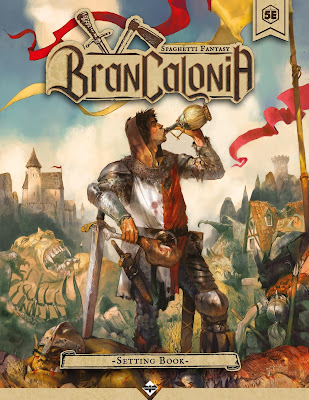
This is the world of Brancalonia – Spaghetti Fantasy, a bawdy, sun-drenched, low fantasy campaign setting for Dungeons & Dragons, Fifth Edition, inspired by Italian tradition, folklore, history, landscapes, literature, and pop culture. Published by Acheron Books following a successful Kickstarter campaign, it is set in a ‘back-to-front’ version of Medieval Italy—even the gorgeous map is flipped from left to right—in which low life heroes, the Player Characters, form Bands and hopefully get hired by hopefully rich merchants, petty nobles, and desperate warlords to undertake the odd job or two, typically illicit, dangerous, and deniable. That is when they are not concocting their own schemes and running into curses, demons, witches, and angry, abandoned spouses. To a wider audience, the most well-known inspiration for Brancalonia – Spaghetti Fantasy will be the films Ladyhawke, Flesh + Blood, and The Princess Bride, along with Carl Collodi’s Pinnochio, but the Brancalonia – Spaghetti Fantasy Setting Book includes numerous others. All of which are likely to be less familiar to a wider audience. And that is a bit a problem because not all of the inspiration is easily available. However, if instead you think of Brancalonia – Spaghetti Fantasy as being distinctly European fantasy—so there is definitely going to be mud and worse underfoot, not unlike Warhammer Fantasy Roleplay, but with better weather, better cooking, and definitely better wine, and then directed by Sergio Leone (with Terry Gilliam as second unit director), then you have the feel of the setting.
The Brancalonia – Spaghetti Fantasy Setting Book, which won the Gold Ennie for Best Electronic Book in 2021 (plus Silver Awards for Product of the Year, Best Writing, and Best Setting) keeps its fantasy low in a number of ways. First, Player Characters can only advance as high as Sixth Level. Second, whilst it provides five new Races, it does not provide any new Classes. Instead, it gives twelve new Subclasses, one each for the twelve Classes in the Player’s Handbook, along with new Feats and Backgrounds. Third, it gives rules for brawling, intentionally non-lethal combat, which typically takes place in a tavern or other dive before the Player Characters scarper after being accused of a Breach of the Peace and another bounty put on their heads. Fourth, their arms, armour, and other equipment is likely to be shoddy, poorly maintained, and will probably fall apart at the least opportune moment. It eschews the use of Alignment, and even if used, discourages any Player Character choosing to be evil, as Knaves are rogues rather than villains. The setting for the most part is humancentric and does not include the traditional Races of Dungeons & Dragons, although they are not unknown.
Besides Humans, the five new Races in the Brancalonia – Spaghetti Fantasy Setting Book are the Gifted, the Malebranches, the Marionettes, the Morgants, and the Sylvans. The Gifted are Humans who know a little bit more magic; Malebranche are Devils who proclaimed the Great Refusal and climbed out of the Inferno, typically via the Eternal Gate which stands in the great chasm into which Plutonia fell and now stands, and who still have diabolic features such as Hellwings and the Hellvoice; Marionettes are animated puppets, often in the form of Pinnochio or the Paladin-like Pupo, who can remove and use their limbs in a brawl; Morgants are tall ‘demi-giants’ with great strength and appetite, known as fearless brawlers and champions often stationed at the vanguard of an army; and Sylvans are rustics at home in the forest. In addition, each Race has its brawl feature which gives it an advantage in nonlethal fight. The first of the twelve new Classes in the Brancalonia – Spaghetti Fantasy Setting Book is the Pagan, a Barbarian subclass, inhabitants of the Pagan Plain who favour speed, anger, and violence; the Harlequin is a Bard as street entertainer; the Miraculist is a Cleric who follows the calendar and favours the saints, and knows several defensive or helpful spells; the Benadante is a Druid as a forest sorcerer capable of interacting with and defending against the undead; the Swordfighter is a duelling archetype for the Fighter; the Friar is a Monk turned religious brawler; the Knight-Errant is the Paladin as rambling protector of the good, and likely the most courageous of any Knave; the Matador, a Ranger who hunts beasts and monsters in the wilds and fights them in the arena; the Brigand is a Rogue who steals from the wealthy and redistributes what he steals, and can always catch his targets by surprise; the Superstician is a very lucky Sorcerer who can also cast protective rituals; the Jinx is a Warlock who has the districting power of the Evil Eye and even cause misfortune; and the Guiscard is a Wizard who specialises in tomb robbing and treasure hunting.
To these Subclasses are added backgrounds such as the Brawler, the Finagler, and the Fugitive, as well as Feats like Ancient Culinary Art, Apothecary, Jibber-Jabber, and Peasant Soul. There are rules too for advancing beyond Sixth Level, but each new Level only grants an Emeriticence, such as Professional Brawler or Blessed Luck. In addition to creating their Player Characters, they come together to create their Bounty Brothers’ den, a comfortable place where they can rest up and hide. It might be an abandoned farmhouse occupied by brigands, matadors, and smugglers, or a tower in plain sight inhabited by knights-errant, swordsmen, and mercenaries, but all begin with one and can be improved with further Grand Luxuries such as Black Market or a Cantina. This though takes gold and Knaves typically only have silver, so there is a community improvement element to play as the Knaves pool their funds. The Den is also where they ‘Rollick’ and rest—the long rest in Brancalonia – Spaghetti Fantasy Setting Book is seven days long, too long to take place during actual play—and perhaps improve their Den, reflect on the Job just done (and note any misdeeds and misdemeanours that lead to further bounties being placed on their heads), and plan for the next Job. This will probably result in some kind of hazard as a result of their past activities, and it can be partially offset by going into hiding for a while. And Knaves being who they are, can also engage in Revelry, a few days of good food, good wine, and good company, and so fritter away some of what they just earned…
Other activities the Knaves can engage in are brawls and dive games. Brawls are not like combat in that Hit Points are not lost. Instead, a Brawl attack inflicts Whacks, most Knaves being able to suffer five of them before being knocked unconscious. Brawlers can pick up props, essentially the things around them, and attack with them or use them to defend themselves with. These are divided between common props—pots, dishes, bottles, stools, and so on, and epic props—tables, barrels, chandeliers, suits of armour, and more. In general, a prop has a beneficial effect like gaining a bonus attack or increasing a Knave’s Armour Class, rather than increasing the whacks inflicted. Knaves also have Moves, which are divided into General Moves, Magic Moves, Class Brawl Features, and so. There are Stray Dangers, like ‘Rain of Stools’ or ‘It’s Raining ham’ which the Condottiero—as the Game Master is known in the Brancalonia – Spaghetti Fantasy Setting Book is called—can add to a brawl. The brawl rules are definitely designed to be cinematic in style and add a sense of action and comedy to play.
In addition to brawling in Dives, a Knave likes to play games and gamble—though that is illegal in the Bounty Kingdom. The Brancalonia – Spaghetti Fantasy Setting Book includes several different Dive games. These include the card game, Poppycock; Barrel Beating, a combined drinking-barrel smashing game in which the winner smashes the barrel and wins the wagers inside; Brancalonian Buffet, an eating contest. There are also rules for shoddy equipment, counterfeiting, equipment for the setting, like the Scudetto, a medium shield which bears the emblem of a city and is thus a symbol of pride for followers of the local Draconian Football Team, concoctions—tonics and the like for what ails you, and even some magical junk. Lastly, there is memorabilia, items of no ecumenic value, but perhaps personal value to their owning Knaves. A Knave begins play with one, but this is not obvious until much later in the book.
For the Game Master—or Condottiero—there is good advice on running Brancalonia – Spaghetti Fantasy. This is to keep the tone light-hearted, magic low, make the game one of tragicomedy and even ‘Grand Guignolesque’, so there is room here for horror too. There is in effect no budget for special effects, or little else, so a game of Brancalonia – Spaghetti Fantasy should be like a film done on the cheap—recycling character actors and redressing extras, natural backdrops and ruins, and so on. Plus, the brawls of ‘brawly’ fantasy to cut down on the bloodshed, but keep up the tension. There is advice as to what to avoid in play—unnecessary violence, sexual themes—though nature of Brancalonia – Spaghetti Fantasy does skirt the issue, and of course, any bigotry. This is the equivalent to safety tools. Plus, there is advice on handling bounties and the law, creating adventures, dives, random roads which may or may go somewhere, and more. There is also a good overall guide to the Bounty Kingdom, its history, its various regions, and even the kingdoms beyond its borders. Each is given a couple of pages, but each includes suggestions as to the types of Jobs that the Knaves might undertake there, and overall, there is just about enough to make each region different and provide the Condottiero with further inspiration.
Penultimately, Condottiero is given a six-part campaign, ‘In Search of Quatrins’ to run. It begins with ‘Little People of the Grand Mount’ and ‘Rugantino: Tales of Love and the Knife’, both of which are for First Level Player Characters, but the first is specifically written as an introductory adventure, one that younger players can roleplay, but also sets up the rest of the scenarios. To this end the Knaves are offered an easy job and the chance to join a company by Roughger of Punchrabbit. The Jobs include treasure hunts, monster hunts, missing marionettes, and more. All together ‘In Search of Quatrins’ should provide a group with several sessions’ worth of play and give them a thorough taste of life in the Bounty Kingdom. They do need some development in places, but the Condottiero should be able to do that as part of preparation. Lastly, Brancalonia – Spaghetti Fantasy Setting Book includes a bestiary of new monsters and a section of ready to use NPCs.
Physically, the Brancalonia – Spaghetti Fantasy Setting Book looks to be superbly presented, with really good artwork and excellent maps. However, it is a translation from Italian and the localisation and editing is not as good as it could have been. In addition, the index is anaemic, so finding anything in the book will be a challenge. The book could also have been done with a step-by-step guide to creating Player Characters for the setting, as there are several aspects of the process which do not appear until much later in the book. Similarly, a glossary would have been incredibly useful.
Ultimately, whether or not you like the Brancalonia – Spaghetti Fantasy Setting Book will depend on your feelings towards Dungeons & Dragons, Fifth Edition. The new rules presented here do add to Dungeons & Dragons, Fifth Edition, but at the same time, they add and enforce the setting and genre of Brancalonia—the brawling, the shoddy equipment, and much, much more. Whether you like it or not, the Bounty Kingdoms setting of Brancalonia – Spaghetti Fantasy jumps from every page into uproarious, tankard banging, wine quaffing, lustily voiced song and then at the end of the night, down in the cups mutterings, before another job presents itself the next day even as you are trying to get over a hangover. Brancalonia – Spaghetti Fantasy Setting Book presents a delightfully different take upon fantasy, for which even if you do not know the inspiration, the book is inspiring in itself, and you should be creating a cast list (for which Oliver Reed should be your number one choice) even as you read the book and prepare your first adventure. Once you have finished reading Brancalonia – Spaghetti Fantasy Setting Book and prepared your first adventure, you should be ready to bring an inglorious fantasy to the table.
Friday, 6 December 2019
Friday Fantasy: More Than Meets The Eye
From the start, including the title and its vibrant cover, it is obvious that More Than Meets The Eye is a weird, fantasy homage to a certain franchise of films involving giant robots capable of transforming into everyday objects. Not only is its location called St. Michael’s Bay, but the antagonists of the bay are transforming aliens, though not robots. Instead they are squidy, squidgy, tentacled aliens—shoggoths?—capable of transforming into everyday objects. This is depicted on the front cover and in a really good illustration inside the book. This transformation theme runs throughout the scenario, whether it is objects transforming into aliens (shoggoths), or the player characters into another race or Class, or simply into goop. There is a certain sexual element to the scenario, but it is not quite as prurient as that of Fish Fuckers.
Like the aforementioned scenario, More Than Meets The Eye is set in the West Country, but Cornwall rather than Devon, begging the question, “What exactly, does the author have against the people of the West Country?”. A light has been in the sky over the coastal village of St. Michael’s Bay or there has been violence in the coastal village of St. Michael’s Bay following a light has been in the sky or nothing has been heard from the leading men of the village, Ernest and Henry Hastings, and their business associates want to ensure that they are all right. These are the reasons to bring the player characters to the village of St. Michael’s Bay, which absolutely has to be the best use of the director’s name under any circumstances and well, it is set in Cornwall, home to Saint Michael's Mount (if there was a French version, there has to be a joke in there about Le Mont-Saint-Jean-Michel-Jarre).
What is going is this. St. Michael’s Bay has been invaded—twice. First by a group of shape-changing aliens in the past, fleeing a civil war amongst their kind. This group has recently been awoken after millennia of hibernation and in the process, the second group, come to Earth to capture the first. Which leads to a confrontation and a stand-off, one which the player characters are likely to break. Depending upon the outcome, there is a chance that the player characters might end up with a—unsurprisingly, given that this scenario is for Lamentations of the Flame Princess Weird Fantasy Roleplay—weird spaceship, which is not actually as bad as it might seem. After all, there are any number of scenarios published for the roleplaying game and other Old School Renaissance roleplaying games which are set in weird locations, for example, Barbarians of the Orange Boiling Sea, which could be reached by a spaceship.
Physically, More Than Meets The Eye: A Short Adventure with Lots of Tentacles is well presented, with some really quite entertaining artwork. The book could be better edited though.
More Than Meets The Eye: A Short Adventure with Lots of Tentacles lives up to its title. It is short, probably providing no more than a session or two of play—though if the player characters get hold of the spaceship, it opens up all sorts of possibilities. It also has a lot of tentacles and no, you do not want to get close and personal with any of them! More Than Meets The Eye: A Short Adventure with Lots of Tentacles is also bonkers, but it is the best version of Michael Bay throughout all of time and space.
Friday, 22 November 2019
Friday Fantasy: Barbarians of Orange Boiling Seas
Instead, the back cover blurb focuses on a story from the far future which although tying in with the overall background of the scenario, it is not really relevant to what the player characters will do in the scenario. Essentially, an interstellar robotic probe a thousand years into the future reaches a distant star system and scans it for habitable worlds. What it discovers will astound those it relays the information back to—and what it has discovered are the doings of the player characters on a moon very, very, very far away from Earth. Some five centuries ago…!
Barbarians of Orange Boiling Seas is not a scenario in the sense that there is a plot with a beginning, a middle, and an end. Rather it is a set-up where the possible arrival, and then definitely the presence and actions of the player characters will drive the action and the story. The set-up is this. It begins in Going Through Forbidden Other Worlds where an off-world missionary mission of Portuguese conquistadors has successfully used the portal in Hell to reach an icy moon called Nibu. There they are surprised to discover the city-state of Bwang-Quos with its sophisticated Stone Age technology clustered around a boiling sea of lava in one of the moon’s volcanic regions and inhabited by the descendants of Earth’s neanderthals who had been abducted thousands of years before by a race of Alien Wizards. The Alien Wizards are now long gone and are of course, revered as gods, which meant little to either the Jesuits or the Conquistadors, who being Jesuits and Conquistadors, set about bringing the Word of God to the heathens and plundering the wealth of the new world for crown and glory.
At the start of Barbarians of Orange Boiling Seas, the conquistadors have conquered Bwang-Quos, have barely pacified the local inhabitants, thrown down their idols (of the Alien Wizards) and begun to construct a proper Catholic cathedral. However, the leaders of the off-world missionary mission are divided in their aims. The Portuguese conquistadors wants to pacify the Bwang-Quos and prepare against any resistance attacks, whilst the surviving priest wants to continue building a cathedral and create a bishopric of his own. The last remnants of the city-state’s royal dynasty has fled to an impregnable sky-fortress said to be the home of an incredible weapon of the gods, and there plots to throw out the invaders. Both factions in the off-world missionary mission would like to capture the last of the royal dynasty and take control of its famed weapon of the gods. Beyond the city, rebels and raiders have taken refuge in the bulrush marshes surrounding the city, there hiding whilst looking for opportunities to strike at the invader and planning to eventually drive them away. The resistance also wants to make contact with the royal dynasty and perhaps gain control of the legendary weapon to use against the invaders. Lastly, the tribes of Ice Barbarians who live in the tundra beyond the forests and bulrush marshes look on, waiting to see what will happen and hoping that the situation will eventually be to their advantage.
It is this febrile situation that the player characters are thrust. The likelihood is that they will have have arrived on Nibu via the portal in Hell—as detailed in Going Through Forbidden Other Worlds—and so will encounter the conquistadors first. Such an encounter is likely to lead to an alliance or an offer of work, either against the rebels or the Royal holdouts. Exploring the city-state will bring the player characters into contact with the local inhabitants, some of whom support the Portuguese, some of whom do not. They may even meet the rebels who might try and persuade the player characters to fight against the Conquistadors. Conquistador patrols and rebel bands are likely to be encountered in marshes. Of course, if the characters arrive by a different method, such as a magical mishap which lands them on Nibu, they may arrive anywhere of the Referee’s choosing and so meet the various NPCs in an entirely different order. Another option, would be for the players to create native inhabitants of Nibu and play as members of one faction or another. That though, would require further preparation upon the part of the Referee.
Barbarians of Orange Boiling Seas provides sufficient detail about all of the various and pertinent factions and locations on Nibu, although there is scope for the Referee to create more of either. Only one location is described in any detail—Hawk’s Peak, the secret redoubt of Bwang-Quos’ royal dynasty—but it is not really a dungeon or adventuring locale in any sense. Surprisingly, none of the NPCs have stats, so it is left up to the Referee to provide these. Whilst it means that the Referee will need to put more effort into preparing the scenario, she can easily scale it to the Levels of her players’ characters. That said, they do have an advantage over the native inhabitants in being stronger and having access to metal arms and armour, and possibly firearms and magic versus the Stone Age materials of the Nibu inhabitants. The lack of stats also makes it easy to adapt to other rules systems, whether that is for the Old School Renaissance or not.
Physically, Barbarians of Orange Boiling Seas is a slim booklet, tidyily laid out with an illustration or a map on every page. It needs an edit in places, but it both art and maps are decently done.
Barbarians of Orange Boiling Seas describes itself as having the “...[C]lassic conquest versus liberation adventure going on…” and indeed, it has that. In fact, it actually has the classic conquest versus liberation adventure going on, because when all said and done, Barbarians of Orange Boiling Seas is a fantasy/Science Fantasy reskinning of a classic conquest versus liberation situation from Earth’s own history, one contemporary with this scenario. That situation is the 1516 invasion of the Aztec Empire by the Spanish conquistadors and there are a great many elements in Barbarians of Orange Boiling Seas which parallel the history of that invasion.
With that parallel in mind, Barbarians of Orange Boiling Seas presents an interesting roleplaying situation in how far the players are willing to explore the strength of their characters’ religious beliefs. Certainly how far they are willing to side with an invading force before it abuts with our contemporary inclination to side with the oppressed… That said, Barbarians of Orange Boiling Seas is of a limited utility. To get the fullest out of it, the Referee will need to have run Going Through Forbidden Other Worlds or found some other means to get the player characters to the distant moon, otherwise the scenario is not easy to add to an ongoing campaign. Barbarians of Orange Boiling Seas has potential as one-off or some weird dreamscape, but this would require some development upon the part of the Referee.
Of limited scope and utility, Barbarians of Orange Boiling Seas is an interesting addition to the Lamentations of the Flame Princess Weird Fantasy Roleplay range, but one that may not see a great deal of play.
Friday, 30 August 2019
Friday Fantasy: Sounds of the Mushroom Kingdom
At heart of Sounds of the Mushroom Kingdom are the eight tribes of Mushroom Mans, each a different colour, each with different abilities, but all hating and ready to fight each other. So, the Black Mushroom Mans are Wizards of casting a few spells each day, Grey Mushroom Mans control their own gravitational direction and can walk on walls and ceilings, and Red Mushroom Mans move faster and have an initiative bonus. Given that this is a Lamentations of the Flame Princess Weird Fantasy Roleplay supplement, so far Sounds of the Mushroom Kingdom is not that weird, except that Mushroom Mans can be eaten and their flesh smells like birthday cake and ice-cream. When their flesh is consumed, it has different, random effects. These are all themed and there is a table of random effects for each type of Mushroom Mans. So for the Purple Mushroom Mans, who are the only Mushroom Mans capable of speaking with humans, their flesh, when consumed, grant the ability to speak, understand, read, and write any language , internalise the thoughts of foes in combat, granting excellent benefits, make the person highly persuasive, grant telepathy with anyone the consumer knows over any distance, and so on. Most of these abilities last just twenty-four hours.
Up until this point, the Sounds of the Mushroom Kingdom prevents beneficial effects in consuming the flesh of Mushroom Mans, though of course weird in that the player characters need to consume the flesh of an intelligent species. The supplement gets weirder when this flesh is eaten more than once in a twenty-four hour period. Playing upon the fact that mushrooms or ‘shrooms’ have psychoactive or psychedelic properties, the supplement presents a table of more weird and random effects such as the ingestor becoming invisible and immaterial for a time—but not his clothes and equipment, a strong light shines out of the ingestor’s eyes, even when closed, or the ingestor cannot simply walk, but must skip and sing with joy, although this makes them more tired.
The competitive rivalry between the eight tribes and the chaos of any spore outbreak is abated should a Mushroom King spawn. This huge, three-headed Mushrooms Mans is in permanent contact with other Mushroom Kings via two heads, but also has his own secret plans in a third. The three heads cannot agree easily and so are slow to act, especially in combat, but each head is a different colour and changes colour from round to round, so it has a range of revolving powers. The Mushroom King is not the only creatures in the Sounds of the Mushroom Kingdom, the others including Toadstool Turtles which serve as mounts for Mushroom Mans and release spores that confuse mammals who attack them, Mooshrooms which are the livestock of the Mushroom Kingdom and which can be milked for their prismatic and psychedelic milk, and Mushroom Zombies, mindless killing machines which when damaged release noxious, necrotic dust into the air, which of course, has its own Necrodelic Effects Table. There are lots of bugs and other types of mushrooms and fungal creatures in the Sounds of the Mushroom Kingdom, such as the Great Tumor, which infects and warps everything around it, including causing all food and drink to cry out not to consume it. Perhaps the most interesting entry in the supplement is the humourless Professor Finkelfunkel, a prickly expert who has been studying the Mushroom Kingdom for several years and who may, or may not, like the player characters. This is expressed in the mushroom tea he serves…
Rounding out the Sounds of the Mushroom Kingdom are some treasures, like the innards of the Golden Mushroom which are valuable if difficult to get, and Transformation mushrooms which can change a character’s attributes if eaten. The Mushroom Mans are also presented as a player character Class. They receive random Hit Dice from Level to Level and their flesh can be consumed without suffering a psychedelic effect. It is not quite clear how the Mushroom Mans Class gains its different colours—presumably by consuming the flesh of other Mushroom Mans—but the Referee should be able to develop the Class a little further.
Physically, Sounds of the Mushroom Kingdom is a lovely little book. It needs an edit in places, but really the artwork is excellent throughout, all done by the same team. This gives the supplement a consistent look. Sounds of the Mushroom Kingdom is weird, but you would expect that of a supplement for Lamentations of the Flame Princess Weird Fantasy Roleplay, but it is not that weird. Certainly not as weird as the what was the previous themed bestiary for the roleplaying game—Slügs. This will probably make the supplement easier to use. If Sounds of the Mushroom Kingdom has a weakness, it is that the ecology—or mycology—feels underwritten in terms of motivations for the Mushroom Kings and what any kingdom wants. Although she will need to develop those herself, should the Referee want to spawn mushrooms and toadstools in her campaign, then all of the spores she needs can be found in the Sounds of the Mushroom Kingdom.
Friday, 9 August 2019
Friday Fantasy: She Bleeds
From the start, She Bleeds is not obviously written as a gaming supplement. It is written instead as a secret manual handed from woman to the next, explaining the rituals involved in the worship of an otherworldly deity known only as ‘She’ or ‘Her’ and the gifts that she grants. Once infected by She, the woman—and it is primarily a woman, although it is possible for a man to follow this path—who has the honour of bearing her, will return again and again to enact rituals at eight different phases of the Moon. Now one of the ‘Blooded’, in return for completing the ritual, the woman is granted a new power associated with her flesh or her blood. Some of the rituals grant different powers depending on which of the two Avatars of Her the woman selects. For example, in the first ritual at the Full Moon, the woman accepts her role as a host to Her, drinks the saliva of a young woman and an old, and after completing the ritual, either selects ‘By gentle kiss’ or ‘By force’. The former grants the woman’s saliva the power to hear as she licks the wound, the latter makes her saliva poisonous that can be licked onto weapons. Such gifts are not permanent, and to refresh them, the woman has to enact the ritual again. These are the slightest of the gifts that She grants, and as the woman enacts further rituals under different phases of the Moon, she is granted more powerful abilities, her blood coming alive until she can become an avatar of Her. A man can also follow this path, but as he accepts the infection that is She and enacts ritual after ritual, his genitalia changes and he too comes to menstruate—and in the process, would gain access to the spells and magic presented in Vaginas Are Magic. That though, would be a path all of its very own…
Only at the end of She Bleeds, after each of the rituals has been presented is the nature of She presented, almost as a final revelation. She has no form but sacrifice and comes to those in pain and suffering, offering her solace and power three times. Should Her chosen accept, then she is infected and becomes an Initiate of She, compelled to enact the first of the lunar rituals—the first of many.
Similarly, the introduction to She Bleeds comes at the end, an afterword rather than an introduction. Here she states that, “Writing a piece about periods is tricky.” before adding that, “No monthly event in my life has made me feel more weak or, at times, more powerful. There’s something integrally beautiful about menstruation and something terrifyingly brutal—much like being a woman—much like playing Lamentations.” She Bleeds is a response to that, a way to make the experience gameable, but without descending into prurience or making it purely about empowerment. There is empowerment here, very much so, but it does not come without cost, for the rituals, repeated over and over, changes the Blooded. There then lies the allegory at the heart of She Bleeds.
Physically, She Bleeds is neatly presented. It maintains a sharp separation between the in-game description and the technical rules description of the rituals presented in the book. The writing needs editing in places and the artwork matches the adult tone of the writing, but is anything other prurient.
Where the difficulty and complexity comes in She Bleeds is in both Referee and player of the woman infected by She keeping track of the calendar as the phases of the Moon change. A simplified method is provided as an easier alternative, but it is not that much less complex… But whatever the method, the point of a player keeping track is to involve him and his character more fully in the turn of the Moon and the powers being granted. To get the fullest out of She Bleeds, that player and his Referee needs to embrace both the nature and process of becoming one of the Blooded, and in doing so, it enables their game and their gaming experience to explore an issue that many might not otherwise.
Friday, 7 June 2019
Friday Fantasy: Obscene Serpent Religion 2
Obscene Serpent Religion 2 takes place some near the borders of the Low Countries and the Rhineland in the early modern period, that is roughly the seventeenth century prior or about the time of the Thirty Years War. In a time of religious strife, it focuses on the sleepy village of Nonsbeck, a popular stop on several trade routes. Its inn, The Laughing Ox, is welcoming, the food and ale hearty, and the staff always pleased to see you—especially if you enjoy the gossip from far and wide. The other features of the town include a smithy whose blacksmith was once a sailor; the Church of St. Margaret dedicated to a saint with an odd monkey fixation; a stables, and lastly a well from which a woeful wail is known to emanate. Each of these locations are described in some detail as are their owners, workers, and employees. These are accompanied by one or more adventures per location as well as a table providing further customers at The Laugh Ox and thus potential encounters for the player characters.
All of this description takes up half of the scenario’s thirty-two pages and is utterly mundane and ordinary. There are hints of some strangeness beneath the bucolic façade, but for the most part, this is not a place where the player characters are intended to dig too deep or indeed discover very much. Instead, what the player characters are supposed to do is stop off and spend the night in Nonsbeck, perhaps two, and then move on to their destination. Obscene Serpent Religion 2 suggests Blood in the Chocolate as being one possible destination, but similarly, Better Than Any Man would also be suitable. Then do it again on the way back or the way to somewhere else. And then…
...At some future visit to the village, the player characters find Nonsbeck changed beyond all recognition. In a nod to Obscene Serpent Religion—a supplement for Lamentations of the Flame Princess Weird Fantasy Roleplay dedicated to the creation of snake cults—the idyll described in the first half of Obscene Serpent Religion 2 has been shattered by the presence of a demonic Snake Creature and a snake cult that has coalesced around her. They have infiltrated nearly all of the establishments in Nonsbeck and turned its decent inhabitants into cultists, if not monsters. How this came about is up to the Referee to decide, but the effects and the current situation in Nonsbeck are gone into the same amount of detail as the scenario’s first half. They will be discovered slowly and then quicker and quicker as the player characters first realise that something is amiss and then uncover more and more of the terrible situation now in the village. Worse—at least for the player characters—the Snake Creature represents a chronological threat to their very existence and once she encounters them, they will find themselves changed in ways they could never imagine… A dozen or so options are given, from simple gender swaps and negating a character’s Class to cult conversion and swapping nationalities. These are likely to have a radically upsetting effect upon the characters, but also explain what has gone on in Nonsbeck whilst they have been away and really, how little the characters could have done about it. If they survive, the player characters are likely to have left Nonsbeck a scene of carnage and themselves changed beyond all recognition…
Now all of this takes some setting up upon the part of the Referee. Nonsbeck has to be added to her campaign and then gently used again and again, essentially making both village and villagers familiar and friendly—and this without arousing suspicion. Obscene Serpent Religion 2 is a scenario for Lamentations of the Flame Princess Weird Fantasy Roleplay after all! This is a challenge in itself, especially given how bloody and radically transformative Lamentations of the Flame Princess Weird Fantasy Roleplay can be. Now Nonsbeck can serve as a refuge away from all of that, but ultimately, the doom will befall the village and… Ultimately, the outcome of the scenario is in the hands of the player characters, indeed, the scenario does not even address any possible outcomes. It really does lie in the hand of the players and their characters.
Physically, behind its creepy cover, Obscene Serpent Religion 2 is cleanly laid out and written. The illustrations are decent, as is the map of the village. The scenario could have done with a map of some of the locations also, but it should not be too challenging for the Referee to come up with versions of her own.
What is interesting about Obscene Serpent Religion 2 is that the author has taken its cue not just from Lamentations of the Flame Princess Weird Fantasy Roleplay, but also from Warhammer Fantasy Roleplay in terms of its tone and play style, quoting in particular, James Wallis, its publisher during the nineteen nineties. Although there is definitely a calm before the storm, when the storm strikes, it is unstoppably grim and perilous, and whilst the player characters can stop it, it is unlikely to be without consequences to themselves given the chronological powers of the Snake Demon or to the changed nature of Nonsbeck and its inhabitants. It should be pointed out that the ordinary nature of both Nonsbeck and its inhabitants do make Obscene Serpent Religion 2 is easy to adapt to other settings or scenarios, especially if they lean towards the grim and perilous.
Obscene Serpent Religion 2 takes time to set up, but if done properly, delivers a brutal battering to a campaign and probably to the player characters. Whether inflicting body horror or character changing circumstances or mental outlooks, Obscene Serpent Religion 2 is a radically transformative experience from which the player characters are unlikely to walk away from unchanged, the village of Nonsbeck left barren in their wake.


