Every Week It's Wibbley-Wobbley Timey-Wimey Pookie-Reviewery...
Showing posts with label Mech Game. Show all posts

Saturday, 8 August 2026

Solitaire: Ion Heart – Pilot’s Handbook

It is fifteen hundred years since the Astral Union was formed and sixty-five years since the Emergence Catastrophe occurred. Nephilim Strand Fleets emerged from the Galactic East and for a decade the Emergence War was waged across the galaxy. Over five decades have passed since and signs of the conflict can be found only almost every planet and in the spaces between. Remnants of the original invasion force, as well as individual Nephilim, can still be found lurking at the furthest reaches of the spatial translation Snap Rifts that bind the planetary systems of the Astral Union together. Bandits and pirates are a threat still, as are corporations running rogue operations. One icon of the war that can still be seen today is the Mech. Before the war, it had been designed as an industrial machine for use in construction and mining, and later developed as a combat vehicle, but the Mech rose to prominence during the defence of the Astral Union. Ion Core technology harnessed the latent psionic ability of all sentient beings using advanced A.I. systems to create a Sync-Bond between a mech and its user, enhancing the precision and dexterity of the Mech and enabling the Mech itself to develop a personality of its own and operate independently, but still linked to its Pilot. Today, Mechs are seen far and wide across the Astral Union, the bond between Pilot and Mech celebrated as if they were a knight and the Mech his steed of old. Together, they adventure and explore, help and hinder, protect and perform, often helping where they can, like itinerant, if hyper-armed, ronin of old.

This is the set-up for Ion Heart: Solo Mech Exploration RPG – Pilot’s Handbook.
It is a solo journalling game published by Parable Games, best known for the horror roleplaying game, Shiver – Role-playing Tales in the Strange & the Unknown. In the roleplaying game, the player will take the roles of both Pilot and Mech, who together explore a universe ravaged by war and now recovering, growing together and strengthening their bond. The roleplaying game provides prompts that will drive the story of their adventures that the player will record in short mission logs. These missions typically take the form of an ‘Exploration Loop’—arriving on a planet, discovering a settlement, encountering a Story Circuit, and engaging in combat and travel encounters, as necessary. A Story Circuit is a narrative arc consisting of six parts. The player needs to play through a minimum of three of these before his Pilot and Mech can play out the finale of the Story Circuit, and so complete its narrative before moving. The Story Circuit is pre-written, but the rest is created at the beginning of each loop. To play, Ion Heart: Solo Mech Exploration RPG needs nothing more than some six-sided dice and a means to record a journal.

Ion Heart: Solo Mech Exploration RPG – Pilot’s Handbook includes some background to the setting really intended to provide flavour and detail, rather than mechanical support. This includes the history of the Astral Union, its organisations and what ordinary life is like, an explanation of the Emergent War and who the Nephilim are, and a timeline. Surprisingly, this also includes the various species which a player can chose from. These include Apollonians or humans from the Apollo-Theta system, the reptilian Varziss of the Varziss Triarchy, the bear-like Urvons of the League of Urvo, the winged and nocturnal bat-like Chiros of Chiros Coalition, the centaur-like Kirvae of the Kirvaen Prefecture, and the cat-like Mo’nau of the Mo’nau Republic. In addition to selecting one of these species during character creation, all of this material can be drawn upon when a player is recording in his journal.

The character creation is for both the Pilot and the Mech. The Pilot is defined by Pilot Body and Pilot Presence, whilst Mech is defined by Mech Brawn and Mech Reflex. Pilot Body is his physical capability and toughness, whilst Pilot Presence is his mental fortitude and reasoning skills. Mech Brawn is the Mech’s strength and toughness, whilst Mech Reflex is his speed and agility. All of these start at zero, but are first modified by the Pilot’s Temperament and the Mech’s Weight Class. The Pilot has an Origin—one of the species listed above, a Pilot Goal such as ‘Adventure Forth’, ‘Escape Past’, and ‘Fulfil Destiny’, and Pilot Temperament, which can be ‘Outgoing’, ‘Reflective’, ‘Analytical’, ‘Intuitive’, ‘Mercurial’, or ‘Rigid’. Each of these provide a benefit. For example, ‘Reflective’ means that the Pilot prefers to keep himself and thinks carefully before committing to anything, which grants ‘+3 Max. Mech Shielding’ and ‘+1 Pilot Body’, whilst ‘Intuitive’ means that the Pilot is empathetic, has a poet’s soul, and makes judgements based on what he feels to be right, and that allows his player can ‘Re-roll two failed Pilot Presence Checks per day.’

Creating or building a Mech is slightly—but only slightly—more complex. The Mech has a Class that can either be Light, Medium, or Heavy. This determines whether it favours speed, durability, and powerful weapons, or a balance between the two, and thus its starting values for Mech Shielding and Brawn and Reflex modifiers. Each Mech has a Ranged Weapons System, Melee Weapons System, and an Auxiliary System, which will also help in combat. Since the end of the war with the Nephilim, all Mechs have been reconfigured or designed to have a civilian Specialisation and thus the capacity to be useful out of combat. This can be ‘Shepherd’, ‘Harvester’, or ‘Bridgebuilder’, for example. All of this—for both Pilot and Mech—can rolled for or chosen by the player. Lastly, there is the Ion Core Sync Bond, which represents the connection between the Pilot and his Mech, and in play, determines how many Heroic Actions or Ion Core engagements that can be conducted per day.

Pilot Name: Makwa
Pilot Origin: Urvon
Pilot Temperament: Analytical (+1 to hit in first Ranged Step of any combat)
Pilot Goal: Save Others
Pilot Presence 0 Pilot Body 0
Mech
Origin: Working Relationship
Weight: Heavy
Ion Core Sync Bond 2
Mech Shielding 46
Battle Scars: 0
Mech Brawn +1
Mech Reflex -1
Attacks: 3
Weapons: Scattergun (Damage: 4+D6) [Buckshot: For every hit with this weapon, make an extra free attack with it]; Forge Hammer (Damage: 6+D6) [Crushing Smite: The Meteorite Thunderstrike Ion Core does an additional +4 damage]
Auxiliary system: TN Field Projector
Mech Specialisation: Repair & Rescue
Mech Quirks: 0

Mechanically, Ion Heart is simple. When a player wants either his Pilot or his Mech to succeed, he rolls a single six-sided die and rolls of four or more means the attempt is successful. A roll of one is always a failure, whilst a roll of six is always a success. For the Pilot, bonuses can come from his Presence or Body as appropriate, but if he fails, the player can decide to have his Pilot undertake a Heroic Action. This automatically succeeds, but at the cost of a Sync Bond slot for that day. The Mech can operate by itself when the Pilot is not in the cockpit. In which case the bonuses for the Mech’s own Mech Brawn and Mech Reflex are used, and the roll required to succeed is still four or more. When a Mech has no instructions, it will revert to the Specialisation it has been programmed with.

Combat uses the same core mechanic, but on attacks, a roll of six is critical hit and inflicts more damage. Similarly, a roll of six to defend against an attack is a critical and deflects part of the damage back at the attacker. A round consists of three steps—Ranged, Melee, and Disengage. A Mech’s Level determines the number of attacks per round, but if the Pilot or Mech decides not to attack, they receive a bonus to the rolls to defend themselves. Damage reduces the Mech Shielding, and this is both when the Pilot is out of the Mech and in the Mech. If the Pilot is out of the Mech, it means that Pilot is not taking damage as such, but his ability to pilot the Mech is being affected.

The Ion Core of a Mech and its A.I. means that it can learn over time as it synchronises with the Pilot and it can also overcharge the Mech’s systems. There is no truly safe way to do this, as even if the Pilot and Mech have enough Sync Bond points—which determines the number of times it can be done per day—engaging the Ion Core can still damage the Mech and will damage the Mech if the number of times it is used exceeds the Sync Bond points. When the Ion Core is engaged, it provides the player with a number of choices, such as the aforementioned ‘Heroic Push’, which allows a failed Mech Brawn or Mech Reflex check to succeed; ‘Shields! Full Power!’, which partially restores Mech Shielding; and ‘Meteoric Thunderstrike!’ which enables a single attack that round and has it automatically succeed with extra damage inflicted. In the long term, through play and combat, the latter if the Mech Shielding is reduced to zero and the Mech is disabled, the Mech can acquire Mech Quirks such as ‘Gallant Protector’, which grants a bonus to Defence rolls if Mech Shielding is seriously reduced, and ‘Ocular Misalignment’, damaging its targeting optics! If there is an issue with the Ion Heart: Solo Mech Exploration RPG, it is that it is hard for the Pilot to improve in comparison to the Mech and the Mech is always more interesting than the Pilot as he has no special abilities or skills.

The play of Ion Heart—the ‘Exploration Loop’—begins with the creation the next destination for the Pilot and his Mech. This includes world building, which drills down from system creation through world creation to settlement design. Examples are provided to choose from, but there are tables which a player can use to create his own. The tables are used to create systems, planets, biomes, and settlements as well as encounters that can be friendly, mysterious, or hostile. The latter are backed up with a range of threats that includes other Mechs and Nephilim enemies. What this provides is a broadly drawn environment that a Pilot and Mech can explore and adventure across. It is also the environment upon which the player will map and tell the tale of one or more Story Circuits.

Eighteen of these are detailed in Ion Heart: Solo Mech Exploration RPG – Pilot’s Handbook, taking up half of the book. There are six each of Peaceful, Protective, and Dangerous Story Circuits, and each one is broken down into five scenes, plus a finale. The player has to play through three of the scenes before playing the finale. The Peaceful Story Circuits include ‘The Remembrance Festival’ and ‘Mech’s Birthday’; the Protective Story Circuits include ‘An Ecologist’s Dilemma’ and ‘Volcanic Chaos’; and Dangerous Story Circuits include ‘Our Fight is Not Over’ and ‘Contested Territory’. This is a great mix of story ideas and gives the game a greater longevity than the average solo journaling game.

In addition, Ion Heart: Solo Mech Exploration RPG – Pilot’s Handbook includes guidance on playing it as a two-player game. Instead of each player controlling his own Pilot and Mech, one player roleplays the Pilot and the other player the Mech, and it suggests the players divide responsibilities between journalling and rules referencing, as well as working together to decide on the actions of their shared Pilot and Mech.

Physically, the Ion Heart: Solo Mech Exploration RPG – Pilot’s Handbook is a nicely done roleplaying game. It is fetchingly presented in swathes of soft colours and easy to read and understand.

Initially, Ion Heart is a challenging given that until a Pilot and Mech survive a Story Circuit and can go up a Level, there is not much in the way of modifiers to affect the dice rolls needed for many actions. This is why the Sync Bond and engaging the Ion Core is so important as it can get the Pilot and Mech out of a tight scrape, but it is more important early on in the game when there are fewer modifiers to skill rolls and fewer chances to engage the Ion Core with any degree of safety. However, careful play and some luck will get the Pilot and the Mech through most situations, and it may help if the player goes through a Peaceful Story Circuit first so that his Pilot can gain a Level.

Ion Heart: Solo Mech Exploration RPG – Pilot’s Handbook explores the relationship between Pilot and Mech, much like a knight and his horse. They are both bonded, literally in the case of the Pilot and Mech with the Sync Bond mechanic. What is so attractive about Ion Heart is that although there is danger to be found and threats to be confronted across the Astral Union, the universe it depicts is not a dark one, but one of hope and restoration, as the Pilot and Mech wander from place to place, in peripatetic fashion, ronin-style. Then unlike other solo journalling games, Ion Heart not only comes with eighteen Story Circuits to tell, but leaves the world open. There is no set ending that the player is striving for and when he has completed the eighteen Story Circuits, he is free to create his own and continue the story of his Pilot and Mech, or wait for expansions from the publisher. In other words, it is up to the player to decide when the story of his Pilot and Mech ends.

Ion Heart: Solo Mech Exploration RPG – Pilot’s Handbook is a rather charming journalling roleplaying game, enjoyably optimistic in tone, and with richness of stories to tell.

Saturday, 22 February 2025

Solitaire: Ion Heart

In the far future, the Astral Union was invaded by the Strand Fleets of the Nephilim Colossi. It was totally unexpected and the enemy, having come from another galaxy, unfathomable. Despite initial setbacks, the Astral Union drove the invaders out and the war was won. That was decades ago, and even today, remnants of the original invasion force, as well as individual Nephilim, can still be found lurking at the furthest reaches of the spatial translation Snap Rifts that bind the planetary systems of the Astral Union together. Perhaps the most significant technological development of the war was the mech. Before the war, it had been designed as an industrial machine for use in construction and mining, and later developed as a combat vehicle, but it rose to prominence during the defence of the Astral Union. Ion Core technology harnessed the latent psionic ability of all sentient beings using advanced A.I. systems to create a Sync-Bond between a mech and its user, enhancing the precision and dexterity of the Mech and enabling the Mech itself to develop a personality of its own and operate independently, but still linked to its Pilot. Today, Mechs are seen far and wide across the Astral Union, the bond between Pilot and Mech celebrated as if they were a knight and his steed of old. Together, they adventure and explore, often helping where they can, like itinerant, if armed, ronin of old.

This is the future of Ion Heart: Solo Mech Exploration RPG. It is a solo journalling game published by Parable Games, best known for the horror roleplaying game, Shiver – Role-playing Tales in the Strange & the Unknown. In the roleplaying game, the player will take the roles of both Pilot and Mech, who together explore a universe ravaged by war and now recovering, growing together and strengthening their bond. The roleplaying game provides prompts that will drive the story of their adventures that the player will record in short mission logs. These missions typically take the form of an ‘Exploration Loop’—arriving on a planet, discovering a settlement, encountering a Story Circuit, and engaging in combat and travel encounters, as necessary. A Story Circuit is a narrative arc consisting of six parts. The player needs to play through a minimum of three of these before his Pilot and Mech can play out the finale of the Story Circuit, and so complete its narrative before moving on. The Story Circuit is pre-written, but the rest is created at the beginning of each loop. To play, Ion Heart: Solo Mech Exploration RPG needs nothing more than some six-sided dice and a means to record a journal.

Between them, the Pilot and the Mech are defined by Pilot Body and Pilot Presence, and Mech Brawn and Mech Reflex. Pilot Body is his physical capability and toughness, whilst Pilot Presence is his mental fortitude and reasoning skills. All of these start at zero, but are first modified by the Pilot’s Temperament and the Mech’s Weight Class. The Pilot is further defined by his Origin, either Apollonian, Varziss, Urvon, Chiros, Kirvae, and Mo’nau. The Apollonians are humans, whilst the rest are anthropomorphic species, roughly reptilian, ursine, bat-like—including being able to fly, centaur-like, and feline, respectively. The Pilot also has a Goal, either ‘Adventure forth’, ‘Return home’, or ‘Escape past’, and a Temperament, either ‘Outgoing’, ‘Reflective’, or ‘Mercurial’.

The Mech has a Class that can either be Light, Medium, or Heavy. This determines whether it favours speed, durability and powerful weapons, or a balance between the two, and thus its starting values for Mech Shielding and Brawn and Reflex modifiers. Each Mech has a Ranged Weapons System, Melee Weapons System, and an Auxiliary System, which will also help in combat. Since the end of the war with the Nephilim, all Mechs have been reconfigured or designed to have a civilian Specialisation and thus the capacity to be useful out of combat. This can be ‘Shepherd’, ‘Harvester’, or ‘Bridgebuilder’. All of this—for both Pilot and Mech—can rolled for or chosen by the player. Lastly, there is the Ion Core Sync Bond, which represents the connection between the Pilot and his Mech, and in play, determines how many Heroic actions or Ion Core engagements that can be conducted per day.

Pilot Name: Aeron
Pilot Origin: Kirvae
Pilot Temperament: Reflective
Pilot Goal: Escape Report
Pilot Presence 0 Pilot Body 0

Level 1
Ion Core Sync Bond 2
Mech Shielding 43

Mech Name:
Mech Weight Class: Medium
Attacks: 3
Mech Brawn 0
Mech Reflex 0
Weapons: Concussion Maul (Damage: 4+D6) [If you hit an enemy with this weapon add +1 to your defence rolls against them]; Auto Blaster (Damage: 3+D6) [You may make a free attack with this weapon when in ranged step of combat.]
Auxiliary system: Liquid-metal armaments
Battle Scars: 0
Mech Specialisation: Harvester
Mech Quirks: 0

At its core, Ion Heart is simple. When a player wants either his Pilot or his Mech to succeed, he rolls a single six-sided die and rolls of four or more means the attempt is successful. A roll of one is always a failure, whilst a roll of six is always a success. For the Pilot, bonuses can come from his Presence or Body as appropriate, but if he fails, the player can decide to have his Pilot undertake a Heroic Action. This automatically succeeds, but at the cost of a Sync Bond slot for that day. The Mech can operate by itself when the Pilot is not in the cockpit. In which case the bonuses for the Mech’s own Mech Brawn and Mech Reflex are used, and the roll required to succeed is still four or more. When a Mech has no instructions, it will revert to the Specialisation it has been programmed with.

Combat uses the same core mechanic, but on attacks, a roll of six is critical hit and inflicts more damage. Similarly, a roll of six to defend against an attack is a critical and deflects part of the damage back at the attacker. A round consists of three steps—Ranged, Melee, and Disengage. A Mech’s Level determines the number of attacks per round, but if the Pilot or Mech decides not to attack, they receive a bonus to the rolls to defend themselves. Damage reduces the Mech Shielding, and this is both when the Pilot is out of the Mech and in the Mech. If the Pilot is out of the Mech, it means that Pilot is not taking damage as such, but his ability to pilot the Mech is being affected.

The Ion Core of a Mech and it’s A.I. means that it can learn over time as it synchronises with the Pilot and it can also overcharge the Mech’s systems. There is no truly safe way to do this, as even if the Pilot and Mech have enough Sync Bond points—which determines the number of times it can be done per day—engaging the Ion Core can still damage the Mech and will damage the Mech if the number of times it is done exceeds the Sync Bond points. When the Ion Core is engaged, it provides the player with a number of choices, such as the aforementioned ‘Heroic Push’, which allows a failed Mech Brawn or Mech Reflex check to succeed; ‘Shields! Full Power!’, which partially restores Mech Shielding; and ‘Meteoric Thunderstrike!’ which enables a single attack that round and has it automatically succeed with extra damage inflicted. In the long term, through play and combat, the latter if the Mech Shielding is reduced to zero and the Mech is disabled, the Mech can acquire Mech Quirks such as ‘Gallant Protector’, which grants a bonus to Defence rolls if Mech Shielding is seriously reduced, and ‘Ocular Misalignment’, damaging its targeting optics! If there is an issue with the Ion Heart: Solo Mech Exploration RPG, it is that it is hard for the Pilot to improve in comparison to the Mech and the Mech is always more interesting than the Pilot as he has no special abilities or skills.

In terms of play and the ‘Exploration Loop’, Ion Heart provides the player with tables to generate its various parts. This includes its biome, a settlement and its amenities, which the Pilot can visit two of per day, Travelling Encounters-which can be friendly, neutral, or hostile, and a selection of enemies, from improved industrial units to one of the most feared mechs in the Astral Union, the Heriot Shieldbreaker. Together these establish a broad environment where the Pilot and Mech will adventure and explore, but what forms the basis the storytelling and the adventures are the Story Circuits. Two of these are provided in Ion Heart: Solo Mech Exploration RPG, ‘The Mech Circus’ and ‘Protecting the Herd’. In the first, the Pilot and Mech encounters Marsha’s Mecha Circus and get to enjoy a night at the circus, but with a Mech! In the second, the Pilot and the Mech find a rural town whose farmers are concerned something or someone has been interfering with their herds of Malhoons, so the Pilot and the Mech have to find the robo-rustlers! Both of these Story Circuits are short and can be played through in single long session of no more than two hours or several, very short sessions in which a single event is played out and recorded.

Physically, the Ion Heart: Solo Mech Exploration RPG is a nicely done roleplaying game. It is fetchingly presented in swathes of primary colours and easy to read and understand.

This version of Ion Heart: Solo Mech Exploration RPG is only the quick-start and the full version of the roleplaying game will include expended content and more Story Circuits. The Ion Heart: Solo Mech Exploration RPG is a tough little game given that until a Pilot and Mech survives a Story Circuit and can go up a Level, there is not much in the way of modifiers to affect the dice rolls needed for many actions. This is why the Sync Bond and engaging the Ion Core is so important as it can get the Pilot and Mech out of a tight scrape, but it is more important early on in the game when there are fewer modifiers to skill rolls and fewer chances to engage the Ion Core with any degree of safety. However, careful play and some luck will get the Pilot and the Mech through some situations. In the process, the player will discover a rather charming little journalling roleplaying game, one that is engagingly optimistic in its tone and the stories presented in its Story Circuits, which makes the Ion Heart: Solo Mech Exploration RPG a very welcome change in comparison to many other journalling games.

Saturday, 11 December 2021

A Narrative Mecha Quick-Start

The Salvage Union Beta Quick-Start Guide is an introduction to the new mecha roleplaying game from Leyline Press, best known for its post-apocalypse, post-BREXIT roleplaying game, Shadow of Mogg. Traditionally mecha roleplaying games and mecha games in general are very technical and tactical, of which BattleTech and its roleplaying game, MechWarrior, are perhaps the best known. Not so 
Salvage Union, which forgoes the tactical and the technical elements of the game play typically found in the genre, in favour of more narrative play. There are different mech types and different weapons and pieces of equipment, as well as different types of mech Pilots in Salvage Union—and in the Salvage Union Beta Quick-Start Guide, but there are no points of armour to scour off in a firefight and keep track off and there is not a detailed resolution system, or even an initiative mechanic! The Salvage Union Beta Quick-Start Guide comes with six Pilots and their mechs, the core mechanics, advice for the Mediator—as the Game Master is known, rules for scrap and salvage, and a sample scenario. All of this in a digest-sided booklet, nearly ninety pages long.

Salvage Union and the Salvage Union Beta Quick-Start Guide takes place on a colony world in the far future which has been heavily scarred by the effects of global warming, deforestation, pollution, nuclear fallout, and several conflicts. The luckiest and the wealthiest live in Corporate Arcologies—each one run by a different corporation, but most are Wastelanders, living in scattered settlements or in the case of a relative few, as members of self-sufficient communities living in gigantic mechs called Union Crawlers. From these roam bands known as Salvage Unions, made up of workers, salvagers, Pilots, and free spirits, each Piloting their scrap-built or former corporate mech, in search of scrap and salvage to keep their machines and the Union Crawler running, and even upgrade their machines. To some the Salvage Unions are folk heroes, to the corporations they are greedy opportunists and recalcitrant rebels, part of the growing Resistance against the corporations taking control of the planet. In 
Salvage Union and the Salvage Union Beta Quick-Start Guide, the Player Characters are part of one such Salvage Union.

At the core of Salvage Union is a Pilot and his Mech. Each Pilot has a Profile, three Stats, three pieces of equipment, and three Abilities. The Profile includes a callsign, background, ideal, flaw, keepsake, and motto, whilst the three Stats are Health, Ability Points, and Stress. Health is how much physical damage a mech Pilot can suffer, Ability Points are expended on Abilities, and Stress is how much mental damage he can take, which can be generated via a player Pushing his Pilot, using certain Abilities and items of equipment. Health, Ability Points, and Stress are the same for each of the six pre-generated Pilot in the Salvage Union Beta Quick-Start Guide. For example, the Engineer archetype has the Callsign of Twitch, the Freelancer Background, her Ideal is Pragmatism and her Flaw is Judgemental, her Keepsake is a Red Toy Car, and her Motto is ‘Call me, or screw it up yourself’. Her three pieces of equipment are Riveting Gun, which when the safety is switched off, can inflict damage, a Wrench that can be used as a melee weapon, and a Portable Arc Welder. Her three Abilities are ‘If I cut this wire…’, ‘Field Repair’, and ‘Talk Shop’. ‘If I cut this wire…’ allows her to pinpoint a System or Module on a Mech and disable it. This can be done in person and requires her player to expend two Action Points, or aboard her Mech with a Welding Laser, in which case it costs two Energy Points to use. Similarly, ‘Field Repair’, which enables her to repair a damaged Module or System, and costs either two Action Points or two Energy Points depending whether she is conducting the repairs in person or in her Mech. Lastly, ‘Talk Shop’ just costs one Action Point to use and means she can engage in conversations other Mechanics, Salvagers, workers, and the like, and they will share information with her.

A Mech has several Systems, its hardware and weapons, and Modules, its software, electronic warfare systems, and the like, as well as three ratings for its Spec—Structure Points, Energy Points, and Heat Capacity. Structure Points are how much damage it can take, Energy Points are expended to power a Mech’s Systems and Modules, and Heat Capacity is how much Heat it can generate before a Reactor Overload Check is required and the Mech either shuts down, loses Systems or Modules, or simply blows up! For example, the Engineer’s Mech is a Type 43 ‘Magpie’, a Medium Class worker Mech developed by the Stefanus Corporation. It features Hot Swap Universal Mounts for easy change of Systems and Modules, and its Systems include a Rigging Arm, Locomotion System, and Welding Laser, which when at Engaged range, can be used a weapon. Other Systems include ‘Repair’, allowing the Pilot to repair a Mech or Structure for two Structure Points—even in combat, and ‘Mass Field Repair’, an out-of-combat which enables the Pilot to repair up to ten Structure Points across any number of Mechs. Both ‘Repair’ and ‘Mass Field Repair’ cost two Energy Points to use. The Type 43 ‘Magpie’ also has a Mini Mortar, an Emergency Hatch, and a Transport Hold. Its Modules include a Comms Module and an EM Shield Projector, which can be projected around itself or another Mech and provides protection against lasers and ballistics. It costs two Energy Points to use and requires a roll on its own table to determine its effectiveness.

There are six pre-generated Pilots and their Mechs in the Salvage Union Beta Quick-Start Guide. They include Hauler, who can intimidate her enemies or make a deal with them and her Mk8 ‘Atlas’, a heavy supply Mech which can also lay a minefield; Scout, a tracker and sniper, whose agile ‘TC40’ Gopher can track and survey targets; Soldier Pilots a GCC21 ‘Brawler’, a combat Mech; Hacker, whose MCS-1337 ‘Mantis’ Mech is designed for stealth and hacking into enemy Mechs; Engineer and her Type 43 ‘Magpie’ repair Mech; and Salvager with his BG-288 ‘Jackhammer’, a sturdy mining Mech intended to survey deep underground, excavate rock, and survive a cave-in! Together, these six are all different and they nicely showcase the range of characters and Mechs possible in Salvage Union.

Mechanically, the Salvage Union Beta Quick-Start Guide and thus, 
Salvage Union, is built around a small set of tables, upon which a player will roll a twenty-sided die. There are no bonuses applied to the roll, but simply an outcome. On a one, the Player Character suffers a ‘Cascade Failure’, meaning that not only has he failed, but has done so spectacularly, or something else has gone wrong. A result of a two to five means a simple ‘Failure’, whilst that of six to ten, means the Player Character has succeeded, but with a consequence. A roll of eleven to nineteen is a ‘Success’ and means that he has succeeded without any penalties, and a roll of a twenty means he has ‘Nailed it’ and succeeded beyond his expectations.

A Pilot can push both himself and his Mech. Pushing his Mech generates Heat and too much can result in a roll on the Reactor Overload Table to see what happens, but it also allows a player to re-roll any check involved with his Pilot’s Mech. Venting Heat is possible, but requires the Mech to be completely shutdown for ten minutes and is therefore vulnerable. If a Pilot pushes himself, he generates Stress and can result in a roll needing to be made on the Stress Overload Table. Similarly, resting for ten minutes will get rid of all of a Pilot’s Stress.

Other tables cover Critical Damage to a Mech and Critical Injury to a Pilot, and there are Modules and Systems which have their own tables, but 
Salvage Union is not much more complex than this. This is because it is actually a resource management roleplaying game—not a complex one, but a resource management roleplaying game nonetheless, with players keeping track of Energy Points and Action Points for their Mechs and Pilots respectively, and deciding where and when to use them. Although both Stress and Heat can be reduced during play, Action Points and Energy Points cannot, Pilots and Mechs needing to speed a week back in their Union Crawler to recover both. This shifts play in Salvage Union to more of a narrative structure, with even combat initiative being handled narratively rather than via random dice rolls, and makes knowing when to use a System, Module, or Action much more important. Similarly, knowing when to Push a Pilot or a Mech for that all important reroll is also important, and is effectively the nearest thing to a skill system that Salvage Union has.

The Salvage Union Beta Quick-Start Guide also includes rules for salvaging and what can be done with salvage, whether that is paying for Downtime aboard the Union Crawler, making repairs to Mechs, or even building new Modules and Systems and upgrading a Mech. There is good advice for the Mediator too, especially on game structure and handling consequences—especially since this is a quick-start. The Mediator is also provided with sample enemy Mechs, a glossary of terms, and several table of salvage. With a bit of care, the Mediator could even design a few Mechs of her own to field against those of the Player Character Pilots.

Lastly in the Salvage Union Beta Quick-Start Guide, there is a short scenario. This is ‘The Downing Of The Atychos’ and sees the Player Characters tracking down a corporation air transport ship which has crashed. It belongs to Evantis Industries, which manufactures experimental heavy mechs and weaponry, and that means potentially good salvage. Unfortunately, the transport has crashed in the city ruins of Hope Falls, thought to be home to outlaws, and there are going to be rival Salvage Unions interested. The Pilots will need to fight and possibly negotiate their way across the area and conduct a survey in order to locate the downed transport, facing some interesting threats and situations along the way. Several fun NPCs are provided too, as well as some different Mechs. It is a decently done adventure which should take a couple of sessions to play, but could easily be developed by the Mediator to run a mini-campaign if the players and their Pilots wanted to explore the area further and scour it empty of salvage.

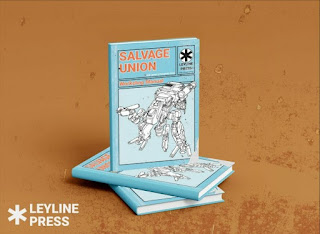
Physically, the Salvage Union Beta Quick-Start Guide is a decently presented digest-sized book, whose cover is reminiscent of a Haynes manual. Inside, the artwork varies in style, from fully painted vistas to line art drawings of the Mechs with cartoon-like illustrations of the pre-generated Pilots in-between. The layout is clean and tidy, and the quick-start is easy to read through.

The Salvage Union Beta Quick-Start Guide does an excellent job of introducing Salvage Union and how it is played. It not only comes with everything necessary to play its scenario, but a bit extra with which the Mediator can expand play beyond the scope of the scenario, providing a broader look at the core game. Some adjustment is necessary in terms of play since although this is a Mecha-style game, as it emphasises narrative play rather than tactical, for both the roleplaying and the Mech combat. Overall, the Salvage Union Beta Quick-Start Guide is an impressive introduction to Mecha-style games and settings, but without resorting to a lot of stats and wargames style play.

—oOo—

Salvage Union is currently being funded via Kickstarter.