Every Week It's Wibbley-Wobbley Timey-Wimey Pookie-Reviewery...
Showing posts with label The Troubleshooters. Show all posts

Friday, 11 February 2022

Aquatic Action

A missing U-boat! A lost painting! A kidnapped journalist! Ex-Nazi villains! All classic ingredients for a mystery and an adventure set during the nineteen sixties, perhaps done as a film or an episode of an action television series made by ITC Entertainment. Or written and drawn as the plot of a French or Belgian comic, one of those bande dessinée or bédé titles starring Tintin, Spirou et Fantasio, Blake & Mortimer, or Yoko Tsuno. Or they could be the ingredients of a scenario for a roleplaying game inspired by those very same bande dessinée titles. The scenario is The U-Boat Mystery and the roleplaying game is The Troubleshooters. Published by Helmgast and Modiphius Entertainment, The Troubleshooters is the roleplaying game of action, adventure, and mystery set in an alternate nineteen sixties. This is an age of international travel, optimism, and co-operation, in which the Player Characters will solve mysteries, investigate crime, and thwart the evil plans for world domination by the secret organisation known as The Octopus. The U-Boat Mystery is the first scenario to be released for The Troubleshooters.

The U-Boat Mystery is designed to be played by between three and five Troubleshooters. Between them, they should have some decent combat skills and one of them at least, should have the Diver ability, if not the Divemaster ability, as the scenario does end in a dive on a submarine. One option might be to let the Troubleshooters have the opportunity to train before the dive itself and spend any Experience Points at that stage of the adventure rather than afterwards.

The U-Boat Mystery opens with a discussion of the Plot Hooks which will get the Troubleshooters involved in the scenario’s mystery. The four are Arch-Enemy: The Octopus, Do-Gooder, Looking for a Case, and Media Darling, and one or more of the Troubleshooters have these as one of their two Plot Hooks, enabling them to get pulled in from the start. This is a feature of The Troubleshooters and each of the Plot Hooks can be used in two ways. Either as a handout which relates the events of the Plot Hook and can be easily shared with the other Troubleshooters, or as a scene in their own right which can be played out as a prequel for each of these Player Characters, ideally before the opening credits roll… For the Troubleshooter with Arch-Enemy: The Octopus, a widow, Mrs Wallhaus gives him a map of the Sitomeyang archipelago in Southeast Asia, before she is suddenly shot and injured; for the Do-Gooder, he helps evacuate the tenants of a burning apartment block and learns that someone heard shots before the fire and that the only person missing is a widow; the Troubleshooter Looking for a Case receives an anonymous bundle of clues, all seemingly unconnected; for the Media Darling, the journalist—Pierre Martin—mentions that he is off to New York and then the Far East to cover a German marine expedition, but is then kidnapped. The Game Master does not use all four, but picks two to tie in two of the Troubleshooters cast and then their players should do their best to pull in the others into the mystery. Of the four Plot Hooks for The U-Boat Mystery, all of which are set in Paris, one of them should definitely involve Pierre Martin.

Once the Troubleshooters are on the trail of Pierre Martin, a journalist for La République, they will find further clues. These include a u-boat lost at the end of World War 2 on a long journey from Germany to Japan, a painting influenced by Wagner and said to be liked by Hitler on display as part of an exhibition in New York, a marine biology expedition being mounted by the University of Hamburg to South East Asia, and more… It should be relatively easy for the Troubleshooters to put these clues together and follow them to the island kingdom of Sitomeyang. There are side clues which though not key to solving the mystery, will help the Troubleshooters and better prepare them for events later on. These will take the Troubleshooters to Hamburg and possibly Berlin, but whether they travel to either city, or indeed to New York, their ultimate destination is Sitomeyang.

In Sitomeyang the Troubleshooters will need to track down the final resting place of the missing u-boat and then make the dive. The final scenes of The U-Boat Mystery involve them diving down to, gaining access to the submarine, and exploring it, perhaps after having sneaked aboard the marine biology (or not) vessel for further clues and probably during a confrontation with the rival dive crew. The dive and the exploration of the submarine is described in some detail and will require some careful planning upon the part of the Troubleshooters as it is technically challenging and could get them into serious trouble if it went wrong. The confrontation is excitingly staged and makes for a great climax in the mode of the underwater scenes from the James Bond film, Thunderball. Throughout the whole of the adventure, the Troubleshooters will find themselves watched, harried, and even attacked, only adding to the tension and excitement of the adventure.

In terms of support for the Game Master, The U-Boat Mystery comes with eleven NPCs and sixteen enemies—one of whom is weird indeed! Besides the four start-up handouts, The U-Boat Mystery includes seven clues and handouts, as well as deck plans for both the enemy ship and the submarine. Details of the city of New York—including such information as Fiddler on the Roof having just opened, and the fictional kingdom of Sitomeyang are provided in the same format as the city descriptions in the core rulebook, meaning that they can be revisited again and again. Similarly, the new gear kits can also be used elsewhere.

Physically, The U-Boat Mystery comes as a handsome hardback, presented in full colour, with some fantastic artwork done in the bande dessinée style. The handouts are very nicely done—the book actually comes with a handful of tourist visas for Sitomeyang!—though the deck plans of the submarine and the boat belonging to the rival marine biology could have been clearer. However, the scenario does feel as it could have been better organised to be a clearer read for the Game Master, certainly in the opening stages when explaining the various clues. One aspect of The U-Boat Mystery which is optional is its Science Fiction elements. The mystery does involve Nazi fringe science and its side effects as written, although neither is crucial to the plot, and they do send the scenario off in a slightly wacky direction.

The U-Boat Mystery is overall, a very nicely done scenario. Neither its mystery nor its clues are particularly complex, meaning that the players and their Troubleshooters can concentrate on the action and the roleplaying as they round them up and put them together. Every Game Master of The Troubleshooters will want to grab The U-Boat Mystery for her campaign because the scenario is exciting and fun, and the players and their Troubleshooters will thoroughly enjoy themselves.

Sunday, 9 January 2022

Jet Age Action

The year is 1965. On March 19th, 1964, a joint Japanese-French mission landed on the Moon aboard the giant atomic rocket Kaguyahime, the Moon Princess – affectionately called Monsieur Renard (‘Mister Fox’) in France because of its orange-red paint job. Two space stations orbit the Earth—the US Aurora and the Soviet Budushcheye-1. In the skies over Europe and far-flung cities, the Aérospatiale/BAC Concorde carries passengers at the speed of sound with BOAC, Air France, and Air Majestique. Around the world the Cold War continues between the United States of America and the Union of Soviet Socialist Republics, with Europe divided by the ‘Iron Curtain’. This includes Arenwald, the alpine principality formerly part of the Austro-Hungarian Empire, squeezed in between Hungary, Sylveria, and Yugoslavia, famous as a stop on the Arlberg Orient Express line from London to Athens, and its Soviet counterpart, the Socialist Republic of Sylveria. The Cold War is not the only threat to the world, a secret organisation known as the Octopus, a centuries-old criminal organisation, has designs on world domination. There are other dangers too, as well as mysteries and conspiracies, many of which the authorities are not best-placed to deal with. Step forward the Troubleshooters, bands of friends and adventurers who are prepared to travel the world and investigate the mysteries, crimes, and dangers that the authorities decline to do. And if they can have fun along the way, all the better!

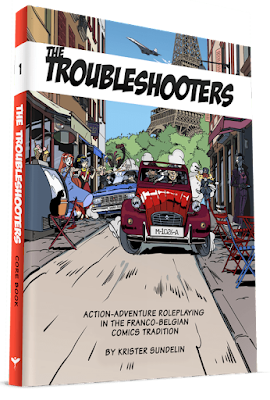
This is the set-up for The Troubleshooters: An Action-Adventure Roleplaying Game inspired by French and Belgian comics—bande dessinée or bédé—such as Tintin, Spirou et Fantasio, Blake & Mortimer, and Yoko Tsuno. Published by Helmgast following a successful Kickstarter campaign, this is an action-adventure roleplaying game set in the second half of the sixties and first half of the seventies, an era of glamour, optimism, and technological advances. Its outlook is optimistic and exciting, a metropolitan world primarily set across a Europe full of diverse and exotic locations. The players will take the roles of the Troubleshooters, freelance adventurers and investigators, friends ready to look into mysteries and crimes, travel to exotic locales, and have adventures! The Troubleshooters can have a theme and thus be a band of curious adventurers, sleuths, agents, or criminals (in the tone of ‘gentleman thieves’)—and The Troubleshooters starts off by discussing these and giving sample inspirations. Each Troubleshooter should be competent, have a particular role in the group—such as the Doer, Investigator, or Muscle, want to adventure, possess a weakness which enhances the story, be fun to play, and fun to play with.

A character in The Troubleshooters is defined by Skills, Max Vitality, Plot Hooks, Traits, Abilities, Complications, and Story Points. Skills—rated as percentiles—are broken down into Background, Social, Investigation, Action, and Combat skills, and they include skills such as Agility, Endurance, Strength, and Willpower, which in other roleplaying games would be used as attributes. Plot Hooks, such as ‘Do-Gooder’ or ‘Media Darling’, are used to pull Troubleshooters into a scenario, and published scenarios will use specific Plot Hooks to involve Troubleshooters. Abilities mark the Troubleshooter out as a special and come in three Tiers with increasingly harder requirements, but at each Tier provide a means for the Troubleshooter to spend Story Points. For example, the Actor Ability requires the Entertainment skill at 65%, and when used with other skills like Charm or Subterfuge, enables a Troubleshooter pretend to be another person. For one Story Point, the Troubleshooter can flip a Subterfuge task check when pretending to be someone else, but for two, he can make a new task check for Entertainment or Charm, and keep the new roll. Complications are roleplaying hooks, for both the player and the Director of Operations—as the Game Master is known in The Troubleshooters is known—and also a source of Story Points. For example, a Troubleshooter with the ‘Amorous’ Complication will earn three Story Points when distracted by his emotions and receives a −2 pips modification to task checks not related to said emotions, three Story Points if a romantic interlude causes him trouble, and six Story Points when a date or romantic interlude prevents him from participating in an important scene.

Troubleshooter creation is template based, though guidelines are included which allow a new template to be built or a Troubleshooter to be built without using a template. Fifteen templates are included from Adventurous Scholar, Aspiring Student, and Caring Veterinarian to Racing Driver, Suffering Artist, and Vigilante Lawyer. Each template includes some background, eleven skills, five Abilities, three Complications, Vitality, extra languages, three gear kits, and some Plot Hook suggestions. A player can modify the skills, but must choose two Abilities, one Complication, five gear kits (this is three more than the template gives, but there is an extensive list of gear included in the book), and two Plot Hooks. He also chooses languages if his Troubleshooter has any and finally decide—or roll—where he met the other Troubleshooters. (Alternatively, the players could just use the six signature Troubleshooters included as examples who figure in all of the examples through the book.)

Dickie Jones – Curious Engineer
Skills: Contacts 45%, Electronics 65%, Engineering 75%, Investigation 45%, Machinery 65%, Science 65%, Search 65%, Security 45%, Melee 45%, Vehicles 45%, Willpower 45%. (All other Skills 15%.)
Abilities: Curious, Tech Wiz
Complications: Combat Paralysis, Crude
Vitality: 5
Languages: –
Gear: Camping Gear, Ham radio set, Electronics toolbox, First Aid Kit, Mechanic’s toolbox (Signature)
Plot Hooks: Friends in High Places, I Owe You

Mechanically, The Troubleshooters is a percentile system. To undertake a Task, a Troubleshooter’s player rolls percentile dice and if the result is equal to or less than the skill and the Troubleshooter succeeds. If the roll is a double and below the Skill value, then the Troubleshooter earns Good Karma, succeeding with a bonus and gains a Story Point. Conversely, Bad Karma is gained if a double is rolled and it is above the Skill value. The Karma can be mechanical or storytelling in nature. The former might be +2 or -2 Pips for Good or Bad Karma, the latter reinforcements turn up, either to help or hinder the Troubleshooters, depending upon whether it is Good or Bad Karma. Modifiers to the roll come in the form of Pips, which range from +5 to -5. If the number of Pips is positive, then any result equal to, or less than the number of Pips on the Ones die will always succeed, even if the actual percentile roll is greater than the Skill value. Conversely, if the number of Pips is negative, then any result equal to, or less than the number of Pips on the Ones die will always fail, even if the actual percentile roll is less than the Skill value. Pips can be applied because the environment, such as in the middle of a storm, or equipment used, such as a tool kit. The Pips system does feel a little weird, even counterintuitive, but it does not take much adjusting to, and once you have, it is very workable.

Notably, if a test is failed, it cannot be repeated, either by the current Troubleshooter or any other Troubleshooter—unless circumstances have changed significantly. Failure though is not intended be an absolute, but rather that the Troubleshooter ‘Fail Forward’ and either learn from the failure or push the story on in interesting ways. For example, in a fight, a Troubleshooter might not be killed, but rather captured, or if a Troubleshooter fails to defuse a bomb in time, he at least learns something about the design. In addition, every Troubleshooter has Story Points. Their most common use is to flip the results of a percentile roll. However, they can also be spent to activate Abilities, get gadgets beyond the standard five a Troubleshooter starts play with, gain clues, and either add something major or minor to the ongoing story. Adding something to the story may require a little negotiation with the Director.

For example, Dickie Jones is participating in a rally across Sylveria. He is the co-driver in a car driven by his fellow Troubleshooter and Finnish rally driver, Tristan Narbrough, but in addition to wanting to place well in the event, they are after a Soviet spy who is heading for the Socialist Republic of Sylveria with some information stolen from one of the sponsors of their car. However, during a night stage, in the middle of a storm, their car, a Mini-Cooper breaks down. Dickie leaps out of his seat, tool kit in hand, and pulls up the bonnet. To determine the fault and fix is going to require a Machinery 65% Test. The Director of Operations sets the Task at ‘-2 Pips’ for the storm, but Tristan’s player describes how he is holding a torch to make sure that Dickie can see what he is doing, which negates the ‘-2 Pips’. Plus, of course, Dickie has his signature Mechanic’s toolbox, which gives him two Pips. So, Dickie’s player is rolling his Machinery 65% Skill at ‘+2 Pips’. Dickie’s player rolls 99%! Not only is this a failure, but it is also one with Bad Karma. This could be bad news for both Dickie and Tristian, but Dickie has the Tech Wiz Ability, which enables his player to reroll an Electronics, Engineering, or Machinery Task for one Story Point. Dickie’s player spends the Story Point and rerolls, but the result is a 71%—better but still a failure… Except no, the value on the Ones die is less than the Pips, which means that Dickie finds the fault, fixes it, and they are back on the road again, driving hard to catch up with and capture the industrial spy!
Combat in The Troubleshooters is more complex and is built around opposed Tests between attacking and defensive Skills, for example, Melee versus Melee Skill or Ranged Combat versus the Agility Skill. The Troubleshooters, as Player Characters, have Defence Skills, but unless they are important, Director characters (or NPCs) do not. Initiative is handled with an Agility Test, with the rests of the two dice added together if successful. Damage is rolled on six-sided dice, typically just two for unarmed attacks, all the way up to seven for machine guns. Rolls of four, five, and six inflict a point of Vitality damage per die, with results of six exploding and potentially doing more damage. Armour allows Soak rolls which negate points of damage, but do not explode. Recovery rolls, made to recover Vitality work the same as Soak rolls. A Troubleshooter or an important Director character is out Cold when they run out of Vitality, although either can take the Wounded or the Mortal Peril Condition instead of suffering Vitality loss. This typically to void being Out Cold, but both have consequences after the fight and take time to heal. What is stressed throughout The Troubleshooters is that it is not a roleplaying game about killing and that it is very difficult for a Troubleshooter to die. Indeed, the most common way of a Troubleshooter dying is when it is dramatically appropriate and the Director has stated that it is a possibility in a scene. As to killing, if a player has his Troubleshooter kill a Director character in cold blood, then the Director is advised to deny the Troubleshooter any free improvement checks at the end of the adventure, and remove all of the Troubleshooter’s Story Points, as well as half of the Story Points of those Troubleshooters’ who could have stopped him. This is harsh, but The Troubleshooters is intended as a positive roleplaying and roleplaying experience.

For the Director of Operations, there is good advice on setting up combat scenes to make them interesting and challenging, adjudicating the use and awarding of Story Points, an extensive list of Gear—including Weird Tech with which to equip the bad guys or interest any budding Tech Wiz Troubleshooter. The advice also covers hosting and running the game, portraying the Director’s characters—including how to make the bigger villains camp, and creating adventures and campaign. She is accorded a full description of the Octopus, its organisation, members, aims, and technology, plus plenty of stats and write-ups of various Director characters and animals. In terms of background, ‘The World of The Troubleshooters’ presents the period and setting in some detail, highlighting not just the differences between the sixties that we know from history and the sixties of The Troubleshooters, but also the similarities. It covers technology, travel, and more before providing a whirlwind guide to some of the interesting places and cities around the world, from Paris and Berlin to Buenos Aries to Ice Station X-14. These are really good, describing each location in a couple of pages including lists of where to stay, things to do, and why that location is being visited as part of the Troubleshooters’ adventure. In fact, these location descriptions feel reminiscent of the Thrilling Locations supplement for the James Bond 007 roleplaying game from 1983 and certainly that sourcebook could be useful until The Troubleshooters gets one of its own. Rounding out The Troubleshooters is a set of appendices which include a calendar for 1965, lists of first names in various languages, a table of character traits, and several lists of profanities, but not profanities, which should allow a Troubleshooter to swear, but not swear, and still maintain the spirit of the bande dessinée. “Blue blistering barnacles!” indeed.

Physically, The Troubleshooters is a stunning looking book. The artwork, done in the ‘Ligne claire’ style pioneered by Hergé, nicely sets the signature cast of The Troubleshooters against the well-drawn backdrop of the real world. Make no mistake, the artwork is excellent throughout, really capturing the feel of the roleplaying’s inspiration. Although it needs a slight edit in places, The Troubleshooters is well written and an engaging read from start to finish. Throughout, the rules and situations are explained in numerous examples of play, all using the signature cast of The Troubleshooters and narrated by Graf Albrecht Vogelin Erwin von Zadrith, the Number Two of the Octopus, as the Director. These are all entertaining to read and tell a story as much as they inform about the rules.

If there are any issues with The Troubleshooters, then there are two. First, there is no scenario. Second, the other thing is that although it references various bande dessinée, it does not list actual titles. Fortunately, there are three scenarios available for the roleplaying game in The Troubleshooters’ Archive. The lack of a bibliography can be got around using the pointers included here as a starting point. In addition, The U-boat Mystery scenario is already available.

The obvious thing about The Troubleshooters is that could be used to run a James Bond style roleplaying game. It could be, and it would work well as a James Bond roleplaying game, but The Troubleshooters is not as cynical in tone or even as murderous as the world of James Bond is in comparison. Much lighter in tone, The Troubleshooters is of course a roleplaying game of adventure tourism in the style of bande dessinée, but also that of the ITC Entertainment television series of the period. For example, The Saint, The Persuaders!, and The Protectors, and whilst it is specific in its bande dessinée inspiration, The Troubleshooters is really the first roleplaying game to look back to the period since Agents of S.W.I.N.G..

The Troubleshooters: An Action-Adventure Roleplaying Game is great looking book with artwork which wonderfully evokes its source material. The rules and mechanics support play in the style of that source material, enabling the players to create fun Troubleshooters, and jet or drive off on amazing, exciting adventures with each other and tell great stories. With its comic book or bande dessinée sensibilities, there can be no doubt that The Troubleshooters takes us back to a simpler, if headier and more optimistic time. The combination means The Troubleshooters is engagingly, delightfully European and charmingly chic.