Every Week It's Wibbley-Wobbley Timey-Wimey Pookie-Reviewery...
Showing posts with label cartoon adventure. Show all posts

Thursday, 29 February 2024

1984: Toon

1974 is an important year for the gaming hobby. It is the year that Dungeons & Dragons was introduced, the original RPG from which all other RPGs would ultimately be derived and the original RPG from which so many computer games would draw for their inspiration. It is fitting that the current owner of the game, Wizards of the Coast, released the new version, Dungeons & Dragons, Fifth Edition, in the year of the game’s fortieth anniversary. To celebrate this, Reviews from R’lyeh will be running a series of reviews from the hobby’s anniversary years, thus there will be reviews from 1974, from 1984, from 1994, and from 2004—the thirtieth, twentieth, and tenth anniversaries of the titles. These will be retrospectives, in each case an opportunity to re-appraise interesting titles and true classics decades on from the year of their original release.

—oOo—

It is interesting to note that two of the hobby’s mostly highly regarded humour roleplaying games were co-designed by Greg Costikyan and both were published in 1984. One, the dystopian Science Fiction roleplaying game, Paranoia: A Role-Playing Game of a Darkly Humorous Future, published by West End Games, was most obviously published in 1984, because after all, that was the year that George Orwell’s eponymous novel is set. The other was Toon – The Cartoon Roleplaying Game. Published by Steve Jackson Games, it was based on an original idea by Jeff Dee which was inspired by a conversation about genres that nobody had then yet designed roleplaying games for. As its title suggested, that genre was cartoons. Not the cartoons of Saturday mornings, but rather the short, sometimes violently anarchic cartoons of Warner Bros’ Looney Toons, Hanna and Barbera’s Tom and Jerry, and Walt Disney’s Silly Symphonies and others. This is a genre that almost everyone is familiar with, making the resulting roleplaying game incredibly familiar in terms of what you were playing and the world in which it took place. However, Toon also asked a great deal of its players in terms of how it was played, because in many ways it was asking them to do everything which other roleplaying games had taught them not to do.

In almost every other roleplaying game, the player not only wants his character to survive, to grow, and to thrive, which invariably means plotting and planning, and taking the time to come up with the best tactics or strategy to achieve all three. Not so in
Toon. Let alone the fact that a character in Toon cannot die—only fall down for three minutes of real time—the play is all about the immediate. What does my character want? How does he achieve that right now? What is the simplest and more direct way of getting that? It does not matter if that direct way is not the most logical, for it serves its purpose right now. So rather than ‘think before you act’, the credo of Toon is ‘ACT before you THINK’. The roleplaying game will even punish a player if he thinks before he acts or attempts to think before he acts, rendering his character Boggled and unable to do anything until his next turn. This is a roleplaying game played at high speed, even breakneck speed, in which the action passes from one character to the next in a flurry, in which Short Subjects and Feature Films always take place in Anytown, Outside of Town, The City, and Outer Space, where there is always a mailbox close by to receive that thing you just ordered, logic has a way of being illogical in an entirely logical way, coincidences are perfectly normal and to be expected, cause and effect might go one way for one character, but not another, and nobody reads the fine print until you write it and persuade everyone as to its veracity.

Toon – The Cartoon Roleplaying Game is a roleplaying game with a genre that everyone will know and will understand how its worlds work, supported by simple, fast-playing mechanics, good advice for the Animator—as the Game Master is known, and four Short Subjects and one Feature Film. One of the Short Subjects is designed to teach the game and so with a quick read through and copies of the characters ready, the Animator really could be running her first game in fifteen minutes.

A character can be anything. An ant, a robot ant, a sea serpent, a kangaroo, a pig, a parakeet, and so on. He can run and talk, take part in the Cartoon Olympics, go to Outer Space, and more, whether he is a Milkman, a Retired General, a French Chef, or a Cowboy. He has four attributes—Muscle, Zip, Smarts, and Chutzpah—which determine how strong, how fast, how intelligent, and how pushy he is. They are range in value between one and six. Each attribute has a number of skills, which range in value between one and nine. He will have a natural enemy, such as a cat for a dog or a park ranger for a bear; a Belief and a Goal, for example, “I hate elephants” and “Stop the hunter from hunting me in Rabbit Season”; a possession or two; and Shtick. A Shtick is an amazing ability that breaks rules. For example, a Bag of Many Things from which innumerable objects can be drawn, Shape Change, Hypnosis, and so on. Mechanically, they are rolled for just like skills to see if they work.

To create a character, a player rolls a six-sided die for each of the four attributes. Species, Occupations, Beliefs, and Goals can selected or rolled for, or selected, whilst Natural Enemies are always chosen. The base value for each skill is equal to its associated attributes, but a player has thirty points to divide between them. Alternatively, a character can have a Shtick, which costs five skill points and always begins play with a value of five. This cannot be increased during character creation, only later through experience. The process is quick and easy and takes five minutes.

Doctor Freuderick “It’s pronounced ‘Frederick’” von Mesenme (Actually Joe from Pittsburgh)
Species: Human
Natural Enemies: Patients and other doctors
Belief: I always know what is best for my patients
Goal: Get rich
Hit Points: 9

Muscle 3
Break Down Doors 3, Climb 3, Fight 6, Pick Up heavy Things 3, Throw 3

Zip 2
Dodge 7, Drive Vehicle 2, Fire Gun 2, Jump 4, Ride 2, Run 4, Swim 4

Smarts 5
Hide/Spot Hidden 5, Identify Dangerous Thing 7, Read 5, Resist Fast Talk 8, See/Hear/Smell 5, Set/Disarm Trap 5, Track/Cover Tracks 5

Chutzpah 6
Fast-Talk 9, Pass/Detect Shoddy Goods 9, Sleight of Hand 6, Sneak 6

Shticks
Hypnosis 5

Possessions
Medical Diploma from The Republic of Užupis University of Universal Study, Pocket Watch, Pipe (for bubbles), medical forms

Mechanically,
Toon is simple. To undertake an action, the player rolls two six-sided dice, and aims to roll equal to or lower than the skill or attribute. It is a simple yes or no mechanic. Situations where there is an opposed roll, such as a fight or a chase or a competition, the outcome is determined by who rolls successfully and who fails. Thus, in a chase, the character who makes a successful roll with either Drive Vehicle, Run, or Swim will get away from the character who fails his roll, whereas if both make a successful roll or fail, neither makes any progress. Combat uses the Fight or Shoot Gun skills, with brawls and bust ups being opposed rolls. In general, if neither side is successful, that is, makes a successful roll whilst the other fails, then after three rounds of both making successful or failed rolls, both characters fall down exhausted. If a character is successfully hit in a fight or shot, then he suffers a six-sided die’s worth of damage. If he loses all of his Hit Points, the character will Fall Down. This is bad, but not actually that bad, because unlike every other roleplaying game, the character is not dead. Instead, he is out for the count, but can bound back, because that count is three minutes of real time. After that, the character and his player are back in the game with full Hit Points, ready to play.

The mechanical aim of play is to earn Plot Points. These actually reflect how well a player has roleplayed his character and served the genre of the Short Subject or the Feature Film. Each Short Subject and Feature Film has a budget to divide amongst the Player Characters at the end, but a player can earn more when his character makes another Fall Down, roleplays the character’s Beliefs & Goals, has his character make a Natural Enemy Fall Down, roleplays his character in a clever or entertaining fashion, and even for making the Animator laugh. Conversely, he loses them if he does not roleplay the character’s Beliefs & Goals or if the character is made to Fall Down by an NPC. Plot Points are used to increase a Player Character’s skills and shticks, including buying new shticks.

In terms of game play,
Toon – The Cartoon Roleplaying Game begins before Player Character creation. This gives a description the base elements of the game, how the skills work, a quick introduction to Plot Points, and some advice the Animator. All this in preparation for ‘The Cartoon Olympics’, a Short Subject designed for the Animator and two players. Taking place in the Anytown Anydome, this sports event will see the Player Characters compete in boxing matches, javelin toss, and marathon to determine the winner. They will also have to deal with Judge Mole, who of course, is blind as and also armed with a deadly starting pistol, and a bunch of monkeys. Although intended for two platers, the Short Subject includes a quartet of potential Player Characters, such as Mack the Mouse, Olga Hippopovna, Fred Bulldog, and Fifi La Feline. This is an easy to prepare Short Subject that can be brought to the table very quickly.

It should be noted that
Toon also emphasises adversarial play, a feature also shared with Paranoia. Player Characters can have conflicting goals even as they work collectively towards the objective of a Short Subject or Feature Film, but more often than not, they are directing competing against each other, as in ‘The Cartoon Olympics’, and unlike in other roleplaying games, there can be a winner. Offset that though, with the fact that Toon is designed for ephemeral, one-shot play rather than campaigns, so even if the same Player Characters appear in a subsequent Short Subject or Feature Film, the events or outcome of a previous Short Subject or Feature Film will not have any real influence on the next one.

Beyond both ‘The Cartoon Olympics’ and Player Character creation,
Toon – The Cartoon Roleplaying Game explains how Beliefs & Goals, skills, and shticks all work, plus there is good advice on being the Animator. Ultimately, this boils down to keeping things moving, throwing in sound effects, playing to the genre, and transmitting the right atmosphere to her players. The advice also stresses that the most important aspect of being an Animator is to remember that the Animator is in charge, and that anything she says goes. That said, the Animator should always be open to ideas from her players and when it counts, she should act crazy.

Rounding out
Toon – The Cartoon Roleplaying Game are another three Short Subjects and one Feature Film. The extra Short Subjects include ‘The Cartoon Olympics Strikes Back!’, which really just expands on ‘The Cartoon Olympics’ with a single page; ‘I Foogled You!’ sends the Player Characters into the jungles of Darkest Africa (conveniently located Outside of Town) in search of the famed Foogle Bird, which involves lots of swinging on vines with a Tarzan-like character and his wife; and ‘Spaced Out Saps’ in which members if the Space Aeronautics Patrol Squad or S.A.P.S., take a trip to the Moon (conveniently located Outside of Town) and investigate strange activity involving The Martian and The Martian Dog. The Feature Film is ‘The Better Housetrap’ in which the Player Characters are trying to hide out in a newly built house, only for them to discover that the house is actually robotic! Each one of the Short Subjects and the Feature Films can be played in a single session and each wears its inspirations firmly on its sleeves.

Physically,
Toon – The Cartoon Roleplaying Game is cleanly, tidily laid out and organised. It is liberally illustrated with entertaining cartoon artwork. The roleplaying game is well written and easy to read and grasp.

—oOo—
Toon – The Cartoon Roleplaying Game was reviewed not once, but twice by Dragon magazine. First by Michael Dobson in ‘New heights(?) in silliness’ in Dragon #92 (December 1984), in which the opening line is, “TOON™, The Cartoon Roleplaying Game, appears at first glance to be just an elaborate joke.” before he qualifies this with, “…TOON is a genuine good idea – an original (if unlikely) concept in role-playing – that is enjoyable, fastmoving, and incredibly silly.” Although critical of the roleplaying game’s use of Plot Points, which he felt were, “…[A] holdover from traditional role-playing games that doesn’t quite fit the TOON spirit. In a straight adventure game, a character’s potential to improve may be important as a tool to motivate the player and to keep a campaign going. In TOON, this approach doesn’t make sense. Cartoon characters never get “better.”” Nevertheless, Dobson described Toon as “Inspired silliness…” Jim Bambra would follow this up in Dragon #144 (April 1989) in ‘Role-Playing Reviews’. He described it as “…[A] classic – a game which deserves the attention of everyone looking for a dramatic change of pace and emphasis in their role-playing.” before concluding with, “The TOON game provides an excellent change of pace and a shift of emphasis away from the more serious role-playing games. I highly recommend it as an evening’s entertainment and as a cure to role-playing blues.”

In ‘Notices’ in Imagine No 21 (December 1984), Mike Lewis was equally as positive, concluding his review with, “Toon is a very refreshing change from the usual run-of-the-mill rpgs which have been appearing recently. The game very firmly puts a sense of humour back into rpgs. If you are interested in cartoons, then Toon is an essential purchase — but even if you aren’t, try it for a change. I am very impressed with the ideas behind this game and hope that it gets more support than most minority RPGs have done in the past. It deserves it.”

R.A. Greer reviewed
Toon in Space Gamer Number 72 ((Jan/Feb 1985) and like Jim Bambra would four years later, described it as an antidote to the roleplaying blues, saying that, “TOON is a quick cure for all your roleplaying ills, a fast-acting balm to be applied directly to your funny bone, speeding you back to those uncomplicated days of roleplaying when it was fun!” His conclusion was equally as complimentary, stating that, “TOON is a gem for those willing to work with it a little bit. (The game should have been published with a qualified Animator stapled inside.) It may not replace the weekly fantasy game, but it’s great change of pace. It is also a great introduction to roleplaying for that new to the hobby and really allows experienced gamers to let down their hair. Almost all of TOON’s problems can be solved by applying this simple maxim: “If you want to do it, exaggerate it; if it’s simple, complicate it; if you’re in a jam, take all steps to make it worse.” Follow these simple rules and you’ll advance the plot and add to the fun. Congratulations to Steve Jackson Games on a job well done.”

None other than Larry DiTillio reviewed Toon in ‘Game Reviews’ in Different Worlds Issue 38 (Jan/Feb 1985), awarding the roleplaying three stars out of four and praising its writing, stating that, “[Greg] Costikyan has clarity, wit, and the good sense to be brief, as well as an obvious love for cartoons. The rulebook not only reads quickly and easily, it makes you eager to play the game.” He advised that, “Role-players of a basically serious nature and gamemasters who prefer rigid detail are advised to stay away. On the other hand, for a few hours of silliness, Toon can’t be beat and is a refreshing change from the ofttimes leaden pace of other role-playing games. It’s fast, it’s fun, it’s simple.”

Lastly,
Toon was reviewed in ‘Open Box’ in White Dwarf Number 63 (March 1985) by Stephen Kyle, who awarded it nine out of ten. He concluded that, “For anyone who likes cartoons, then Toon is definitely worth looking into. It concentrates more on the Warner Brothers/Hanna Barbera type of American cartoon, rather than the more sophisticated British product like Dangermouse. Nevertheless, all of us have favourite cartoons or characters and Toon enables you to recreate them easily and with a lot of fun. I just hope it gets more support than most minority RPGs.”
—oOo—

Toon – The Cartoon Roleplaying Game does have one single problem—and it is a big one. That is the degree of buy-in that a Game Master and her players need to have to play and enjoy Toon, the willingness to accept its implied anarchy and mandatory impulsiveness of ‘ACT before you THINK’, and to break the learned habits of playing roleplaying games. A player unwilling or unable to make that adjustment is not going to enjoy or appreciate the fun that Toon has to offer.

Toon – The Cartoon Roleplaying Game is and was a groundbreaking roleplaying game, because of its treatment of the cartoon genre and its humour, although numerous roleplaying games have visited its genre since. It is simple, even simplistic, but the simplicity of the rules and the mechanics means that Toon is incredibly easy to teach and just as easy to grasp, and when it comes to its genre, Toon has the most accessible, most familiar genre of almost any roleplaying game. After all, who has not seen a Looney Tunes or Tom and Jerry cartoon? Which absolutely makes it great for convention play. That said, whilst it can be used as an introductory roleplaying game, it is not written as an introductory roleplaying game, so is best suited to be run by an experienced Game Master who can adapt to its fast pace and over the top, silly play. Similarly, this is a roleplaying game whose speed and tone is something that experienced players will also have to adapt to in order to get into the spirit of the roleplaying game and its silly, cartoon humour. Essentially, this is not a roleplaying game which the Game Master simply decides to run—her players have to buy into the whole concept, big anvil, stick of dynamite, and all.

Toon – The Cartoon Roleplaying Game is undemanding fun that in the hands of a good Animator rewards energy, inventiveness, and impulsiveness. Toon – The Cartoon Roleplaying Game is the roleplaying equivalent of a tonic, a great pick up and play roleplaying game that enables the players to engage in all of the mayhem and madness of their favourite childhood cartoons and after they Fall Down, get back up and dive right back in.

Friday, 27 January 2023

The Other OSR—Gozr – Sci-Fantasy RPG

The Angry Sun bleeds on the Broken World. Some days it burns hot and cold. Some days it burns the land. Some days it drains the Wiz of their powers. Others it is cool and sleepy. Sky Wyrms hunt for meat below. Fallen towers radiate magic and hide spells. Ruins hide the secrets and treasures of the past. This is the Broken World. The Broken World is the world of the Gooz now. Warty, hairy, dirty, ugly, flute-eared Gooz. Once they were just vermin, but the Pretty Ones are long dead in the ground. The Gooz explore the world, search the ruins, and climb the towers, sometimes to save the Broken World, but mostly to get rich. They set out from Gooz City ready to face danger such as the Quetzplow, which will slurp out a Gooz’s brains, Assassin Bots, and coin-eating Mooku which can glue a Gooz to the ground with its snot. This is the setting for the Gozr – Sci-Fantasy RPG, a post-apocalyptic roleplaying game designed and drawn by James V. West. The author and illustrator is best known for the fanzine, Black Pudding, the Old School Renaissance, Swords & Sorcery fanzine, which he also draws and writes—just like the Gozr – Sci-Fantasy RPG. Black Pudding brought a slightly gonzo sensibility to the Old School Renaissance and every issue left the reader wanting to see a roleplaying based on its content. That roleplaying game is Doomslakers. It not the Gozr – Sci-Fantasy RPG, which instead is an over-the-top, gonzo, underground comic style post-apocalyptic roleplaying game in which everything is hand drawn and handwritten. Literally nothing in the Gozr – Sci-Fantasy RPG is printed using traditional founts or layout. Coloured in vibrant shades, it is a riotous mass of tables, rules, and illustrations that boggles the mind!

Gozr – Sci-Fantasy RPG is published by Random Order Creations following a successful Kickstarter campaign. It has an Old School Renaissance sensibility, one it shares with microclones such as Into the Odd, Knave, and Cairn, and in comparison with those roleplaying games and other retroclones, it has two primary issues—one obvious, one less so. The former is the presentation. It is bold, it is bright, it is a jumble, and that makes it inaccessible—or at least difficult to access with any ease. Everything jumps off the page, so it takes just that little more effort than another roleplaying game would. The latter is the lack of a ready to play scenario. Gozr – Sci-Fantasy RPG does include a table of ‘Recent Events of Some Gravity’, an ‘Adventure Machine’ table, and a ‘Towers’ table to help the Gooz Master create adventures from these prompts, but a scenario would have been a useful inclusion.

A Gooz in Gozr – Sci-Fantasy RPG starts with three attributes or Action Classes as they are called here—Cunning, Magic, and Prowess. Confusingly, they are abbreviated to ‘AC’, which sort of makes sense when the Gooz Master asks a player to roll against an ‘Action Class’. These are initially rated eight, ten, or fourteen, the lower the Action Class the better it is. He also has Hit Points; a Defence value, which reduces damage taken directly; and points of ‘Gooz’ to spend on doing extraordinary things. Creating a Gooz is a fourteen-point step, as a player rolls not just for starting Hit Points and armour, but also starting weapon, money, colour of blood, colour of skin, eyes, and hair, hair style, lucky symbol, talent, background, clothes, name, possessions, and ears. Talents include Alchemy, Psionic, Strong, Eyebeam, and more. Alternatively, many of these a player can simply pick from the table. A Gooz is just a Gooz unless he is a Gooz Wizard and even if not, there is a chance of his knowing a single vulgar spell or possibly more (if he knows more, he might as well be a wizard).

Name: Finus
Cunning: 8
Magic: 10
Prowess: 14

Hit Points 15

Gooz 5

Talent: Extra Arm
Armour: None
Weapons: Falx (2d4), Pistol (2d4 six-shot)
Lucky Symbol: Cat
Money: 3 Tossers

Blood: Orange
Skin: Pink Hair: None Hair Colour: Grey Eyes: Pink Ears: Triangles

Wearing: Crude loincloth
Possessions: Pyramid puzzle, lockpick kit, blanket
Background: Burglar
Need: Set up the best cat sanctuary in all of Gooz City
Deed: Stopped Kern from eating another cat

Mechanically, Gozr – Sci-Fantasy RPG is simple. It is player-facing, so a player rolls the dice both to attack and defend in combat, rather than the Gooz Master rolling for the latter. To have his Gooz undertake an action, a player rolls against the appropriate Action Class, aiming to roll equal to or higher than the value. Thus, lower Action Classes are better than higher ones. A natural twenty is a critical hit and a special effect will always apply, such as a knockdown or a disarm, whereas it may apply if the roll is a ‘Solid Hit’, five or more higher than the value of the Action Class and . A natural roll of one is a fumble, in which case the player describes the unfortunate outcome. However, a roll of just one under the Action Class is called a ‘Graze’ and while counted as a miss or failure, allows for a small benefit. A Gooz can be Lucky or Unlucky, in which case a +2 or -2 is levied on the roll, respectively. It is also possible for a Gooz to be luckier or unluckier than this. One nice touch about the Gooz Sheet for Gozr – Sci-Fantasy RPG is that space is given for both ‘Solid Hit’ and ‘Graze’ values for each Action Class.

Gooz can also be spent for the Gooz to be amazing. A point allows a Gooz to pull off a cool stunt, steal the initiative, succeed at die roll, learn a fact from the Gooz Master, gain an extra action, and even add a fact to current game. Gooz is the equivalent of hero or luck points and refreshes daily.

Combat in Gozr – Sci-Fantasy RPG is similarly simple, but can also be deadly. On a turn, a Gooz can do one thing—take an action or move, plus do something trivial. The Defence value is deducted from any damage rolled, but all damage dice explode, so can inflict a lot of damage and easily kill a Gooz. If an enemy’s Hit Points are reduced to zero, then it is dead, but a Gooz has a choice—death or debasement. The former is the noble choice and the player’s new Gooz gains a small boon. The latter means that the Gooz is knocked down, scarred, and suffers from the permanent effect of the deadly blow. Damage can also be ‘Real’ such as that suffered by a Wizard from his weakness. This ignores Defence. Beyond this, Gozr – Sci-Fantasy RPG covers rules for fumbles, cover, conditions, morale, poisons, nasty scars, travel, exploration, and more.

Magic in Gozr – Sci-Fantasy RPG is divided between the Vulgar, the Wizardly, and the True. . Vulgar magic includes spells such as Bite It or Sparkler or Hold Breath. Whilst magic requires a roll against a Gooz’s Magic Action Class, a Wizard can undo, counter, and even reverse the effects of Vulgar spells. True magic is not to be trifled with and all Gooz believe that doing so was what killed the Pretty Ones and really, really annoyed the Sun. An actual Wizard must adhere to the three Laws of True Magic—bear a Wizard’s mark, suffer a weakness that is his bane, and be followed by a Watcher who will always be following and judging the Wizard’s exploits. Wizard spells are more powerful than Vulgar spells and include spells such as Blend In, Exploding Doom, Ice Burst, and Liar. All cost Wiz to cast and a Wizard begins play with between two and twelve points of Wiz. Points of Wiz are recovered much like Hit Points, but the Wizard must choose between the two—he cannot recover both at the same time. A Wizard can also have a familiar and know a few tricks. One major difference between ordinary Gooz and Gooz Wizards, at least mechanically, is that ordinary Gooz begin with the equivalent of having gained a Level prior to beginning play. Gooz gain Levels by surviving adventures and with a new Level gain two out of more Hit Points, a spell, increased Wiz, a treasure, or some lucky rolls.

Treasure is where Gozr – Sci-Fantasy RPG begins show off the weirdness of its setting. Items of power can sacrificed in return for fortune. At worst, this result in scorched earth as the Sun rains down fireballs on the land and everyone knows about it, but at best, not only all the Gooz go up a Level, but the land is healed for a time… Quite what that means is left up to the Gooz Master to decode. There are long tables of treasure, including Frivolous Junk, Strange Items, Odd Armour, and Super Tech. The Gooz Master can even give any treasure secret properties with another table. In terms of setting, Goozer City, the last beacon of civilisation, first bastion of Gooz ascendancy, is detailed in terms of more tables that the Gooz Master can roll on to create streets, buildings, routes, smells, vendors, and more. Beyond the city there is map of the immediate regions with short encounter tables for each, an ‘Adventure Machine’ table and tables to create towers that leak sorcery and secrets, the daily effects of the Sun, and both a table to create monsters and a decent bestiary too.

Physically, Gozr – Sci-Fantasy RPG is cartoonishly presented, in a style that echoes Ralph Bakshi’s Wizards. It is busy, vibrant, and full of little embellishments that seem to sneak into view as you are trying to find something else. It is not so much well written as well hand drawn and written giving it a highly distinctive look. However, it could be better organised as the section on Wizards and magic is the middle of the section that ready should be for the Gooz Master.

There can be no doubt that the Gozr – Sci-Fantasy RPG is as much a piece of art—cartoonish art—but art nonetheless, as it is a roleplaying game. As a work of art it is more accessible than as a roleplaying game, its funky, gonzo fanzine-like style often inhibiting the technical nature of the roleplaying game. Not necessarily to the point where the Gozr – Sci-Fantasy RPG is unplayable, but rather to present the reader with a hurdle that has to be overcome in finding where everything is and thus learning how to play.  The other hurdle is the lack of scenario. Now there are plenty of tables which the Gooz Master can take inspiration from, but given that 
Gozr – Sci-Fantasy RPG includes a handful sample Player Characters, it seems odd not to have a starter scenario too.

Gozr – Sci-Fantasy RPG looks—and is—fun. Weird and wacky, funky and freaky, gonzo and goofy, Gozr – Sci-Fantasy RPG is a joyously higgledy-piggledy toolkit for cartoonishly post-apocalyptic fun.

Saturday, 25 June 2022

Cartoon Chaos

Ker-Splat!
is a cartoon action roleplaying game inspired by Looney Toons and Tom & Jerry. Dynamite will get stuffed down trousers. Anvils will land on heads. Walls will be run into. Cheesegraters will be slide up and down. Stairs will be fallen down. Custard pies will be thrown and land in faces. And whether he has fallen down or is still standing, the cartoon character who suffers all or any one of these will be Bamboozled as a scattering of stars or a flight of tweeting birds orbit his head. Published by MacGuffin & Company
Ker-Splat! is a fast-playing silly roleplaying game for anyone who wants to play a chicken with a chainsaw, an otter on a skateboard, a goldfish in a bucket, a squirrel wiseguy, a mouse with a mallet, or anything else. It is ridiculous, it conforms to genre physics, not real physics, and it involves either Ordered Chaos or Pure Chaos, and true to the genre, it is played out in two-dimensional world.

A Player Character in 
Ker-Splat! is defined by his name, his Pitch, his Drive, his Quirk, his Look, and seven stats. His Pitch is whatever the character is, for example, a ‘Raccoon in a monocle and waistcoat who wants an easy life’ or ‘A Knight on a noble quest who was never told what the quest was and whose visor keeps jamming closed’. His Drive is his motivation, such as ‘Dining on freshly caught chicken’ or ‘Preventing the wolf from eating you and your fellow chickens’. His Quirk is whatever his special ability is, Ker-Splat! listing some nineteen, such as Pocket Dimension, Lucky Duck, Disguise, Wealth, and more.

A Player Character has seven stats. These are divided between the five Humours—Pow, Zip, Umm, Wow, and Pop, and Ouch! and HUH!, the latter measuring how long it is until he is either Ker-Splatted or Bambozzled. Pow is the character’s physical strength and size, Zip how fast and dextrous he is, Umm how brainy, Wow how charismatic, and Pop his ability to use tools and equipment, as well as his ability to order something from the ‘AKMEE™ PLC Catalog’. The Humours are rated between two and nineteen, and there are pluses and minuses to their high or low. For example, a Player Character with a high Zip will be fast and able to run away, but will often miss the little details, be impatient, and so on. With a low Zip, the character will take his time to understand things, not act rashly, trigger fewer traps, and so on. A Player Character with a high Umm will be good at making plans and spotting things, but in the two-dimensional cartoon world of 
Ker-Splat! will notice that tunnel entrance is just painted on the side of the mountain and so go around, whereas a Player Character with a low Umm would accept that tunnel as reality and race down it (and likely get run over by a train).

Player Character is simple. A player defines his character’s Pitch, Drive, Quirk, and Look, but he only sets the value for one of his character’s Humours. Each of the other players takes it in turn to set one stat before passing the character to the next player and so on round the table until all of the Humours are defined. In each case, a player is simply assigning a value, but in this way, the players collectively define the cast of the carton.

Chuffy the Chicken
Chicken with a Chainsaw, who isn’t going to let the wolf get her or her fellow chickens
Pow 5 Zip 12 Umm 9 Wow 12 Pop 10
Ouch! 3
HUH! 3
Quirk: Lucky Duck

Mechanically, 
Ker-Splat! is simple, but it does look a bit complex. It all depends if the Player Character is attempting to do something in keeping with his Humour or something that is not in keeping with his Humour. If the Player Character is attempting to do something in keeping with his Humour, his player must succeed or roll under his character’s Humour on a twenty-sided die. If the Player Character is attempting to do something that is not in keeping with his Humour, he must fail or roll over his character’s Humour. For example, if Chuffy the Chicken wants to use her chainsaw, her player rolls under her Pop Humour, but if she wants to break her chainsaw to prevent the wolf from using it, her player rolls over her Pop Humour. Simple enough, but where it gets slightly confusing is the fact that this can also change what a critical result is, depending upon whether the Player Character is trying to succeed or trying to fail. Thus, if trying to succeed, a ‘Good Crit’ is a roll of a one and a ‘Bad Crit’ is a roll of twenty, but if trying to fail, a ‘Good Crit’ is a roll of twenty and a ‘Bad Crit’ is a roll of one. Then if you throw in the usual mechanic for Advantage and Disadvantage…

When it comes to a Player Character’s Quirk, it always works. However, how it works and what the effect is when it does, is not always in the control of the Player Character using it. This is randomly determined by the roll of the die and half the time the player controls it and narrates the outcome, a quarter of the time another player controls it, and the other quarter, the GM controls it.

Player Character versus Player Character conflict is both simple and complex—complex that is in relation to the simple option. Which is de-escalation. Everyone involves keeps rolling a twenty-sided die until one player rolls a one and his character succeeds. Which is both simple and simply counterintuitive to the genre and simply an awkward means of preventing Player Character versus Player Character conflict. Especially given how the game goes out of its way to emulate the genre and give the players control of the outcome in other situations, such as the use of Quirks.

There are two options for combat—Ordered Chaos and Pure Chaos. The more complex of these is Ordered Chaos. In Ordered Chaos, the Player Characters are in order of their Humours depending upon the situation. For example, a martial arts contest would go in order of the highest to lowest Zip, but lowest Zip to highest Zip in a considered confrontation. NPCs, which are kept simple with a strength and a weakness, are slotted into the order as the GM decides. This is simple enough as long as the GM remembers which Humour applies to which situation. If an attack works, the target character’s player rolls a six-sided die against his Ouch! or HUH! depending on the nature of the attack. Roll under and the Player Character is fine, roll over and the Player Character is either Ker-Splatted or Bamboozled. When his character is Ker-Splatted or Bamboozled, his player keeps rolling a twenty-sided die until he rolls a one and comes to… A fight like this continues until either one side prevails or the GM gets bored…

The Pure Chaos variant—which is not recommended for online play—uses the same rules for de-escalation. Thus everyone rolls a twenty-sided die. When a player rolls a one, he can act. It is chaotic and unlike the de-escalation rules it fits the genre.

Ker-Splat! is primarily designed to be played as a one-shot. However, it does include rules for campaign, a Player Character YAY! at the end of each scenario which can subsequently be spent to buy a ‘Spree of Luck’, a temporary ‘Intern’, or even ‘Irritate the GM’. The latter lets a player pass a note to the GM with improv style play notes about how the scenario is being narrated which she must follow. Most of these options are quite fun and play around with the narrative rather than improve a Player Character. The GM also gets her on set of GM YAY options to purchase.

Ker-Splat! includes guidelines in inclusivity that take into account that most Player Characters will be animals—walking talking animals in a world where there are animals who are not! This cover gender and even sex, but also the appropriate use of stereotypes, noting that this is difficult to avoid given the genre. However, the advice is to be careful and considerate, and that includes not characters having a black face after explosions. There is also advice on the use of the Big Red Button as more immediate version of the X-card. There are more usual guidelines for NPC and scenario design and a couple of same scenarios.

Physically, 
Ker-Splat! is a bright and breezy affair. There is lots of bold, full colour artwork throughout and the book is well written. It does need a close read in places, primarily because it is organised into seemingly random boxes, so does not flow quite so easily.

Ker-Splat! is designed to be chaotic, bonkers fun and it will do that. Some of the rules arguably do not fit the genre and others do need everyone to adjust to them as they are counterintuitive, because almost every other roleplaying game does not have a player to roll to fail. However, make that adjustment and the ‘roll to succeed/roll to fail’ mechanic works and suits the genre. Overall, Ker-Splat! combines light, fast cartoon action with some fun narrative elements which add to the chaos with being quick and easy to bring to the table.

Friday, 11 February 2022

Aquatic Action

A missing U-boat! A lost painting! A kidnapped journalist! Ex-Nazi villains! All classic ingredients for a mystery and an adventure set during the nineteen sixties, perhaps done as a film or an episode of an action television series made by ITC Entertainment. Or written and drawn as the plot of a French or Belgian comic, one of those bande dessinée or bédé titles starring Tintin, Spirou et Fantasio, Blake & Mortimer, or Yoko Tsuno. Or they could be the ingredients of a scenario for a roleplaying game inspired by those very same bande dessinée titles. The scenario is The U-Boat Mystery and the roleplaying game is The Troubleshooters. Published by Helmgast and Modiphius Entertainment, The Troubleshooters is the roleplaying game of action, adventure, and mystery set in an alternate nineteen sixties. This is an age of international travel, optimism, and co-operation, in which the Player Characters will solve mysteries, investigate crime, and thwart the evil plans for world domination by the secret organisation known as The Octopus. The U-Boat Mystery is the first scenario to be released for The Troubleshooters.

The U-Boat Mystery is designed to be played by between three and five Troubleshooters. Between them, they should have some decent combat skills and one of them at least, should have the Diver ability, if not the Divemaster ability, as the scenario does end in a dive on a submarine. One option might be to let the Troubleshooters have the opportunity to train before the dive itself and spend any Experience Points at that stage of the adventure rather than afterwards.

The U-Boat Mystery opens with a discussion of the Plot Hooks which will get the Troubleshooters involved in the scenario’s mystery. The four are Arch-Enemy: The Octopus, Do-Gooder, Looking for a Case, and Media Darling, and one or more of the Troubleshooters have these as one of their two Plot Hooks, enabling them to get pulled in from the start. This is a feature of The Troubleshooters and each of the Plot Hooks can be used in two ways. Either as a handout which relates the events of the Plot Hook and can be easily shared with the other Troubleshooters, or as a scene in their own right which can be played out as a prequel for each of these Player Characters, ideally before the opening credits roll… For the Troubleshooter with Arch-Enemy: The Octopus, a widow, Mrs Wallhaus gives him a map of the Sitomeyang archipelago in Southeast Asia, before she is suddenly shot and injured; for the Do-Gooder, he helps evacuate the tenants of a burning apartment block and learns that someone heard shots before the fire and that the only person missing is a widow; the Troubleshooter Looking for a Case receives an anonymous bundle of clues, all seemingly unconnected; for the Media Darling, the journalist—Pierre Martin—mentions that he is off to New York and then the Far East to cover a German marine expedition, but is then kidnapped. The Game Master does not use all four, but picks two to tie in two of the Troubleshooters cast and then their players should do their best to pull in the others into the mystery. Of the four Plot Hooks for The U-Boat Mystery, all of which are set in Paris, one of them should definitely involve Pierre Martin.

Once the Troubleshooters are on the trail of Pierre Martin, a journalist for La République, they will find further clues. These include a u-boat lost at the end of World War 2 on a long journey from Germany to Japan, a painting influenced by Wagner and said to be liked by Hitler on display as part of an exhibition in New York, a marine biology expedition being mounted by the University of Hamburg to South East Asia, and more… It should be relatively easy for the Troubleshooters to put these clues together and follow them to the island kingdom of Sitomeyang. There are side clues which though not key to solving the mystery, will help the Troubleshooters and better prepare them for events later on. These will take the Troubleshooters to Hamburg and possibly Berlin, but whether they travel to either city, or indeed to New York, their ultimate destination is Sitomeyang.

In Sitomeyang the Troubleshooters will need to track down the final resting place of the missing u-boat and then make the dive. The final scenes of The U-Boat Mystery involve them diving down to, gaining access to the submarine, and exploring it, perhaps after having sneaked aboard the marine biology (or not) vessel for further clues and probably during a confrontation with the rival dive crew. The dive and the exploration of the submarine is described in some detail and will require some careful planning upon the part of the Troubleshooters as it is technically challenging and could get them into serious trouble if it went wrong. The confrontation is excitingly staged and makes for a great climax in the mode of the underwater scenes from the James Bond film, Thunderball. Throughout the whole of the adventure, the Troubleshooters will find themselves watched, harried, and even attacked, only adding to the tension and excitement of the adventure.

In terms of support for the Game Master, The U-Boat Mystery comes with eleven NPCs and sixteen enemies—one of whom is weird indeed! Besides the four start-up handouts, The U-Boat Mystery includes seven clues and handouts, as well as deck plans for both the enemy ship and the submarine. Details of the city of New York—including such information as Fiddler on the Roof having just opened, and the fictional kingdom of Sitomeyang are provided in the same format as the city descriptions in the core rulebook, meaning that they can be revisited again and again. Similarly, the new gear kits can also be used elsewhere.

Physically, The U-Boat Mystery comes as a handsome hardback, presented in full colour, with some fantastic artwork done in the bande dessinée style. The handouts are very nicely done—the book actually comes with a handful of tourist visas for Sitomeyang!—though the deck plans of the submarine and the boat belonging to the rival marine biology could have been clearer. However, the scenario does feel as it could have been better organised to be a clearer read for the Game Master, certainly in the opening stages when explaining the various clues. One aspect of The U-Boat Mystery which is optional is its Science Fiction elements. The mystery does involve Nazi fringe science and its side effects as written, although neither is crucial to the plot, and they do send the scenario off in a slightly wacky direction.

The U-Boat Mystery is overall, a very nicely done scenario. Neither its mystery nor its clues are particularly complex, meaning that the players and their Troubleshooters can concentrate on the action and the roleplaying as they round them up and put them together. Every Game Master of The Troubleshooters will want to grab The U-Boat Mystery for her campaign because the scenario is exciting and fun, and the players and their Troubleshooters will thoroughly enjoy themselves.

Sunday, 9 January 2022

Jet Age Action

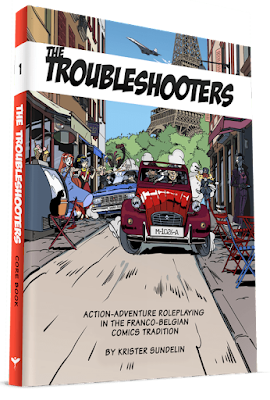
The year is 1965. On March 19th, 1964, a joint Japanese-French mission landed on the Moon aboard the giant atomic rocket Kaguyahime, the Moon Princess – affectionately called Monsieur Renard (‘Mister Fox’) in France because of its orange-red paint job. Two space stations orbit the Earth—the US Aurora and the Soviet Budushcheye-1. In the skies over Europe and far-flung cities, the Aérospatiale/BAC Concorde carries passengers at the speed of sound with BOAC, Air France, and Air Majestique. Around the world the Cold War continues between the United States of America and the Union of Soviet Socialist Republics, with Europe divided by the ‘Iron Curtain’. This includes Arenwald, the alpine principality formerly part of the Austro-Hungarian Empire, squeezed in between Hungary, Sylveria, and Yugoslavia, famous as a stop on the Arlberg Orient Express line from London to Athens, and its Soviet counterpart, the Socialist Republic of Sylveria. The Cold War is not the only threat to the world, a secret organisation known as the Octopus, a centuries-old criminal organisation, has designs on world domination. There are other dangers too, as well as mysteries and conspiracies, many of which the authorities are not best-placed to deal with. Step forward the Troubleshooters, bands of friends and adventurers who are prepared to travel the world and investigate the mysteries, crimes, and dangers that the authorities decline to do. And if they can have fun along the way, all the better!

This is the set-up for The Troubleshooters: An Action-Adventure Roleplaying Game inspired by French and Belgian comics—bande dessinée or bédé—such as Tintin, Spirou et Fantasio, Blake & Mortimer, and Yoko Tsuno. Published by Helmgast following a successful Kickstarter campaign, this is an action-adventure roleplaying game set in the second half of the sixties and first half of the seventies, an era of glamour, optimism, and technological advances. Its outlook is optimistic and exciting, a metropolitan world primarily set across a Europe full of diverse and exotic locations. The players will take the roles of the Troubleshooters, freelance adventurers and investigators, friends ready to look into mysteries and crimes, travel to exotic locales, and have adventures! The Troubleshooters can have a theme and thus be a band of curious adventurers, sleuths, agents, or criminals (in the tone of ‘gentleman thieves’)—and The Troubleshooters starts off by discussing these and giving sample inspirations. Each Troubleshooter should be competent, have a particular role in the group—such as the Doer, Investigator, or Muscle, want to adventure, possess a weakness which enhances the story, be fun to play, and fun to play with.

A character in The Troubleshooters is defined by Skills, Max Vitality, Plot Hooks, Traits, Abilities, Complications, and Story Points. Skills—rated as percentiles—are broken down into Background, Social, Investigation, Action, and Combat skills, and they include skills such as Agility, Endurance, Strength, and Willpower, which in other roleplaying games would be used as attributes. Plot Hooks, such as ‘Do-Gooder’ or ‘Media Darling’, are used to pull Troubleshooters into a scenario, and published scenarios will use specific Plot Hooks to involve Troubleshooters. Abilities mark the Troubleshooter out as a special and come in three Tiers with increasingly harder requirements, but at each Tier provide a means for the Troubleshooter to spend Story Points. For example, the Actor Ability requires the Entertainment skill at 65%, and when used with other skills like Charm or Subterfuge, enables a Troubleshooter pretend to be another person. For one Story Point, the Troubleshooter can flip a Subterfuge task check when pretending to be someone else, but for two, he can make a new task check for Entertainment or Charm, and keep the new roll. Complications are roleplaying hooks, for both the player and the Director of Operations—as the Game Master is known in The Troubleshooters is known—and also a source of Story Points. For example, a Troubleshooter with the ‘Amorous’ Complication will earn three Story Points when distracted by his emotions and receives a −2 pips modification to task checks not related to said emotions, three Story Points if a romantic interlude causes him trouble, and six Story Points when a date or romantic interlude prevents him from participating in an important scene.

Troubleshooter creation is template based, though guidelines are included which allow a new template to be built or a Troubleshooter to be built without using a template. Fifteen templates are included from Adventurous Scholar, Aspiring Student, and Caring Veterinarian to Racing Driver, Suffering Artist, and Vigilante Lawyer. Each template includes some background, eleven skills, five Abilities, three Complications, Vitality, extra languages, three gear kits, and some Plot Hook suggestions. A player can modify the skills, but must choose two Abilities, one Complication, five gear kits (this is three more than the template gives, but there is an extensive list of gear included in the book), and two Plot Hooks. He also chooses languages if his Troubleshooter has any and finally decide—or roll—where he met the other Troubleshooters. (Alternatively, the players could just use the six signature Troubleshooters included as examples who figure in all of the examples through the book.)

Dickie Jones – Curious Engineer
Skills: Contacts 45%, Electronics 65%, Engineering 75%, Investigation 45%, Machinery 65%, Science 65%, Search 65%, Security 45%, Melee 45%, Vehicles 45%, Willpower 45%. (All other Skills 15%.)
Abilities: Curious, Tech Wiz
Complications: Combat Paralysis, Crude
Vitality: 5
Languages: –
Gear: Camping Gear, Ham radio set, Electronics toolbox, First Aid Kit, Mechanic’s toolbox (Signature)
Plot Hooks: Friends in High Places, I Owe You

Mechanically, The Troubleshooters is a percentile system. To undertake a Task, a Troubleshooter’s player rolls percentile dice and if the result is equal to or less than the skill and the Troubleshooter succeeds. If the roll is a double and below the Skill value, then the Troubleshooter earns Good Karma, succeeding with a bonus and gains a Story Point. Conversely, Bad Karma is gained if a double is rolled and it is above the Skill value. The Karma can be mechanical or storytelling in nature. The former might be +2 or -2 Pips for Good or Bad Karma, the latter reinforcements turn up, either to help or hinder the Troubleshooters, depending upon whether it is Good or Bad Karma. Modifiers to the roll come in the form of Pips, which range from +5 to -5. If the number of Pips is positive, then any result equal to, or less than the number of Pips on the Ones die will always succeed, even if the actual percentile roll is greater than the Skill value. Conversely, if the number of Pips is negative, then any result equal to, or less than the number of Pips on the Ones die will always fail, even if the actual percentile roll is less than the Skill value. Pips can be applied because the environment, such as in the middle of a storm, or equipment used, such as a tool kit. The Pips system does feel a little weird, even counterintuitive, but it does not take much adjusting to, and once you have, it is very workable.

Notably, if a test is failed, it cannot be repeated, either by the current Troubleshooter or any other Troubleshooter—unless circumstances have changed significantly. Failure though is not intended be an absolute, but rather that the Troubleshooter ‘Fail Forward’ and either learn from the failure or push the story on in interesting ways. For example, in a fight, a Troubleshooter might not be killed, but rather captured, or if a Troubleshooter fails to defuse a bomb in time, he at least learns something about the design. In addition, every Troubleshooter has Story Points. Their most common use is to flip the results of a percentile roll. However, they can also be spent to activate Abilities, get gadgets beyond the standard five a Troubleshooter starts play with, gain clues, and either add something major or minor to the ongoing story. Adding something to the story may require a little negotiation with the Director.

For example, Dickie Jones is participating in a rally across Sylveria. He is the co-driver in a car driven by his fellow Troubleshooter and Finnish rally driver, Tristan Narbrough, but in addition to wanting to place well in the event, they are after a Soviet spy who is heading for the Socialist Republic of Sylveria with some information stolen from one of the sponsors of their car. However, during a night stage, in the middle of a storm, their car, a Mini-Cooper breaks down. Dickie leaps out of his seat, tool kit in hand, and pulls up the bonnet. To determine the fault and fix is going to require a Machinery 65% Test. The Director of Operations sets the Task at ‘-2 Pips’ for the storm, but Tristan’s player describes how he is holding a torch to make sure that Dickie can see what he is doing, which negates the ‘-2 Pips’. Plus, of course, Dickie has his signature Mechanic’s toolbox, which gives him two Pips. So, Dickie’s player is rolling his Machinery 65% Skill at ‘+2 Pips’. Dickie’s player rolls 99%! Not only is this a failure, but it is also one with Bad Karma. This could be bad news for both Dickie and Tristian, but Dickie has the Tech Wiz Ability, which enables his player to reroll an Electronics, Engineering, or Machinery Task for one Story Point. Dickie’s player spends the Story Point and rerolls, but the result is a 71%—better but still a failure… Except no, the value on the Ones die is less than the Pips, which means that Dickie finds the fault, fixes it, and they are back on the road again, driving hard to catch up with and capture the industrial spy!
Combat in The Troubleshooters is more complex and is built around opposed Tests between attacking and defensive Skills, for example, Melee versus Melee Skill or Ranged Combat versus the Agility Skill. The Troubleshooters, as Player Characters, have Defence Skills, but unless they are important, Director characters (or NPCs) do not. Initiative is handled with an Agility Test, with the rests of the two dice added together if successful. Damage is rolled on six-sided dice, typically just two for unarmed attacks, all the way up to seven for machine guns. Rolls of four, five, and six inflict a point of Vitality damage per die, with results of six exploding and potentially doing more damage. Armour allows Soak rolls which negate points of damage, but do not explode. Recovery rolls, made to recover Vitality work the same as Soak rolls. A Troubleshooter or an important Director character is out Cold when they run out of Vitality, although either can take the Wounded or the Mortal Peril Condition instead of suffering Vitality loss. This typically to void being Out Cold, but both have consequences after the fight and take time to heal. What is stressed throughout The Troubleshooters is that it is not a roleplaying game about killing and that it is very difficult for a Troubleshooter to die. Indeed, the most common way of a Troubleshooter dying is when it is dramatically appropriate and the Director has stated that it is a possibility in a scene. As to killing, if a player has his Troubleshooter kill a Director character in cold blood, then the Director is advised to deny the Troubleshooter any free improvement checks at the end of the adventure, and remove all of the Troubleshooter’s Story Points, as well as half of the Story Points of those Troubleshooters’ who could have stopped him. This is harsh, but The Troubleshooters is intended as a positive roleplaying and roleplaying experience.

For the Director of Operations, there is good advice on setting up combat scenes to make them interesting and challenging, adjudicating the use and awarding of Story Points, an extensive list of Gear—including Weird Tech with which to equip the bad guys or interest any budding Tech Wiz Troubleshooter. The advice also covers hosting and running the game, portraying the Director’s characters—including how to make the bigger villains camp, and creating adventures and campaign. She is accorded a full description of the Octopus, its organisation, members, aims, and technology, plus plenty of stats and write-ups of various Director characters and animals. In terms of background, ‘The World of The Troubleshooters’ presents the period and setting in some detail, highlighting not just the differences between the sixties that we know from history and the sixties of The Troubleshooters, but also the similarities. It covers technology, travel, and more before providing a whirlwind guide to some of the interesting places and cities around the world, from Paris and Berlin to Buenos Aries to Ice Station X-14. These are really good, describing each location in a couple of pages including lists of where to stay, things to do, and why that location is being visited as part of the Troubleshooters’ adventure. In fact, these location descriptions feel reminiscent of the Thrilling Locations supplement for the James Bond 007 roleplaying game from 1983 and certainly that sourcebook could be useful until The Troubleshooters gets one of its own. Rounding out The Troubleshooters is a set of appendices which include a calendar for 1965, lists of first names in various languages, a table of character traits, and several lists of profanities, but not profanities, which should allow a Troubleshooter to swear, but not swear, and still maintain the spirit of the bande dessinée. “Blue blistering barnacles!” indeed.

Physically, The Troubleshooters is a stunning looking book. The artwork, done in the ‘Ligne claire’ style pioneered by Hergé, nicely sets the signature cast of The Troubleshooters against the well-drawn backdrop of the real world. Make no mistake, the artwork is excellent throughout, really capturing the feel of the roleplaying’s inspiration. Although it needs a slight edit in places, The Troubleshooters is well written and an engaging read from start to finish. Throughout, the rules and situations are explained in numerous examples of play, all using the signature cast of The Troubleshooters and narrated by Graf Albrecht Vogelin Erwin von Zadrith, the Number Two of the Octopus, as the Director. These are all entertaining to read and tell a story as much as they inform about the rules.

If there are any issues with The Troubleshooters, then there are two. First, there is no scenario. Second, the other thing is that although it references various bande dessinée, it does not list actual titles. Fortunately, there are three scenarios available for the roleplaying game in The Troubleshooters’ Archive. The lack of a bibliography can be got around using the pointers included here as a starting point. In addition, The U-boat Mystery scenario is already available.

The obvious thing about The Troubleshooters is that could be used to run a James Bond style roleplaying game. It could be, and it would work well as a James Bond roleplaying game, but The Troubleshooters is not as cynical in tone or even as murderous as the world of James Bond is in comparison. Much lighter in tone, The Troubleshooters is of course a roleplaying game of adventure tourism in the style of bande dessinée, but also that of the ITC Entertainment television series of the period. For example, The Saint, The Persuaders!, and The Protectors, and whilst it is specific in its bande dessinée inspiration, The Troubleshooters is really the first roleplaying game to look back to the period since Agents of S.W.I.N.G..

The Troubleshooters: An Action-Adventure Roleplaying Game is great looking book with artwork which wonderfully evokes its source material. The rules and mechanics support play in the style of that source material, enabling the players to create fun Troubleshooters, and jet or drive off on amazing, exciting adventures with each other and tell great stories. With its comic book or bande dessinée sensibilities, there can be no doubt that The Troubleshooters takes us back to a simpler, if headier and more optimistic time. The combination means The Troubleshooters is engagingly, delightfully European and charmingly chic.

Saturday, 13 November 2021

[Free RPG Day 2021] Enter the Collection

Now in its fourteenth year, Free RPG Day in 2021, after a little delay due to the global COVID-19 pandemic, took place on Saturday, 16th October. As per usual, it came with an array of new and interesting little releases, which traditionally would have been tasters for forthcoming games to be released at GenCon the following August, but others are support for existing RPGs or pieces of gaming ephemera or a quick-start. Of course, in 2021, Free RPG Day took place after GenCon despite it also taking place later than its traditional start of August dates, but Reviews from R’lyeh was able to gain access to the titles released on the day due to a friendly local gaming shop and both Keith Mageau and David Salisbury of Fan Boy 3 in together sourcing and providing copies of the Free RPG Day 2020 titles. Reviews from R’lyeh would like to thank all three for their help.

—oOo—

Enter the Collection: An Adventure for the Essence20 Roleplaying System is Renegade Game Studios’ offering for Free RPG Day in 2021. It is the first scenario designed using the publisher’s Essence20 Roleplaying System and is written to be used with any of three roleplaying games it is planning based in turn on the G.I. Joe, Power Rangers, and Transformers intellectual properties. The scenario provides a little investigation and interaction, a fair degree of stealth, and plenty of action, but it is not specifically written for any one of those three roleplaying games. This has its advantages and its disadvantages, all of which stem from the fact that the scenario is generic in its set-up, its plotting, and its tone. Now whilst that means it can be run easily with the G.I. Joe Roleplaying Game, Power Rangers Roleplaying Game, or the Transformers Roleplaying Game, it also means that it could run with almost any other modern set roleplaying game. It also means that it feels like a Saturday morning cartoon, but though is very much what Renegade Game Studios is aiming for with this scenario and the three roleplaying games in general.

Enter the Collection takes place in Crystal Springs, a community just half an hour away from the nearest major shipping and transportation hub where nothing extraordinary ever happens. That until the past few weeks when there has been a rash of missing person reports, an increased number of patients coming into Accident & Emergency due to anonymous violent crimes, and a sharp rise in late night activity outside of city limits in the industrial park. Despite complaints made to the mayor and the city police department, neither have responded and nothing seems to have been done about any of this strangeness. Then the Player Characters’ contact (command leader?) gets in touch and asks them to investigate, telling that they should meet, Doctor Caroline Benedict, a biology professor at a local college.

When they meet Doctor Benedict, she shows them the strange blue mussels she has in the nearby Lake Vermillion and tells them that a colleague, Terrance Brighton, is missing. After investigating his house (and avoiding his nosey neighbours) and then going to Lake Vermillion, the Player Characters will quickly discover that someone is dumping toxic chemicals into the lake and that the culprits are prepared to go to great lengths to protect their operations. The Player Characters will be able to track the culprits back to their base of operations. There they can confront the masterminds behind the operation and perhaps learn a little more about what is going on in Crystal Springs.

Mechanically, Enter the Collection: An Adventure for the Essence20 Roleplaying System does not include any explanation of the Essence20 mechanics. It is clear that it is a d20 System-based with Player Characters and NPCs having skills rated by die type, from a four-sided die to a twenty-sided die, which is rolled and added to the result of a twenty-sided die to exceed the difficulty of the test in order to succeed. Devices and vehicles can have similar die-based bonuses as evidenced by the various vehicles detailed in the scenario, which range from a half-track to a stealth fighter. What this means is that it is relatively easy for the Game Master to discern skill ratings and bonuses from devices and vehicles and so potentially be able to run the scenario for the roleplaying game of her choice if she does not have access to either the G.I. Joe Roleplaying Game, Power Rangers Roleplaying Game, or the Transformers Roleplaying Game.

Physically, Enter the Collection: An Adventure for the Essence20 Roleplaying System is well presented and written. The artwork is good, although no NPC is depicted and the depictions of the vehicles are from top down only. There are maps of two of the locations, but not of the final area or the general area, so the Game Master might want to provide both—and the one of the actual area could be real if the Game Master wants to set the scenario somewhere that actually exists.

Enter the Collection: An Adventure for the Essence20 Roleplaying System leaves some questions to be answered, especially if the Game Master wants to run a sequel. On its own though, Enter the Collection: An Adventure for the Essence20 Roleplaying System is a perfectly adequate scenario which will easily fit the G.I. Joe Roleplaying Game, Power Rangers Roleplaying Game, or the Transformers Roleplaying Game—or in fact, the modern-set roleplaying game of the Game Master’s choice. Consequently, although Enter the Collection: An Adventure for the Essence20 Roleplaying System supports G.I. Joe Roleplaying GamePower Rangers Roleplaying Game, or the Transformers Roleplaying Game, it does not actually sell the reader on any one of them.