Every Week It's Wibbley-Wobbley Timey-Wimey Pookie-Reviewery...

Monday, 20 November 2023

Miskatonic Monday #245: At the Gates of Carcosa

Between October 2003 and October 2013, Chaosium, Inc. published a series of books for Call of Cthulhu under the Miskatonic University Library Association brand. Whether a sourcebook, scenario, anthology, or campaign, each was a showcase for their authors—amateur rather than professional, but fans of Call of Cthulhu nonetheless—to put forward their ideas and share with others. The programme was notable for having launched the writing careers of several authors, but for every Cthulhu Invictus, The Pastores, Primal State, Ripples from Carcosa, and Halloween Horror, there was Five Go Mad in Egypt, Return of the Ripper, Rise of the Dead, Rise of the Dead II: The Raid, and more...

The Miskatonic University Library Association brand is no more, alas, but what we have in its stead is the Miskatonic Repository, based on the same format as the DM’s Guild for Dungeons & Dragons. It is thus, “...a new way for creators to publish and distribute their own original Call of Cthulhu content including scenarios, settings, spells and more…” To support the endeavours of their creators, Chaosium has provided templates and art packs, both free to use, so that the resulting releases can look and feel as professional as possible. To support the efforts of these contributors, Miskatonic Monday is an occasional series of reviews which will in turn examine an item drawn from the depths of the Miskatonic Repository.

—oOo—
Publisher: Chaosium, Inc.
Author: Quico Vicens-Picatto

Setting: 26th Century colonial space
Product: Scenario
What You Get: Twenty-one page, 640.22 KB Full Colour PDF

Elevator Pitch: Groundhog Day-style horror on the edge of reality.
Plot Hook: Investigate a sudden anomaly before it becomes a threat to the colony.
Plot Support: Staging advice, six pre-generated Investigators, two maps and deck plans,
and eight Mythos creatures.
Production Values: Serviceable

Pros
# Intriguing setting and ideas
# More scenario and set-up than plot
# Potentially fascinating new system of magic
# Entomophobia
# Mycophobia
# Chronophobia

Cons
# Needs a strong edit
# More scenario and set-up than plot
# Undeveloped presentation impedes comprehension

Conclusion
# Potentially interesting Science Fiction horror setting and ideas impeded by lack of clarity and clear implementation
# Scenario needs stronger set-up and staging in terms of plot to be run effectively

Sunday, 19 November 2023

Jonstown Jottings #85: Crimson King

Much like the Miskatonic Repository for Call of Cthulhu, Seventh Edition, the Jonstown Compendium is a curated platform for user-made content, but for material set in Greg Stafford’s mythic universe of Glorantha. It enables creators to sell their own original content for RuneQuest: Roleplaying in Glorantha, 13th Age Glorantha, and HeroQuest Glorantha (Questworlds). This can include original scenarios, background material, cults, mythology, details of NPCs and monsters, and so on, but none of this content should be considered to be ‘canon’, instead rather fall under ‘Your Glorantha Will Vary’. This means that there is still scope for the authors to create interesting and useful content that others can bring to their Glorantha-set campaigns.

—oOo—

What is it?
Crimson King is a scenario for use with RuneQuest: Roleplaying in Glorantha which can be played as either a sequel to both The Duel at Dangerford and Black Spear: A Hero Wars Saga for RuneQuest or a one-shot. It provides a single session’s worth of play and could also be used as a convention scenario.

It is a seventy-five page, full colour 30.81 KB PDF.

It is a sixty-eight page, full colour softback book.

The layout is tidy and both artwork and cartography are excellent.

The scenario is can be easily be adapted to the rules system of the Game Master’s choice.

Where is it set?
Crimson King takes place in the Tarsh King’s MoonPalace on the Red Moon in the year ST 1627 just before the Hero Wars ramp up. Suggestions are given if the Game Master wants to set the scenario prior to ST 1627.

Who do you play?
Crimson King provides six pre-generated Player Characters which were previously seen in A Rough Guide to Glamour and Life of Moonson, Book One: The Characters. They consist of the Red Emperor, Moonson Argenteus, his bodyguard and chief spy Count Julan, his older sister, Great Sister, his cousin, The Red Dancer of Power, his daughter, Jar-eel the Razoress, and former rebel turned loyal captain and Chief Food-Taster, Beat-pot Aelwrin.

What do you need?
Crimson King requires RuneQuest: Roleplaying in Glorantha and ideally, the RuneQuest Gamemaster Screen Pack or the RuneQuest Starter Set.

What do you get?
Crimson Keep is the chance for the players to take the roles of the divine rulers of their Lunar Empire enemies. It has been done before with the ‘Life of Moonson’ freeform, but Crimson King scales the fifty roles of that LARP down to a manageable six whilst still ramping up the epic nature of its scenario. They are guests of Tarsh King Pharandros at his MoonPalace on the Red Moon, and Crimson King is—initially—a freeform in which the relationships between the dinner guests and their fears are explored and played out. Each of the six pre-generated Player Characters is highly detailed, not mechanically, but in terms of background, with the information on the character sheets is well presented and easy to grasp. The wealth of information given though, does mean that the scenario is going to be appreciated more by experienced players and Gloranthaphiles who will enjoy the details and significance of both playing the pre-generated Player Characters and the events of the scenario.

Unfortunately, the dinner party does not go as planned when there is an assault upon the MoonPalace! The action switches up with each of the Player Characters having a chance to shine as they personally defend the various porticos which open out onto the Red Moon. And then, it switches up again, but in most unexpected fashion.

Essentially, Crimson King plays out as an epic, though highly staged film, which starts out as Casablanca, but switches midway into a combination of Terry Gilliam’s The Adventures of Baron Munchausen, Star Wars, Austin Powers: The Spy Who Shagged Me!, and just about any James Bond film you care to name. Fortunately, what could have been a messy mélange of influences is kept, if not necessarily under control or reined in, at least corralled and energised in service of the plot.

Is it worth your time?
YesCrimson Keep is an over-the-top, ‘batshit’ crazy epic that brings genuinely imaginative high action and high interaction to a Glorantha freeform.
NoCrimson Keep is potentially off-putting, if not intimidating because of its scale and the wealth of knowledge it draws from, even though the scenario does its best not to overwhelm either player or Game Master.
MaybeCrimson Keep is too weird and involves the doings of High Lunar muckety-mucks and that really is not for everyone.

Your Starship

The starship in Star Trek, and thus Star Trek Adventures—the 2d20 System roleplaying game published by Modiphius Entertainment —has an incredible role to play. She is transport. She is tool. She is protection. She is force projection. She is narrative tool. She is totem. She is home. And of course, she is a character in her own right. A character with history and back story and quirks, one which becomes part of the story as the events of the missions performed by the characters, whether on screen or the page, or in the imagination of the roleplaying game, play out. In Star Trek Adventures, there has always been scope for the players to choose and personalise the Starfleet vessel that their officers serve aboard, starting with the core rulebook and then expanded upon in Star Trek Adventures: The Command Division. After all, a ship whose mission profile is Pathfinder and Reconnaissance Operations means her crew will be undertaking very different assignments to one whose Mission profile is Tactical Operations. However, what players have not been able to do is design a ship from the ground, and that is exactly what the Utopia Planitia Starfleet Sourcebook does. That though, is not all that there is to the Utopia Planitia Starfleet Sourcebook.

However, what the Utopia Planitia Starfleet Sourcebook is not, is a general guide to the starships of the Star Trek setting. Its focus is entirely upon those of Starfleet and that includes not just the basic three eras of play in which Star Trek Adventures can be set, but five! The basic three of Enterprise, Star Trek: The Original Series, and Star Trek: The Next Generation are joined by Star Trek: Lower Decks and Star Trek: Picard as well as Star Trek Online. In design terms, this means that the authors can draw upon fifty-five years of Star Trek source material and four hundred years in terms of the setting. In doing so, the Utopia Planitia Starfleet Sourcebook provides a history of Starfleet, an examination of life aboard a Starfleet vessel or space station, rules and guidance creating both starships and space stations—whether that is using a spaceframe from the keel up or adapting them from existing designs, and advice for the Game Master on how to use starships and space stations as a means to tell interesting stories. Half of the book though is dedicated to describing and detailing the background, purpose, design history, notable vessels, and game stats of over seventy Federation and Starfleet starship classes, space stations, and small craft. Many of which are classic designs seen on screen while some are all new, having been specifically designed using the rules in the book. Some have appeared in previous supplements for Star Trek Adventures, but having them all in one place is undoubtedly useful and they really are the highlight of the Utopia Planitia Starfleet Sourcebook, each accorded enough background information to satisfy the Star Trek fan as well as the Star Trek roleplayer.

The Utopia Planitia Starfleet Sourcebook opens with the history of the Federation and Starfleet, really beginning with the events that lead to the founding of both. This includes the founding of the United Earth Space Probe Agency and the Eugenics War and World War III, the hope that space travel and exploration offered seemingly being lost as those still in space looked on as both conflicts broke out. It proceeds from Zefram Cochrane’s launch of the first Warp capable vessel, the Phoenix, and encounter with the Vulcans, through relationships and conflicts with the Andorians, Tellarites, Klingons, Romulans, and more, all the way up to the defence of the Federation from both the Borg and the Dominion. Its emphasis is on how these events change the design philosophy of both the Federation and Starfleet in the starships it fields. Notably, the Battle of Wolf 359 and its destruction of the fleet hurriedly mustered by Starfleet, forced the Federation to evaluate its need for dedicated warships. The chapter sets the context for the rest of the book, including a look at life in Starfleet, which adds an engaging roleplaying exercise in having the player detail the daily life of his Starfleet officer character, which can then be brought into play. There is information too, on downtime activities, whether that is random games in the crew lounge, martial arts being studied in the gym, and of course, the holodeck. The section on the latter is short and it is a subject which deserves a supplement of its own. There is discussion too of various shipboard systems, facilities, procedures such as evacuating a ship, how to use the ‘speed of the plot’ as a narrative device—nicely supported by the Excelsior under Captain Hikaru Sulu racing to save the Enterprise in Star Trek VI: The Undiscovered Country, and whether to use the transporters, the shuttle, or even land the ship, to go down to the planet. There are rules included for handling the landings by both.

Despite the future of the Federation being a post-scarcity economy, there are still resources, mostly rare minerals and metals, which need to be resourced and mined. The classics are latinum, used by the Ferengi Alliance as a currency and dilithium crystals used in the antimatter warp drives of almost every starship. The Utopia Planitia Starfleet Sourcebook presents these as means to drive plots, whether through mining or trading, and then does the same for salvage and retrieval.

Actually designing or adapting a starship means asking a few pertinent questions such how many crew should it have, how specialised should the ship’s role be, what makes it unique, and what is its backstory? Answering these questions will influence both the stats for and the nature of the ship, along with what its character is, and so make it meaningful in play. This is not a character in the traditional roleplaying sense—though that option is available if the ship’s computer is sentient—but it will have an influence upon the narrative as the Player Characters interact with it. All of this is done during session zero, prior to assigning any points. Actually designing a starship consists of assigning a pool of points to the starship’s Systems—modified by the era in which the vessel is going to be designed for and for the scale of its spaceframe; assigning a second, smaller pool of points to the starship’s Departments; and then choosing Spaceframe Talents, assigning weapons, and a trait for the starship. The last thing selected is the Mission Profile, such as Battlecruiser, Scientific and Survey Operations, or Strategic And Diplomatic Operations. The Mission Profile determines the base value for the starship’s Departments and provides a choice of related talents to choose from.

PACKET CLASS COURIER
LAUNCH YEAR: 2375
PRIMARY SHIPYARDS: Utopia Planitia Fleet Yards, Mars; Baikonur Orbital Complex, Earth
OVERVIEW: The expansion of Federation influence into the Alpha Quadrant and Deep Space 9 and the Shackleton Expanse led to a stretching of Starfleet’s resources and ability to support both regions. The initial solution was a courier model, designed to transport personnel and cargo at high speed, but this deemed to be too specialised and changes were called for to give the spaceframe greater flexibility beyond its core role. This was done with the addition of the capacity to carry a mission pod.
CAPABILITIES: The Packet entered service in 2375 and proved to be as fast as the designers intended. The standard Mission Pod is a Warp Propulsion pod increasing the class’ range and speed even further. However, the combination of high speed and the mission pod capacity often sees the Warp Propulsion Pod swapped out for an Emergency Recovery pod or a Field Hospital pod. Even with the time necessary to swap a pod out, the Packet Class Courier can often reach the scene of an emergency faster than a more dedicated ship. Consequently, there have been calls for the class to used in a permanent Crisis and Emergency Response role. One pod has been specifically designed for the Packet Class, the Diplomatic Support pod, intended to be used where emergency diplomatic missions need to be performed or summits conducted. To date, the Diplomatic Support pod has not been used in the field.
REFITS AND VARIANTS: Plans for the Packet Class include an upgrade to the tractor beams.
NAMING CONVENTIONS: Packet class vessels are named after famous messengers or points of call for courier vessels. Examples include Falmouth, the Paul Revere, Mercury, and Hikyaku.

SYSTEMS
Comms 8 Engines 9 Structure 8
Computers 7 Sensors 8 Weapons 7

DEPARTMENTS
Command 3 Security 1 Science 1
Conn 3 Engineering 4 Medicine 2

Scale: 3 Resistance: 3
Power: 4 Shields: 9

WEAPONS:
Phaser Arrays (Energy, Medium Range, 6, Versatile 2, Area or Spread)
Tractor Beam (Strength 2)

TALENTS:
Advanced Shields
Extensive Shuttle Bays
Improved Warp Drive

MISSION PROFILE: Logistical/Quartermaster

TRAITS:
Federation Starship

The Utopia Planitia Starfleet Sourcebook then repeats this for small craft and space stations. The process is not difficult, but it is not as clearly explained as it could have been, as it is not initially clear that the Mission Profile provides the base values for a ship’s Departments. Once this is realised, starship and space station design becomes relatively easy.

Half of Utopia Planitia Starfleet Sourcebook is dedicated to describing Federation and Starfleet spaceframes. This includes the base values for each spaceframe so that a group can modify version of their own. These start with the J-Class/Y-class freighter (Travis Mayweather’s family vessel as seen in Enterprise) in 2102 and proceed chronologically to the Pathfinder class in 2410. Along the way, there are classics such as the NX, Constitution, Miranda, Excelsior, Defiant, and Intrepid class vessels. The inclusion of the Crossfield class allows the inclusion of the U.S.S. Discovery. Not only content with drawing upon the many ships seen on screen, the Utopia Planitia Starfleet Sourcebook also draws from Star Trek Online for the Reliant, Sutherland, Gagarin, and Odyssey class vessels. Plus, there are numerous small craft given similar treatment, such as the Danube-class runabout, and space stations like the K-Class Border Outpost and DS9.

For the Game Master, optional rules expand the Jury-rig Talent, primarily through the Player Characters having to cannibalising a working system to make the temporary fixes, give guidelines on modifying shuttlecraft, expand the rules for manoeuvring ships, and adds zone hazards, like dense debris or asteroid fields, ion storms, nebulas of various classes, and so on to make space travel that bit more dangerous and challenging. Lastly there are guidelines for making maintenance an important factor in ship’s life and using it to present challenges to the Player Characters.

Rounding out the Utopia Planitia Starfleet Sourcebook is a set of ten mission briefs. These are one-page affairs, which include having to solve the problem of a macrogelatinous lifeform filling a ship and trapping everyone one in it except for those stuck in the Jefferies Tube who have to solve the problem, stopping the memetic spread of a dead civilisation’s technology, being cast into another dimension where the starship becomes an exhibit in an alien zoo, and being trapped outside on a spacewalk when everything goes wrong. There is a nice variety of ideas here, some of them a little weird and so perhaps suited to Star Trek: The Original Series which was weird in its stories.

Physically, the Utopia Planitia Starfleet Sourcebook is not only a great looking book, but it also probably has the most art of any book for Star Trek Adventures. The writing is good and the illustrations are excellent—especially if you like starships! The most notable feature of the Utopia Planitia Starfleet Sourcebook’s presentation is that it does not use the LCARs background with its white text on black, instead opting for standard back text on white. It is thus most readable.

The only downside to its publication is that similar books are going to be needed for the Klingons, Romulans, and innumerable other species found in Star Trek, but otherwise, the Utopia Planitia Starfleet Sourcebook is the sourcebook that Star Trek Adventures needed. The Utopia Planitia Starfleet Sourcebook successfully throws a spotlight upon the role of the starship in Star Trek Adventures, whilst also showcasing over seventy different models and classes that will be enjoyed by the Star Trek gamer and fan alike. What impresses most of all is that the Utopia Planitia Starfleet Sourcebook lets player and Game Master together take the conn to create and then bring their own starship to life and make it a part of their Star Trek Adventures campaign.

Saturday, 18 November 2023

You’re Going on an Adventure!

In the north-west of Middle-earth, in the region of Eriador is a bucolic idyll, a land of quiet ways, of a small people going about their business and knowing about everyone else’s business and genealogies, far away both geographically and mentally from the doings of wizards (especially wizards) and kings, orcs and goblins, and such nasty things as adventures. This is the Shire, home to the Hobbits, some of whom as it turns out, will very much find themselves caught up in the doings of wizards (especially wizards) and kings, orcs and goblins, and such nasty things as adventures. That though was in the past with the queer doings of Mr. Bilbo Baggins, who went away with a wizard and came back a very different Hobbit, the least of which was being surprisingly rich. It is also in the future for Mr. Frodo Baggins, the distant cousin of Mr. Bilbo Baggins, yet to be born. In this interregnum between the events of The Hobbit and The Lord of the Rings, the Shire is a quiet, contemplative place, forgotten by most, and where little anything of any consequence happens. All that is set to change with Shire Adventures.

Shire Adventures is adaptation of the source material and adventure content from The Ring One Starter Set. Published by Free League Publishing, The Ring One Starter Set did three things. First, it introduced The One Ring: Roleplaying in the World of Lord of the Rings core rules. Second, it described the Shire for The One Ring, serving as the sourcebook for that setting for the roleplaying game. Third, it provided a mini-campaign of adventures, initiated by an appropriate figure of note and played through by some surprising figures from Hobbit history. Shire Adventures does two of these. First as a supplement for The Lord of the Rings Roleplaying—the adaptation of new edition of The One Ring: Roleplaying in the World of Lord of the Rings for use with Dungeons & Dragons, Fifth Edition—it serves as the sourcebook for the Shire. Second, it provides a mini-campaign of adventures—the first adventures for The Lord of the Rings Roleplaying, just as The Ring One Starter Set provided the first adventures for The One Ring, Second Edition.

Shire Adventures is divided into two parts plus an appendix. The first, ‘Regarding the Shire’, details its history, geography, and features. A prologue though, highlights how adventuring, though very much not the norm in the Shire, is different to that of Dungeons & Dragons in one important aspect—weaponry! Hobbits are not a martial people and actual weapons, if found, are regarded as mathoms or trinkets. Bounders and Sheriffs, who walk the boundaries of the Shire and keep the peace, are simply armed with staves and bows. This will definitely influence the play of the second part of Shire Adventures, ‘The Conspiracy of the Redbook’. ‘Regarding the Shire’ begins with the history of The Shire from its founding and later founding of Buckland, the defeat of Golfimbul and his Goblin horde (and creation of the game of Golf by knocking the goblin chief’s head clean off and down a rabbit hole) by Bandobras ‘Bullroarer’ Took of Long-Cleeve and his Hobbitry-in-arms, all the way up to the disappearance of Bilbo Baggins and his return. The majority of the section is dedicated to the geography of the Shire across its Four Farthings and beyond into Buckland (and little further). Alongside all of this, there are engaging sidebars which explore different aspects of Hobbit culture, such as the Art of Smoking and smoke ring competitions, Hobbit attitudes towards Gandalf the Grey (mostly he means trouble, unless fireworks are involved), and descriptions of important NPCs, like Mayor Pott Whitfoot, or Gorbadoc ‘Old Broadbelt’ Brandybuck, the current Master of Buckland. Tables of random events and encounters and rumours and tales all add extra details and hooks and elements which the Loremaster can take away and form into small adventures that can be played beyond the five in ‘The Conspiracy of the Redbook’. At the very end of ‘Regarding the Shire’, the authors take us outside of the Shire, there to encounter the much-feared Old Man Willow, though not for every long if they can find the happiest and strangest being near the Shire, Tom Bombadil.

One aspect of Shire Adventures—and also The One Ring, Starter Set—is that just like The Hobbit and The Lord of the Rings—it is a starting point for adventures. However, it is the starting point for adventures for some most unexpected figures in the Shire. The events of ‘The Conspiracy of the Redbook’ take place in the year 2960 of the Third Age, nearly twenty years after the Battle of the Five Armies as detailed in The Hobbit. Since Bilbo Baggins’ return, a whole new generation of Hobbits has come of age, and so the slightly odd Hobbit has decided that certain youngsters should experience some excitement and some intrigue—if only in a little way. Those Bilbo has chosen represent the generation between that of himself, and that of Frodo Baggins, Peregrin Took, and Meriadoc Brandybuck—and in some cases they are the parents of Frodo, Pippin, and Merry. They are initially, Drogo Baggins, Esmeralda Took, Lobelia Bracegirdle, Paladin Took II, Primula Brandybuck, and Rorimac Brandybuck. All are presented as ready-to-play, pre-generated Player-heroes, joined by Balin, though he is not available to play at the start. Their inclusion and the period setting for Shire Adventures means that at this point The Lord of the Rings Roleplaying is looking back still, to The Hobbit, rather than forward to The Lord of the Rings.

‘The Conspiracy of the Redbook’ consists of five adventures. Three need to be run in order—the first one and the last two, but the other two can be run second or third in the campaign. The Player-heroes, Hobbits all, are summoned by Bilbo Baggins for tea and a task or two, all to imbue in them a little of the same sense of adventure that he now has. The adventures will send the Player-heroes hither and thither across the Shire and have them doing very un-Hobbity things. This includes travelling to Michel Delving to steal an artefact from the Mathom-house, tracking down the club of Bandobras ‘Bullroarer’ Took at the very edge of North Farthing, tracking down some of Gandalf’s lost fireworks, travel all the way across the Shire to deliver a letter to Farmer Maggot, and there to help him out with some missing chickens. The campaign is really rather fun and should provide several good sessions’ worth of play, almost at a genteel pace.

Rounding out Shire Adventures is set of eight Player-hero sheets, one each for all of the pre-generated Player-heroes ready to play through ‘The Conspiracy of the Redbook’. Each comes with a little background and a good illustration, and they are nice, clear, and easy to read. They are of course, all linked by family connections, as any good Hobbits should be. They should be all fun to play (especially Lobelia Bracegirdle!) and all have decent Stealth and Riddle skills, but low combat skills.

Physically, Shire Adventures is very cleanly presented in a clear, open style, and the content itself is engaging to read. In particular, the maps done inside the front and back covers are excellent, done in a style reminiscent of Tolkien and will satisfy any Tolkien fan. The artwork is also very good, a pen and ink style that captures the old-world rustic charm of the Shire.

Where Shire Adventures is problematic is in its setting between the events of The Hobbit and The Lord of the Rings, and really between the events of The Hobbit and the starting year for The Lord of the Rings Roleplaying. There can be no doubt that the adventures are great and the chance to play the pre-generated Player-heroes is a wonder in itself, but what next? There are ideas and hooks throughout Shire Adventures for the Loremaster to develop, but it would be nice to see Player-heroes characters have other adventures too. Shire Adventures is also missing a where next?’ section. What does the Loremaster run after the ‘The Conspiracy of the Red Book’ campaign? The obvious choice is Bree as it is close by and if the Loremaster has access to it, the Bree-land Region Guide for Adventures in Middle-earth, the original adaptation of The One Ring to Dungeons & Dragons, Fifth Edition by Cubicle Seven. It would require some adaptation to The Lord of the Rings Roleplaying, but this is not insurmountable. Of course, the obvious next step is The Lord of the Rings Roleplaying itself, and the Loremaster and her players creating their own Player-heroes and beginning a campaign of their own.

Shire Adventures is a lovely supplement, it wraps the Loremaster and her Hobbitish players in the warmth and comfort of the Shire, before sending them out to be exposed to adventure and mild peril. For the players and their Hobbits this is their first chance to experience excitement and danger, whilst for the Loremaster, there is source material that she can return to and develop adventures of her own.

The Other OSR: 10 Downing

Mausritter – Sword-and-Whiskers roleplaying is a rules-light fantasy adventure microclone in which the very big and very dangerous world is explored from a mouse eye’s point of view. It encompasses not only the world of nature, but also the world that the players themselves live in. This is our world, but one in which the mice are anthropomorphic and can talk, as can other species. Beyond the walls of their home, the world is one of opportunity and adventure, fraught with hazards natural and unnatural, those untouched by mankind and those imposed by mankind. Using the base mechanics from Into the Odd, mice in Mausritter need to be brave, resourceful and clever, as well as lucky if they are to survive. Scenarios for Mausritter tend to be location based. Either the mice having to explore a single location, which could actually be a tree stump, a human-sized suit of armour, a grandfather clock, or an abandoned human-made shack, as in Mausritter: Honey in the Rafters or a sandbox setting containing numerous locations, such as Mausritter: The Estate Adventure Collection or Mayfield. In being real places—or places inspired by the real world—there is definitely a sense of wonder about these locations because we are seeing and exploring them from a very different angle. Would this sense of wonder be invoked if the setting were real, and not only real, incredibly familiar to almost everyone in the world, let alone the country? What if a Mausritter campaign took place in a seat of power? What if a Mausritter campaign took place in 10 Downing Street, one of the most famous addresses in the world?

10 Downing: A Mausritter Campaign is set inside the cramped splendour of the Georgian townhouse that is 10 Downing Street, home to the Prime Minster of Great Britain and the seat of the government in office. In recent decades, it has been home to some colossal figures of British politics, including Margaret Thatcher, Tony Blair, and Boris Johnson. It is also notoriously infested with mice and other rodents and for several centuries there has been a cat in residence at 10 Downing Street, appointed as ‘Chief Mouser to the Cabinet Office’. The current holder of the title—and the first to do so officially, is Larry. Having served through five premierships to date, Larry is the lord of all he surveys. His reputation as a mouser has varied over the years, but Larry is no fool. He knows that his presence is enough to instil fear in the mice also resident in 10 Downing Street and so in order to avoid undue chasing and catching of mice, he has come to an agreement with the mice. If they avoid making trouble and certainly avoid coming to the notice of the building’s many human inhabitants, he will leave them be. This leaves him with a mice retinue of servants and time to focus—at least occasionally—upon a more pressing problem: rats! This then, is the basics of the situation as describing in 10 Downing, which also presents the complete floorplans for all three floors of the house and numerous storylines and five ready-to-play quests and adventures involving six rival factions, eight new hirelings, new creatures, new treasures, and new spells. 10 Downing: A Mausritter Campaign includes everything a Mouse Master and her micey medley need to play through a mini-campaign of multiple mouse sessions.

10 Downing presents an overview of the house combined with the floorplans. These have been marked with the important locations, such as the Cocked Hat Rats stronghold, tunnels through the wall, and the Chief Mouser’s domain. These are briefly described as are the locations throughout the building, adding in details such as available quests to be started there and treasures to be found there. Some of these are thematically fun, such as the Flaming Churchill, a cigar which belonged to Winston Churchill and whose odour keeps cats away. The various factions, such as The House of Lordly Mice, the original mice in the house, or the Cocked Hats Rats, a gang of cockney rats, which are interlopers in the house. This sets up a social divide in 10 Downing Street over which Larry the cat lords it all. 10 Downing includes six quests, such as scavenging for food during a feast held in the dinning room, fomenting rebellion against Lord Mouse and his cabinet.

The quests and the adventure locations are given more detail. These include breaking into a bust in search of a powerful spell tablet or rescuing the nephew of the Lord Mouse after the Cocked Hat Rats have kidnaped him. Some of the quests have random elements and some also have the potential to change the balance of power in 10 Downing Street. All six quests are solid affairs, and supported for stats of the major NPCs and creatures. In addition, there new items in the forms of traps (to ensnare the corgis), new stealth spells, and treasures such as razor blade or teacup handle weapons and even Paddington’s Coat as armour.

What 10 Downing cannot really do is bring the human element into play. Of course, the many human locations that are the setting for other Mausritter campaigns and scenarios are busy places with many humans moving about, living and working, but in 10 Downing Street, the footfall is incredibly high. There are politicians, ministers, government officials, Downing Street staff, security, and even the Prime Minister’s family all moving about, and doing so through much of the day. Only once do the humans appear in the Encounters table, and even then, they are the cleaners, there after everyone else has gone—for the day, or to bed. That said, one of the quests does involve the Queen coming to tea—which of course, dates 10 Downing—and the Player Characters setting traps to prevent the corgis from causing any trouble. It gives the quest a delightful personal presence that everyone will enjoy. Yet it is disappointing that the personal presence comes from a visitor rather than anyone who is expected to be in 10 Downing Street. More so because we all have good idea who would be in the house, depending, of course, upon which Premiership the Game Master decides to set her 10 Downing campaign during. Now of course, the author cannot account for the five (actually, three if we want to be historically accurate since the Queen could really only have visited three of them for tea) Prime Ministers, the members of their cabinets, staff, or family. This is something that the Game Master will have to work into her campaign herself. Which will require some research upon the part of the Game Master.

Physically, 10 Downing is breezily presented. The self-penned artwork is cartoony, but the author mixes in a lot of public domain art too. The floorplans are a little small, but the PDF comes with larger maps that a little clearer.

10 Downing: A Mausritter Campaign has everything that the Game Master needs to run a campaign set in 10 Downing Street. However, it requires some research and development upon the part of the Game Master to fully bring out its political nuances and influences, but for a certain audience, 10 Downing: A Mausritter Campaign will give a chance for their mice to play when the Prime Minister is away.

Friday, 17 November 2023

Friday Fantasy: The Dragon’s Secret

Deep in the forest stands a grand cathedral. A grand cathedral dedicated to ‘Aulde Dawne’, a Gold Dragon who answered the call to protect the peoples of the nearby village and give them her blessing. In return the villagers gave tribute to her and a temple was built, then upgraded, and more tribute was made. Yet this was never enough, for eventually ‘Aulde Dawne’ went mad and rampaged across the countryside, and it took heroes a great effort to be put a stop to her predations. Yet as successful as those heroes were, they never found the treasure hoard that had been given to ‘Aulde Dawne’ over the years and neither has anyone else since. For a great many years, the Cathedral of the Golden Dragon has been sealed up, but rumours abound of not just the great treasure to be found in its vaults, surely hidden where none has been able to find it to date, but also great secrets. This is the set-up for The Dragon’s Secret, a dungeon adventure published by Fifth Wall Games & Miniatures for use with Swords & Wizardry that requires a party of six to eight Player Characters of Fifth to Seventh Level. Notably, it is designed by Jennell Jaquays, best known as the designer of one of the greatest Dungeons & Dragons scenarios ever published, Dark Tower, and certainly the best scenario that Judges Guild ever published. If The Dragon’s Secret is half as good as Dark Tower, or even Caverns of Thracia, then this is definitely a dungeon worth looking at.

The Dragon’s Secret is based on maps that Jaquays drew as a teenager and the adventure that she subsequently developed for both the 2017 North Texas RPG Con and the Dungeons of Doom IV Kickstarter campaign. The current and completed version consists of some thirty-four locations across three levels, homebrew rules, a few factions, two new Player Character species, several new monsters, and a potential means to access the author’s own The Thousands Worlds campaign setting. All packaged in an easy-to-use fashion. The ease of use extends to adapting to the Game Master’s own campaign, since the Cathedral of the Golden Dragon is located in a relatively isolated forest. Consequently, it would work in settings such as The Midderlands or Dolmenwood without any problems, just as it would in the Game Master’s own campaign setting. The scenario includes several ‘Dragon Tales’ or reasons why the Player Characters might want to get involved, including helping would be villagers resettle an abandoned village called Dragon’s Gold; going for the bounty on a pair of wizard’s apprentices; collecting a spider venom which could induce a zombie-like effect; and so on. These can be used to involve the Player Characters and tie the scenario into the Game Master’s campaign.

The Dragon’s Secret begins with the author giving some engaging context and history to the dungeon before she settles down and provides the backstory to the scenario and explains how the book works. The backstory is genuinely original and clever, leaving you to wonder why you never thought of it. Essentially, the presence of ‘Aulde Dawne’ and the construction of the Cathedral of the Golden Dragon was one big confidence trick. A good one, which is one reason why the Game Master should take a look at The Dragon’s Secret rather than the reviewer unnecessarily giving too much away. Then the scenario’s format for its room features—Snapshots, Backstory, Remarkables, Secrets, Curios, Traps, Treasure, and Denizens—is explained. Of these, ‘Snapshots’ represents what a Player Character would be aware of upon first glance; ‘Backstory’ adds further details, sometimes for the benefit of the Player Characters rather than the Game Master; ‘Remarkables’ are the standout features of the location; ‘Curios’ are often exotic, out of place, or out of context objects randomly found (and rolled for on a table at the back of the book); and Denizens covers everything that might be encountered in the location. Denizen descriptions then have their own features—Tactics/Roleplay, Encounters, Snapshots, Insight, Profiles, Lore, and Tales. ‘Encounters’ is where a denizen may be encountered; ‘Insights’ the Player Characters’ first impressions of him; ‘Lore’ gives any rumours or gossip associated with him; ‘Profile; a more detailed description of the denizen; and ‘Tales’ are ideas for further adventures which might involve the denizen and the Player Characters. Not every denizen or group has all of these features, but they all do provide a structured means of providing detail about them.

Besides random encounters, The Dragon’s Secret includes several factions. These include a band of Fowl Folk Adventurers and a group of merchants. All of whom have full stats and guides on their tactics in a fight and on how to roleplay them. Their presence, as well as that of Erebox the Aardvark, can drive the adventure forward or can impede the Player Characters’ progress depending on how they interact with them. There is also a table of random encounters for outside of the dungeon, though in the main, The Dragon’s Secret is not a wilderness and dungeon adventure. There is scope here for the Game Master to expand this aspect of the adventure if she wants to.

There are some decent encounters to found across the dungeon, supported with some terrific NPCs. For example, there is a Giant Clockwork Automaton, which will clank and bash about with the Player Characters in its chamber, but search further and they find the operators of the device, who were having ‘fun’ with them. Both are very well described and the Game Master will have a lot of fun herself in portraying them. Then there is a Black Onyx Skull, a cursed magical item that wakes up nearby undead, but a cost of draining a Player Character’s Levels. The finale itself takes place in a giant cavern against a trio of ghoulish-dragons and their ghoul minions, each of the undead dragons slightly different in design and personality. It is a grand fight around a towered spiral staircase and in and out of the nearby tunnels, and definitely deserves to be played on the table with miniatures.

However, the design of The Dragon’s Secret is split in two. One half is dedicated to its backstory, with the Player Characters attempting to find their way to Aulde Dawne’s hoard and possibly learning about the Cult of the Gold Dragon. The former is more likely than the latter, with it unlikely that the Player Characters will ever learn the back story to the scenario. The half of the dungeon is dedicated to a series of rooms that are only tangentially connected to each and not to the back story. These locations draw from the funhouse style of dungeons, with rooms full of random ideas and concepts. The Player Characters will have to investigate these in order to find the keys to puzzle to get to the end, but they do not anything more than a weird randomness to the whole thing.

As good as the back story is to The Dragon’s Secret and as fun and as entertaining as some of its encounters are, problems abound with the scenario, the majority of which extend from it not quite being a completed book and it not being fully edited. There are design issues with the format of room descriptions and adherence to that format, which can often lead to minor elements being mentioned before the more important elements that the Game Master will definitely need to know. For example, the fact that there might be a curio at the bottom of a pit before mentioning the fact that the room does actually contain a pit trap or waiting until the description of the denizens in the Denizen section that there are actually zombies in the room. It is often unclear how one room connects to another or how aspects of a room interact with another, or where the important pieces of a puzzle are in the rest of the dungeon, let alone the fact that there is tunnel going nowhere. The dungeon maps are almost, but not quite decent, being numbered in an odd order and there being one location mentioned in the text, but which is not on the map. It turns out that this location is actually outside the dungeon, on the plateau behind the cathedral. Obviously, the description should have been in the wilderness section where the Player Characters could have encountered it there!

The writing also veers between humour and annoyingly pointless text. Examples of the former include, “What’s worse than zombies or spiders? Zombie spiders!!” and a room called ‘The Unpopular Dead’. Examples of the latter include the Backstory for the ‘The Pot O’ Silver’ location, which reads, “There’s obviously a story here, but now is not the time for its telling.” and the Backstory for ‘She’s Got Legs …’, which reads, “This was a room that originally just had centipedes in it. I made it more interesting in the update. Oh? You were expecting backstory about the centipede goddess? That’s yet another story.” And? Exactly when is a good time to tell that story? If so much attention is paid to providing the Game Master with detail and information throughout the rest of the scenario, why not here?

All of these problems are not insurmountable. All it takes to overcome them is good preparation upon the part of Game Master. However, it is not just ‘good’ preparation required by the Game Master, but extra preparation, in order have the necessary and often wayward information at her fingertips.

In addition, there are also two further problems, both idiosyncratic in nature. These are the addition of the two new Player Character species—also given as monsters—from the author’s campaign. These are the Fowl Folk and Earth Pigs, or rather Ducks (and other waterfowl) and Aardvarks. The latter are clearly drawn from the long-running comic book series, Cerebos the Aardvark, whilst the former are heavily influenced by the Durulz, or Ducks of Glorantha and RuneQuest. In fact, one major NPC, Erebox the Aardvark is more or less Cerebos the Aardvark renamed and given stats for the adventure. Both species tend to be played for their inherent humour, let alone their oddness, both of which may feel out of place in the Game Master’s own campaign. As a one shot, their inclusion is fine, but as part of a campaign, they will probably require adding in earlier lest their inclusion feel unnecessarily odd or out of place.

Physically, The Dragon’s Secret looks great. The artwork is excellent and the maps good bar the missing and the extra locations. The text itself needs a good edit and the scenario as a whole a little more development that would come with a good editor asking the author questions.

The Dragon’s Secret is playable as written, but requires more preparation time than it ordinarily should. In general, the funhouse aspects of the dungeon outweigh its theme and the plot of its backstory, and anyone coming to the adventure expecting something like Dark Tower or The Caverns of Thracia will be disappointed. Nevertheless, with some extra effort upon the part of the designer, let alone the Game Master when she comes to run it, and The Dragon’s Secret will be an enjoyably detailed funhouse dungeon. Unfortunately, The Dragon’s Secret is not a Jaquays classic.

[Free RPG Day 2023] Heckin’ Good Doggos

Now in its sixteenth year, Free RPG Day for 2023 took place on Saturday, June 24th. As per usual, Free RPG Day consisted of an array of new and interesting little releases, which are traditionally tasters for forthcoming games to be released at GenCon the following August, but others are support for existing RPGs or pieces of gaming ephemera or a quick-start. Thanks to the generosity of David Salisbury of Fan Boy 3, Fil Baldowski at All Rolled Up, and others, Reviews from R’lyeh was able to get hold of many of the titles released for Free RPG Day, both in the USA and elsewhere.

—oOo—

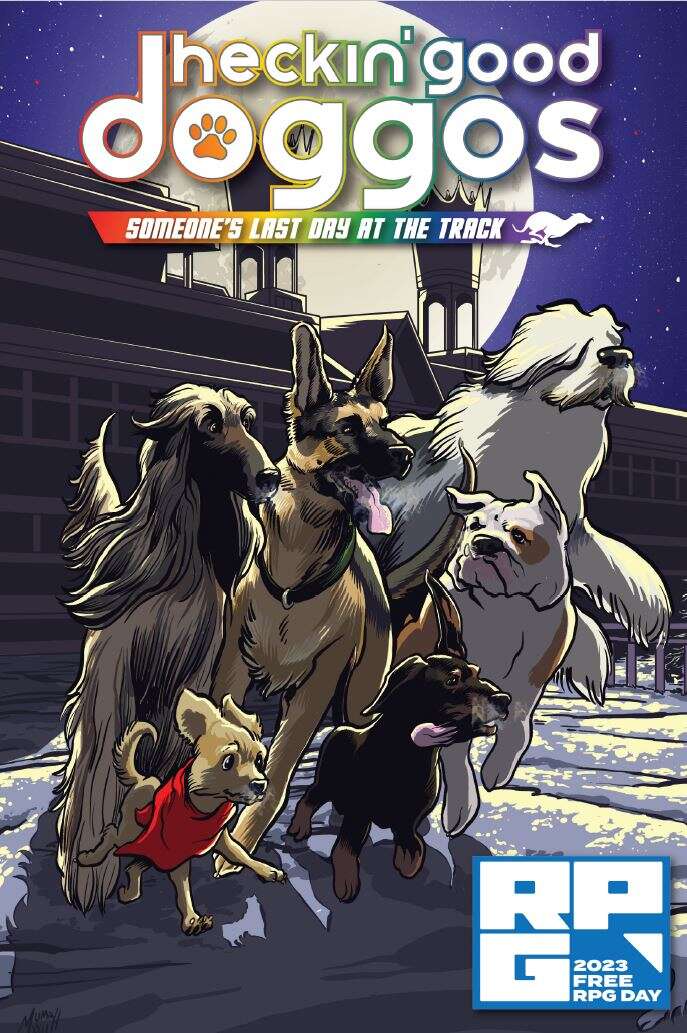
Heckin’ Good Doggos – Someone’s Last Day at the Track is the contribution to Free RPG Day 2023 from Wet Ink Games, best known as the publisher of horror roleplaying games, Never Going Home and Jiangshi: Blood in the Banquet Hall. In comparison, Heckin’ Good Doggos – Someone’s Last Day at the Track is anything other a horror roleplaying game. Heckin’ Good Doggos is a light, family friendly roleplaying game of canine anthropomorphism in which the player take the roles of family dogs who go on adventures which involve ‘Dogs doin’ Dog Stuff’ and being a ‘good doggo’, and Heckin’ Good Doggos – Someone’s Last Day at the Track is the quick-start for it. It contains the quick-start rules for the roleplaying game’s +One System, six ready-to-play pre-generated dog characters, and a full adventure, ‘Someone’s Last Day at the Track’. In order to play, a group will need a pool of six-sided dice and at least one deck of ordinary playing cards. One if there are less than five players, two if there are six players. In general, the +One System is not too complex, the idea of playing dogs will be familiar to almost everyone, and the scenario is fairly simple. The only possible downside to the scenario is that it takes place at a dog track, that is, a track where dogs are raced and there is gambling on the winners of each race. What this means is that the scenario takes place in a more adult setting than may be suitable for younger participants and that not everyone is going to familiar with what a dog track is.

A Good Doggo in Heckin’ Good Doggos is defined by his Breed, his Best Friend, three Attributes, Training, Paw Size, and Character Growth. Breed can be Cute, Friendly, Big, and Fast, and this allows the player to add a card to a Conflict without playing a card. For example, the Cute Breed allows a Heart card to be played and Fast a Club card. His Best Friend is his human owner or a human the dog knows and who has an occupation or equipment which the dog can call upon the human to use if necessary. Attributes are Brawn, Smarts, and Guts, each of which has three associated areas of Training. For example, ‘Sensing’, ‘Knowing’, and ‘Fiddling’ for Smarts. His Paw Size indicates how many cards his player can hold in his hand during play. Attributes range between one and ten, skills between one and five, and Paw Size between four and seven. Character growth is achieved at the end of an adventure and can give a dog a new skill, or improve an Attribute, Skill, or Paw Size. A dog also has a note to indicate how he helps and what his neighbourhood is like.

Mechanically, Heckin’ Good Doggos – Someone’s Last Day at the Track and thus Heckin’ Good Doggos uses the +One System. This involves rolling a number of six-sided dice each to the skill being used. Each five or six rolled is a success. Harder tasks require more Successes. ‘+One Manipulations’ enable a player to change the outcome using points from the Attribute associated with the Skill. Prior to a roll, a manipulation can be made to add a die to a roll or even gain a skill in a previously untrained skill, if only temporarily. After the roll, to increase the value of a die roll by one—typically from a four to a five—and to reroll any number of dice. In addition to skill rolls, dogs can face Challenges, which are attempted by the whole pack as a group effort. They simply need to roll a number of Successes equal to the target number for the Challenge for the whole pack to succeed.

Playing cards in the +One System are played on a one-for-one basis rather than their value with each suite being tied to a narrative theme. These are Spades to friends and relationships, Hearts to cutes and being cute, Diamonds to Teeth and direct physical attacks, and Clubs to Paws and overcoming physical obstacles. Jokers can substitute for anyone of these and players begin play with four cards. All cards can be spent to help heal a dog, but normally they are used to resolve a conflict or add a Success. A player has to narrate how his dog takes advantage of the card’s theme in helping his dog overcome the conflict or Challenge.

Conflicts are like Challenges, but do not use dice, only the cards. Conflicts are also not necessarily fights, but situations that the dogs might have to defeat, escape, or otherwise end the conflict. The Narrator sets a Target Number in terms of the number of cards required, and the Target Number can vary not only in terms of difficulty, but also in how the Conflict can be resolved. For example, the dogs wants to get into a building where dog fights are being held. The Narrator might suggest that the dogs push past the bouncers on the door (three Clubs or Paws), but the bouncers will know they have got in; sneak in via a broken widow (four Clubs or Paws) and nobody knows they are in the building; and being friendly with the bouncers (four Spades or Friends). The objective is to provide the players and their Pack with options, and if the Pack lacks the right cards, they can play any card and narrate how its suit works to overcome the Conflict. However, this is likely to come at the cost of a consequence suffered.

In general, the rules are clearly explained and there are plenty of examples play as well. There is advice also on setting the tone of play and on using Safety Tools such as the X-Card.

Heckin’ Good Doggos – Someone’s Last Day at the Track comes with six pre-generated dog Player Characters. There is a good mix of dog types, but the Narrator should be careful to makes sure that there are as many areas as possible of Training covered if there are fewer than five or six players.

The scenario in Heckin’ Good Doggos – Someone’s Last Day at the Track is the eponymous ‘Someone’s Last Day at the Track’ It takes place at the local dog track on the biggest race day of the year, the State Derby. The dogs have the opportunity to get in on their day, ideally with their Best Friends, mooch around for a bit, being a good doggo, sniffing about, and hopefully finding some good, if not necessarily wholesome treats to scarf down. There are the kennels to investigate, the concessions area, and the race track itself, but very quickly, the dogs will run into the track’s criminal fraternity—the dog gang under the stands! The leader of the dog gang wants to know who the fastest runner is going to be in the State Derby. Can the Player Character dogs find out or do they have other plans? It is a fairly simply plot, but this combined with the other doggy activities and learning the mechanics will provide a gaming group with a single session’s worth of play.

Physically, Heckin’ Good Doggos – Someone’s Last Day at the Track is brightly, cheerfully presented. The writing is clear and the illustrated of the various dogs are excellent. It is a pity that none of the character sheets for the dogs have illustrations, although it does leave room for the players to decide their own dog species. 

Heckin’ Good Doggos – Someone’s Last Day at the Track is a good quick-start and a good introduction to Heckin’ Good Doggos. Its setting and its mechanics make it suitable for younger teenagers and older players and an experienced Narrator, especially one who has run some storytelling style games, will be able to grasp the +One System and explain how it works with ease. Overall, the setting and theme to Heckin’ Good Doggos – Someone’s Last Day at the Track will be familiar to almost everyone, making it very accessible, because everyone knows how to be a good dog, if only for an evening.