Every Week It's Wibbley-Wobbley Timey-Wimey Pookie-Reviewery...
Showing posts with label Sandbox. Show all posts

Sunday, 17 May 2026

Forest of Fear

From Leicester and Newark in the north, to Oxford and St. Albans in the south, from Banbury and in Kineton in the west to Beford and Peterborough in the east, the forests have become one and as one, they are beginning to spread beyond their former boundaries. As the Forest Sauvage grows wild and unchecked, strangling paths and ripping up fields and starving villages, returning the heart of Logres into a wild forest of years past. When travellers wander too close to its eaves, they wonder where they are and in whose lands they journey, whilst the lords upon whose lands the forest borders worry at the encroaching undergrowth and canopy, fearful that what they hold by right will be lost and turned into an impassably dense morass of trees. Yet this is not a natural phenomenon. The kingdom of Logres has been weakened for decades now, ever since the death of King Uther Pendragon. Not just in terms of power and control, but also spiritually. It is this weakness that Madog de Sauvage, a lord of the fae, has taken advantage of to extend his kingdom into the mortal realms. As the newly crowned king, Arthur seeks to unite and restore his father’s kingdom, but this new realm, this Forest Sauvage, threatens his kingdom from within.

This is the set-up for Pendragon: The Sauvage King, a sandbox campaign framework that expands the world of King Arthur Pendragon and Pendragon, Sixth Edition thematically and chronologically. It can be run using the Pendragon Starter Set or the core rulebooks.
As a supplement, Pendragon: The Sauvage King takes content from the start of the highly regarded Great Pendragon Campaign, which explores the spread and threat of the Forest Sauvage and updates it to Pendragon, Sixth Edition. In the previous Pendragon: The Grey Knight, the Player-Knights did enter the realm of the Fairy, but only in a small way, here they confront its power, its majesty, and its unreality in full force. They will discover its growing influence at the edge of the Forest Sauvage as they probe its fringes, hopefully in the process finding a way past the fringes and ever deeper under its canopy, in the process discovering what has happened to the former counties of Lambor, Tribruit, and Wuerensis, as well as their lords, and ultimately forge a path to the court of King Madog de Sauvage.

‘The Forest Sauvage’ is not the only content in
Pendragon: The Sauvage King, but it is its feature content. Narratively, its starting point is the spread of the Forest Sauvage, but for the Game Master and her Player-knights, there are multiple starting points and ways into the Forest Sauvage. Four introductory adventures are divided between motivations and plot hooks that are personal or directed. The personal might be that the King Sauvage has kidnapped a Player-Knight’s child and replaced them with a Changeling, compelling the Player-Knight and his companions to go in search of them, whilst the directed include Saint Dubricus and Merlin the Magician becoming worried about the spread of the Forest Sauvage or King Arthur becoming concerned when an ally asks for help or contact is threatened with an important county, and so the Player-Knights are asked to investigate. The plot hook with the replacing of a Player-Knight’s child with a Changeling is likely the one with most interesting and radical of outcomes since it can lead to the creation of an interesting heir. The other adventures in ‘The Forest Sauvage’ take place inside the Forest Sauvage, typically in the towns and villages which have become trapped within the forest realm. Moving through the forest is challenging because like other fairy realms, it is very easy to lose track of time, and unlike the typical adventure for Pendragon, supplies matter. This is also a campaign where the Hunting skill is very important and the Folklore skill a close second. The Player-Knights will need to proceed with civility and their honour and their reputation will be tested throughout.

With multiple entry points, ‘The Forest Sauvage’ can be run by the Game Master more than once, each time with a different starting point. There is the possibility that a group of Player-Knights might try more than one starting point if they fail to make progress with another. The majority of the adventures are short and can be run in a single session, sometimes less than a single session. This does leave some room for the Game Master to insert content of her own, which can be the other two adventures in the book, generated from the tables at the back of the book, or selected from The Companions of Arthur community content. The capacity for this drops the deeper the Player-Knights travel into the Forest Sauvage. Multiple entry points and plot threads means that many of the almost thirty adventures in ‘The Forest Sauvage’ will not be run. That said, the Game Master can take some of adventures she has not run and adapt them to be run later in her campaign. The Game Master will also need to work harder with ‘The Forest Sauvage’ to set it up for her players and their knights than with other content for Pendragon as it is not linear. Fortunately, ‘The Forest Sauvage’ does guide the Game Master through the set-up process and along the possible plot threads. All of the mini-adventures are neatly organized into sections that in turn cover their Setting, Characters, Secrets, Problems, Solutions, and Glory rewards. Often the section of Solutions suggests multiple ways in which issues outlined in the preceding Problems section can be resolved. Many of the mini-adventures are short enough to run from the page.

Another issue in running ‘The Forest Sauvage’ is chronological. Since its events are triggered by the death of King Uther Pendragon in 495 C.E., it can be run from any time then onwards, particularly from 508 C.E. 
This gives it some flexibility, though if ‘The Sword Campaign’ of the Pendragon Starter Set and Pendragon: The Grey Knight, is being run, the likelihood is that the Player-Knights are going to be occupied! Later in the timeline, after the events of Pendragon: The Grey Knight, as Pendragon: The Sauvage King acknowledges, Merlin is not present in 517 or 518 C.E., so that limits the plot hook involving Merlin for the campaign.

As a campaign, ‘The Forest Sauvage’ present the Player-Knights with a ride range of challenges, whether that is gambling over games of knucklebones in ‘A Game of Chance’ or playing a game of skill to win knowledge in ‘A Scholarly Opinion’, searching for lost dogs in ‘The Baron’s Hounds’, literally overcoming indolence in ‘The Castle of Ease’, racing horses in ‘The Castle of the Race’, evacuating a village about to overtaken by the forest in ‘Cutting Through’, defeating a magical boar in ‘Horror at Alcester’, and more. They will find that many of the lords whose lands lie on the edge of the forest have reacted in many different ways and so have to be entreated in different ways too. This is a mystic maze of often soporific befuddlement, but in turn ‘The Forest Sauvage’ will also horrify and bewitch its Player-Knights.

In addition to ‘The Forest Sauvage’, Pendragon: The Sauvage King also contains two other adventures. Both could be used as introductory adventures, added to an existing campaign, or used in conjunction with ‘The Forest Sauvage’. The latter is quite easy because both adventures take place close to the borders of the Forest Sauvage. Both can also be played through in a single session. In ‘The Adventure of Black Annis’, the townsfolk of Leicester implore the Player-Knights to come to their aid in dealing with a horrifying hag who has been preying on lone travellers and children. Any encounter with her is likely to devolve into a nasty fight and she may even turn the tables and hunt the Player-Knights. She can be defeated though, but dealing with her permanently is an undertaking in itself. The Player-Knights have an opportunity to participate in a moon-lit horse race across the countryside from the Great White Horse of Uffington. This will test much more than the Player-Knights’ Horsemanship skill—though both it and their horses are greatly tested—but this is a thrilling flit across the landscape. Lastly, ‘Other Scenarios’ presents a handful of adventures, some of which could be run more than once as they include tables for generating their precise details.

Physically, Pendragon: The Forest Sauvage is well very presented. The artwork is excellent and the illuminations entertaining. The maps are decent and add much to the manuscript-like feel of the book.

After the rush of the Pendragon Starter Set and the Pendragon: The Grey Knight, which together laid the foundations of what is to come with the Great Pendragon Campaign, what Pendragon: The Sauvage King feels like is the difficult second album. It is both more challenging to use and more challenging to fit into a campaign, primarily because of the open framework of ‘The Forest Sauvage’, but also because rather than a single beginning and middle, it has multiple beginnings and middles. Picking and choosing between these require set-up and development effort upon the part of the Game Master, but the rewards are ultimately worth it, because with more choice, comes the scope to tailor the campaign framework of ‘The Forest Sauvage’ to the players and their knights. Supported by other content, in particular, two good adventures, Pendragon: The Sauvage King is a small campaign in which the Player-Knights can confront a threat to the realm like no other in a framework that lets them make its story their own.

—oOo—

Chaosium, Inc. will be at UK Games Expo which takes place from Friday, 29th to Sunday 31st of May.

Friday, 8 August 2025

Friday Fantasy: The Magonium Mine Murders

‘Trouble down mine’ is the least of the problems facing the Player Characters in The Magonium Mine Murders, a scenario which details the many plots and mysteries that have beset the settlements of the Halbeck Valley. The kingdom in which the Halbeck Valley sits is moderately wealthy with an awareness of magic that sees it put to war in the long running conflict with the neighbouring barbarian tribes. The government is notoriously corrupt, its nobles and politicians accepting bribes and when not corrupt, likely incompetent. The war is unpopular, more so since conscript was instituted. Those workers dubbed essential are not subject to the draft and wear a magical token to indicate their exemption. This includes the workers at the mine in the Halbeck Valley where magonium ore, a rare mineral with magical properties important to the war, is dug out of the ground. Prisoners captured from the barbarian tribes are also made to work in the mines. There are reports of deaths in the mines, but the money that the actual miners are making from the extra demand for magonium has made them relatively wealthy and they are spending it in the taverns and brothel that have sprung to cater for them in a nearby village, turning it into a ‘new’ town, much to the annoyance of the villagers. There are rumours too, of bandits attacking travellers in the valley, and there is very much likely to be more than this going on, but now, there is news that Reith Alba, boss of the mine, has been found dead with a crossbow bolt in her back!

The Magonium Mine Murders is a scenario published by Gonzo History Project, better known as James Holloway, the host of the Monster Man podcast. It written for use with Old School Essentials, Necrotic Gnome’s interpretation and redesign of the 1981 revision of Basic Dungeons & Dragons by Tom Moldvay and its accompanying Expert Set by Dave Cook and Stephen M. Marsh. Designed to be played by a party of Second to Third Level Player Characters—up to Fourth Level—it is what the author calls a ‘Cluebox’. What this really means is that it combines elements of a murder mystery with a sandbox, so a “sandbox-style murder-mystery scenario” according to the author. The scenario requires some set-up in terms of the setting, primarily the two warring kingdoms and the importance of a magical ore and its associated industrialisation. Beyond that, the plots—of which the scenario has a total of seven—are easily adaptable. For example, The Magonium Mine Murders could be run in a Science Fiction or a Wild West setting with some retheming and some renaming, or the scenario could just simply be adapted to the fantasy roleplaying game of the Game Master’s choice.

Part of that is due to the easy presentation of the content. Two pages labelled ‘What’s Going on’ sum up the scenario’s many, varied, and highly interconnected plots, followed by pages that provide detailed summaries of the Halbeck Valley, the two towns—the old and the new, the mining camp, the mine itself, and more. The information is really very well organised and accessible for the Game Master. The starting point for the scenario is the page actually called ‘Getting Started’, which offers several hooks to pull the Player Characters into its plots. These include investigating Magonium poisoning in the river, infiltrating a gambling ring, delving into the mine to determine the cause of a recent spate of accidents, and even do some debt collection! Any one of these can be used as the initial hook and then the others introduced as necessary when the Player Characters interact with the associated NPCs. Alternatively, the hooks could be tailored to specific character types. For example, a Druid Player Character could be asked to investigate the Magonium polluting the river, a Thief Player Character instructed to collect the debt, a Dwarf Fighter hired to investigate the mine, and so on. This would provide the players and their characters with more individual hooks and motivations. Of course, the main hook for the scenario is the murder of the head of the mine.

The murder site is the office of the head of the mine and is one of the few detailed locations in the scenario. The others include the ruined temple where the bandits stash their loot and some caverns under the under the mine, though the former is not as pertinent to the scenario’s plots as the latter is. The investigation is supported by a series of events that occur over the course of the investigation and by details of some fifteen NPCs. Their descriptions are thumbnail in nature and include details of what they know and any activities or reasons that the Player Characters might become suspicious of them. Each is also accompanied by a portrait. These vary in quality and style, but in general suggest that the scenario is set during the Industrial Revolution. This is followed by rules for Magonium poisoning, handling the prize fights being run in the New Town, a bestiary with full stats for the NPCs, and the various items, magical and otherwise, to be found in the scenario. The rules for handling prize fights do not add anything mechanical, even though Old School Essentials and similar retroclones are poor at handling unarmed combat. (As an option, the Game Master might want to look at Brancalonia – SpaghettiFantasy Setting Book for its non-lethal combat rules.) Rather, they add narrative detail and track the course of the prize fights—which are, of course, rigged.

Rounding out The Magonium Mine Murders is advice on running the scenario, necessary, as the author points out, since the scenario is not a natural fit to Dungeons & Dragons-style adventures with its heavy emphasis on investigation. The advice primarily consists of letting the players drive the investigation, relying upon their descriptions of what their characters are doing rather than on dice rolls and being generous with the clues to keep the story and their investigation going. This even extends to possible solutions to the various situations in the Halbeck Valley. Although there is a solution as to who committed the murder of the mine chief, how the other plotlines in the scenario are concluded is really up to the Player Characters and that is even if they engage with a particular plotline. With so many, the Player Characters may not encounter all of them and even if they do, not always follow up on them.

Overall, what The Magonium Mine Murders presents is a set of plots, places, and NPCs that the Game Master can present to her players and their characters and have them pull and push on them as they like. In places though, the Game Master is likely going to wish that there were more detail. The towns in particular are underwritten and feel as if they are in need of colour, especially New Town, which has the rough and tumble feel of a frontier town that has struck it rich. The Game Master is going to want to add some incidental NPCs and events to add colour and flavour and so enforce a sense of place. This is less of an issue in the Old Town. Similarly, the NPC descriptions are a bit tight and with so many of them, the Game Master, will need to work hard to make them stand out from each other. What this means is that the Game Master will need to do development work in addition to the usual preparation effort.

Physically, The Magonium Mine Murders is decently presented and organised. Both artwork and cartography are serviceable, and the writing is decent, if terse in places. The format of the adventure is fanzine style, but is not fanzine in the traditional sense.

The Magonium Mine Murders is an interesting attempt to combine a sandbox with a murder mystery—and it is an attempt that does work. The Game Master is certainly given enough information to run it and its numerous plots from the page, but the scenario is underwritten and lacks colour in places. What this means is that the Game Master is probably going to want to develop and flesh out some aspects of the scenario to enhance its roleplaying aspects and make it come alive, at the very least. Despite possessing a tendency toward succinctness, The Magonium Mine Murders packs a lot of play into its pages and is likely to be a decent, player-driven investigation.

Monday, 6 May 2024

[Fanzine Focus XXXV] Keep It Together

On the tail of the Old School Renaissance has come another movement—the rise of the fanzine. Although the fanzine—a nonprofessional and nonofficial publication produced by fans of a particular cultural phenomenon, got its start in Science Fiction fandom, in the gaming hobby it first started with
Chess and Diplomacy fanzines before finding fertile ground in the roleplaying hobby in the 1970s. Here these amateurish publications allowed the hobby a public space for two things. First, they were somewhere that the hobby could voice opinions and ideas that lay outside those of a game’s publisher. Second, in the Golden Age of roleplaying when the Dungeon Masters were expected to create their own settings and adventures, they also provided a rough and ready source of support for the game of your choice. Many also served as vehicles for the fanzine editor’s house campaign and thus they showed another Dungeon Master and group played said game. This would often change over time if a fanzine accepted submissions. Initially, fanzines were primarily dedicated to the big three RPGs of the 1970s—Dungeons & Dragons, RuneQuest, and Traveller—but fanzines have appeared dedicated to other RPGs since, some of which helped keep a game popular in the face of no official support.

Since 2008 with the publication of Fight On #1, the Old School Renaissance has had its own fanzines. The advantage of the Old School Renaissance is that the various Retroclones draw from the same source and thus one Dungeons & Dragons-style RPG is compatible with another. This means that the contents of one fanzine will be compatible with the Retroclone that you already run and play even if not specifically written for it. Labyrinth Lord and Lamentations of the Flame Princess Weird Fantasy Roleplay have proved to be popular choices to base fanzines around, as has Swords & Wizardry. Similarly, the fanzine has been a popular format for Mausritter. However, the format has in the main, been a vehicle to provide specific support in the form of scenarios, rather than general content, such as Keep It Together.

Keep It Together – An Adventure Zine
is a scenario for Mausritter – Sword-and-Whiskers roleplaying, the rules-light fantasy adventure microclone in which the very big and very dangerous world is explored from a mouse eye’s point of view. This is our world, but one in which the mice are anthropomorphic and can talk, as can other species. Beyond the walls of their home, the world is one of opportunity and adventure, fraught with hazards natural and unnatural, those untouched by mankind and those imposed by mankind. Using the base mechanics from Into the Odd, mice in Mausritter need to be brave, resourceful, and clever, as well as lucky if they are to survive. Scenarios for Mausritter tend to be location based. Either the mice having to explore a single location, which could actually be a tree stump, a human-sized suit of armour, a grandfather clock, or an abandoned human-made shack, as in Mausritter: Honey in the Rafters or a sandbox setting containing numerous locations, such as Mausritter: The Estate Adventure Collection or Mayfield. Keep It Together is sandbox setting, but with a twist.

Keep It Together – An Adventure Zine was published by The Necropede as part of ZineQuest #3. Describing itself as ‘An Adventure Area for Mausritter’, it details the area between two mouse towns—Willowthorpe and New Willowthorpe. There is a New Willowthorpe because nearby development by humans uprooted trees, diverted the stream, and destroyed an area nearby, and so the inhabitants of the village decided that they would be better off elsewhere. Packing their belongings, they moved three miles away, on the other side of a pond. However, some of the mice in Willowthorpe did not want to make the move, after all, Willowthorpe was their home and they were unsure of whether New Willowthorpe would be a success or not. Now it has, and the inhabitants of New Willowthorpe want their friends and neighbours from their old home to move into their new home with them. However, the journey to New Willowthorpe was dangerous and none of them feel ready to brave it again. Thus, they put out the call for adventurers. Can they make the trek across the wilds, including tall grasses and dangerous, to bring news of New Willowthorpe to old Willowthorpe, persuade the inhabitants to make the journey, and then lead them to their new home?

The Player Characters have two primary routes between the two towns. Either by sailing or rowing boat across the pond and along the streams, or through the grasslands. Both offer their own dangers and both are replete with their own encounters and locations. Travel by boat is simpler, but predators can more easily see the mice from the sky, whilst the grass is taller than the mice and harder going, it both hides the mice from predators from above and the mice from seeing the predators above. Of course, the weather and time of year will travel conditions too. Between the old and new towns lie the Great Log, hollow with end in the water, and the easternmost point of the nearby Rat Lady’s kingdom; an Old Graveyard where it is always cold and foggy, no matter the weather, and now beset by some strangeness; and field of rocks below there are caves where ancient treasures might be found. There are only a handful or two of such locations, but they are nicely detailed and each one comes with an encounter table.

At either end of these encounters stand Willowthorpe and New Willowthorpe. Of the two, New Willowthorpe is more briefly described, but there is more than enough information to support the Player Characters with rumours, rafts to use to get across the pond, and even some hirelings who will accompany them. Old Willowthorpe is described in more detail, as are its NPCs, and the village is also given a map as well. The seven mice still living in the village are simply and directly detailed, a handful of bullet points listing background, the reason why they have not yet left, views of the other mice, and so on, all providing the Game Master with sufficient information for her to portray them effectively. Each is also accompanied by a thumbnail portrait that the Game Master should use to show her players. There is also a table indicating the relationships between the remaining mice and a table for randomly determining what they might be doing day or night. Whilst each of the remining inhabitants’ homes and the village’s major businesses are detailed, another table provides random descriptions of the abandoned buildings.

Once the Player Characters have arrived in Willowthorpe, their aim is to persuade and then the remaining mice to New Willowthorpe. Some do not want to leave, some are scared of leaving, some do not want to leave anything behind, some do not want to leave anyone behind, and some want everyone to go elsewhere. The Player Characters will need to sort through who wants what and why, and then persuade to change their minds, all before making the journey back. This is all complicated by the interest of several external factions who have taken an interest in the current state of Willowthorpe. These factions, including the Rat lady and the Fey are described at the end of the adventure are the monsters that might be encountered. Plus, there is list of new spells, such as Calm water, Protection from Undead, and Float. Lastly these new spells as well as several items are provided as tokens to cut and slip into a Player Character’s backpack and so take up space.

Physically, Keep It Together – An Adventure Zine is a neat and tidy affair. It is well written and the artwork is good. The artwork is cute, though the look is sometimes more fifties suburbia than the usual medieval look of Mausritter.

Keep It Together – An Adventure Zine is a there and back again adventure for Mausritter – Sword-and-Whiskers roleplaying. The ‘there’ being a straightforward trek through the wilderness, whilst the ‘back again’ has the feel of pioneers on the frontier of the Old West, the Player Characters guiding a wagon train home. The scenario can be played through as is, but there is scope for expansion, which the Game Master may want to consider if her Player Characters want to go and investigate the caves and other locations. The Game Master may also want to add a little more treasure, as there is very little to be found in the pages of the adventure. Should the Game Master want to add Keep It Together – An Adventure Zine to an existing Mausritter campaign, the size and the scale of both setting and story make it very easy to add.

Overall, Keep It Together – An Adventure Zine is a solid adventure for Mausritter – Sword-and-Whiskers roleplaying.

Saturday, 18 November 2023

The Other OSR: 10 Downing

Mausritter – Sword-and-Whiskers roleplaying is a rules-light fantasy adventure microclone in which the very big and very dangerous world is explored from a mouse eye’s point of view. It encompasses not only the world of nature, but also the world that the players themselves live in. This is our world, but one in which the mice are anthropomorphic and can talk, as can other species. Beyond the walls of their home, the world is one of opportunity and adventure, fraught with hazards natural and unnatural, those untouched by mankind and those imposed by mankind. Using the base mechanics from Into the Odd, mice in Mausritter need to be brave, resourceful and clever, as well as lucky if they are to survive. Scenarios for Mausritter tend to be location based. Either the mice having to explore a single location, which could actually be a tree stump, a human-sized suit of armour, a grandfather clock, or an abandoned human-made shack, as in Mausritter: Honey in the Rafters or a sandbox setting containing numerous locations, such as Mausritter: The Estate Adventure Collection or Mayfield. In being real places—or places inspired by the real world—there is definitely a sense of wonder about these locations because we are seeing and exploring them from a very different angle. Would this sense of wonder be invoked if the setting were real, and not only real, incredibly familiar to almost everyone in the world, let alone the country? What if a Mausritter campaign took place in a seat of power? What if a Mausritter campaign took place in 10 Downing Street, one of the most famous addresses in the world?

10 Downing: A Mausritter Campaign is set inside the cramped splendour of the Georgian townhouse that is 10 Downing Street, home to the Prime Minster of Great Britain and the seat of the government in office. In recent decades, it has been home to some colossal figures of British politics, including Margaret Thatcher, Tony Blair, and Boris Johnson. It is also notoriously infested with mice and other rodents and for several centuries there has been a cat in residence at 10 Downing Street, appointed as ‘Chief Mouser to the Cabinet Office’. The current holder of the title—and the first to do so officially, is Larry. Having served through five premierships to date, Larry is the lord of all he surveys. His reputation as a mouser has varied over the years, but Larry is no fool. He knows that his presence is enough to instil fear in the mice also resident in 10 Downing Street and so in order to avoid undue chasing and catching of mice, he has come to an agreement with the mice. If they avoid making trouble and certainly avoid coming to the notice of the building’s many human inhabitants, he will leave them be. This leaves him with a mice retinue of servants and time to focus—at least occasionally—upon a more pressing problem: rats! This then, is the basics of the situation as describing in 10 Downing, which also presents the complete floorplans for all three floors of the house and numerous storylines and five ready-to-play quests and adventures involving six rival factions, eight new hirelings, new creatures, new treasures, and new spells. 10 Downing: A Mausritter Campaign includes everything a Mouse Master and her micey medley need to play through a mini-campaign of multiple mouse sessions.

10 Downing presents an overview of the house combined with the floorplans. These have been marked with the important locations, such as the Cocked Hat Rats stronghold, tunnels through the wall, and the Chief Mouser’s domain. These are briefly described as are the locations throughout the building, adding in details such as available quests to be started there and treasures to be found there. Some of these are thematically fun, such as the Flaming Churchill, a cigar which belonged to Winston Churchill and whose odour keeps cats away. The various factions, such as The House of Lordly Mice, the original mice in the house, or the Cocked Hats Rats, a gang of cockney rats, which are interlopers in the house. This sets up a social divide in 10 Downing Street over which Larry the cat lords it all. 10 Downing includes six quests, such as scavenging for food during a feast held in the dinning room, fomenting rebellion against Lord Mouse and his cabinet.

The quests and the adventure locations are given more detail. These include breaking into a bust in search of a powerful spell tablet or rescuing the nephew of the Lord Mouse after the Cocked Hat Rats have kidnaped him. Some of the quests have random elements and some also have the potential to change the balance of power in 10 Downing Street. All six quests are solid affairs, and supported for stats of the major NPCs and creatures. In addition, there new items in the forms of traps (to ensnare the corgis), new stealth spells, and treasures such as razor blade or teacup handle weapons and even Paddington’s Coat as armour.

What 10 Downing cannot really do is bring the human element into play. Of course, the many human locations that are the setting for other Mausritter campaigns and scenarios are busy places with many humans moving about, living and working, but in 10 Downing Street, the footfall is incredibly high. There are politicians, ministers, government officials, Downing Street staff, security, and even the Prime Minister’s family all moving about, and doing so through much of the day. Only once do the humans appear in the Encounters table, and even then, they are the cleaners, there after everyone else has gone—for the day, or to bed. That said, one of the quests does involve the Queen coming to tea—which of course, dates 10 Downing—and the Player Characters setting traps to prevent the corgis from causing any trouble. It gives the quest a delightful personal presence that everyone will enjoy. Yet it is disappointing that the personal presence comes from a visitor rather than anyone who is expected to be in 10 Downing Street. More so because we all have good idea who would be in the house, depending, of course, upon which Premiership the Game Master decides to set her 10 Downing campaign during. Now of course, the author cannot account for the five (actually, three if we want to be historically accurate since the Queen could really only have visited three of them for tea) Prime Ministers, the members of their cabinets, staff, or family. This is something that the Game Master will have to work into her campaign herself. Which will require some research upon the part of the Game Master.

Physically, 10 Downing is breezily presented. The self-penned artwork is cartoony, but the author mixes in a lot of public domain art too. The floorplans are a little small, but the PDF comes with larger maps that a little clearer.

10 Downing: A Mausritter Campaign has everything that the Game Master needs to run a campaign set in 10 Downing Street. However, it requires some research and development upon the part of the Game Master to fully bring out its political nuances and influences, but for a certain audience, 10 Downing: A Mausritter Campaign will give a chance for their mice to play when the Prime Minister is away.

Saturday, 16 September 2023

Best of... Bernpyle YEAR ONE

Before the advent of the internet, the magazine was the focus of the hobby’s attention, a platform in whose pages could be news, reviews, and content for the roleplaying game of each reader’s choice, as well as a classified section and a letters page where the issues of day—or at least month—could be raised and discussed in chronically lengthy manner. In this way, such magazines as White Dwarf, Imagine, Dragon, and many others since, came to be our community’s focal point and sounding board, especially a magazine that was long running. Yet depending upon when you entered the hobby and picked up your first issue of a roleplaying magazine, you could have missed a mere handful of issues or many. Which would have left you wondering what was in those prior issues. Today, tracking down back issues to find out and complete a magazine’s run is much easier than it was then, but many publishers offered another solution—the ‘Best of…’ magazine. This was a compilation of curated articles and support, containing the best content to have appeared in the magazine’s pages.

1980 got the format off to a good start with both The Best of White Dwarf Scenarios and The Best of White Dwarf Articles from Games Workshop as well as the Best of Dragon from TSR, Inc. Both publishers would release further volumes of all three series, and TSR, Inc. would also reprint its volumes. Other publishers have published similar volumes and in more recent times, creators in the Old School Renaissance have begun to collate and collect content despite the relative youth of that movement. This includes The Gongfarmer’s Almanac which has collected community content for the Dungeon Crawl Classics Roleplaying Game since 2015 and Populated Hexes Monthly Year One which collected the content from the Populated Hexes Monthly fanzine. The ‘Best of…’ series of reviews will look at these and many of the curated and compiled titles from the last four decades of roleplaying.

—oOo—

Bernpyle is a fanzine dedicated to
Mausritter – Sword-and-Whiskers roleplaying, the rules-light fantasy adventure microclone in which the very big and very dangerous world is explored from a mouse eye’s point of view. This is our world, but one in which the mice are anthropomorphic and can talk, as can other species. Beyond the walls of their home, the world is one of opportunity and adventure, fraught with hazards natural and unnatural, those untouched by mankind and those imposed by mankind. Using the base mechanics from Into the Odd, mice in Mausritter need to be brave, resourceful and clever, as well as lucky if they are to survive. Funded via a Kickstarter campaign, Bernpyle YEAR ONE collects the most interesting, the most popular, and the best content from first six issues. This includes a regional hexcrawl complete with eight adventure sites and locations, a selection of alternative mechanics inspired by a range of Old School Renaissance adjacent roleplaying games and even a non-Old School Renaissance, new weapons, spells and magic items, two playable species, and more.

Bernpyle: Year One opens with ‘The Earldom of Bernpyle’, a hexcrawl of nineteen sub-hexes. At its heart is the large settlement of Bernpyle, once home to rats, but now home to twelve hundred mice and a minor kingdom where mice reside in some safety and trade is booming. To the west, the woods of the Feylands are home to the Faerie Queen and her people, once at war with the earldom, but now there is a tentative peace between them. To the east is the road that humans built through Cobblefence Park and The Great Spine mountain range. The earl hopes to find a way through the mountains to expand his economic reach into the grasslands on the other side. ‘The Earldom of Bernpyle’ includes a map of the region; a description, but no map of Bernpyle itself; a list of the factions present—including their resources and goals; and stats for all factions, notably The Six, the cavalier mice and their bird mounts, who aid the earl. This though, is only the start, as Bernpyle: Year One expands greatly upon the simple hexcrawl.

The major content starts with two big adventures. ‘A Grizzly Revelation at Badger Burrow’ is set in a series of caves and human-dug mine beneath The Great Spine mountains. A renowned wizard and teacher, a star-faced mole named Suetonius, known to live there, as is a tribe of shrews. However, when the mice venture into the caves, they discover not one tribe of shrews, but two—and they are at war. A religious schism has divided them and the tribes meet daily to battle each other in the caves. The scenario is one of exploration and diplomacy more than combat, with mice choosing the latter option likely to find themselves dead quite quickly. Various outcomes are covered, but to get to the best of them, the mice will need to solve difficult situation. If ‘A Grizzly Revelation at Badger Burrow’ is classic dungeon adventure, then ‘Murky Mysteries of Mice in Marshes’ is traditional hexcrawl—or rather diamond crawl, since it consists of a single hex divided into twelve equal, diamond-shaped segments. The hamlet/town (the fanzine is not quite sure) of Coypu sits on the edge of the Froschsumpf Marshes in the Feylands. The mayor is known for his extensive whisky collection, but has not been heard from recently. Could the swamp’s frogs under their tyrant Mudlord Swelcheeks have something to do with this? The resulting scenario is a boggy bayou horror-tinged affair with some revolting villains.

In addition to the stats for the monsters, NPCs, and treasures to be found in both scenarios, Bernpyle: Year One includes a description of ‘The Missing Wand of Suetonius the Wise’, whom the mice will probably have met in the first scenario. The wand is given quite a good list of its abilities, but an even longer list of magical maladies that can befall the user if he miscasts. There are descriptions, illustrations, and floorplans of the border towers surrounding Bernpyle, each previously used by humans to play something called ‘disc golf’. In ‘Traversing the Feylands’, the author takes inspiration from The Gardens of Ynn to turn the region into layers that the mice will in effect descend as they delve deeper into the forest. This is complicated by the fact that locations within the forest can move, so if the mice may not necessarily being going up or down but both during their delve. The idea is supported by a number of tables which the Game Master will use as prompts.

Separate to the ‘The Earldom of Bernpyle’, ‘A Not So Stille Nacht’ is included as one of the fanzine’s more popular pieces. It is a one-shot, in which the mice are celebrating Christmas at the North Pole when Belsnickel the barn cat and his Pixie allies invade Santa’s polar home. It is as twee as you would expect it to be and if your playing group is partial to that sort of thing, is a passable Christmas one-shot. ‘MausTrap’ is more interesting in that it takes the concept of the Character Funnel from the Dungeon Crawl Classics Roleplaying Game and applies it to Mausritter, only with a crueller touch. The mice are ordinary mice in debt, and to clear that debt they are being sent down a dungeon to return with enough pips’ worth of treasure to repay said debt. Each player has four mice and if any survive, they become First level and can begin play as normal. Tables are provided of occupations and occupational possessions, and the possible nature of their debts. ‘Rodents and Recreations’ adds a set of classic Dungeons & Dragons-style alternative backgrounds, such as wizard, assassin, and barbarian. They are primarily designed for creating mice on the go for one-shots, being ready-to-play packages that can be applied to a player’s mouse.

Other rules cover ‘Foraging Whilst in Human settlements’, whilst ‘Mouserules of Combat’ adds a ‘to hit’ roll where there is none in Mausritter with the intention of keeping players coming to Mausritter from Dungeons & Dragons, Fifth Edition, and mounted combat and movement is added with ‘Mauspanzer – A ‘tacti-cool’ brief for Warband Scale Mounts’. The rules cover finding or buying them, and using them in combat, which is only becomes possible after a mount has acquired a Prestige Level or two. ‘Scars’ gives a table of injuries and effects for whenever a mouse is reduced to zero hit points. They include ‘Battle Worn’, ‘Shaken’, ‘Jostled’, ‘Haunted’, and more. ‘Time and Resource tracking in the Veins’ is inspired by Veins of the Earth and adds rules to make Mausritter even harder when delving into deep into the underground. This does run counter to the light nature of Mausritter, but if the Game Master and her group are happy with that, their dungeon delves are going to be tough indeed. Alongside this, there are new spells in ‘Magic from Mayfield’ with a botanical theme, such as Petal Strike and Thorn Bramble, thistles turned into weapons, and even #’A Weapon from Maukbörg’, a big crossbow.

‘Songvogel – A Maus’ Field Guide to Songbirds and other perching avian’ introduces the Songbird as a playable race, all small, and all hailing from Harmony Glade. There are just three Backgrounds—Soldier, Porter, and Companion. The Soldier gets armour, the Porter can carry more with his Traveller’s Duffle, and the Companion has a Saddle and Bridle, enabling a mouse to ride on his back. Songbirds do not have hands, so cannot use weapons. Instead, they use their beak attack and talon strikes. ‘Make a Fienkrieger’ provides another playable race, Fae Warriors whose love of Mauskind have led them to become Faerie Outcasts. The creation involves rolling for Former Occupation, Physical Look, Wing Type, Colour, and Weapon of Choice. Instead of spell tablets, the Fae have Tattoos, for example, Blood Dart, which lets a mouse or fae shoot a projectile out of his skin and Maus’ Paw, which grants the user a spectral paw with which manipulate objects at a distance. Rounding out Bernpyle YEAR ONE is ‘For Mouse, for Home, for Bernpyle!’, which lists all of the releases for Mausritter and even though Bernpyle YEAR ONE was published in 2022, there are a lot!

Physically, Bernpyle YEAR ONE is well presented. The artwork is excellent and the maps clear and easy to use. One issue is that the book does refer to other locations and content from other issues of Bernpyle, so in places the Game Master will need to locate other issues.

Bernpyle YEAR ONE is a lovely little book. It is really divided into the two halves—one devoted to Bernpyle as a location and the other a Mausritter miscellany. In truth, ‘The Earldom of Bernpyle’ content is better than the rest, being more focused and useable, and thus easier to bring to the table. It is a pity that more of Bernpyle as a location was not included. Bernpyle YEAR ONE has something for every Mausritter Game Master, something to play, something to try, and all nicely packaged.

Friday, 31 March 2023

Friday Fantasy: Bottled Sea

The classic hex crawl is an open-ended sandbox-style adventure in which the players and their characters explore a large geographical area, containing various Points of Interest, each of which can be explored individually or perhaps in a sequence determined from clues found at each location. Typically, the Player Characters will have a good reason to explore the area, such as being tasked to find a specific location or person, but instead of knowing where the location or person might be, only know that they are somewhere in that region. Armed with limited knowledge, the Player Characters will enter the area and travel from one hex to the next, perhaps merely running into a random encounter or nothing at all, but perhaps finding a Point of Interest. Such a Point of Interest might be connected to the specific location or person they are looking for, and so might contain clues as to its location, then again it might not. In which case it is just a simple Point of Interest. Initially free to explore in whatever direction they want, as the Player Characters discover more clues, their direction of travel will typically gain more focus until the point when they finally locate their objective. Classic hex crawls include
X1 Isle of Dread for Expert Dungeons & Dragons and Slavers for Advanced Dungeons & Dragons, Second Edition, whilst more recent examples have been Barrowmaze and What Ho, Frog Demons!.

Bottled Sea
is a hex crawl—or sea crawl (seabox?)—from Games Omnivorous dotted with the flotsam and jetsam of the ages, coral-reefs stung together from debris from across the universe, wrecks both sunken and afloat, technology scavenged and jury-rigged to new purpose—survival, dolphin-riders, Mother Sea Cucumbers spraying acid, Mimic-Islets that swallow ships whole, strange tides that sweep ships away, and more. The Bottled Sea is an in-between dimension where ships lost at sea end up, from past, from today, from the future, and from elsewhere. Here survivors search for the food and water necessary to survive, but also myths of the Bottle Sea, rumours of solid land, and salvage that can be used to make repairs or even something better. At the heart of the Bottle Sea is the Harbourage, a palimpsest of waste and rubble kept assiduously buoyant, where Travellers are always welcome, especially if they have resources, in particular, the rare dirt, paper, and plants, to trade and use as currency. Four factions vie for control of Harbourage. The Collectors are a masonic lodge of inventors working haphazardly to create an article island. The Ichthys are amphibious mutants, highly capable deep-sea salvagers, who want a greater unity between the sea and the surface. The Shepherds are an ascetic cult which worships and herds Sheep for their wool and their milk, and want to take its herd home. The Rainmakers are priests of the rain.

The Bottled Sea takes its cue from the publisher’s earlier The Undying Sands, being part of its ‘Hex-n-Screen’ format series. It is thus a hex crawl of a different stripe. First, it is systemless; second, it is improvisational; third, it is random; and fourth, it is physical. The Bottled Sea consists of four elements. These are forty hex tiles, Game Master Screen, two double-sided card sheets, a cloth bag, and two pamphlets. The hexes, done in sturdy cardboard and full colour using a rich swathe of tones, measure six-and-a-half centimetres across. Their backs are either blank or numbered. The former show simple calm seas on their front, whilst the latter have locations on their front. There are eighteen such locations, all of which are different. There is the floating city of Harbourage, home to the four factions which dominate the Bottled Sea. On their journey across the Bottled Sea, the Player Characters may run into the Alabaster Fingers, colossal rocks scoured by guano and inscribed by Myths; the Drifting Dealers aboard their lashed-together ships, ready to trade salvage and other goods; the Hives, where enigmatic Beekeepers harvest and sell hallucinogenic honey; and the Great Dross Reef at the shallowest point in the Bottled Sea, a combination of rubbish and coral. There are many more, the most notable of which is the Floating Hexahedron, a sealed cube of highly polished, reflective material, which so far nobody has been able to gain access to and has any idea as what might be inside. The style of the artwork on the hexes is busy and cartoonish, but eye-catching, and gives the Bottled Sea a singular look which sets it apart from both other gaming accessories and neighbouring regions.

The Game Master Screen is a horizontal, three panel affair. The front depicts a paddle-galleon on the Bottled Sea itself, about to be overtaken by a tempestuous storm. The back is the meat of the supplement. Here, from left to right, it explains what Bottled Seas is, how to use and the best way to use it; tables of myths, salvage, pelagic—meaning open sea—encounters, weather, and details of the locations across the Bottled Sea—including areas of Solid Ground and the Mythical Whirlpool. Two locations are described in detail, one The Beacon, a lighthouse home to a Wizard, said to be able to use magic or psionic powers, depending upon, of course, who you ask, whilst the other is the Harbourage. Here can be found the Sea Lion Milk Farm, the Museum of Discarded Curiousity, the Blood Polo Sharkadrome, the Oyster Ranch, Wishing Windows, and other establishments. These require development upon the part of the Game Master, as they are not as detailed as other locations (and tiles) on the Bottled Sea, and similarly the entries on the tables of tasks and jobs will also need some development.

The first of the two posters has a full illustration of The Beacon on the one side and Harbourgae on the other. The second depicts and describes not what is on the Bottled Sea, but in the Bottled Sea. On the front is a cross section of the sea below the surface with various creatures and features illustrated and numbered, whilst on the back, ‘What is in the Sea’ provides a quick description, plus rules for fishing and deep-diving.

The Bottled Sea also includes two small pamphlets. ‘The Floating Hexahedron’ describes the six-sided, very shiny polyhedron, which literally floats above the surface of the Bottled Sea. The Shepherds from the Harbourage make an annual pilgrimage to wherever it is currently located, but like everyone else, cannot find their way in. What is inside is thus a mystery for everyone. The means to open it can be found somewhere across the Bottled Sea and locating said mean will form part of the backdrop to any campaign set on the Bottled Sea. The pamphlet provides basic descriptions as to what is inside the Floating Hexahedron, its major features, and also some adventure hooks to bring into play. The one piece of advice for the Game Master is that she should watch the 1997 film, Cube. The smaller, but longer pamphlet, ‘Watercrafts’ details some ten of the water-going vessels on the Botted Sea, from Rubbish Raft and Hydro-Cage to Catamaran Wavecutter and Benthic Bell. All have a lovely illustration, a short description, and details of their speed, price, crew requirement, power source, and cargo capacity. These are very nicely done and the illustrations are thoroughly charming. These are all vessels that the Player Characters can encounter, build, purchase, or sail—or depending upon their scruples, attack and/or capture.

So that is the physicality of Bottled Sea. What of the random nature of Bottled Sea? Simply, the hexes are placed in the cloth bag and drawn one-by-one, as the Player Characters cross or explore one hex and then move onto the next, creating the region hex-by-hex. If the hex is simple sand dunes, the Game Master might roll on the ‘Pelagic Encounters’ or ‘Weather’ tables to create random encounters. When the Player Characters reach a numbered location, they can explore one or more of individual places there, the Game Master improvising what will be encountered there based on the sentence or two description given for each. There is more detail for Harbourage, The Beacon and the Floating Hexahedron, especially the latter, and thus more for the Game Master to base her improvisation upon. This randomness means that playing Bottled Sea will be different from one gaming group to the next, more so than with other hex crawls or scenarios.

So that is the random nature of Bottled Sea and the improvisational nature of Bottled Sea? What of the systemless aspect of Bottled Sea? No gaming system is referenced anywhere on Bottled Sea, yet there is an assumed genre within its details. So it is weird. It is more Science Fiction than fantasy, especially with the inclusion of the Floating Hexahedron and many of the watercraft. However, it would work with Player Characters from any setting with a tradition of sailing, whether the ancient world or the Age of Sail or the modern day. Player Characters can come from the same setting, perhaps the same ship, or from an array of backgrounds or settings. Then depending upon what style and tone of game that the Game Master wants to run, a Bermuda Triangle style game could be using a fairly mundane ruleset, such as Savage Worlds or Basic Roleplay. However, there are numerous choices for a more fantastic style of play considering the Science Fiction elements of the setting. Numenera would be an obvious choice, as would Electric Bastionland: Deeper into the Odd, Hypertellurians: Fantastic Thrills Through the Ultracosm, and Troika!. It could even be run using Rifts if the Game Master wanted to! A more generic rules system would also work too, as would any number of Old School Renaissance retroclones. Another genre to shift Bottled Seas into would be that of the Post Apocalypse, for example, using Mutant Crawl Classics Roleplaying Game – Triumph & Technology Won by Mutants & Magic or Barbarians of the Ruined Earth. However, Bottled Sea underplays its Post Apocalyptic elements, so the Game Master will need to bring them into play more. Ultimately, whatever the choice of rules, the Game Master will need to know them very well in order to improvise.

As suggested by the range of roleplaying games which Bottled Sea would be a natural fit for, its influences are equally as diverse. Those given include Waterworld, New Weird, and a Canticle for Leibowitz, but there is also the feel of boy’s own adventure or Saturday morning cartoons combined with elements of horror, such as the Floating Hexahedron. Of course, Bottled Sea need not be run as a standalone mini-campaign, but as an extension to an existing one. All the Game Master need do is provide a reason for the Player Characters to visit the Bottled Sea. For example, the Bottled Sea could be a rumoured location of a device of the Ancients in the Third Imperium for Traveller or what if the Player Characters were passengers from a crashed starship in the MOTHERSHIP Sci-Fi Horror Roleplaying Game?

In terms of play, Bottled Sea sort of traps the Player Characters within its confines. It keeps them within its limits until the last hex is drawn from the bag and they can find their way out. By that time, the Player Characters will probably have visited every hex and encountered multiple threats and dangers, and if they have engaged with any of the four factions to be found in Harbourage, they are likely to have found employment too, and that will drive them back out onto the Bottled Sea again. How or when that will happen all depends upon when the city location is drawn during play. What this means is that the Bottled Sea is a mini-campaign in its own right.

Bottled Sea is fantastically thematic and fantastically presented. A Game Master could grab this, set-up the Game Master’s Screen, pull the first tile, and start running a mini-campaign. However, that would take a lot of improvisation and improvisational skill upon the part of the Game Master, who also has to know the game system she is running the Bottled Sea with very well to run it easily. All of which is needed because the textual content of The Undying Sands really consists of prompts and hooks with little in the way of detail—if any. Perhaps a better way of approaching Bottled Sea—especially if the Game Master is not as confident about her ability to improvise—is to work through the locations, especially Harbourage, and prepare, prepare, prepare. Some Game Masters may relish the prospect, but others may wish that there had been more information given in Bottled Sea to make the task easier for them.

Ultimately, Bottled Sea gives a Game Master the means to improvise and run a fantastically pulpy campaign in a range of genres against a weird Science Fiction, lost worlds, lost at sea background. How much improvisation and how much preparation is required, will very much be down to the individual Game Master.

Friday, 3 February 2023

The Other OSR—Chimneyhaus

Chimneyhaus
is a scenario for Mausritter – Sword-and-Whiskers roleplaying, the rules-light fantasy adventure microclone in which the very big and very dangerous world is explored from a mouse eye’s point of view. This is our world, but one in which the mice are anthropomorphic and can talk, as can other species. Beyond the walls of their home, the world is one of opportunity and adventure, fraught with hazards natural and unnatural, those untouched by mankind and those imposed by mankind. Using the base mechanics from Into the Odd, mice in Mausritter need to be brave, resourceful and clever, as well as lucky if they are to survive. Scenarios for Mausritter tend to be location based. Either the mice having to explore a single location, which could actually be a tree stump, a human-sized suit of armour, a grandfather clock, or an abandoned human-made shack, as in Mausritter: Honey in the Rafters or a sandbox setting containing numerous locations, such as Mausritter: The Estate Adventure Collection or Mayfield. Chimneyhaus itself is a sandbox setting.

Chimneyhaus is published by Fey Light Studio. It details a single location and the surrounding area. The single location is the McRheetz Farm, a fairly isolated dairy farm which stands in the middle of County Langlade. Here the mice have made their home in a disused chimney stack on the farmhouse and inhabit a series of cliffside-like homes up the inside of the chimney, with a smoker at the top where the mice smoke cheese and a cheese cave and brewery at the bottom. Home to a family of some sixty mice, they have an odd relationship with the farmer and his family. They think the mice are fairies and so leave a pint of milk out daily, lest the ‘fairies’ turn the rest of his milk sour. Of course, the mice turn the milk into cheese! However, Frey, the McRheetz family cat, is always hungry and has both the run of the farm and the trust of the farmer! The farm itself is nicely detailed, and include the Haystack Market where traders met, the Sugar Maple Orchard where the mice regularly tap the trees the syrup for mead, and the Chicken Coop where the chickens are plotting a revolution, but their short-term memory means that they forget and must start again in the morning!

Beyond the boundaries of the farm, Chimneyhaus presents County Langlade, a complete mega-hex full of locations. The McRheetz Farm stands at the centre with places like a cave, home to a bear, but which has strange markings on its walls; a lake home to a frog prince; and a cemetery where ghosts wander in search of the living to leech heat from. There is a hamlet nearby too, the site of an abandoned well that was once home to mice and here the pigeons strut the streets. These are supported by details of the factions, such as a centipede army, the Queen B’s Hive, and Willy the Weasel, plus more detailed adventure sites. These expand upon their descriptions in the County Langlade write-up and come with complete with plot hooks, and encounters and things that the Player Characters might find. There are four of these, plus a short bestiary with new creatures for Mausritter, some new conditions, and a handful of new spells.

Physically, Chimneyhaus is short and succinctly presented. The conciseness of the writing means that not only is everything is easy to grasp, but there is space too for the Game Master to add her own content. The artwork and look of the book does vary in quality though. One illustration is at least too big, whilst the actual chimney where the mice live is charmingly illustrated in rich colours, the map of farm itself is terribly bland and uninviting.

Chimneyhaus is a charmingly rural sandbox for Mausritter which can be run on its own, or combined with other titles for Mausritter. There is certainly space in County Langlade for Mausritter: The Estate Adventure Collection or Mayfield. Equally, the Game Master has plenty of room to add her own content, or even developing something already mentioned in the supplement, such as the abandoned well in the nearby hamlet. In whatever way it is used, Chimneyhaus will be a classic player-driven sandbox which the players can explore at their leisure, their mice discovering in the process a world of magic, mystery, and menace, whether as a campaign on its own or expanded by the Game Master.

Saturday, 22 January 2022

Starship Dustbowl

Death Ziggurat in Zero-G is a scenario for Metamorphosis Alpha: Fantastic Role-Playing Game of Science Fiction Adventures on a Lost Starship. The first Science Fiction roleplaying game and the first post-apocalypse roleplaying game, Metamorphosis Alpha is set aboard the Starship Warden, a generation spaceship which has suffered an unknown catastrophic event which killed the crew and most of the million or so colonists and left the ship irradiated and many of the survivors and the flora and fauna aboard mutated. Some three centuries later, as Humans, Mutated Humans, Mutated Animals, and Mutated Plants, the Player Characters, knowing nothing of their captive universe, would leave their village to explore strange realm around them, wielding fantastic mutant powers and discovering how to wield fantastic devices of the gods and the ancients that is technology, ultimately learn of their enclosed world. Originally published in 1976, it would go on to influence a whole genre of roleplaying games, starting with Gamma World, right down to Mutant Crawl Classics Roleplaying Game – Triumph & Technology Won by Mutants & Magic from Goodman Games. And it would be Goodman Games which brought the roleplaying game back with the stunning Metamorphosis Alpha Collector’s Edition in 2016, and support the forty-year old roleplaying game with a number of supplements, many which would be collected in the ‘Metamorphosis Alpha Treasure Chest’.

Death Ziggurat in Zero-G is designed an introductory scenario and campaign starter for players new to Metamorphosis Alpha and the Starship Warden. Ideally this is with the tribe of Mutants and Humans based at Super Shop Mart, but the scenario includes some notes on how to use it in an existing campaign. It consists of three parts. In the first, the Player Characters go about their daily lives as members of the Super Shop Mart Tribe. Sometimes standing guard duty or examining newly brought in technological artefacts of the Ancients, but at others being sent out to find food, water, or other artefacts, raid or see off a raid by another tribe, and so on. In the middle section, the Player Characters discover the remains of a cryostasis facility and a strange artefact—the detached, but preserved head of the very crotchety Professor Cardunkle. Initially, all he wants is a new body for his head—any body will do, which can result in some hilarity because of the incongruity of the head of an old man being attached to something totally ridiculous. Eventually though, he will want his own body back and knowing where it is, Professor Cardunkle both directs the Player Characters and promises great treasure. This third and last part of the scenario consists of exploring the ruins of another facility whose internal structure has more or less been turned upside, which represents a challenge in itself.

All of this, and thus, Death Ziggurat in Zero-G, takes place in a closed environment, a great dustbowl known as the Silver Waste, a desert of polished, silver dunes whipped up and scoured by daily endless sandstorms and nightly freezing temperatures, where several tribes eke out a desperate existence. There is lack of permanence to the region due to the constant sandstorms and no one knows what lies beyond the Silver Waste, though in one direction stands ‘The Great Mirror’, a gigantic, flat, reflective wall which stretches as far as the eye can see left and right, and then from the ground high into the sky. The scenario only describes the Player Characters’ Super Shop Mart base of operations and the scenario’s endpoint, the ‘Death Ziggurat’ of the title in full detail, but several other locations are also described and these, when combined with the table of missions for the Player Characters’ tribe and table of random encounters, should actually provide a playing group with several sessions’ worth of play before it moves on to the scenario’s main plot. The sandbox element of the scenario also means that the Game Master could develop and add her own plots and content if she so desired. This would add depth to the scenario as well.

The plot to the scenario is by no means new, but it is nicely dressed up and layered with its post-apocalyptic future and rough environment. It does provide the Game Master with a fun NPC to portray whilst leaving scope for to develop and portray the other NPCs in the region. There is a not a great deal of treasure or artefacts to be found in the Silver Waste, and in many cases, finding what there is involves a lot of work, but to be fair, the point of 
Death Ziggurat in Zero-G is not on finding goodies, but discovering its secrets and finding a way out. There is promise of powerful artefact though—no less an artefact than an entirely new colour band with the blessing of James M. Ward, designer of Metamorphosis Alpha—the incredible capabilities of which will have factions beyond the Silver Waste fighting with both each other and the Player Characters to possess!

For the Game Master, there is some staging advice on running Death Ziggurat in Zero-G, but in general, this is an easy scenario to run. Perhaps the oddest aspect of running the scenario is that to get the most out of Death Ziggurat in Zero-G, it is suggested that the Game Master be multi-lingual or even use coded speech such as Pig Latin. This is to roleplay another aspect of the scenario rather than Professor Cardunkle, and intended to confound the technologically illiterate Player Characters rather than the players. This may prove to be a challenge for the Game Master, so another option might be record some phrases, perhaps done by a computer voice, as part of her preparation. If the Game Master is multi-lingual, then she can have some further roleplaying that aspect of the scenario.

One issue with Death Ziggurat in Zero-G is that beyond the limits set by ‘The Great Mirror’ and the inclusion of the new Colour Ring, it does not necessarily feel like a scenario for Metamorphosis Alpha. This is because its inclusion of base names such as ‘Super Shop Mart’ and ‘Me Depo’ feel more grounded, better suited to a planetside apocalypse like that of Gamma World or Mutant Crawl Classics, rather then being set aboard a giant generational colony spaceship like the Starship Warden.  That said, the Player Characters of the Super Shop Mart tribe will have no idea that they are aboard a spaceship at all, so that is not necessarily an issue for them. Plus of course, the Game Master could just run Death Ziggurat in Zero-G as an Earth-bound starting scenario for Gamma World or Mutant Crawl Classics and no-one would be any the wiser.

Physically, Death Ziggurat in Zero-G is cleanly presented. The maps are nicely done as are the illustrations, and the whole layout matches that you would expect of title from Goodman Games, feeling very much as it does for Dungeon Crawl Classics or Mutant Crawl Classics.

Overall, Death Ziggurat in Zero-G is a solid starting scenario. It has plenty of scope for the Player Characters to explore a mini-apocalypse as well as its main plot, and is flexible enough place aboard the Starship Warden as intended, or else where.

Sunday, 26 December 2021

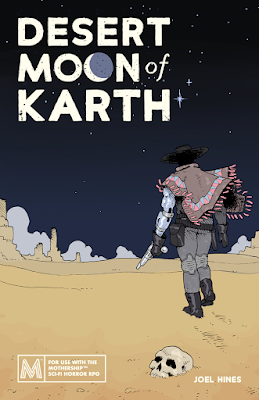
[Fanzine Focus XXVII] Desert Moon of Karth

On the tail of Old School Renaissance has come another movement—the rise of the fanzine. Although the fanzine—a nonprofessional and nonofficial publication produced by fans of a particular cultural phenomenon, got its start in Science Fiction fandom, in the gaming hobby it first started with Chess and Diplomacy fanzines before finding fertile ground in the roleplaying hobby in the 1970s. Here these amateurish publications allowed the hobby a public space for two things. First, they were somewhere that the hobby could voice opinions and ideas that lay outside those of a game’s publisher. Second, in the Golden Age of roleplaying when the Dungeon Masters were expected to create their own settings and adventures, they also provided a rough and ready source of support for the game of your choice. Many also served as vehicles for the fanzine editor’s house campaign and thus they showcased how another DM and group played said game. This would often change over time if a fanzine accepted submissions. Initially, fanzines were primarily dedicated to the big three RPGs of the 1970s—Dungeons & Dragons, RuneQuest, and Traveller—but fanzines have appeared dedicated to other RPGs since, some of which helped keep a game popular in the face of no official support.

Since 2008 with the publication of Fight On #1, the Old School Renaissance has had its own fanzines. The advantage of the Old School Renaissance is that the various Retroclones draw from the same source and thus one Dungeons & Dragons-style RPG is compatible with another. This means that the contents of one fanzine will be compatible with the Retroclone that you already run and play even if not specifically written for it. Labyrinth Lord and Lamentations of the Flame Princess Weird Fantasy Roleplay have proved to be popular choices to base fanzines around, as has Swords & Wizardry.

One of the trends in ZineQuest—the annual drive on Kickstarter to create fanzines, fan-created magazines supporting their favourite game—has been away from the more traditional format to the more focused. Traditionally, the fanzine consists of a collection of articles, covering a wide array of subjects. For example, in a fanzine devoted to Dungeons & Dragons or one of its many retroclones, such articles might provide new character Classes, spells, monsters, magical items, a scenario or dungeon, and so on. Although ZineQuest in 2021–ZineQuest #3–certainly included fanzines of that type, there were fanzines that were not so much fanzines as complete roleplaying games in themselves or complete supplements for existing roleplaying games. Desert Moon of Karth is a perfect example of the latter.

Desert Moon of Karth is a complete scenario for the MOTHERSHIP Sci-Fi Horror Roleplaying Game. Designed and published by Joel Hines following a successful Kickstarter campaign, it is also quite a different scenario in tone and flavour and set-up for the MOTHERSHIP Sci-Fi Horror Roleplaying Game. The genre for the MOTHERSHIP Sci-Fi Horror Roleplaying Game is Blue Collar Sci-Fi horror, most obviously inspired by the films Alien and Outland, and the majority of the scenarios for the roleplaying game are horror one-shots. Not so, Desert Moon of Karth. Instead, Desert Moon of Karth is a sandbox scenario whose genre is that of the Space Western and whose inspirations include Dune, Firefly, Alien, John Carter of Mars, Cowboy Bebop, and The Dark Tower as well as A Pound of Flesh, Ultraviolet Grasslands, and Slumbering Ursine Dunes.

The setting for Desert Moon of Karth is a desert moon on the far edge of the galaxy. It is perhaps best known as being a source of Coral Dust, the addictive blue-grey powder harvested and ground from the bones of the ancient, almost mythic species known as the Wigoy, which have ossified into coral and when ingested stills the aging process and sharpens the mind. There has been a ‘gold rush’ to Karth, a ready flow of would be prospectors willing to brave the harsh environment and the attacks by the infamous Sandsquids attracted by their searches deep into the sand. Access to Karth is limited though via a rickety orbital elevator fiercely controlled by the colonial marines of the Manian Expeditionary Force, as a network of relic orbital satellites shoot down all ships or flying objects—incoming or outgoing. This combination of distance from the centre of the galaxy and inaccessibility means that Karth has gained another reputation—that of a haven for criminals and the galaxy’s most wanted. So the lawless desert moon attracts not just prospectors, but bounty hunters too.

Like any good sandbox—and Desert Moon of Karth really is set on a sandbox—Desert Moon of Karth is a toolkit of different elements. These start with ten highly detailed locations, beginning with the frontier boomtown, Larstown, and then continuing with the Shattered Visage of an angelic man, the Seahorse Mine, the played out location of the first Wigoy prospecting operation on Karth, the Silver Spire, home to a trio of immortal Old People known as the Dawnseekers who research and harvest organs to ensure their longevity, a Ship Graveyard of vessels brought down by the orbital defences, and the Krieg Ranch where the best though-flea-bitten camels for travel across the deserts of Karth can be hired, run by a cranky old woman who keeps her husband on ice in case he can be taken off world for treatment to a grievous injury. Around these locations, four factions dominate Karth. One consists of the Dawnseekers, another the Manian Expeditionary Force, but these are joined by the Valley Rangers, a cargo cult formed around the Lunar Park Service’s bureaucracy and conservationists who abhor technology and seek to maintain the world’s ecology, and the Wigoy themselves, aliens hiding from the other factions with long term aims for the whole of Karth and beyond…

All four factions and the majority of the locations include NPCs with often opposing aims and jobs—both known and secret—that the Player Characters might be employed to fulfil. These, though, are just the start in Desert Moon of Karth, because they are richly supported with table after table of random encounters, motivations, NPCs, rumours, and more! That ‘more’ includes tables of reasons why the Player Characters might have come to Karth, gifts that the Wigoy might grant, worn space hulks, bounty hunters and their possible quarries, oldtech artefacts, what happens when the Player Characters go Wigoy prospecting, and things to be found on bodies, and more.

Although there is potential future mapped out in Desert Moon of Karth, it really only plays out if the Player Characters do nothing. Ultimately then, the Player Characters have a huge opportunity to involve themselves in and influence events on the moon, but this is very much player driven. Once their characters have their motivations—either selected ahead of time or generated using the table in the book, it is very much up to the players to involve themselves in both life and the events going on across Karth.

Mechanically, Desert Moon of Karth is very light, and thus much in keeping with the MOTHERSHIP Sci-Fi Horror Roleplaying Game. There are various stats for the NPCs of course, but they are percentile and easily adaptable, whilst the specific rules cover things such as travel across Karth and prospecting for Wigoy coral—and that is it. What this means is that Desert Moon of Karth is not only very light, but easily adapted to the mechanics of the roleplaying game of the Warden’s choice. Any version of the Star Wars roleplaying games, Cepheus Deluxe, Stars Without Number, Firefly, HOSTILE, and others would work with this supplement with a minimum of preparation, as would many a generic system too.

However, the tone of Desert Moon of Karth may not necessarily match the campaign being run by the Warden if for the MOTHERSHIP Sci-Fi Horror Roleplaying Game, and that likelihood increases if adapted to another Science Fiction roleplaying game. There is horror as you would expect for something written for the MOTHERSHIP Sci-Fi Horror Roleplaying Game, but there is also a weirdness too in the presence of the Wigoy and their secrets, and they might have a profound effect upon a Game Master’s campaign if certain events happen. Nevertheless, the self-contained nature of Karth itself and of Desert Moon of Karth makes it very easy to use. Nor need that be as an addition to an existing campaign. It could be a one-shot adventure, a mini-campaign of its own, or as a source of ideas and tables from which the Game Master can pick and choose elements to add to her own game.

Physically, Desert Moon of Karth is a compact fifty-two page supplement—perhaps a little too big to be really called a supplement. It is well written, it is easy to read, the illustrations are excellent, and the maps, whether of the moon itself, or Larstown or the interior of a Sandsquid are all great.

As a sandbox, and a sandbox space western at that, Desert Moon of Karth pushes MOTHERSHIP Sci-Fi Horror Roleplaying Game in a new direction and opens up the scope of gaming possible for those rules—especially with the new edition available. Whatever the system used, Desert Moon of Karth is crammed full of gaming content adding a weird world to the Science fiction roleplaying game of your choice, but really offering a fantastic mini-campaign. Not just a good fanzine, Desert Moon of Karth is really good good Science Fiction supplement.