Every Week It's Wibbley-Wobbley Timey-Wimey Pookie-Reviewery...
Showing posts with label Joel Hines. Show all posts

Saturday, 1 January 2022

Reviews from R'lyeh Post-Christmas Dozen 2021

Since 2001, Reviews from R’lyeh have contributed to a series of Christmas lists at Ogrecave.com—and at RPGaction.com before that, suggesting not necessarily the best board and roleplaying games of the preceding year, but the titles from the last twelve months that you might like to receive and give. Continuing the break with tradition—in that the following is just the one list and in that for reasons beyond its control, OgreCave.com is not running its own lists—Reviews from R’lyeh would once again like present its own list. Further, as is also traditional, Reviews from R’lyeh has not devolved into the need to cast about ‘Baleful Blandishments’ to all concerned or otherwise based upon the arbitrary organisation of days. So as Reviews from R’lyeh presents its annual (Post-)Christmas Dozen, I can only hope that the following list includes one of your favourites, or even better still, includes a game that you did not have and someone was happy to hide in gaudy paper and place under that dead tree for you. If not, then this is a list of what would have been good under that tree and what you should purchase yourself to read and play in the months to come.

—oOo—

The Eldritch New England Holiday Collection originated as a series of scenarios in the Miskatonic University Library Association monograph line, but Golden Goblin Press has collected and updated them to Call of Cthulhu, Seventh Edition, and presented them as a fully playable campaign set in Lovecraft Country. Not though as traditional Investigators of Call of Cthulhu, but as children growing up and attending family holidays—Halloween in Dunwich, Christmas in Kingsport, Easter in Arkham, and Independence Day off Innsmouth. They are aware that their hometowns are different, that horrors—both human and inhuman—lurk in dark places and even beyond the Veil of Sleep. As friends and family, they must face the dangerous truths of the secret world around them, including their relatives… The Eldritch New England Holiday Collection combines a sense of magical realism with Lovecraft’s cosmic horror and infuses traditional Lovecraftian investigative roleplaying with a sense of warmth and charm not found elsewhere in Call of Cthulhu.

Free League Publishing ($41.99/£32)
One of the big questions about the Alien: The Roleplaying Game is whether or not it could be played in Campaign mode. Alien: The Roleplaying Game can be played in two modes—Cinematic and Campaign. Cinematic mode is designed to emulate the drama of a film set within the Alien universe, and so emphasises high stakes, faster, more brutal play, and will be deadlier, whilst the Campaign mode is for longer, more traditional play, still brutal, if not deadly, but more survivable. However, until the publication of the Colonial Marines Operations Manual, a Campaign was something that the roleplaying game lacked. With its release, we got both a sourcebook on the history, organisation, and equipment of the United States Colonial Marine Corps, and a full blown, seven-part campaign for Alien: The Roleplaying Game. This is Frontier War, a horrifying campaign in which multiple factions vie for control of the biotechnology derived from the Xenomorphs. Frontier War consists of seven parts and combines Space Horror, Sci-Fi Action, and a Sense of Wonder, in a horrifically good, desperately deadly (but not too deadly), and epically grand military-conspiracy horror campaign.

Joel Hines ($24/£18)
Desert Moon of Karth is a complete scenario for the MOTHERSHIP Sci-Fi Horror Roleplaying Game in a different vein for the Blue Collar Sci-Fi horror roleplaying game. It is a Space Western sandbox scenario inspired by Dune, Firefly, Alien, John Carter of Mars, Cowboy Bebop, and The Dark Tower. Located on the far edge of the galaxy, the Desert Moon of Karth is the only source of Coral Dust, the addictive powder harvested and ground from the bones of the ancient, almost mythic species known as the Wigoy. Thus there has been a ‘gold rush’ to Karth, plus its remoteness means that it has become a haven for criminals and the galaxy’s most wanted, all behind a world protected and blocked by a network of relic orbital satellites which shoot down all ships or flying objects—incoming or outgoing. The setting is built around ten locations of the sandbox and four factions, each with their own motivations and tasks for hire. Armed with an incredible set of inspiring tables, including the ever faithful, ‘What you find on the body’ table, the Game Master can support Desert Moon of Karth’s player-driven campaign as they and their characters—bounty hunters, on-the run criminals, prospectors, journalists wanting a story, and so on—explore the weirdness of this alien world. The rules-light Desert Moon of Karth is good not just for the MOTHERSHIP Sci-Fi Horror Roleplaying Game, but is a great little toolkit and scenario for almost any Science Fiction roleplaying game.

Chaosium, Inc. ($29.99/£29.99)
If you thought the Call of Cthulhu Starter Set was good, then prepare to be amazed because the RuneQuest Starter Set is actually better. It uses the same format of rules, sample Player Characters, a solo scenario, and several scenarios you can play with your friends, plus dice, but there is more background content, fourteen ready-to-play Player Characters, a lengthy solo scenario, three lengthy scenarios to play with your friends, plus dice, play aids, and maps—maps that are gorgeously detailed in their depiction of Glorantha’s Sartar. Designed as an introduction to RuneQuest: Roleplaying in Glorantha, the RuneQuest Starter Set provides the prospective Game Master and her players with everything needed to start playing in the mythic world of Glorantha and then keep playing for multiple sessions. All of which is presented in an easy-to-learn fashion with the rules in one booklet, the background in another, the solo adventure in a third, and three adventures in the fourth. Further, the adventures booklet includes the complete details and a lovely map of the city of Jonstown, the perfect starting base for the Player Characters and provide further background that will be enjoyed by the veteran players of the game. No starter set has been as comprehensive as the RuneQuest Starter Set, making it the perfect entry point for both Glorantha and RuneQuest: Roleplaying in Glorantha.

The Merry Mushmen ($35/£25.99)
2021 saw the continued rise of the gaming magazine and the Old School Renaissance got its own with Knock!, of which two issues were released in 2021. It came crammed with content—polemics and treatises, ideas and suggestions, rules and rules, treasures, maps and monsters, adventures and Classes, and random tables and tables, followed by random tables in random tables! All of which is jam-packed into a vibrant-looking book. Primarily designed for use with Necrotic Gnome’s Old School Essentials Classic Fantasy, the contents of Knock! are readily and easily adapted to the retroclone of the Game Master’s choice, making the magazine an incredible resource. It includes contributions from a wide array of the movement’s most influential writers, publishers, and commentators, some of the best entries being the ‘Dungeon Checklist’, ‘What Do Monsters Want?’, ‘300 Useless Magic Loot’, and ‘Borderlands’—the latter a surprisingly learned examination of B2 Keep on the Borderlands. Fantastically presented, it was followed up by a second issue which had even more content and thus more ideas and support for your Old School Renaissance campaign.

MIT Press ($35/£30)
The author of Playing at the World: A History of Simulating Wars, People and Fantastic Adventures, from Chess to Role-Playing Games explores the first decade of the roleplaying hobby in search of the answer to the question, “What was the first roleplaying game?” Or rather, when did the wargame, Dungeons & Dragons, and the similar games which followed it, actually become roleplaying games? 
In doing so, he charts the debate over questions such as the role and impartiality of the Referee, the right way to create characters, character competency versus player competency, who should roll the dice—the Referee or the players, how much should the player know about the game’s mechanics, how should Alignment work and affect a character, and what is the point of play—to acquire Experience Points and become superhuman, to explore and tell a story, or a combination of the two? This is a fascinating account of the earliest days of the hobby and its fandom, capturing it for posterity.

Savage Spiel ($6.75/£5)
Inspired by the mystery stories of Miss Marple, Jessica Fletcher, and Father Brown, murder comes to your small cosy village and it is up to the ladies of a certain age to gather the clues, identify the culprit, and solve the murder! Based on Jason Cordova’s Brindlewood Bay, this storytelling roleplaying focuses entirely on the mystery. Using stripped down Powered by the Apocalypse mechanics, the matrons search for clues and chat with the suspects, each applying their own investigative style. Sometimes finding a clue is easy, but sometimes it comes with a complication or a condition, and when that happens, the Matrons can always have a ‘Nice Cup of Tea’ and so remove the condition. If the investigation gets really hairy and a Matron finds herself in trouble, she can always ‘Go to the Adverts’ and have everyone help resolve tense moment during the break! Once the Matrons have acquired enough clues, they can ‘Put It All Together’, make their accusation, and explain their deductions. The clever aspect of all of this is that every mystery comes with a potential set of suspects, complete with clues pointing towards their guilt, but no predetermined murderer. Who exactly committed the murder is all up to the Matrons of Mystery to deduce.

Osprey Games ($35/£25)
Inspired by both history and the epic myth cycles of the Ancient Near East—The Iliad, The Odyssey, and GilgameshJackals – Bronze Age Fantasy Roleplaying takes place in Zaharets, the Land of Risings, a fantastic version of the Levant whose peoples have only recently risen up and over thrown the monstrously bestial kingdom of Barak Barad whose Taken enslaved humanity and staked their claim to the region by establishing cities at both ends of the War Road, the north-south route which helps ensure peace and prosperity. Yet dangers lurk beyond the road, dark secrets left over from Barak Barad, bandits raid the caravans on the road, and dark powers whisper promises of power to the ambitious. There is another danger—Jackals. Men and women who give up the safety of community and law and order to face the threats and mysteries which lie beyond the road. No good community would have truck with the Jackals. For who knows what evil, what chaos they might bring back with them? Yet Jackals keep the community safe when it cannot and some become Zaharets’ mightiest heroes, even leaders when they retire. This is an excellent set-up and makes for great community tension even as the Jackals give protection, and there is even a campaign available, Jackals: The Fall of the Children of Bronze.

Arc Dream Publishing ($64.99/£47.99)
The first campaign for Delta Green: The Role-Playing Game pulls the Agents into a world of twisted apartments and improbable architecture before dumping them out again and then pulling them back in again decades later to twist the world around them in a paranoia-infused mystery that defies both answers and conception. When even reality cannot be trusted there is only each other to rely upon in this insidious investigation into madness and mayhem whose answers—if not the solution, may lie on the shores of Lake Carcosa. Will you answer the call of the Yellow King? Can you withstand his influence which seems to change the reality around you? And if you can, just who are you working for and can you trust each other? Impossible Landscapes is a truly disturbing and brilliantly weird campaign, as both a book and a campaign, and the latter is supported by some incredibly rich, detailed, and layered handouts—handouts that constantly raise questions more they provide answers. 

Finally, after twenty years of waiting since the release of Dune: Chronicles of the Imperium and with the release of the new film, the hobby got the Dune roleplaying game it deserved. Dune: Adventures in the Imperium the player take on roles of members of one the noble Houses of the Imperium and must guide its fortunes through the conflicts, conspiracies, and connivances which play out just under the veneer of formality and civility that every House projects. How this is played out—espionage, political or diplomatic manoeuvring, forging alliances, black operations, and even open warfare are potentially useful tools if the result can elevate the House to an even greater status. In game terms, this is played at the level of the House itself as an organisation, but as Player Characters—Bene Gesserit, Mentats, Smugglers, Spy Masters, Sword Masters, and more—they will not be influenced by such decisions, but they have the potential to affect their outcome with the success or failure of individual missions. Dune: Adventures in the Imperium combines the simple mechanics of the 2d20 System with an incredible amount of background detail. This is fantastic gaming adaptation of a highly detailed and much revered setting, and a must for any gamer who is a fan of Frank Herbert’s Dune.

Goodman Games ($63/£79.99)
The sixth in the Original Adventures Reincarnated line from Goodman Games, this takes another classic scenario or campaign and combines high-quality scans from multiple printings of the original first edition adventure modules, commentary by gaming luminaries, and a complete adaptation of the original module for use with Dungeons & Dragons, Fifth Edition—and more. Coming as a two-book slipcase set, Original Adventures Reincarnated #6: Temple of Elemental Evil takes us back to T1 The Village of Hommlet and T1-4: The Temple of Elemental Evil as the region around Hommlet is once again beset by bandits and monsters. Has the great evil, defeated many years ago, returned to prey upon lands hereabout? Of course it has! Beginning with a classic village imperiled by evil—indeed, T1 The Village of Hommlet was one of the first villages to be so imperiled—brave adventurers will gather clues and investigate, eventually venturing into the Temple of Elemental Evil itself and delving deep into the complex below where it is said the evil still lies undefeated. Not just a great reproduction, Original Adventures Reincarnated #6: Temple of Elemental Evil is an expansion too into a complete mega-dungeon and mini-campaign designed for First Level through to Seventh Level. Original Adventures Reincarnated #6: Temple of Elemental Evil can be played through as of old, but the new addition brings new mysteries and encounters which will enhance the nostalgia.

Chaosium, Inc. ($74.95/£55.49)
Last year, the Jonstown Compendium, the community content programme for RuneQuest: Roleplaying in Glorantha, gave us a great starting campaign with Six Seasons in Sartar. Now the author of that campaign returns with an even bigger campaign, one that can be run as a standalone, but really works best as a sequel to Six Seasons in Sartar. In The Company of the Dragon the Player Characters must guide the survivors of their clan as they are forced to go on the run from the Lunar Empire. As they do, they must build and maintain their own community, to create their own myth, and ultimately, as they become involved in some of the major events leading up and including the Dragonrise, have them forge their own destiny. Superbly supported with tools, advice, and discussion, as well as numerous episodes to run, The Company of the Dragon is exactly what both the campaign and the sequel that Six Seasons in Sartar needed, as well as being a great prequel to the events of RuneQuest: Roleplaying in Glorantha and the forthcoming Sartar Campaign.

Sunday, 26 December 2021

[Fanzine Focus XXVII] Desert Moon of Karth

On the tail of Old School Renaissance has come another movement—the rise of the fanzine. Although the fanzine—a nonprofessional and nonofficial publication produced by fans of a particular cultural phenomenon, got its start in Science Fiction fandom, in the gaming hobby it first started with Chess and Diplomacy fanzines before finding fertile ground in the roleplaying hobby in the 1970s. Here these amateurish publications allowed the hobby a public space for two things. First, they were somewhere that the hobby could voice opinions and ideas that lay outside those of a game’s publisher. Second, in the Golden Age of roleplaying when the Dungeon Masters were expected to create their own settings and adventures, they also provided a rough and ready source of support for the game of your choice. Many also served as vehicles for the fanzine editor’s house campaign and thus they showcased how another DM and group played said game. This would often change over time if a fanzine accepted submissions. Initially, fanzines were primarily dedicated to the big three RPGs of the 1970s—Dungeons & Dragons, RuneQuest, and Traveller—but fanzines have appeared dedicated to other RPGs since, some of which helped keep a game popular in the face of no official support.

Since 2008 with the publication of Fight On #1, the Old School Renaissance has had its own fanzines. The advantage of the Old School Renaissance is that the various Retroclones draw from the same source and thus one Dungeons & Dragons-style RPG is compatible with another. This means that the contents of one fanzine will be compatible with the Retroclone that you already run and play even if not specifically written for it. Labyrinth Lord and Lamentations of the Flame Princess Weird Fantasy Roleplay have proved to be popular choices to base fanzines around, as has Swords & Wizardry.

One of the trends in ZineQuest—the annual drive on Kickstarter to create fanzines, fan-created magazines supporting their favourite game—has been away from the more traditional format to the more focused. Traditionally, the fanzine consists of a collection of articles, covering a wide array of subjects. For example, in a fanzine devoted to Dungeons & Dragons or one of its many retroclones, such articles might provide new character Classes, spells, monsters, magical items, a scenario or dungeon, and so on. Although ZineQuest in 2021–ZineQuest #3–certainly included fanzines of that type, there were fanzines that were not so much fanzines as complete roleplaying games in themselves or complete supplements for existing roleplaying games. Desert Moon of Karth is a perfect example of the latter.
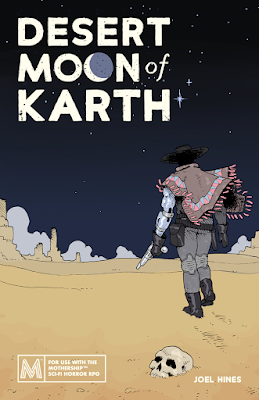
Desert Moon of Karth is a complete scenario for the MOTHERSHIP Sci-Fi Horror Roleplaying Game. Designed and published by Joel Hines following a successful Kickstarter campaign, it is also quite a different scenario in tone and flavour and set-up for the MOTHERSHIP Sci-Fi Horror Roleplaying Game. The genre for the MOTHERSHIP Sci-Fi Horror Roleplaying Game is Blue Collar Sci-Fi horror, most obviously inspired by the films Alien and Outland, and the majority of the scenarios for the roleplaying game are horror one-shots. Not so, Desert Moon of Karth. Instead, Desert Moon of Karth is a sandbox scenario whose genre is that of the Space Western and whose inspirations include Dune, Firefly, Alien, John Carter of Mars, Cowboy Bebop, and The Dark Tower as well as A Pound of Flesh, Ultraviolet Grasslands, and Slumbering Ursine Dunes.

The setting for Desert Moon of Karth is a desert moon on the far edge of the galaxy. It is perhaps best known as being a source of Coral Dust, the addictive blue-grey powder harvested and ground from the bones of the ancient, almost mythic species known as the Wigoy, which have ossified into coral and when ingested stills the aging process and sharpens the mind. There has been a ‘gold rush’ to Karth, a ready flow of would be prospectors willing to brave the harsh environment and the attacks by the infamous Sandsquids attracted by their searches deep into the sand. Access to Karth is limited though via a rickety orbital elevator fiercely controlled by the colonial marines of the Manian Expeditionary Force, as a network of relic orbital satellites shoot down all ships or flying objects—incoming or outgoing. This combination of distance from the centre of the galaxy and inaccessibility means that Karth has gained another reputation—that of a haven for criminals and the galaxy’s most wanted. So the lawless desert moon attracts not just prospectors, but bounty hunters too.

Like any good sandbox—and Desert Moon of Karth really is set on a sandbox—Desert Moon of Karth is a toolkit of different elements. These start with ten highly detailed locations, beginning with the frontier boomtown, Larstown, and then continuing with the Shattered Visage of an angelic man, the Seahorse Mine, the played out location of the first Wigoy prospecting operation on Karth, the Silver Spire, home to a trio of immortal Old People known as the Dawnseekers who research and harvest organs to ensure their longevity, a Ship Graveyard of vessels brought down by the orbital defences, and the Krieg Ranch where the best though-flea-bitten camels for travel across the deserts of Karth can be hired, run by a cranky old woman who keeps her husband on ice in case he can be taken off world for treatment to a grievous injury. Around these locations, four factions dominate Karth. One consists of the Dawnseekers, another the Manian Expeditionary Force, but these are joined by the Valley Rangers, a cargo cult formed around the Lunar Park Service’s bureaucracy and conservationists who abhor technology and seek to maintain the world’s ecology, and the Wigoy themselves, aliens hiding from the other factions with long term aims for the whole of Karth and beyond…

All four factions and the majority of the locations include NPCs with often opposing aims and jobs—both known and secret—that the Player Characters might be employed to fulfil. These, though, are just the start in Desert Moon of Karth, because they are richly supported with table after table of random encounters, motivations, NPCs, rumours, and more! That ‘more’ includes tables of reasons why the Player Characters might have come to Karth, gifts that the Wigoy might grant, worn space hulks, bounty hunters and their possible quarries, oldtech artefacts, what happens when the Player Characters go Wigoy prospecting, and things to be found on bodies, and more.

Although there is potential future mapped out in Desert Moon of Karth, it really only plays out if the Player Characters do nothing. Ultimately then, the Player Characters have a huge opportunity to involve themselves in and influence events on the moon, but this is very much player driven. Once their characters have their motivations—either selected ahead of time or generated using the table in the book, it is very much up to the players to involve themselves in both life and the events going on across Karth.

Mechanically, Desert Moon of Karth is very light, and thus much in keeping with the MOTHERSHIP Sci-Fi Horror Roleplaying Game. There are various stats for the NPCs of course, but they are percentile and easily adaptable, whilst the specific rules cover things such as travel across Karth and prospecting for Wigoy coral—and that is it. What this means is that Desert Moon of Karth is not only very light, but easily adapted to the mechanics of the roleplaying game of the Warden’s choice. Any version of the Star Wars roleplaying games, Cepheus Deluxe, Stars Without Number, Firefly, HOSTILE, and others would work with this supplement with a minimum of preparation, as would many a generic system too.

However, the tone of Desert Moon of Karth may not necessarily match the campaign being run by the Warden if for the MOTHERSHIP Sci-Fi Horror Roleplaying Game, and that likelihood increases if adapted to another Science Fiction roleplaying game. There is horror as you would expect for something written for the MOTHERSHIP Sci-Fi Horror Roleplaying Game, but there is also a weirdness too in the presence of the Wigoy and their secrets, and they might have a profound effect upon a Game Master’s campaign if certain events happen. Nevertheless, the self-contained nature of Karth itself and of Desert Moon of Karth makes it very easy to use. Nor need that be as an addition to an existing campaign. It could be a one-shot adventure, a mini-campaign of its own, or as a source of ideas and tables from which the Game Master can pick and choose elements to add to her own game.

Physically, Desert Moon of Karth is a compact fifty-two page supplement—perhaps a little too big to be really called a supplement. It is well written, it is easy to read, the illustrations are excellent, and the maps, whether of the moon itself, or Larstown or the interior of a Sandsquid are all great.

As a sandbox, and a sandbox space western at that, Desert Moon of Karth pushes MOTHERSHIP Sci-Fi Horror Roleplaying Game in a new direction and opens up the scope of gaming possible for those rules—especially with the new edition available. Whatever the system used, Desert Moon of Karth is crammed full of gaming content adding a weird world to the Science fiction roleplaying game of your choice, but really offering a fantastic mini-campaign. Not just a good fanzine, Desert Moon of Karth is really good good Science Fiction supplement.