Every Week It's Wibbley-Wobbley Timey-Wimey Pookie-Reviewery...
Showing posts with label Encounters. Show all posts

Friday, 27 May 2022

Mapping Your Encounter

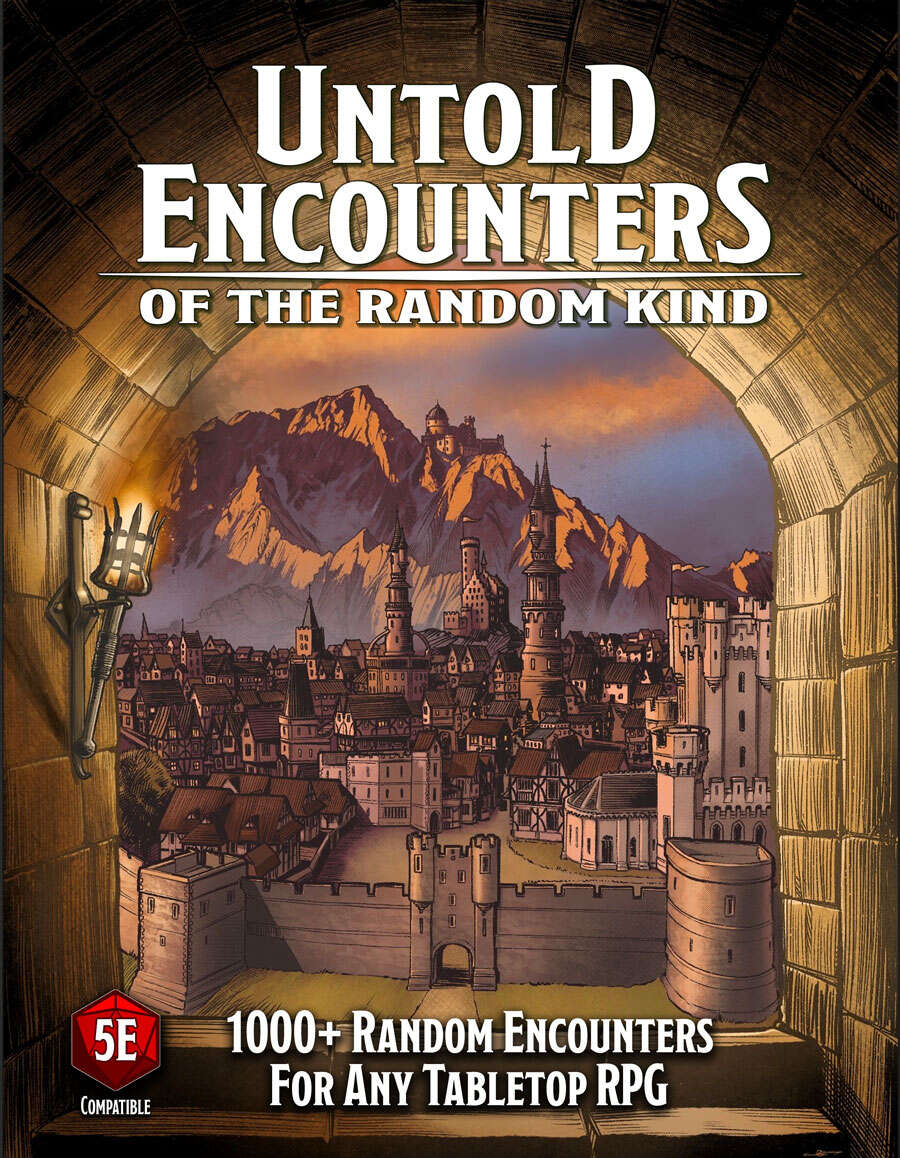
There have always been encounters in roleplaying because fundamentally, roleplaying is built on encounters, and the most fun has come from great encounters and their outcome and the roleplaying which comes from them. Yet coming up with interesting, involving, or even challenging encounters can hinder the most creative of Game Masters. So it is no surprise that the industry has fulfilled this need all the way back to books such as Dungeons & Dragons Monster & Treasure Assortment Set One: Levels One-Three, published by TSR, Inc. in 1977 and Traveller Supplement 6: 76 Patrons, published in in 1980 by GDW. This need has never gone away, with roleplaying genres such as fantasy, horror, and fantasy, along with specific roleplaying games and settings all being treated to their supplements of encounters, personalities, and places. In each book, each of their encounters can obviously be run as written, but each can also be adapted to fit the Game Master’s campaign, or even simply serve as inspiration. One of the latest entries to join this long list of supplements is Untold Encounters of the Random Kind.

Untold Encounters of the Random Kind is published by Loke BattleMats, a publisher best known for its maps for roleplaying games, such as The Towns & Taverns Books of Battle Mats, The Wilderness Books of Battle Mats, and The Dungeon Books of Battle MatsUntold Encounters of the Random Kind promises over a thousand random encounters, much like the ‘Books of Battle Mats’ series across towns, wildernesses, and dungeons, as well as adventure generators, random tables, and more. The latter includes six sample adventures.

Untold Encounters of the Random Kind is designed to be compatible with Dungeons & Dragons, Fifth Edition. However, it is not actually a Dungeons & Dragons, Fifth Edition supplement and there are no Dungeons & Dragons, Fifth Edition stats or content in the supplement. Instead it uses Keywords across seven categories—Mechanics, Damage, Difficulty, Challenge, Enemy Types, Group Sizes, and NPC Types. So for example, Damage which can be inflicted by an attack, a trap, a spell, an environmental effect, and so on, is listed as Minor, Light, Major, and Lethal, whilst the Difficulty of a task is listed as Simple, Routine, Difficult, Very Difficult, or Near Impossible. All of these are easily adapted to the fantasy roleplaying game of the Game Master’s choice, whilst the ‘5E Mechanics’ section suggests how the supplement’s Keywords can be translated into Dungeons & Dragons, Fifth Edition. This is via Keywords, primarily the Keywords for Damage, Difficulty, and Challenge—the latter to Challenge Rating, and together it amounts to just two pages. In a supplement which is over three hundred pages long… The point is that Untold Encounters of the Random Kind is just as easy to use with Dungeons & Dragons, Fifth Edition as it is with the retroclone of the Game Master’s choice, be it Old School Essentials, Swords & Wizardry, or Labyrinth Lord. In other words, Untold Encounters of the Random Kind is very much Old School Renaissance compatible.

Untold Encounters of the Random Kind is tidily organised into its three sections covering town, wilderness, and dungeon encounters. Each section begins with an overview of the nature of the location type, terrain, district, or encounter types (so cemeteries, docks, and noble quarters for towns, arctic, forests, and sea and shore for wildernesses, and dungeon doors, enemies, and intrigue for dungeons), advice on using the encounters, as well as information particular to the section. Thus for Town Encounters there notes on town dignitaries, wilderness and dungeon crossovers, townsfolk, types of town, and how to create non-human towns. For the different types of wilderness, there is guidance on the weather, visibility, geography, and travel and survival, whilst for dungeons there is advice on traps, denizens, building dungeons, crossovers, and more. None of these entries is accorded more than a few short paragraphs, and arguably, any one of them is likely worth an essay or two of their very own. As a starting point though, the advice in Untold Encounters of the Random Kind is solid throughout.

None of the advice in each section is more than three pages in length before Untold Encounters of the Random Kind delves into its encounters. There are more than fifty entries in each of these tables and each one is expanded upon with a full description. These are given alphabetically following all of the tables. There is a degree of repetition here, for example, the ‘Abandoned Cart’ encounter, found with signs of something heavy having been dragged from it, can be found in the Castle Ward, Guild Quarter, High Street, Lanes, and Noble Quarter, but for most part the encounters are confined to one area or district. For example, the ‘Jury’ is only found in the Noble Quarter and a ‘Hollow Tree’ is found in the Forest. Some entries add flavour and feel, such as ‘Fantastic Music’, the wind whistling through past them sounds so happy as they trek across the Arctic region that the spirits of the Player Characters are uplifted, whilst on the Sea & Shore, the heavy salt content in the water and the air matts hair giving the Player Characters odd hairdos. It also affects fur coats. Boons may also be found in be the wilderness and dungeons, such as a ‘Coin Stash’ or ‘Mechanical Oddity’ with an as yet unfathomable purpose, and a dungeon or ‘Ring of the Lost’ which provides protection and a strange effect on compasses and ‘Salvage Onshore’ of valuable trade goods, similarly both found, though in the wilderness. Wilderness boons consist of coins and valuables, survival and supply caches, and even ores and gems. Similarly, dungeon boons consist of coins and other valuables, but also can be clues and of course, magical items. In both cases of wilderness and dungeon boons there is advice on how to include them and their potential story ramifications.

In comparison to the earlier sections of town and wilderness encounters, the dungeon encounter section goes into a bit more detail. There are tables here for location and back story, plus sample monster suggestions and building particular encounters. Again whole essays or even supplements have been written about dungeon design, so the advice is solid, but not deep.

Included at the end of the three sections—town, wilderness, and dungeon—is a pair of scenarios. These are designed for either Second, Fourth, or Eighth Level Players and each consists of a two-page spread. These have been constructed using the tables and encounters in Untold Encounters of the Random Kind with differently formatted text used to refer to encounter types and also Dungeons & Dragons, Fifth Edition monster types. This is by name only, so again no stats. The six include ‘Wanted’ in which a local watch captain wants a shady relative brought in before the con artist’s enemies catch up with him; ‘Parched’, which opens with the Player Characters shipwrecked on the shores of a desert and a five-day trek to the nearest oasis with little water between them; and in ‘The Cursed Folly’, the Player Characters have been paid well to clear out a folly by a somewhat dotty member of the owning noble family who wants to live in it. Each of the six comes with a decent map of the adventure location, but each will require the Game Master to provide the stats for the various monsters. All six are all decent adventures, each offering little more than a session’s worth of play, and potentially the publisher could take the format and do a whole supplement of full encounters like it.

Physically, Untold Encounters of the Random Kind is decently presented. It does need an edit in places, but the artwork is excellent. Overall, the supplement is a clean and attractive book.

Untold Encounters of the Random Kind is not necessarily a book that as a Game Master you need to own. However, as a book of prompts, ideas, and inspiration, Untold Encounters of the Random Kind is a useful tome to have on the shelf—whichever version of Dungeons & Dragons or retroclone that the Game Master prefers because this supplement will work with them all.


—oOo


Loke BattleMats will be at UK Games Expo which takes place from Friday, June 3rd to Sunday, June 5th, 2022.


Monday, 23 October 2017

Iconic Battles I

High Magic & Low Cunning: Battle Scenes for Five Icons is a supplement for 13th Age, the Dungeons & Dragons-style RPG  with an emphasis on storytelling as well as high action published by Pelgrane Press. It is the first book in the ‘Battle Scenes’ trilogy, each of which presents a series of Icon-themed encounters which can be dropped into an ongoing game with relatively little preparation upon the part of the Game Master. These encounters are battles, built across the three tiers of play—Adventurer, Champion, and Epic—and tied to each one of five Icons. These are the Archmage, the High Druid, the Orc Lord, the Prince of Shadows, and The Three. There are three such encounters per Icon, with three battle scenes per encounter, giving a total of some forty-five or so battles in High Magic & Low Cunning. Further, the supplement comes with a companion Map Folio, which contains maps for each of the volume’s battle locations, so that the Referee can bring the action to the table in full colour.

Besides the 13th Age core rules, the Game Master will also need access to the 13th Age Bestiary, 13 True Ways, and the Book of Loot. Some new magic items are added in High Magic & Low Cunning, but these are not the focus of the supplement, whereas the new monsters it does add, are more the focus of the supplement.

High Magic & Low Cunning is well organised. Each battle series follows the same format. This begins by giving the suggested Level range for the player characters, followed by an introduction, suggested story openings, and alternate Icons. The story openings, typically three or four per battle series provides options for involving the player characters, these varying according to their relationship with the Icon involved. For example, in the first battle series for the Archmage, ‘Moz’s Magnificent Mess’, the story opening for the player character with a positive or conflicted relationship with the Archmage is to have him go clean up Moz’s mess, whereas the story opening for a player character with a conflicted or negative relationship with the Archmage might go to Moz’s aid for favours before the Archmage can or learns of it. Between these two options are two more neutral story openings. Alternate Icons offers other avenues into the battle series via the player characters’ connections with Icons other than the primary one for the series. These typically put a different slant or flavour upon the battle series. A text box, ‘Icons in Play’, discusses which Icon relationships work with the particular battle series and so should be favoured in terms of information and other advantages by the Game Master.

Each battle series consists of three battle scenes. These are come with a map—done in greyscale rather than the full colour of the maps in the High Magic & Low Cunning Map Folio—flavour text and location description, and details of the terrain, traps, monsters, their tactics and loot, how Icon relations will work in the battle, plus monster stats and next steps. The latter helps the Game Master set up the next battle or gives options for outcomes after the last battle in a series. Notes are included on how to scale each battle scene up and down, according to the number of players. Penultimately, each battle series is rounded out with a number of story endings, each one corresponding to a story opening given at the start of each battle series. So for ‘Moz’s Magnificent Mess’, the story ending for the player character with a positive or conflicted relationship with the Archmage and who together with his fellow player characters succeeds in cleaning up Moz’s mess without causing a blemish to the Archmage’s reputation, will Moz’s gratitude and a handful of minor magical items as a reward. Should they fail though, the Archmage and his people will be annoyed with the player characters and his companions and Moz will probably be punished. For the player character with a conflicted or negative relationship with the Archmage who together with his companions help Moz, will gain a favour or two from Moz, but if they fail, the Archmage will send forces after them as punishment! Every battle series comes to a close with some suggested battle scene connections, actually links to other battle series, so that the Game Master could run one series after another. Not all of these occur in High Magic & Low Cunning, so for example, ‘Moz’s Magnificent Mess’, the battle scene connections lead to series involving the Icons, the Dwarf King, the Elf Queen, and the Lich King, whereas ‘Old Injuries Repaid’, a battle series for the Orc Lord has connections to both the Dwarf Lord and the High Druid. Of these, only the High Druid of these appears in High Magic & Low Cunning, so if the Game Master wants to get the very fullest out of this supplement, he may also want to pick up the other supplements in the ‘Battle Scenes’ trilogy—The Crown Commands: Battle Scenes for Four Icons and Fire & Faith: Battle Scenes for Four Icons. The first of these will include battle scenes for the Dwarf King, Elf Queen, Emperor, and Lich King, whilst the latter will include battle scenes for the Crusader, Diabolist, Great Gold Wyrm, and Priestess. 

So, what does High Magic & Low Cunning offer in terms of adventure? There are more adventures set in the wilderness than set in urban, but the standout urban series, ‘Back-Alley Politics’, involving the Prince of Shadows, ends in a fight across an ever shifting, tilting, trap-laden floor. Other locations are more arcane, such as ‘The Lightning Station’ for the Archmage, which involves a race across the clouds for a lost artefact, and ‘Thief of Dreams’ for the Prince of Shadows, sends the player characters into the lands of dream. The majority though, are set in the wilderness. Of these, the High Druid receives not three separate battle series, but three linked battle series in effect giving nine battle scenes in which the player characters must stop a series of power draining rituals; one Orc Lord series, ‘Rafting Razeredge Gorge’, sends the player characters on a raft down river gorges infested with orcs who swing down on ropes and pepper them with arrows, whilst ‘Conquer & Defend’, also for the Orc Lord, sends then up a mountain pass to recapture and then defend a frontier fortress.

Notably though, the battles and the series escalate from a Level range of First and Second Levels up through to the top tier for 13th Age—Tenth Level. Fittingly, this comes at the end of the book and because 13th Age is a roleplaying game derived from Dungeons & Dragons, it involves the Icon, The Three, and dragons! Or rather one dragon in particular and a big, big battle! It is not really giving away much to say that the player characters will require Potions of Fire Resistance at the very least because this will be a fight against a Red Dragon as big as they come! It brings High Magic & Low Cunning to a rousing and hair-singeing conclusion.

The primary use for High Magic & Low Cunning will be for the Game Master as a source of readymade encounters and mini-adventures to choose from and throw at his players and their characters. This can be done as intended, tying a battle series to the player characters via their Icon relationships, especially when a complication is called for following an Icon relationship roll, but it could be down according to terrain and features of each battle series, depending upon where the player characters are and where the campaign is. A third use of course, is as inspiration for the Game Master when writing scenes and encounters for his own campaign.

Yet High Magic & Low Cunning is not quite perfect. An index would not have gone amiss, even a small one could have listed the battle scenes by Level and by terrain. More problematically, a great many of the battle scenes are double-strength encounters, and so extra challenging. This is made clear in the text, but it could have been made more obvious for the Game Master up front. Physically, High Magic & Low Cunning is a solid softback, done in black and white with some excellent pen and ink artwork. Although the book is well written, by Pelgrane Press’ standards, the editing feels just a little too rushed. The full colour maps of the High Magic & Low Cunning Map Folio though, are very nicely done, and come in marked and unmarked versions so the Game Master can reuse them as necessary.

High Magic & Low Cunning: Battle Scenes for Five Icons takes the idea of the Icon relationships at the heart of 13th Age and builds on them to present a fast and easy means for the Game Master to bring them to the table with a minimum of preparation time. The accompanying options also mean that the Game Master can better tailor the various scenes to the player characters’ Icon relationships, giving him greater flexibility in how and when they can be run, thus serving to give the supplement greater utility. Above all, High Magic & Low Cunning: Battle Scenes for Five Icons—along with its companions in the trilogy—is a volume that the Game Master is going to want to keep to hand, ready for just when he needs it and the players and their characters need the challenge.