Saturday, 26 February 2022
Rogue Reports
Rogue Trooper: Tour of Nu-Earth 1 is sadly, the only supplement for Rogue Trooper. Like Judge Dredd: Case File Compendium 1 it is an anthology of scenarios. The seven scenarios or ‘Mission Reports’ within its pages are all set on Nu-Earth, the toxic hellhole and battleground which is the main setting for the Rogue Trooper series. Each scenario comes with a full explanation of its plot, clues, NPC stats, details of its aftermath, and a discussion of possible extra plots and developments which can be added or might come about because of the actions of the Player Characters. Many include suggestions on how to use the scenarios with the Judge Dredd setting for Judge Dredd and the Worlds of 2000 AD or the other roleplaying setting, Strontium Dog.
The anthology opens with ‘Horror At Camp Vlad’, the first of three Mission Reports by John White. The Player Characters are a team of Nort military investigators working for the Office of Public Truth sent to Camp Vlad to find out why so many Prisoners of War have been shot making escape attempts. Other options are discussed, including making Camp Vlad a mutant detention camp in Judge Dredd or Strontium Dog. Camp Vlad is located in a stifling jungle far from the frontlines and apart from the escape attempts, everyone is bored stiff and none too happy to see the Player Characters. This is a solid piece of investigation involving an interesting mystery and a fun scenario which gives the Game Master some good NPCs to portray and plays up a few clichés. Plus the players get to roleplay Nort investigators which means they have latitude in how they conduct themselves, which can be fun to roleplay.
It is followed by ‘Killer in the Night’, also by John White. The Game Master has a few NPCs to portray in this Mission Report when the Player Characters, a Southern combat team is an obvious routine mission—guard a group of Nort Prisoners of War being moved from the frontlines to internment elsewhere. The scenario is intentionally linear, since the Player Characters have to travel along a set route, but along the way, something begins to strike at the prisoners—and if not the prisoners, then the guards. Rumours fly around the convoy about ‘Baba Yaga’ stalking both prisoners and guards and so fear mounts. Backed up with random events, this is a creepy game of ‘Ten Little Indians’ on the move across hostile territory (well, almost everywhere is hostile on Nu-Earth).
Benjamin Rogers’ first Mission Report in Rogue Trooper: Tour of Nu-Earth 1 is not so much a ‘Mission Report’ as a campaign concept, but it does include a short scenario. ‘Unlucky 7s’ provides an alternative to the standard campaign set-up in Rogue Trooper which has the Player Characters as ground pounders, or infantry types. Instead of infantry, the Player Characters are the crew of a Hopper, a VTOL vehicle used for a variety of purposes. This discusses the various roles aboard the Hopper, including Commander, Medic, Engineer, EWS/SIGINT (Signals Intelligence) officer, Gunner, Navigator, Pilot, and Sysop, and suggests the skills for each of them. Equipment and several variants are listed too, as well as a table of vehicle traits and the description of the 29th Assault Hopper Squadron, 7th Souther Air Cav, which as the Unlucky 7s, has an ‘unlucky’ reputation. The sample encounter, ‘Relieving Squad Costa’ is a evacuate under fire mission which would get an air cavalry style campaign off to a good start.
‘Deep Trouble’ is John Rogers’ third and final Mission Report in Rogue Trooper: Tour of Nu-Earth 1 and it is designed for use with the previous Mission Report, ‘Unlucky 7s’. When a Souther flier vanishes near Klumpflot Lake in a remote part of the Hell Hunt Jungle with an important intelligence officer aboard, Milli-Comm assigns the recovery mission to the Unlucky 7s and the Player Characters’ vehicle. This mission ups the ante by inverting the environment and making the Player Characters explore the depths of a lake in order to find the wreck of the crashed VTOL. Since this is a lake on Nu-Earth, this is not a pleasant experience and is made all the more challenging by the local flora and fauna and the danger of Nort patrols and possible intervention. ‘Deep Trouble’ is an enjoyably inventive scenario and its inclusion suggests that a campaign revolving around air cavalry and air support could be a lot of fun.
Ben Rogers’ third and final Mission Report in Rogue Trooper: Tour of Nu-Earth 1 is ‘Black Market Shenanigans’ and it continues to support the author’s ‘Unlucky 7s’ campaign set-up. When a fellow soldier is beaten up, the Player Characters go to his aid and in doing so, bring them to the attention of the base’s black-market dealer, ‘Big Moxie’. It turns out the soldier they helped is in debt to the dealer and effectively, so are the Player Characters. Do the Player Characters help him out, and if so how? How do they deal with ‘Big Moxie’—do they pay her off, get into debt themselves, or even end up working for her? This is an entirely base set scenario. Its one weakness is whether or not the Player Characters decide to get involved—and if not, the scenario has ‘Big Moxie’ come after them until they are forced to act. Alternatively, the victim of the thugs sent by ‘Big Moxie’ could have been set up as an NPC earlier in the campaign, perhaps even be one of those rescued in the earlier ‘Relieving Squad Costa’. Apart from this, ‘Black Market Shenanigans’ makes for a nice change of pace, primarily involving social interaction skills and when combat does occur, brawling.
The final Mission Report in Rogue Trooper: Tour of Nu-Earth 1 is ‘Assault on Nu-Everest’ by Adrian Smith. This is another ‘Unlucky 7s’ scenario, more Where Eagle’s Dare than anything else as the Player Characters are assigned a covert extraction mission which turns into an assault and rescue up a mountain whilst being hunted by monsters! The Player Characters can be as loud or as quiet as they want and it should all climax in a chase back down the mountain in order to escape back to their VTOL. If the Player Characters are successful, they have the chance to redeem the reputation of their regiment. This is an entertaining scenario let down by the fact that its plot is explained in the reading rather than at the start, so the Game Master is not forewarned.
Rogue Trooper: Tour of Nu-Earth 1 is in general well written with decent maps as needed and illustrations taken from the comic. It does need an edit in places.
Rogue Trooper: Tour of Nu-Earth 1 is a solid selection of scenarios for Rogue Trooper. One issue is that the majority of the Mission Reports are for the ‘Unlucky 7s’ campaign set-up, so they are difficult to use in a general campaign set on Nu-Earth. If perhaps all of the Mission Reports in the anthology had been written for the ‘Unlucky 7s’ campaign framework, the supplement could have had more focus and some of the scenarios would have been easier to set up. In fact, the other two scenarios could have been moved elsewhere and made way for more scenarios and more development for the ‘Unlucky 7s’ campaign framework. Ultimately, Rogue Trooper: Tour of Nu-Earth 1 is one third one thing, a scenario anthology, and two third another, a campaign. Consequently, it does not as if it is one whole thing. Nevertheless, Rogue Trooper: Tour of Nu-Earth 1 does contain some entertaining and inventive scenarios, and it does come with a decent campaign starter and if a Game Master for Rogue Trooper does not have this supplement, she should definitely buy it as quickly as she can.
[Fanzine Focus XXVII] Beyond the Borderlands Issue #2
On the tail of the Old School Renaissance has come another movement—the rise of the fanzine. Although the fanzine—a nonprofessional and nonofficial publication produced by fans of a particular cultural phenomenon, got its start in Science Fiction fandom, in the gaming hobby it first started with Chess and Diplomacy fanzines before finding fertile ground in the roleplaying hobby in the 1970s. Here these amateurish publications allowed the hobby a public space for two things. First, they were somewhere that the hobby could voice opinions and ideas that lay outside those of a game’s publisher. Second, in the Golden Age of roleplaying when the Dungeon Masters were expected to create their own settings and adventures, they also provided a rough and ready source of support for the game of your choice. Many also served as vehicles for the fanzine editor’s house campaign and thus they showed another DM and group played said game. This would often change over time if a fanzine accepted submissions. Initially, fanzines were primarily dedicated to the big three RPGs of the 1970s—Dungeons & Dragons, RuneQuest, and Traveller—but fanzines have appeared dedicated to other RPGs since, some of which helped keep a game popular in the face of no official support.
Beyond the Borderlands Issue #2 takes both Dungeon Master and her players into that den of evil which so threatens the Keep, the Caves of Chaos! Or rather, it does not. For in Beyond the Borderlands Issue #2, the Caves of Chaos become The Bloody Ravine, a sharp valley whose walls are pockmarked by cave entrances, beyond which many different tribes of Humanoids find their home. Traditionally the Caves of Chaos have always been presented from right to left with the head of the valley to the left. Here, it is turned ninety degrees, so that when the Player Characters enter the valley, it is more obvious that they are ascending its dangers. The Game Master is given simple rules for handling the Alert Level from one cave to the next, starting at ‘Off Guard’ to ‘Can’t be Surprised’ and comes with a trio of Adventure Hooks, two out of the three potentially leading to the doom of Stronglaw Keep!
Friday, 25 February 2022
A Collection of Crimes
The analogy opens with Judge Dredd Case File #1: Monkey Business by Russ Morrissey. This is a fairly uncomplicated affair, intended to be run as a one-shot or convention scenario, preferably with the pregenerated Player Characters from the core rulebook. That said, it is easy to run with Judges of the players’ own creation, or even with Civilians dealing with the problem because the Judges are busy or with a gang of Perps looking to take down their rivals. Bronson & Sons, a small and not very modern department store, has been taken over by a gang of apes. One is atop the roof, armed with a bazooka and causing mayhem, whilst the rest are inside awaiting the rival of the Judges (or their rivals). This includes a Gorilla ready and waiting in full football gear to bat up, and the rest of the gang all in Prohibition-era suits and fedoras. There is a wrinkle or two, and the Game Master will have fun hamming it up with the Ape gang, but otherwise, this is easy to run and drop into an ongoing campaign.
Judge Dredd Case File #2: Nobody Expects the SJS! by Benjamin Rogers is intended as an interlude. The totalitarian nature of the regime governing Mega-City One comes to the fore when the Judges are pulled from an investigation, whether in the middle or at the end of a shift and told to report to another station house. The Judges are stripped of their equipment and interviewed and interrogated by Judge Mordant of the Special Judge Squad to determine if they are guilty of misconduct. Several methods of interrogations are provided for Judge Mordant, up to and including ‘The Random Physical Coercion Test’ or Corporal Punishment. Consequently the scenario includes warnings about the content and rightfully so. The scenario is highly adversarial, involving harsh interrogation and psychological and physical abuse, with essentially the Game Master acting directly against the players’ Judges, who depending upon if they are guilty of misconduct, may end up sentenced to Titan and thus out of the campaign. Other outcomes are also discussed and both these and the situation itself, are interesting to roleplay if the group is not too uncomfortable with it. Lastly, ‘Judge Dredd Case File #2: Nobody Expects the SJS!’ does feel too early to run in campaign.
Judge Dredd Case File #3: Night of the Living Dredd by Richard August has a lovely pun for a title and takes the Judges (or other character types) below Mega-City One and onto the banks of the Big Smelly. Occasionally, the Justice Department sends Judges down below of a sweep of the underground area and the player Judges might be on such a sweep or another case, when they are best by a horde of zombies and forced to take refuge in the dilapidated remains of a suburban house. This is the end of Night of the Living Dead played out with daysticks and Lawgivers in which the Judges have to survive a terrible night in hope of rescue, all the while wondering what was the cause of the corpse cortege.
Judge Dredd Case File #4: Obstructing the Law by Benjamin Rogers presents a big challenge for the Judges when a Citi-Block is thrown into disarray when the local eating champion gets stuck on the way out of his apartment in Gordon Ramsay Block on the way to a local eating competition. This is fantastic situation which requires careful intervention by the Judges, not just in freeing the Fattie from where his stuck, but in dealing with the consequences if they fail. This includes dealing with citizens from the rival Jamie Oliver Block, the chances of the situation escalating into a Block War, Gordon Ramsay Block residents rioting, and more. This is a fun roleplaying situation which makes inventive use of the Judge Dredd setting.
Judge Dredd Case File #5: Red Dredd Redemption by Richard August is more of a set-up than an actual adventure or investigation. It is, however, a classic set-up. A Perp whom the Judges previous put away has been released from the Iso-Cubes and wants to revenge. To do this, the Perp conducts a reign of terror against the Judge (or his family if he has one), which should culminate in the kidnapping of an ally or a family member, perhaps a particularly reliable informant. For the Judges, the scenario should start with them coming to the rescue of the victim and the apprehension of the Perp. There are some nice suggestions as where this should take place, but it should be isolated and it will require some development upon the part of the Game Master. Like the earlier ‘Judge Dredd Case File #2: Nobody Expects the SJS!’, the set-up for ‘Judge Dredd Case File #5: Red Dredd Redemption’ means that it is better suited for Judges with more than a few cases and arrests on their record.
‘Judge Dredd Case File #6: All Boxed Up’ by Shaun Cook is a longer scenario in which the philanthropist Quququey, an alien trader, wants to redevelop one of Mega-City One’s shanty towns, Cardboard City, as part of a trade deal. The Judges are tasked with assisting him and keeping him safe, which means checking the area prior to his visit. There are lots of opportunities for investigation into minor crime, dealing with members of the Anti-Alien League who object to Quququey’s presence, and interacting with the citizens of Cardboard City. The Game Master will certainly have a lot of fun portraying the ordinary citizenry and oddballs that the Judges run into. There is scope also for Perp Player Characters in particular, their objectives being at odds with those of the Judges, of course. This will require a little adjustment upon the part of the Game Master. This is another solid slice of Judges working the streets and will probably take a session or two to play. If there is an issue with the scenario, it is that it could have done with better organising to make the various plots and motivations clearer.
‘Judge Dredd Case File #7: The Future of Law Enforcement’ by Marc Langworthy is the last scenario in the anthology. Where many a Judge Dredd campaign begins with the Player Characters as Cadet Judges on their Hot Dog Run or Eagle Day, here the Judges are summoned by Judge Dredd himself and assigned to oversee the latest batch of Cadets on their Hot Dog Run, a test run of their capabilities and training into the Cursed Earth. In particular, this Hot Dog Run is targeting a band of mutant raiders, ‘Cherpo’s Crusaders’, which has been active recently in the Alabama Morass. The Judges, accompanied by the Cadets, will need to search the area around Sausage Tree Farm, which is where most of the convoys that ‘Cherpo’s Crusaders’ has targeted, has come from. Along the way there are random encounters and the Cadets to keep an eye on. They take a supporting role mechanically and there is a random chance that they will mess up in one encounter. Each Player Character Judge is expected to take charge of one Cadet and it is suggested that each player also roleplay one of the other Cadets. The scenario includes rules and guidelines for this. This is solid, meaty little scenario which will culminate in the Judges giving assessments of their charges.
Physically, Judge Dredd: Case File Compendium 1 is nicely presented and well written. The scenarios do vary in quality and some of them do require development upon the part of the Game Master. Some though really are good and will be fun to both run and play as part of your Judge Dredd & The Worlds of 2000 AD campaign.
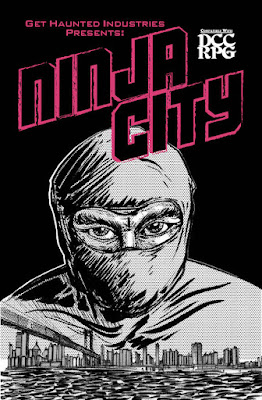
[Fanzine Focus XXVII] Ninja City
Monday, 21 February 2022
Miskatonic Monday #98: The Curse of Black Teeth Keetes
Between October 2003 and October 2013, Chaosium, Inc. published a series of books for Call of Cthulhu under the Miskatonic University Library Association brand. Whether a sourcebook, scenario, anthology, or campaign, each was a showcase for their authors—amateur rather than professional, but fans of Call of Cthulhu nonetheless—to put forward their ideas and share with others. The programme was notable for having launched the writing careers of several authors, but for every Cthulhu Invictus, The Pastores, Primal State, Ripples from Carcosa, and Halloween Horror, there was a Five Go Mad in Egypt, Return of the Ripper, Rise of the Dead, Rise of the Dead II: The Raid, and more...
The Miskatonic University Library Association brand is no more, alas, but what we have in its stead is the Miskatonic Repository, based on the same format as the DM’s Guild for Dungeons & Dragons. It is thus, “...a new way for creators to publish and distribute their own original Call of Cthulhu content including scenarios, settings, spells and more…” To support the endeavours of their creators, Chaosium has provided templates and art packs, both free to use, so that the resulting releases can look and feel as professional as possible. To support the efforts of these contributors, Miskatonic Monday is an occasional series of reviews which will in turn examine an item drawn from the depths of the Miskatonic Repository.
Author: Perry Grosshans
Setting: An island off Kingsport, New England (Lovecraft Country) for Pulp Cthulhu: Two-fisted Action and Adventure Against the Mythos in the Desperate Decade of the nineteen thirties.
Product: Scenario
What You Get: Twenty-Eight page, 2.27 MB Full Colour PDF
Elevator Pitch: Pirates of the Caribbean meets The Goonies off Lovecraft Country.
Pros
Jonstown Jottings #55: Creatures of Glorantha
Much like the Miskatonic Repository for Call of Cthulhu, Seventh Edition, the Jonstown Compendium is a curated platform for user-made content, but for material set in Greg Stafford’s mythic universe of Glorantha. It enables creators to sell their own original content for RuneQuest: Roleplaying in Glorantha, 13th Age Glorantha, and HeroQuest Glorantha (Questworlds). This can include original scenarios, background material, cults, mythology, details of NPCs and monsters, and so on, but none of this content should be considered to be ‘canon’, but rather fall under ‘Your Glorantha Will Vary’. This means that there is still scope for the authors to create interesting and useful content that others can bring to their Glorantha-set campaigns.
Creatures of Glorantha is a bestiary for use with RuneQuest: Roleplaying in Glorantha.
It is an eight page, full colour, 1.45 MB PDF.
The layout is clean and tidy, but could have been better organised and it needs an edit. The artwork is decent.
Where is it set?
Who do you play?
Creatures of Glorantha requires RuneQuest: Roleplaying in Glorantha and the RuneQuest: Glorantha Bestiary.
Sunday, 20 February 2022
It's Doom O'Clock!
A Player Character in Shiver is defined by an Archetype, six Core Skills, one or more Abilities, and a Fear. There are seven Archetypes—the Warrior, the Maverick, the Scholar, the Socialite, the Fool, the Weird, and the Survivor—and each emphasises one of the six Core Skills and provides three Paths, each of which provides ten Tiers of Abilities as the character gains experience and goes up a Character Level. For example, the Maverick’s Paths are the Thief, the Assassin, and the Ranger. The Tier One Ability for all Mavericks is Dodge, but the Tier Two Ability for the Thief is Sneaky, for the Assassin, Sneak Attack, and for the Ranger, Covering Fire. An option is given that when a Player Character reaches Tier Five, he can either carry on in his own Archetype or switch to another one altogether and become a Hybrid, though this also means that he has a Fatal Flaw as a troubled character.
The six Core Skills—effectively both skills and attributes—are Grit, Wit, Smarts, Heart, Luck, and Strange. Grit represents a character’s physical capabilities; Wit covers physical dexterity; Smarts is his intellect and capability with investigation and technology; Heart is his charisma and charm; Luck is his good fortune and the random of the universe; and Strange is his capacity for using magic, psychic powers, and so on. Of the Archetypes, the Fool relies upon Luck rather than a specific Core Skill; the Weird is the strange individual who might follow the Eldritch, Spiritualist, Psionic, or Body Horror Path; and Survivor is a generalist who might follow the Chosen/Leader, Survivalist, or Cockroach Path, the desperate, cowardly type. In addition, a Player Character has a Luck Bank for storing Luck—one for all Archetypes, except for the Fool, who has space for three; a current Fear status—either Stable, Afraid, or Terrified; and a Lifeline—Weakened, Limping, Trauma, and Dead—which is the same for all Archetypes.
To create a character in Shiver, a player selects an Archetype, a Background which adds a unique Ability and a Flaw. He also adjusts one Core Skill in which his character is deficient. It really is as fast as that. The longest step is noting it all down. Of course, playing a character at a higher Tier will take a longer because the player needs to choose more Abilities, but not by much.
Henry Brinded
Archetype: Scholar
Path: Academic (Tier One)
Abilities: Medic!
Background: The Nerd
Ability: Run Away! Flaw: Weak
Fear: Ligyrophobia
Grit: 2 Wit: 3 Smarts: 5 (Talent: 1) Heart: 3 Luck: 3 Strange: 3
Mechanically, Shiver uses a dice pool system of six-sided dice, their faces marked with the symbols for the roleplaying game’s six Core Skills—Grit, Wit, Smarts, Heart, Luck, and Strange. To these are added Talent dice, eight-sided dice marked with Luck and Strange symbols. (The rules include a conversion guide for using standard six-sided and eight-sided dice, but if the group still wants to use the dice system, there is an online dice roller.) When he wants his Player Character to undertake an action, he assembles a dice pool based on the action and its associated Core Skill plus Talent dice if the Player Character has in that Core Skill. Further dice can be added or deducted depending on whether the Player Character has Advantage or Disadvantage, an Ability which applies, or the player wants to spend his character’s Luck, and on the character’s Fear status.
The aim is to roll a number of symbols or successes in the appropriate Core Skill, the Challenge Rating ranging from one and Easy to five and Near Impossible. If the player rolls enough, then his character succeed; if he rolls two Successes more than the Challenge Rating, it is a Critical Hit; and if a player rolls three or more dice and every symbol is a success, this is Full House. In combat, a Critical Hit doubles damage and a Full House triples it, but out of combat the Director—as the Game Master is known in Shiver—will need to suggest other outcomes for both. If Luck symbols are rolled, one can be saved in the Player Character’s Luck Bank for later use, but if two are rolled, they can be exchanged for a single success on the current skill roll, or they can be used to turn the Doom Clock back by one minute. A failed roll does not necessarily mean that the Player Character fails as he can use other means to succeed at the task if his rolls enough successes in another Core Skill for that task, though this requires some narrative explanation. However, a failed roll has consequences beyond simply not succeeding—each Strange symbol rolled pushes the Doom Clock up by a minute…
For example, the scholar Henry Brinded has found a tome written in Latin containing a spell which he thinks will dispel the monster stalking the halls of the college where he teaches. He can hear the thing getting closer and desperately intones the spell direct from the book. Henry’s player will roll the five dice for his Smarts plus its Talent die and the Director will sets Challenge rating at two. However, Henry is at a Disadvantage because he is intoning from the tome in a hurry and because he has not had the time to study either the tome or the spell. This would reduce the number of Smarts dice his player would roll to four, but Henry has one Luck in his Luck Bank and uses that to counter the Disadvantage. He rolls one Grit, one Smarts, and three Luck on the Core Skill dice and two Luck on the Talent die. This gives him one Smarts and would be a failure except for the five Luck. Henry’s player changes two of the Luck into a Smarts, guaranteeing his successful casting of the spell, adds a third Luck to Henry’s Luck Bank, and the last two he uses to move the Doom Clock back one minute…
Fear in Shiver uses the same Challenge Rating system and mechanics. A Fear Check is made with a Player Character’s Strange Dice, and if the player fails the check, the character becomes Afraid, and if Afraid, becomes Terrified. If Afraid, a Player Character loses one die from all Core Skills, and two if Terrified. This temporary, and a Player Character can get rid of the effects of Fear be escaping or vanquishing the threat, steadying himself (this requires another Fear Check), or another Player Character uses an Ability to help him.
Narratively, Shiver is played out against a Doom Clock. This at eleven o’clock at night and counts up minute by minute to Midnight and the Player Characters’ inevitable Doooommm! However, at ‘Quarter Past’, ‘Half Past’, ‘Quarter To’, and ‘Midnight’ certain events will happen, these being defined in the scenario or written in by the Director. So if camping at Lake Blood, a storm might break out at ‘Quarter Past’, then the strange old man who actually knows more than he is letting on might be abducted at ‘Half Past’, a tree fall on the Player Characters’ van at ‘Quarter To’, and then ‘Midnight’, the Serial Killer switch to chasing the Player Characters rather than stalking them. In general the Doom Clock will tick up due to the actions of the Player Characters, whether that is because of a failed skill check with Strange symbols, a failed Fear Check, abilities for the Weird Archetype, Background Flaws, or simply interacting with the wrong things in game. What this means is that dice rolls become even more uncertain, their outcome having more of negative effect potentially than just failures, but this is all in keeping with the genre. However, just as the Doom Clock can tick up to ‘Midnight’ through the Player Characters’ actions. It can also be turned back due to their actions. Rolling two Luck on skill checks, reaching Story Milestones, finding clues and important items, and certain Abilities can all turn the Doom Clock back.
Just as the Doom Clock racks up the tension and triggers bad events, it can also trigger positive events. Some Archetypes have Abilities which can only be used ‘Once Per Doom Quarter’ (others can only be used ‘Once Per Doom Cycle’), whilst the Weird Archetype in particular has Abilities which require the Doom Clock to tick up and trigger. This does make the Weird Archetype a little more complex than the other Archetypes to play and the Abilities are not always going to be helpful to the other Player Characters.
For the Director, there is good advice on her role, setting up a game and setting its tone, building and structuring a story, getting the Player Characters involved, adjudicating the rules, handling the Doom Clock and designing events around it, handling Player Character deaths, and rewarding the Player Characters. The latter ranges from handing out Advantage dice and turning the Doom Clock back to their finding weapons and equipment and being given Levels Up. The latter is based on narrative events and each gives an Archetype access to new Abilities and/or Core Skill increases. In a campaign, it might be as often as at the end of a chapter, but in a one-shot it might be as fast as once a Quarter on the Doom Clock! In addition, the Director is given a huge list of equipment from baseball bats and books of banishment to stake rifles and zweihanders, from acid flasks and bear traps to the Helsing crossbow and Excalibur, and from berserker’s bear and bomb disposal suit to jet packs and symbiotic entities, there is just everything she needs to equip her Player Characters, NPCs, and seed a scenario across an array of genres and time periods.
Similarly, the Director has a big list of monsters and enemies to choose from. They categorised under Slashers, Shapeshifters, Dark Magic, Demonic, Cosmic Horrors, Eldritch Entities, Spirits, Aliens, Vampyrs, and Zombies. All are fully detailed and reflect a wide range of threats and stories that they lend themselves to, and further support the different subgenres of horror that Shiver is designed to cover. In addition to their own Abilities, these monsters and enemies can use Reaction Tables which the Director rolls on whenever a Player Character strikes them in combat. This requires a roll of a single Skill die, and might see a Bruiser type retaliating a slashing attack that does one Blunt damage if the Grit symbol is rolled or Dracula turning into a Cloud of Bats and flitting away on the roll of a Wit symbol. Apart from the Reaction table for Dracula, the Reaction tables are all generic and include a no effect result for rolling the Luck symbol—except for Dracula in which case, he gets hit ‘Right in the Kisser’ and prevents him from making an infect attacks on the next round due to the blow on his fangs! There is advice too for creating Reaction tables for other monsters. Lastly, there is a scenario, ‘Corporate Risers’, which casts the Player Characters as lowly employees at a corporate research centre when there is an outbreak of the zombies. It is a decent scenario which gives a chance for the Director and her players to experience Shiver in a one-shot. It includes notes on character types to create for it, or the player could use those from the SHIVER RPG Quick-start Guide.
Physically, Shiver – Role-playing Tales in the Strange & the Unknown is a good-looking book. The artwork is excellent, done in a style similar to that of Mike Mignola and his Hellboy comic, and very much showcases the type of horror stories that Shiver was designed to handle. The writing is clear, but in places, the roleplaying game could have been slightly better organised to make things easier to find.
If there is an issue with Shiver, it lies its generic nature and sometimes in the limited choices offered by the Archetypes. The generic nature means it has to work harder at some subgenres than others and not all of the Abilities offered by the Paths for the Archetypes necessarily fit. This is all due to Shiver having to cover a wide variety of horror types and elements and so some nuances may be lost. However, there are nuances to be found in the mechanics, especially in the Archetype and Ability design as they interact with the Doom Clock. Another issue is that as written, it does feel primarily written for one-shots, so it would be interesting to see what a campaign for Shiver looks like.
Shiver – Role-playing Tales in the Strange & the Unknown is great for one-shots and convention games too. Its simple, fast-paced mechanics hide some nice little nuances—especially in the design of Archetypes and the way that they and the dice rolls interact with the Doom Clock, which means that the players are not just going to be kept on their toes by the monsters, but also by their own dice rolls, as the tension racks up and the clock ticks down... If a group is looking for a generic horror roleplaying game that veers a little towards the Pulp and which can do a range of horror subgenres, especially film-inspired ones, then Shiver – Role-playing Tales in the Strange & the Unknown is a perfect choice.