Every Week It's Wibbley-Wobbley Timey-Wimey Pookie-Reviewery...

Monday, 5 September 2022

Jonstown Jottings #67: The Sunken Dead

Much like the Miskatonic Repository for Call of Cthulhu, Seventh Edition, the Jonstown Compendium is a curated platform for user-made content, but for material set in Greg Stafford’s mythic universe of Glorantha. It enables creators to sell their own original content for RuneQuest: Roleplaying in Glorantha13th Age Glorantha, and HeroQuest Glorantha (Questworlds). This can include original scenarios, background material, cults, mythology, details of NPCs and monsters, and so on, but none of this content should be considered to be ‘canon’, but rather fall under ‘Your Glorantha Will Vary’. This means that there is still scope for the authors to create interesting and useful content that others can bring to their Glorantha-set campaigns.

—oOo—

What is it?
The Sunken Dead is a scenario for use with RuneQuest: Roleplaying in Glorantha.

It is an eleven page, full colour, 4.42 MB PDF.

The layout is tight and it needs an edit. The cover is decent, but the scenario name is lost among the canopy. It is art free.

Where is it set?
The Sunken Dead is nominally set in and near the territory of the Orleving Clan of the Malani Tribe in Sartar. With some light adjustment it can be located to anywhere where the practice of cattle raids is seen as honourable conduct.

Who do you play?
Player Characters of all types could play this scenario, but The Sunken Dead is intended for new players and their characters, as well as the relatively inexperienced Game Master (who may be confused by the use of the Storm Rune rather than the Air Rune).

What do you need?
The Sunken Dead requires RuneQuest: Roleplaying in Glorantha and the Glorantha Bestiary. The RuneQuest Gamemaster Screen Pack will useful about the area around the Colymar Tribe and Apple Lane if the Game Master is basing her campaign there.

What do you get?
The Sunken Dead is a straightforward and simple scenario. Yantar Raelston, a loyal Thane, of the Colymar tribe, offers to guide the Player Characters on their first cattle raid. He clearly lays out the rules for the benefit of the characters (and their players) and then everyone sets out the next morning. The first half of the scenario consists of a series of skill rolls as the Player Characters attempt to overcome various obstacles their journey. Of course things do not go as planned, and just as the Player Characters is about to snatch up the cattle, both target herd and its shepherds are attacked. Do the Player Characters take advantage of the Chaos—literally—and take the cattle they came out for or do they go to the aid of the herders?

The choice is simple and either way, leads to some decent roleplaying, as does another challenge on the way home from the cattle raid. This challenge can easily be omitted if time is short, otherwise, the scenario offers two good sessions’ worth of play at the most.

The Sunken Dead showcases an element of Heortling culture—cattle raiding—in a short and easy scenario which can be slotted into an ongoing campaign in its early days or perhaps used as a flashback. The details of honourable cattle raiding are a pleasing inclusion.

Is it worth your time?
YesThe Sunken Dead is short filler scenario that pleasingly showcases, ‘How to Conduct a Cattle Raid’, an aspect of Heortling culture and puts it into practice.
NoThe Sunken Dead is not really useful if cattle raids are not part of the culture where the Game Master’s campaign is set.
MaybeThe Sunken Dead is not a sophisticated scenario and may be too action orientated for some groups, although it does have potential if the Game Master wants to turn it around and have her players and their characters defend against a cattle raid.

Miskatonic Monday #127: The Heat

Between October 2003 and October 2013, Chaosium, Inc. published a series of books for Call of Cthulhu under the Miskatonic University Library Association brand. Whether a sourcebook, scenario, anthology, or campaign, each was a showcase for their authors—amateur rather than professional, but fans of Call of Cthulhu nonetheless—to put forward their ideas and share with others. The programme was notable for having launched the writing careers of several authors, but for every Cthulhu InvictusThe PastoresPrimal StateRipples from Carcosa, and Halloween Horror, there was Five Go Mad in EgyptReturn of the RipperRise of the DeadRise of the Dead II: The Raid, and more...

The Miskatonic University Library Association brand is no more, alas, but what we have in its stead is the Miskatonic Repository, based on the same format as the DM’s Guild for Dungeons & Dragons. It is thus, “...a new way for creators to publish and distribute their own original Call of Cthulhu content including scenarios, settings, spells and more…” To support the endeavours of their creators, Chaosium has provided templates and art packs, both free to use, so that the resulting releases can look and feel as professional as possible. To support the efforts of these contributors, Miskatonic Monday is an occasional series of reviews which will in turn examine an item drawn from the depths of the Miskatonic Repository.

—oOo—

Name: The Heat
Publisher: Chaosium, Inc.
Author: MichaƂ Pietrzak

Setting: Jazz Age Kingsport
Product: Scenario
What You Get: Eighteen page, 729.45 MB Full Colour PDF

Elevator Pitch: The family that feuds spreads its love as Kingsport heats up...
Plot Hook: Frayed tempers seem strange in a happy family, could it be the heatwave?
Plot Support: Staging advice, three handouts, seven NPCs, one floorplan, two Mythos monsters, three new spells, and one Mythos tome. 
Production Values: Reasonable.

Pros
# One night one-shot
# Straightforward investigation
# Potential Lovecraft Country campaign starter
# Low key, Mythos-infused twist upon Greek myth
Underplayed introduction to the Mythos
# Interesting options given for scenario’s end
# Sympathetically portrayed villain

Cons
# Needs a good edit
# Backstory remains hidden, so hides the more subtle horror
# Straightforward investigation
# Big clue on the front page!
# Options given for scenario’s end incomplete

Conclusion
# Short, but direct investigative one-shot which could work as a Lovecraft Country campaign starter
# Horrifying Mythos-infused twist upon Greek myth that needs development in places, but still works despite that.

Sunday, 4 September 2022

Warhammer Fantasy Roleplay IV

Under the guidance and protection of His Imperial Majesty Emperor Karl-Franz I, the Glorious Empire is a bountiful bastion of civilisation and order, together with its faith in the great gods Sigmar and Ulric, a redoubtable fortress against its many enemies and the forces of Chaos that threaten it from without. Great armies of Orcs, Goblins, and worse—Chaos Warriors, Beastmen, Mutants, and Daemons. Yet there are dangers from within too. Bickering nobles, fumbling and feuding for power and influence undermine both defences and resolve of the greatest and most powerful nation in the Old World, pirates who prey on the shipping of the empire’s mighty rivers and bandits who pick at the weary traveller on its network or roads that bisect the deep swathes of forest, and worse. Numerous cults hide in the shadows, some appearing to be no more than excuses for frowned upon frivolity and debauchery, but all too many dedicated to the Ruinous Powers, those dark gods from which the Winds of Magic do blow and threaten to corrupt the unwary and the ambitious, even as they are studied and harnessed by the Colleges of Magic. The practices and beliefs of such cult threaten mind, body, and soul of the members, twisting them, mutating them, and driving them to spread the reach of Chaos until the Witchfinders act, burn them out and put them to the sword, before covering their activities up. Meanwhile, the citizens labour for themselves and their families and pay their taxes to the Empire for protection by day, drink and gamble and gossip as agitators cry out for better life and the overthrow of some noble or other (or even the Emperor himself—what heresy!) if they can by evening, before retiring to behind closed doors by night, fearful of what stalks the forests, what lies in the village over yonder, what curse a witch may lay upon them, and what Beastmen might catch them unwary on the morrow, rip them limb from limb—or worse! Yet there are some who see there is more to life than mere drudgery. They may never be nobles, but they might make coin enough to get by, they might make a difference in driving off monsters and mutants even as the locals look at them in fear and wonderment, and they might just help keep the Empire safe!

This is the Empire and the Old World, the setting for Warhammer Fantasy Roleplay. The publication of its fourth edition by Cubicle Seven Entertainment is a reminder that once upon a time, Games Workshop published roleplaying games. Chief amongst these was of course Warhammer Fantasy Roleplay, which even thirty years on, remains the definitive British roleplaying game. Its mix of fantasy, European history—the Holy Roman Empire in particular, Moorcockian cosmology, humour, grim and perilous feel, disease and damnation, and mud and shit underfoot, very much set it apart from the fantasy found in other roleplaying games of the time—and arguably since. Perhaps the best expression of those elements is not in the roleplaying game itself, but in what is arguably the greatest British roleplaying campaign ever published—The Enemy Within. Subsequently published by Hogshead Publishing, before returning to Games Workshop via Black Industries with a second edition designed by Green Ronin Publishing, and then by Fantasy Flight Games as a third edition which combined the roleplaying with physical elements such as cards and counters usually found in board games and so was not compatible with either the first or the second editions (although it was still playable as a roleplaying game). Warhammer Fantasy Roleplay, Fourth Edition shares the same setting as the previous editions, but mechanically draws from the first and second editions, remaining a relatively low, percentile driven set of mechanics, designed to do ‘grim and perilous’ roleplaying in a world of mud and blood, Chaos and fear, and desperation and danger. It is a roleplaying game in which minor nobles, dwarf slayers, witch hunters, ex-soldiers, merchants, road wardens, petty wizards, priests to Sigmar and Ulrich, and of course, rat catchers—plus little dog, hold back incursions by the forces of Chaos, run scams, uncover cults and conspiracies, and more, all in the face of intransigence and callousness upon the part of the ruling classes and the churches.

A Player Character in Warhammer Fantasy Roleplay, Fourth Edition has a Species—Human (Reiklander), Halfling, Dwarf, High Elf, or Wood Elf; a Class—Academic, Burgher, Courtier, Peasant, Ranger, Riverfolk, Rogue, or Warrior; and Career, such as Nun, Watchman, Duellist, Hedge Witch, Pedlar, Wrecker, Grave Robber, or Warrior Priest. He has ten attributes—Weapon Skill, Ballistic Skill, Strength, Toughness, Initiative, Agility, Dexterity, Intelligence, Willpower, and Fellowship—expressed as percentages. His Fate and Fortune are linked together as destiny and his luck, and his Resilience is his inner strength and linked to grit through the ‘single word’ Motivation which drives him to act. Skills, both Basic and Advanced, as well as Talents are derived from the character’s Species and Career. Advanced skills are only available to those who have studied or practiced them and require at least one Advance in them to use. An Advance is an improvement of a skill by +1%, and these can be applied to skills and characteristics. Each Class and Career provides trappings and items of equipment. A Player Character also has Ambitions, short term and long. Fulfilling the former will grant an Experience Point bonus, whilst fulfilling the latter might reward an even larger Experience Point reward or even see the Player Character retire! Similarly, the Party of Player Characters will also have its own ambitions.

One notable facet of Warhammer Fantasy Roleplay is that of Careers and how Player Characters can advance through or even change them, and it is no different in Warhammer Fantasy Roleplay, Fourth Edition. Each Career has four levels, presented on the same page, and when a Player Character wants to change Career, he either moves up to the next level of the Career he is in or a completely new one. It costs Experience Points to change a Career, more if the Career is in an entirely different Class. All of the Classes, Careers, Species, and so on, are nicely detailed, including the thoughts of the various Species on other Species and options for Species aspects such as ‘Animosity (Elves)’ for the Dwarfs, which let a player decide rather than adhere to a stereotype.

Character creation in Warhammer Fantasy Roleplay, Fourth Edition—apart from attributes, which are all random—can be random or chosen by the player. If the former, extra Experience Points are awarded to the Player Character, for each stage the player decides to roll and keep the result. The last step process is answering questions about the character’s origins, family life and childhood, why he left home, best friends, greatest desire, and more. This can include adding Psychological Traits like Fear (Snakes), Frenzy, or Hatred (Slavers), primarily for roleplaying opportunities rather than mechanical benefits. The process is not particularly quick, if only because there is a fair amount of information to note down. In general, if rolled, the chances of roll up a non-Human Player Character is slim and certain Careers are unavailable to some Species. For example, the Priest is a Human-only Career, the are no Dwarf or Halfling Wizards, and of course, the Slayer is a Dwarf-only Career.

Sigfreda von Stark is the youngest daughter of House Stark, sister to several older brothers. Where her brothers were taught to fight, she was not allowed to, and her brothers made fun of her. She learned to give as good as she got, and this went from taunting to punches and she gave as good as she got. Forbidden to enlist in the army and despite being married (he avoids her for the black eye she gave him on their wedding night), she applies her muscle and underhand means of applying it to making a living without him or his annoying mother. What she can, she saves for training.

Name: Sigfreda von Stark
Species: Human (Reiklander)
Class: Warrior
Career: Protagonist
Motivation: Greed
Ambition: To beat the snot out of her brothers

Age: 22 Height: 5’ 6”
Eye Colour: Blue Hair Colour: Dark Brown

Weapon Skill 32 Ballistic Skill 33
Strength 38 Toughness 31
Initiative 33 Agility 34
Dexterity 34 Intelligence 35
Willpower 34 Fellowship 27

Wounds: 12
Fate: 3
Resilience: 3
Movement: 4

Skills: Athletics +5, Cool +5, Dodge +5, Endurance +5, Entertain (Taunt) +5, Evaluate +5, Gossip +5, Haggle +5, Intimidate +5, Language (Bretonnian) +3, Language (Wastelander) +3, Lore (Reikland) +3, Melee (Basic) +5, Melee (Brawling) +7
Talents: Acute Sense (Listen), Dirty Fighting, Noble Blood, Savvy, Sixth Sense, Warrior Born
Trappings: Mask, Clothing, Hand Weapon, Dagger, Pouch, Knuckledusters, Leather Jack

Mechanically, Warhammer Fantasy Roleplay, Fourth Edition uses percentile dice. A Simple test is roll against an attribute or skill plus attribute. If the situation requires the Game Master and player to know how well his character did, he rolls a Dramatic Test. This is slightly more complex in that the ‘tens’ value on the dice roll is subtracted from the ‘tens’ value of the skill. This determines the Player Character’s Success Level, which can be positive or negative. The higher it is, the better the outcome, the lower—or more negative—it is, the worse the outcome. Opposed rolls generally compare Success Levels, the Player Character or NPC with more succeeding over the other.

For example, Sigfreda is a hired by a brewery to persuade the landlord of a rough, riverside tavern, Klatt’s Bier Haus, to pay his bills. Her player will roll Sigfreda’s Intimidate plus Strength (42%), which will be opposed by Klatt the landlord’s Cool plus Will Power (32). Sigfreda’s player rolls 23. Subtracting ‘tens’ value of the dice roll, or two, from the ‘tens’ value of the skill value gives two Success Levels. The Game Master rolls 63 for the landlord, which leaves him with minus three Success Levels. Without having to lay a hand on him, Sigfreda has reduced him to a quivering mess, and he quickly apologises, saying that it is not his fault because some local toughs have been taking nearly all takings in protection money. Sigfreda’s player spots an opportunity and asks how much Klatt the landlord would pay to get these toughs off his back…

Melee combat also uses opposed rolls—Weapon Skill versus Weapon Skill if parrying or the Dodge Skill if trying to get out of the way, whereas missile attacks, rolled on Ballistic Skill are Simple Tests. Success Levels not only determine if a Player Character manages to strike his opponent in combat, but also the amount of extra damage inflicted. Damage is determined by a combination of the Success Levels from the attack roll, the weapon, and the Strength Bonus, with armour and the target’s inherent Toughness counting against the incoming damage. If a double is rolled—eleven, twenty-two, thirty-three, and so on—then a critical hit has been made. This can be made when attacking or parrying, and it can even be made when an opponent has rolled more Success Levels than the character’s player. Thus, a character can lose an exchange of blows, but still inflict an effect. In addition, the combat mechanics in Warhammer Fantasy Roleplay, Fourth Edition are designed to have a character build upon success, gaining Advantage when attacking an opponent who is surprised, charging into combat, defeating an important NPC, and so on, gaining a +10 bonus to combat actions each time. This is lost if a Player Character or NPC loses an opposed roll or suffers a wound, but is designed to give a Player Character an edge as he gains momentum in a fight. Both players and Game Master are expected to keep track of Advantage for both the Player Characters and NPCs, the suggestion being that tokens be used where everyone can see them.

Later that morning, the two toughs, Klaus and Karl, call in to take the day’s takings from Klatt’s Bier Haus. As Karl keeps an eye on the door, Sigfreda informs Klaus at the bar that the tavern’s takings are not available and that neither of them is welcome at the establishment. Unfortunately, Sigfreda fails to intimidate him like she did Klatt and Klaus steps in close and asks, “Says who?” “Me—and this mug” she responds and with that she slams the mug of beer into his face. Klaus is no fool and the Game Master gives him a chance of spotting the attack, but fails the Perception Test. Klaus now has the Surprised Condition, which grants Sigfreda a +20% bonus on the Melee (Brawling) Test for her attack. For this one attack, she has a 59% attack chance, opposed by Klaus’ Melee (Brawling) Test of 32%. Sigfreda’s player rolls 22%, which gives her three Success Levels and is a Critical Hit too. The Game Master rolls 98%, which minus six Success Levels! Sigfreda is using an improvised weapon, which means that she inflicts a base of her Strength Bonus (three) plus Success Levels (three) plus weapon base damage (one) plus her one level of Dirty Fighting (one), for a total of eight! In addition, Sigfreda has +1 Advantage.

Normally, the result of the Melee (Brawling) Test would be reversed to determine the location struck, which in this case would be Klaus’ left arm. However, the Critical Hit means it is randomly determined, which is a roll of the 05% and the head! Klaus’ Toughness Bonus of three means the thug suffers five Wounds. Plus, Sigfreda’s player rolls 32% on the Head Critical Wounds table. This means that Klaus suffers two more Wounds, which ignore armour and Toughness, and suffers the Stunned Condition. Until the Game Master can make a successful Endurance Test for Klaus, the thug cannot take an action and is at a penalty to all Tests. In addition, Sigfreda has +1 Advantage. At the end of the round, she is at +2 Advantage. As Klaus wavers, Karl grips his club and rushes towards Sigfreda as she slips her knuckledusters onto her hands.

Combat in Warhammer Fantasy Roleplay, Fourth Edition is designed to have the Player Characters’ fortunes fluctuate back and forth across the battle, as well as encourage their players to be tactical in order to take and maintain Advantage. It covers not simple hand-to-hand melees, but also two-weapon fighting, mounted combat, movement, chases, pulling blows, and more. Damage is not just a case of inflicting as many Wounds as possible, but also Conditions which will be typically inflicted through Critical Wounds. Warhammer Fantasy Roleplay, Fourth Edition has a table for each location, and the results are all brutal. Long time fans of the roleplaying game will be pleased to see the last entry for the Head Critical Wounds table: “Your head is entirely severed from your neck and soars through the air, landing 1d10 feet away in a random direction (see Scatter). Your body collapses, instantly dead.”

However, the Player Characters do have number of factors in their favour. First, they have Fate Points and Fortune Points. Fortune Points grant a Player Character a little luck and allow his player to reroll a failed Test, add a Success Level to a Dramatic Test after it is rolled, and to disregard Initiative order and have the character act when they want. Fate Points are spent to avoid death or completely avoid taking incoming damage. Second, they have Resilience Points and Resolve Points. Resilience Points grant immunity to a Psychological Trait or effect for a round, enable the Player Character to ignore all modifiers from all Critical Wounds for a round, or remove a Condition. Resilience Points are spent to prevent a Player Character from suffering a mutation due to Corruption or to select the result of a Test, which in combat can be right down to location and the Critical Wounds table. These do all give a Player Character an advantage, something to fall back on in an emergency, but mechanically, are four different types of points really necessary? It is cumbersome and difficult to remember what does what. Why not reduce the number of types and increase the costs of what they can do? (Of course, this increases the number of times a player can use the lesser benefit, but this is cumbersome still.)

In addition to suffering horrible, scarring wounds in bar fights, let alone on the battlefield, Player Characters can encounter Lesser Daemons, Mutants, Warpstone, Chaos worshippers and their temples, and worse, let alone suffering despair, all of which can lead to them suffering Corruption and gaining Corruption Points. Corruption and gaining Corruption Points can even be gained for making a ‘Dark Deal’ with the Ruinous Power, the player choosing—and it is always the player’s choice in what is a Faustian Pact—this option when out of Fortune Points and really, really needing to reroll a failed Test. Except for Elves, which are only affected mentally, Corruption twists both body and mind. Corruption Points can be lost in a number of ways. Absolution, but that requires a great deed, such as cleansing a Chaos temple; accepting a Mutation, but has its own dangers, especially if the witchfinders find out; and listening to Dark Whispers. Again, this is the player’s choice, but in return for the Corruption Point, something bad will happen, such as a prisoner being allowed to escape, an ally being accidentally shot, or falling asleep on watch… Which is a delightful narrative mechanic with the Game Master literally leaning over the table and whispering into the player’s ear. Also covered are ailments, diseases, and infections—all of which are as unpleasant as you would expect, but not quite as much fun as the rules for Corruption.

A campaign of Warhammer Fantasy Roleplay, Fourth Edition could entirely focus upon the adventures that the Player Characters have, but the rules do cover what they can do on their downtime as option. A Player Character is subject to random events, but he can simply spend money, train an animal, bank his treasure, consult an expert, craft an object, train, invention something, and more. There are potential endeavours for Species and Classes as well as general ones, but all together, they help the Player Characters’ develop and grow, and explore their lives away from the stresses of adventuring.

Religion and faith play important roles in The Empire and the Old World. Warhammer Fantasy Roleplay, Fourth Edition presents numerous gods and cults in accessible fashion, the primary focus being Sigmar and his associated pantheon. There are lots of little details here that help bring their worship alive, most notably the various strictures for each deity which their most devout or Blessed worshippers follow, and which if violated, will earn them Sin Points. Gain too many and if the worshipper appeals to his god, then he may bring the Wrath of the Gods down upon his head. Careers such as Nun, Priest, and Warrior Priest, provide the Bless Talent enabling such Blessed to enact Blessings, whilst the Invoke Talent lets the Blessed call on their gods for the more powerful miracles. There are only a limited number of Blessings and Miracles per god, and then only for primary gods worshipped in The Empire. In comparison, the Chaos Gods are only given a cursory examination.

Magic is one of the most powerful aspects of the Old World, drawing as it does from the Winds of Magic which can only be seen by those who possess the Second Sight. Only Elves and Humans use magic, but where Elves can harness more than the one of the eight Winds of Magic, Humans rarely can, and often follow such a path to damnation and the influence of the Ruinous Powers. Accepted, but rarely trusted by the populace at large, magic is studied at the Colleges of Magic in Altdorf, the capital of The Empire, as eight different lores—The Lore of Light, The Lore of Metal, The Lore of Life, The Lore of Heavens, The Lore of Shadows, The Lore of Death, The Lore of Fire, and The Lore of Beasts. The Lore of Hedgecraft and the Lore of Witchcraft are also known, but not sanctioned by Colleges of Magic, and both are rarely practiced. Divided into Petty, Arcane, Lore, and Chaos spells, casting requires the Language (Magick) Skill for minor spells and the Channelling skill for major ones. It is possible to Overcast, extending the Range, Area of Effect, Duration, or number of Targets, though this requires a greater number of Success Levels when making the test, but a critical roll, whether a Critical success or a Fumble, the player’s caster has to roll on the miscast tables—the ‘Minor Miscast Table’ for lesser spells and the ‘Major Miscast Table’ for the more powerful spells. For example, ‘Unfasten’ on the former causes all belts, buckles, and laces undo, causing pouches to drop, armour to fall off, and trews fall down, whilst ‘Traitor’s Heart’ on the latter prompts the Dark Gods to entice the caster to commit horrendous perfidy. They will grant him all Fortune Points he has lost should he betray or attack a friend and a gift of one Fate Point if the caster causes a friend to lose a fate Point. Overall, the rules for magic and spell casting, are straightforward and easy to use, and they do cover the both the Lore of Hedgecraft and Lore of Witchcraft, as well as Dark Magic, the latter primarily for the Game Master’s NPCs.

In addition to some decent advice on running the game for the Game Master, Warhammer Fantasy Roleplay, Fourth Edition includes a good guide to Reikland—though not the greater Empire, a timeline of The Empire, an extensive look at goods and crafting in ‘The Consumer’s Guide’, and a bestiary, complete with illustrations and an explanation of the bestial traits. It covers ordinary animals such as bears and boars, green-skinned hordes like Orcs, Goblins, and Snotlings, Daemons, Beastmen, Mutants, and a whole lot more. All good supporting material and all useful to running the roleplaying game, although ‘The Consumer’s Guide’ feels oddly placed so far back in the book. The bestiary is far from complete, but is certainly comprehensive enough for most starting campaigns. The one omission here is the lack of a scenario. Although there are several hooks given in the guide to Reikland, the omission feels even odder given that the last page of Warhammer Fantasy Roleplay, Fourth Edition is an advert for scenario anthology Rough Nights & Hard Nights, which opens with, “Continue Your Adventures With…” which is really difficult to do if the core book does not provide the Game Master and her players that starting adventure to actually continue from!

Physically, Warhammer Fantasy Roleplay, Fourth Edition is very well presented. The layout is clean and tidy, and from the start, the artwork is excellent, and the world of The Empire is very well illustrated throughout. There is initially an idyllic feel to The Empire in its depiction early in the book, shifting to a grimmer and grimier feel later on. Throughout, the writing is good, although it could have benefited from more fulsome examples in places to really to get a feel for the flow of the game.

Long-time fans of this roleplaying game will pick up Warhammer Fantasy Roleplay, Fourth Edition and feel very much at home with its dingy, dangerous, and sometimes decadent depiction of the Old World and The Empire in particular, combined with often brutal and bruising mechanics. Though not quite as brutal and bruising as perhaps in previous iterations, with Player Characters having to access to Fate Points and Fortune Points, Resilience Points and Resolve Points, and then trying to achieve and maintain control of Advantage in combat. The addition of the four Hero Point types does feel like it is overegging the mechanics’ attempt to keep the Player Characters alive, but the addition of Corruption Points and Sin Points, and their use are entertaining narrative-focused additions. Despite these additions, newer players may find the sometimes-unforgiving mechanics too much and potentially be uncomfortable with the often-intolerant attitudes and politics that are part and parcel of the setting and always have been. Well then, Warhammer Fantasy Roleplay, Fourth Edition is not their roleplaying game.

Warhammer Fantasy Roleplay, Fourth Edition is fantastic iteration of the classic British roleplaying game, returning grim and perilous roleplaying to where it started in the Old World. There is mud and blood to be trudged though, there is Chaos to be faced, there are cults to be looked into and smashed in disgust, and there are Beastmen to be hacked down, and by Sigmar’s hammer, Warhammer Fantasy Roleplay, Fourth Edition is the right way to do it.

Saturday, 3 September 2022

The Other OSR—Frontier Scum

Beyond the great frontier lies the Lost Frontier, dominated by Covett City, a teeming, bloated city of exploited masses and stinking industries, which arises out of the tarry swamps its factories pollute. Melanethon P. Murrsom, sits at the head of the Incorporation which controls this coastal city and whose influence reaches far and wide. Inland across to Sunken Hill where coffins are chained shut before burial and the dead are said to ring their grave bells still even as looters plunder the coffins that rise from the swamp. Across Carcass County where the roots of the ancient bloodgum trees have a taste for flesh. To Slackgaff-by-the-Sea in Stubbshead County, strife riven by an unpaid debt owed to the Incorporation. To frozen Dalliance in the south across the sea, where the Allied Governess rules with a love as cold as the artic wastes beyond the newly reopened silver mines that the Incorporation previously closed and claimed to have been worked out. West to Fort Gullet, an oil city where the gun rules and Marshal Betjemen Knapp and his posse of ne’er-do-wells enforce their law at gunpoint. Beyond to Palace in the Dust Barrens where the Redrum Boys, outlaws all, protect the exiles, homesteaders, bushwhackers, and deserters from Incorporation carpetbaggers, sending them packing after taking all they have on them—plus a pound of flesh—back to Covett city, even as they ensure that the hill around remain lawless. To Sickwater Oasis in the north, where the klepto-meritocratic Outlaw Union recognises only the licences it issues, otherwise killing all lawmen and bounty hunters, and hates any other legalise otherwise to the point of murder. At the edge of the Lost Frontier stretches the Western Expanse, accessible by the hellmouth of Allhallows Canyon, and beyond that lies the Scree Knives, a purgatory of slat flats where only the desperate pioneer and sanctimonious sect finds a home.

This is the setting for Frontier Scum: A Game About WantedOutlaws Making Their Mark on a Lost Frontier. It is inspired by the Acid Westerns, such as Jodorowsky’s El Topo, Jarmusch’s Dead Man, and Zahler’s Bone Tomahawk, which twisted the traditional westerns of the twentieth century and their conservatism with the radical counterculture of the sixties. Instead of codes of honour and morality and the mythic search for justice and a chance to begin again in a land of golden opportunity, the west of the Acid Western is infused with uncertainty and loss, the landscape and its promise of renewal subverted by avarice and ambition. The Lost Frontier of Frontier Scum is not the frontier of the Wild West, nor the frontier of the Weird West—its horrors being mundane and manmade, but a frontier, almost a hallucination of a twisted frontier of its very own. Published by GamesOmnivorousFrontier Scum is an Old School Renaissance adjacent roleplaying game, inspired mechanically by Mörk Borg, in which the players take the roles of Outlaws. They are criminals and they are guilty. They did the crime they are accused of and are going to be hanged. Perhaps, if they can escape their fate at the end of a noose, then perhaps they can make their mark—pull off the biggest heist, win the biggest pot in a poker game, hit a silver motherlode, or even reap their own brand of justice—on the Lost Frontier.

An Outlaw in Frontier Scum has four stats—Grit, Slick, Wits, and Luck—which range in value from -3 to +3. He also has a pair of traits which make him stand out, a crime which he most definitely did commit and why he is wanted (dead or alive), a background which helps define starting skills and equipment, plus a bonus skill and a bonus item. He also has a canteen of water, a stolen horse, and a gun and some ammunition. Most importantly, he has a hat. This hat will save his life. Probably. So, he should keep it close. Probably wear it. Character creation is entirely randomly, except skills. These are devised by the player, though the event which inspired their selection is randomly determined. 

Windor ‘Grubworm’ Casket
A Charlatan and a Fraud
Outlaw Scum with ‘An Artist’s Soul’ and ‘Plague-Pox Scars’
Who is Wanted Dead or Alive for the Crime of Attempted Fraud

Grit -2 Slick 0 Wits +1 Luck -2
Hit Points: 2

Skills
Sympathetic Begging (lost all his stock)
Bargaining (sold some actual treasure)
Disguise Disease (you caught the Plague-Pox)

Items
Self-Help Bible
Expensive Perfume
Tin of sixteen biscuits

Stolen Mount
Donkey (HP 2, Morale 8, slow, bad at manoeuvring)

Gun
Pocket pistol (d6)

Hat
A stiff bowler, brushed to perfection, with an emergency ten dollar note inside the hat.

Mechanically, Frontier Scum requires a simple roll of a twenty-sided die against a Difficulty Rating, the standard Difficulty Rating being twelve, with the appropriate stat applied as a modifier. The standard rules for Advantage and Disadvantage are used, the former primarily derived from a Outlaw’s skills, and each player has an Ace up his Sleeve, which can be expended to reroll any die result which is not a one or twenty. If a player rolls a natural twenty on an ability check, he has the choice of choosing an additional Ace or a new skill. (This new skill must relate to the situation under which it was rolled, up to a maximum of six skills.) However, if a player rolls a natural one on an ability check, every player loses all of their Aces! In general, Frontier Scum is player-facing, so the players roll the dice, for example, to hit with an attack or to avoid an attack rather than the Game Master rolling an NPC’s attack.

Gun combat is nasty, and shots always hit (except tricky shots which require a roll). Damage dice can explode, so characters can be killed with a single shot or hit with extra shots from fanning a pistol or slamming in more rounds from a repeater rifle! Fortunately, every good character should be wearing a hat. If a player is shot, he can ignore damage by having his hat shot off his head. Which is an entertaining emulation of the genre! Then afterwards, once the fight is over, a player can roll his character’s Luck to retrieve his hat and see if it is still wearable.

An Outlaw can take damage that reduces him to zero Hit Points, necessitating a Death Check. This can result in straight death, but it might leave him dying and losing ability points, but it could also result in the Outlaw gaining ability points! An Outlaw can also suffer one of two Conditions—Drunk and Miserable. Of the two, Drunk is the more entertaining, with the Miserable Condition either due to being skunked, rain-sodden, frostbitten poisoned, exhausted, or some other cause, which prevents the Outlaw from healing when rested until the cause is addressed. When Drunk, an Outlaw swaps two abilities at random and that is always how he reacts when drunk. It is a potentially entertaining effect, and depending on the value of the abilities swapped, could be disadvantageous to the Outlaw or advantageous.

For the Game Master there are numerous tables upon which to roll for inspiration, from ‘Scum on the Trail’ and ‘Scum on the Streets’ to ‘House Loot’, Pocket Loot’, and ‘Tomb Loot’. There is even a ‘Going on a Bender’ table, followed by ‘What Was Won’, ‘What was Lost’, and ‘Who You Owe’ tables for evening’s carousing at the saloon. There are tables of employment opportunities and bounties too, sufficient enough to provide a variety of encounters, set-ups, and developments. Frontier Scum also includes the scenario, ‘Escape the Organ Rail’, which begins with the Outlaws held aboard a black penal train being transported to their execution. Naturally linear in design—after all, the Outlaws have to fight and make their way up the train to the engine to effect an escape, the scenario is presented in car order from the Outlaws’ cells to the engine. Each car is shown in cross section rather than floor plan. The Outlaws begin play shackled together hand and feet, which should challenge the players until they find the right keys. Although Frontier Scum is intended to be a more mundane version of the Old West than the horror of the Weird West, the scenario does involve elements of the weird and horror. If the Outlaws succeed in stopping the train and escaping, there is the chance they get away with some loot, find themselves a patron, or if they want, there is an ‘Epilogue Or How To Spend 10,000 Silver’ table if they scarper.

Physically, 
Frontier Scum has an immediate presence. It is done as a board book, with a non-glossy, plain matte cover and no spine so that the glue binding is visible. The feeling in the hand is rough and tactile like no other roleplaying game. Inside, the black and white layout is done as a Sears, Roebuck and Co. catalogue and it is incredibly atmospheric, pulling the reader into the setting with tight blocks of black and white, and period style illustrations. The graphic design on Frontier Scum really brings the game to life and adds so much to its atmosphere.

Imagine in 1895 if the paste up artist at Sears, Roebuck and Co., high on absinthe and laudanum, sat down to create a game of the vanishing frontier. Frontier Scum: A Game About Wanted Outlaws Making Their Mark on a Lost Frontier is what you would get, a roleplaying game of the last, dark days of desperate Outlaws surviving on a dream of the frontier turned nightmare, ravaged by avarice and ambition, and the vicissitudes of modernity and misuse.

Manimal Madness

Mutant Crawl Classics #12: When Manimals Attack is the eleventh release for
Mutant Crawl Classics Roleplaying Game – Triumph & Technology Won by Mutants & Magic, the spiritual successor to Gamma World published by Goodman Games. Designed for Second Level player characters, what this means is that Mutant Crawl Classics 12: When Manimals Attack is not a Character Funnel, one of the signature features of both the Mutant Crawl Classics Roleplaying Game and the Dungeon Crawl Classics Role Playing Game it is mechanically based upon—in which initially, a player is expected to roll up three or four Level Zero characters and have them play through a generally nasty, deadly adventure, which surviving will prove a challenge. Those that do survive receive enough Experience Points to advance to First Level and gain all of the advantages of their Class. In terms of the setting, known as Terra A.D., or ‘Terra After Disaster’, this is a ‘Rite of Passage’ and in Mutants, Manimals, and Plantients, the stress of it will trigger ‘Metagenesis’, their DNA expressing itself and their mutations blossoming forth. By the time the Player Characters in Mutant Crawl Classics #12: When Manimals Attack have reached Second Level, they will have had numerous adventures, should have understanding as to how their mutant powers and how at least some of the various weapons, devices, and artefacts of the Ancients they have found work and can use on their future adventures.

Mutant Crawl Classics #12: When Manimals Attack begins with the Player Characters coming to the rescue of a young Manimal, who has been chased up a tree by some ravenous preyor beasts. They will learn that although she cannot talk very much, her name is ‘Anji’. She is friendly, seems fascinated by the village’s sole pure Strain Human, and despite her Mustelid appearance, claims she comes she is ‘ooman’ and that she comes from the fabled lands of ‘tsoo’. She seems to settle into the Player Characters’ village, but in the middle of the night attackers loom out of the darkness, setting hut after hut alight. In the morning, the tracks are easy to find—with signs of something apelike, something feline, and something unknown—and lead out into the jungle. Barring an encounter or two, the Player Characters are able to follow the tracks back to a large domed structure. On the side can be seen the word, ‘ZUU’.

The scenario assumes that the most likely approach the Player Characters will take is stealth, following Anji’s escape route out of the ‘tsoo’ back to within its confines. There they find themselves not in a building as such but a stretch of open grasslands, the sky a different colour… Once they have dealt with the robots informing visitors that park is a closed and they are trespassing and that any Manimals are in the wrong zone, interacting with the Manimals will reveal the situation. They are trapped in a habitant, ruled over by the Savage One and his brutal guards, but it was the Savage One who made them stronger and better than they were. Finding out further information means breaking out of this one habitant and into the others, and there is some fun to be had seeing the Player Characters exploring some radically different climes than the ones they are used to. It is interesting to see the Player Characters challenged in this. Ultimately, they will be able to determine what is going on at the ‘ZUU’, and either rescue or free the numerous Manimals in its various habitats.

Mutant Crawl Classics #12: When Manimals Attack is a short scenario, emphasising stealth and investigation in preparation for a confrontation with the Savage One and his brutal guards. The strangely bestial creature has plans for more than just the ‘ZUU’, wanting to convert Terrans of all types into the Manimals they were meant to be. He certainly has the means to do so. The scenario is reminiscent of H.G. Wells’ The Island of Doctor Moreau as well as two Cryptic Alliances from Gamma World—the ‘Zoopremisists’ and ‘The Ranks of the Fit’. They are not the same of course, but there are similarities. The scenario is, though, about confronting and fighting the supremacy of one species type over another in the world of Terra A.D. It should be no surprise that the Savage One is portrayed as a supremacist monster and certainly as a monster by the artist, Kelly Jones, on the front cover of the module.

Physically, Mutant Crawl Classics #12: When Manimals Attack is cleanly and tidily laid out. As you would expect for a book from Goodman Games, the scenario—especially its locations—is highly detailed and is given a decent piece of cartography. However, the Savage One is illustrated not once, but three times if the cover is included, and it is too much. Ideally, an illustration and even a map—after all, it would have had a visitors’ map before the Great Disaster—of the ‘ZUU’ could have been included as handouts, both of them helping to enhance and improve game play.

Mutant Crawl Classics #12: When Manimals Attack is decent scenario which should provide two good sessions worth of play or so. Full of detail, it which presents an interesting confrontation for Manimal Player Characters in particular.

Friday, 2 September 2022

Friday Fantasy: The Obsidian Anti-Pharos

In the year of our lord, 1631, a strange island came to be on the coast of the city of Plymouth, in the fair county of Devon, where none had stood before. From all around it could be seen, far and wide, for a great light shone from atop a lighthouse that stood at very centre of the strangely circular isle. When sailors saw the light, their only thought was to sail their ships until they beach them upon the shores of that very island, and soon there was not one ship at sea for many miles to see. The merchants of the city did rain much in the way of complaints, for the light was clearly a danger to their livelihoods and did raise fair sum with which to reward brave adventurers who would venture to the shores of the aberrant isle and seek out the reason for the beguiling light. This is the set-up for 
The Obsidian Anti-Pharos, a scenario designed for low Level Player Characters for use with Lamentations ofthe Flame Princess Weird Fantasy Roleplay. Published by Lamentations of the Flame Princess, the scenario is primarily a short mini-dungeon that slots easily into the default historical period for Lamentations of the Flame Princess Weird Fantasy Roleplay—that is, the early modern period of the seventeenth century—and equally, is as easy to adapt to the retroclone of the Game Master’s choice. The dungeon though is tough and unforgiving and if the Player Characters are to survive, they are going to need to have a lot of luck on their side.

The Obsidian Ant-Pharos provides the Player Characters with two options for their getting involved. However, whether offered a reward of a thousand silver or being shipwrecked on the shore of the island itself, what the Player Characters discover is a perfectly round island at the centre of which stands the strange tower, fifty foot tall and apparently cut from one piece of black stone. The thickly wooded island itself is divided into two hemispheres by a barricade, each occupied by a different, but antagonistic tribe. In addition to each tribe hating the other, primarily because of the way it worships the occupant of the tower, Khepegoris, each tribe practises cannibalism and will happily eat any sailor washed up on the shore. Which is just the second problem that the Player Characters has to deal with getting onto the island—the first being withstanding the effects of the hypnotic light beams cast by the type of the tower. (Of course, the aim is the scenario to get to and investigate the tower, but players do object to their characters being pulled about so obviously…) Neither tribe, both descended from the Khepegoris’ servants, can agree on what colour the doors to the tower should be either—one side believes it should blue, the other it should be yellow, and wear wooden masks painted accordingly.

The third big problem that the Player Characters will face is getting into the tower. The doors on the outside—the ones which one tribe wants to paint yellow, the other tribe blue—are false and if anyone touches them, they vanish. This is the fourth big problem. The actual entrance is a hatch in the ground that appears at random, so initially, the players are going think that there are multiple hatches across the island. The key to the hatch is also missing (sort of). The Game Master will definitely need to drop some hints as to how the Player Characters might find the clues to getting into the tower. That fourth big problem remains in the meantime, because when a Player Character touches either of the false doors, not only does he vanish, but reappears on a platform in a room, surrounded by water (but which is actually potent acid) with a door by the wall, some forty feet away. This is the tower prison. It is left up to the player’s ingenuity to work out exactly how his character is going to get out of the situation, but the fourth big problem is not the true nature of the problem. Instead, it is the fact that it separates the Player Characters from each other and splits the party. Touching the false doors on the outside of the tower is not the only method the scenario has of splitting the party by dumping one or more in this prison.

As the Player Characters proceed up the tower, they will encounter a maze, a grotto with a bejewelled alligator-shaped automaton, a bed chamber, and more. There is a clue to be found to how to proceed through the maze, but beyond that? The tower has very much been built to dissuade visitors and intruders and so any attempt to move forward upon the part of the Player Characters will be down to guess work as there are no clues whatsoever. For example, the bejewelled alligator-shaped automaton contains two keys, one of which will open the door to the next room. Pull that one out and the Player Character will be fine, but pull the other out and the Player Character loses a limb. There is no way of knowing which is the right key. In effect, 
The Obsidian Anti-Pharos shares elements of the death-trap dungeon a la S1 The Tomb of Horrors, but with less of a reliance on puzzles. Plus, Khepegoris returns and is really not very happy about anyone having been meddling in his home. How exactly he returns is unlikely to turn out well for at least one Player Character…

Which leaves the fifth and final big problem for the Player Characters—what do they do about Khepegoris if he does return? He need not return, that being down to Player Character invention, but if he does, Khepegoris is very much of a higher Level than they are and they unlikely to pose a real threat to him. He may even reward them for bringing him back to life. If he stays, his research will remain a regular threat to local shipping, so the Player Characters may be back again, this time to kill him—if they can. Ultimately, the best outcome for the Player Characters is not to summon him at all—inadvertently or otherwise, as his presence will radically alter the campaign.

Physically, 
The Obsidian Anti-Pharos is laid out white on black and has solid artwork and cartography. Unfortunately, the editing is slipshod, and the result is the scenario feels rushed in places.

The Obsidian Anti-Pharos does have its moments—the interaction and roleplaying with either of the two tribes should prove entertaining and watching the players come up means to escape the acid pool prison should prove either inventive or frustrating. Yet the end result is underwhelming, a dissatisfying death-trap dungeon that does not seem to reward the players and their characters for their guesswork and is likely to end in an exercise in frustration for both.

Friday Filler: The Fighting Fantasy Science Fiction Co-op V

Escape the Dark Sector: The Game of Deep Space Adventure
brought the brutality of the Fighting Fantasy solo adventure books of the eighties to both Science Fiction and co-operative game play for up to four players in which their characters begin incarcerated in the detention block of a vast space station and must work together to ensure their escape. Published by Themeborne, with its multiple encounters, traps, aliens, robots, objects, and more as well as a different end of game Boss every time, Escape the Dark Sector offered a high replay value, especially as a game never lasted longer than thirty minutes. Now, like its predecessor, Escape the Dark Castle: The Game of Atmospheric Adventure, the game has not one, but three expansions! Funded via a Kickstarter campaign, each of the three expansions—Escape the Dark Sector – Mission Pack 1: Twisted TechEscape the Dark Sector – Mission Pack 2: Mutant Syndrome, and Escape the Dark Sector – Mission Pack 3: Quantum Rift—adds a new Boss, new Chapters, new Items, and more, taking the path of the escapees off in new directions to face new encounters and new dangers. Each expansion can be played on its own with the base game, or mixed and matched to add one, two, or three mission packs that increase the replay value of the core game.

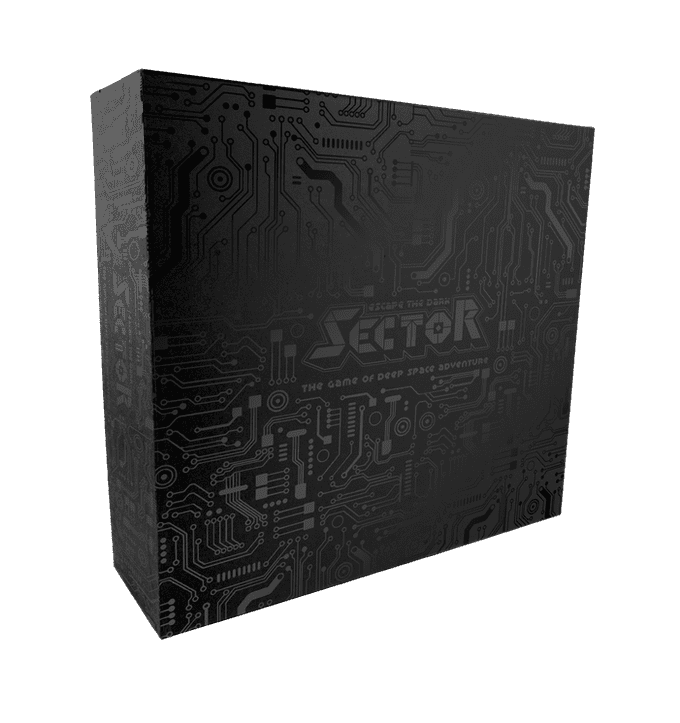
Escape the Dark Sector: The Collector’s Box is no mere pretty box to hold the core game and all three of its expansions, although it is pretty. The large, square, and sturdy box is matte black and has circuitry picked out in UV detailing for quite a subtle effect and a quiet, but imposing presence on your shelf. Inside there is space to hold and organise all of the game’s cards—sleeved or unsleeved—as well as dice, playmats for the escapees, scorepads, pencils, and the various rulebooks. If you are looking for somewhere to hold your copy of Escape the Dark Sector and its three expansions, both to store and organise for play, then Escape the Dark Sector: The Collector’s Box is very much what you need. That is not all though.

In addition to holding everything for the game, Escape the Dark Sector: The Collector’s Box also comes with its own content. These begin with not one, but four new Bosses which could be faced at the end of a game as part of the players’ escape attempt. They include ‘The Changeling’, which can never take two consecutive wounds of the same type so that the escapees need to vary their attack types; ‘The Monolith’, simply inflicts damage by its very presence and cannot be flanked, so there is no teaming up for attacks; ‘Grottle & Snork’ are a pair of murderous aliens who also cannot be flanked, but vary their attack type from round to round; and ‘Madame Chrome’, a cyborg or robot defended by a drone swarm.

The three new Start cards provide new beginning points for the escapees, all three of which have them finding a way out of their cells. For example, having prised their cell doors open, one Start card presents the players with two options. If they take the left door, the players ‘Discard the first Act 1 Chapter Card’ and each draw a ‘Starting Weapon Card’ for each escapee. If they take the right door, the players ‘Add one Act 1 Chapter Card’ to the mission deck and then a ‘Starting Weapon Card’ for each escapee as well as two new Item Cards. This Start Card presents the players with a simple choice—reduce the number of Chapter Cards and thus the difficulty of the escape attempt and get a simple reward, or increase the number of Chapter Cards and thus the difficulty of the escape attempt and get a bigger reward. The most fun involves a scavenger breaking into the escapees’ cell and the players having the choice of fighting it or making a bargain with it. If they defeat it, the escapees gain all of the scavenger’s items, but if they strike a bargain, they gain one item it has previously stolen, and they get to ‘Discard the first Act 1 Chapter Card’. It is delightfully thematic.

The new crew member is K-100, an android escapee. It rolls an entirely different die—a twelve-sided die. One faced is marked with a ‘Triple’, the face being marked with all three traits. This counts as a Double when rolled and a Block in close combat. However, one face of the die is ‘Blank!’ and this is rolled, the android’s neural-net freezes and it is forced to reboot for the next round. This is the player missing a go, but again, it is thematically appropriate.

Escape the Dark Sector: The Collector’s Box adds three new Items or pieces of equipment. The ‘Alien Blaster’ can fire both ballistic ammunition and energy ammunition, the player being able to choose between them. Since it is an ‘Alien Blaster’, sometimes its bio-identification feature will discourage the escapee from using it with its imposter repulsion system, converting an ammo die into damage it inflicts on the wielder! The escapees begin play with the ‘Life Support Module’ in their inventory and can be used be transfer Hit Points between escapees. It is then discarded after use.

The biggest Item in the Escape the Dark Sector: The Collector’s Box is the ‘Demolition Mech’! This has its reference card and Event Card, which is drawn randomly from the Item Deck. Any escapee can pilot it, but cannot carry Items when doing so. The ‘Demolition Mech’ itself is represented by four mech section cards which together form the image of the mech itself. Although the pilot cannot use any Items or mutations (from Escape the Dark Sector – Mission Pack 2: Mutant Syndrome), he can use the mech’s Demo-Cannon in ranged combat or Wrecking Ball in close combat. Both are powerful weapons. In addition, the ‘Demolition Mech’ is armoured, able to take any amount of damage on each of the four locations—represented by its four mech section cards—but only the once. When that happens, the damaged mech section card is turned over and cannot take any further damage. Damage to the torso can destroy the Demo-Cannon or it can hinder the use of the Wrecking Ball. Should all four section cards of the ‘Demolition Mech’ be damaged, it explodes! The pilot is thrown from the wreckage and suffers a lot of damage. The pilot can eject from the ‘Demolition Mech’ before this happens.

The ‘Demolition Mech’ adds a new level to the play of Escape the Dark Sector, literally powering it up. Of course, it has a downside or two. Push its use to far when it takes damage and an escapee can be badly injured, and it also limits what an escapee can carry. Its use is fun though and energises the game when the event card for the ‘Demolition Mech’ is drawn.

Lastly, Escape the Dark Sector: The Collector’s Box comes with a new ‘YOU’. This is in sturdy metal and has a hefty weight to it as it passes from one player to the next, Chapter Card after Chapter Card.

Physically, Escape the Dark Sector: The Collector’s Box is as well produced as the core game. The new Start Card and Boss Cards are large and in general easy to read and understand, whilst the ‘Demolition Mech’ includes its own reference card. Each one is illustrated in Black and White, in a style which echoes that of the Fighting Fantasy series and Warhammer 40K last seen in the nineteen eighties. The box itself is sturdy and capacious.

Escape the Dark Sector: The Collector’s Box is both an entertaining and a practical addition to Escape the Dark Sector. As with the three Mission Packs for Escape the Dark Sector, this box adds more randomness and just a little more flavour to the play of the game, but always balances the advantage that any one card—Crew Member, Chapter Card, Start Card, Boss Card, and even the ‘Demolition Mech’ cards—with potential disadvantages too. The Escape the Dark Sector: The Collector’s Box provides more choice and more randomness and more Sci-Fi theme, as well as more storage space, nicely rounding (or squaring off) out the game with its own big box.