Every Week It's Wibbley-Wobbley Timey-Wimey Pookie-Reviewery...

Saturday, 19 June 2021

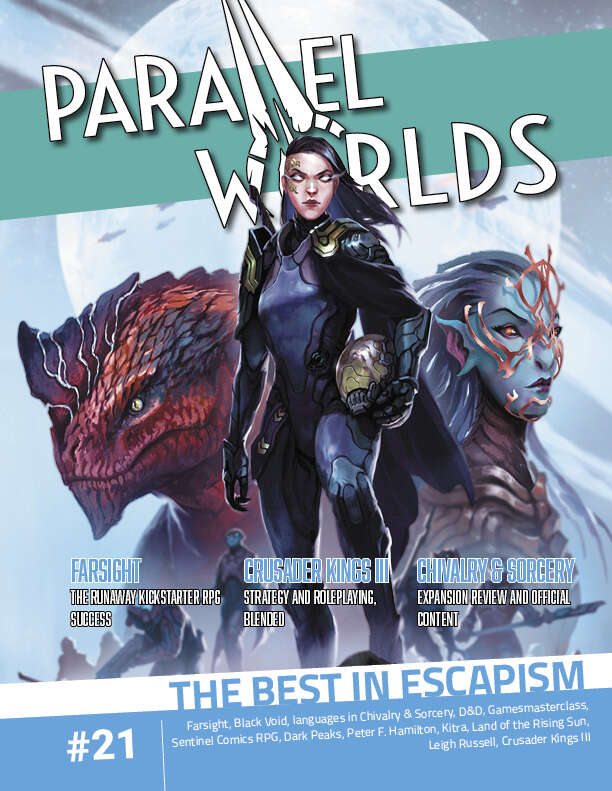
Magazine Madness 4: Parallel Worlds #21

The gaming magazine is dead. After all, when was the last time that you were able to purchase a gaming magazine at your nearest newsagent? Games Workshop’s White Dwarf is of course the exception, but it has been over a decade since Dragon appeared in print. However, in more recent times, the hobby has found other means to bring the magazine format to the market. Digitally, of course, but publishers have also created their own in-house titles and sold them direct or through distribution. Another vehicle has been Kickstarter.com, which has allowed amateurs to write, create, fund, and publish titles of their own, much like the fanzines of Kickstarter’s ZineQuest. The resulting titles are not fanzines though, being longer, tackling broader subject matters, and more professional in terms of their layout and design.

—oOo—

Parallel Worlds feels a little old-fashioned. By which Reviews from R’lyeh means that it supports the gaming hobby with content for a variety of games. So an issue might include new monsters, spells, treasures, reviews of newly released titles, scenarios, discussions of how to play, painting guides, and the like… That is how it has been all the way back to the earliest days of The Dragon and White Dwarf magazines. By which Reviews from R’lyeh means that it can be purchased, if not from your local news agents, then from your local games store. Just like The Dragon and White Dwarf magazines could be back in the day. However, Parallel Worlds, published by Parallel Publishing can also be purchased in digital format, because it is very much not back in the day. By which Reviews from R’lyeh means that Parallel Worlds has reached the grand old age of twenty-one—and these days, that is no magazine achievement for a magazine, gaming or otherwise.

Parallel Worlds #21 promises ‘The Best in Escapism’. It offers a mix of scenarios and support for various roleplaying games as well as interviews with creators and reviews of various books and games. The issue opens with editor Chris Cunliffe’s editorial lamenting the challenging nature of differing opinions and expressing them online, but highlighting that actually, through differing opinions you can discover new things, and that to some extent, the magazine is a vehicle for that. The first content in the issue is ‘Farsight – An Interview with Dario Pesce and Francesco Lucenti’, the Venice-based designers of their new roleplaying game, Farsight, and their company, Lightfish Games. As entertaining as the interview is, it actually focuses very little upon Farsight, the Dungeons & Dragons, Fifth Edition evolved roleplaying game, recently published following a successful Kickstarter campaign. Whether talking about themselves and their influences, this is still intriguing enough to make the reader want to check out the roleplaying game itself.

The actual gaming content in the issue begins with a scenario for Black Void, the roleplaying game of esoteric fantasy set in and around Llyhn the Eternal City, a dystopian cosmopolis and trading hub at the epicentre between the Cosmos and the Void. Here, Living in filthy alleys and shanties among beggars, slaves and the casteless, humanity is very much at the bottom of the social hierarchy in Llyhn, a city inhabited and ruled by eerie beings from faraway worlds, bizarre sapient entities and otherworldly Daimons from beyond the Veil. However, there are factions in the city who want this to change, for humanity to rise beyond its meagre existence, of which the latest is ‘The Cause’, a movement to unite humanity and work to improve its conditions. In Joel Lonergan’s ‘Offers Too Good’, the Player Characters are present at a recruitment drive for ‘The Cause’ and even if they decline to join, they get an offer of a job—join and find out exactly what the leaders of ‘The Cause’ want. The scenario is short and will pose a moral dilemma for the Player Characters, but really feels like a set-up to something bigger.

Stephen Turner, the designer and publisher of Chivalry & Sorcery, Fifth Edition, adds to the world of the Dragon Reaches with ‘Languages of the Dragon Reaches’. Again short, it explores the linguistic development of the setting and provides two scripts—Tadarn Runes and Bethrin Script, both of which Game Master can use to add flavour to her Chivalry & Sorcery campaign. The world’s most popular roleplaying game in the world comes under the spotlight, or at least an aspect of it, in ‘The Three Pillars of D&D Part 3: Exploration’ by Ben Potts. Previous entries in the series examined social interaction and combat, and if they were as decently done as this third and final part, then both are worth tracking down and reading. This article identifies the key elements of exploration in Dungeons & Dragons—travel and puzzles (and traps), and suggests ways in which they can be made both challenging and interesting to play. It also examines how Short Rests and Long Rests work in the game and points own how clunky they are and how they impede one character Class and not another. However, solutions are suggested as are ways in which both Short Rests and Long Rests—Short Rests in particular, can be made to be exciting and interesting without the Player Characters necessarily losing the benefits of either. In examining the way in which Dungeons & Dragons is played, this article feels old fashioned in that similar articles of its ilk have been written again and again over the years, but of course, looking at the various previous editions of the roleplaying game, rather than the current one. This does not in any way make it a poor article and any Dungeon Master running a Dungeons & Dragons, Fifth Edition game will find this an interesting and informative article, full of suggestions and advice that will either help her run a better and more fun game, or perhaps confirm that she is already implementing both and making her game better and more fun.

Editor Chris Cunliffe’s ‘From Tabletop to Desktop’, part of Parallel Worlds’ ongoing ‘Games Master Class’ series treads ground much touched upon by Wyrd Science – Session Zero, that of the shift of play around the table to play online precipitated by COVID-19. He explores his own problems in making that shift, as well as those of his fellow players, plus the changes in terms of preparation, socialising, and interaction within the game itself. In particular, more preparation is required, conversation and interaction are more focused, but does not flow as well as they would around the table, and play time is not just much slower, but also more tiring. This does not mean that gaming online is impossible, in fact, mechanically, it is much, much easier than it was a decade ago… However, for many gamers, it is the only roleplaying possible, but it is possible and it is very much easier than it once was. What one advantage it does omit is that online gaming brings people together, not just from the next town or nearby big city, but from around the world. (For example, I regularly game and chat with players who are not just ten miles away, but hundreds and even thousands of miles away.) Another development that the author ignores is that of virtual conventions. Still the article is informative and warns the potential online player and Game Master of the issues he and she will face when taking the next step into the virtual world, though perhaps it could have highlighted the benefits a bit more and perhaps included the experiences of others who have made the jump.

The remainder of Parallel Worlds #21 is devoted to reviews. They include reviews of Sentinel Comics – The Roleplaying Game, Land of the Rising Sun—the historically inspired adaptation of Chivalry & Sorcerery, Fifth Edition, and The Dark Peaks: Deep Maw. The problem with the first two reviews—the review of Land of the Rising Sun in particular is definitely underwritten—is that they focus just a little too much on the artwork than the text, so that they are drawn out, perhaps taking up space for another review or even a series of thumbnail reviews which might have broadened the appeal of the magazine and made it more useful. In comparison, the review of The Dark Peaks: Deep Maw is more focused and more engaging. Similarly, the reviews of A Hole in the Sky, an audio book by Peter Hamilton and the Young Adult space opera novel, Kitara, by Gideon Marcus, do not suffer from that problem.

Perhaps the least interesting articles in Parallel Worlds #21 are saved to last. ‘Moving to Dystopia: Why an Established Crime Writer is Turning to Dystopian Fiction’ is an interview with Leigh Russell about why she is making the aforementioned shift, whilst ‘Rules of Succession: Appreciating Crusader Kings III’ is about Chris Cunliffe’s experiences with the computer games Crusader Kings II and Crusader Kings III. The latter is interesting from the roleplaying experiences it offers, but again feels too long, whereas the former is short, with extra artwork making it both longer and more of an infomercial than an actual interview.

Physically, Parallel Worlds #21 is professionally presented and written. The layout is clean, strong, and easy to look at, and in general is easy to read. In places, especially in the reviews, the artwork does overpower the text, but overall, this is a good-looking affair.

The problem with Parallel Worlds #21 is that it simply needs more content which will attract gamers and readers to come back to it and content that a Game Master can bring to her table. This is not to say that the issue lacks good content—for example, ‘The Three Pillars of D&D Part 3: Exploration’ and ‘From Tabletop to Desktop’ are both informative and useful, and the scenario, ‘Offers Too Good’, is a good introduction to Black Void. However, too many articles are strung out and the issue lacks content that would attract a wider audience, perhaps the addition of a scenario or article aimed at larger fanbases for different games who might pick up the issue and then appreciate the rest of the content might have helped. This is in addition to generic content too. Of course, it is difficult to take in the swathes of roleplaying titles being released from one month to the next, but there could have been more reviews too, which again, could have appealed to a wider audience.

There can be no doubt that roleplaying magazines have a hard time surviving in contemporary times, but Parallel Worlds #21 does not make it easy for itself by having too much content which does not support the hobby and which is too light. There are a few good articles within the issue and it needs to build on those to bring readers back to it on a regular basis rather than their simply checking out an issue to see if there might be something good in its pages.

—oOo—

An Unboxing in the Nook video is available here.

Friday, 18 June 2021

Dinosaurs and Mutants, Oh My!

The Level of the Lost is a scenario for Metamorphosis Alpha: Fantastic Role-Playing Game of Science Fiction Adventures on a Lost Starship. The first Science Fiction roleplaying game and the first post-apocalypse roleplaying game, Metamorphosis Alpha is set aboard the Starship Warden, a generation spaceship which has suffered an unknown catastrophic event which killed the crew and most of the million or so colonists and left the ship irradiated and many of the survivors and the flora and fauna aboard mutated. Some three centuries later, as Humans, Mutated Humans, Mutated Animals, and Mutated Plants, the Player Characters, knowing nothing of their captive universe, would leave their village to explore strange realm around them, wielding fantastic mutant powers and discovering how to wield fantastic devices of the gods and the ancients that is technology, ultimately learn of their enclosed world. Originally published in 1976, it would go on to influence a whole genre of roleplaying games, starting with Gamma World, right down to Mutant Crawl Classics Roleplaying Game – Triumph & Technology Won by Mutants & Magic from Goodman Games. And it would be Goodman Games which brought the roleplaying game back with the stunning Metamorphosis Alpha Collector’s Edition in 2016, and support the forty-year old roleplaying game with a number of supplements, many which would be collected in the ‘Metamorphosis Alpha Treasure Chest’.

The Level of the Lost is written by the designer of Stonehell Dungeon: Down Night-Haunted Halls and very much wears its inspiration on its sleeve. Well, actually it does not wear one inspiration on its sleeve, so much as have it roar above the jungle canopy and then stomp and chomp on the Player Characters with said inspiration. Then, with the second inspiration, just let the scenario and the Player Characters’ involvement in it get on with it. The first inspiration is Jurassic Park by Michael Crichton—who receives a big name check throughout the scenario, and what this means is that The Level of the Lost is a scenario in which the Player Characters will be confronted with big, roaring, stomping, chomping dinosaurs and because The Level of the Lost is a scenario for Metamorphosis Alpha, those big roaring, stomping, chomping dinosaurs have mutant powers too. The second inspiration, that of Arthur Conan Doyle’s novel, The Lost World, really sums up the whole of the scenario in being set on a lost world or ‘Level’ of the Starship Warden (or rather half-Level), which the Player Characters have limited access to. The result is that The Level of the Lost is big, bruising, and anything other than subtle, but mutant dinosaurs means mutant dinosaurs—and that can only mean one thing. Well two things actually—danger and over-the-top fun.  

The events of The Level of the Lost takes place behind a feature known as the ‘Impenetrable Wall’. Rumour has it that the fabled trader, Gurn the Far-Travelled, has found one of the fabled Command Rings, perhaps one of the most potent artifact of the original crew, since it grants the wearer  complete control over the Starship Warden and access to any Level and through any door—including the previously closed door in the ‘Impenetrable Wall’. So when his robot companion is found damaged outside the open door through the ‘Impenetrable Wall’, there has to be truth in the rumours. The question is, what happened to Gurn the Far-Travelled and wherever he is, does he still have the Command Ring?

What lies beyond the ‘Impenetrable Wall’ is a mini-sandbox comprised of increasingly difficult encounters with dinosaurs made all the more challenging by the fact that they, like many of the Player Characters, possess mutations and the fact that their larger metabolisms means that many of the mutations and devices will not be as effective upon them. There are other encounters too, including with a tribe of reptilian humanoids and a unit of highly trained Pure Strain Humans, but in the main, the Player Characters are free to wander where they will. The forests and mists will not necessarily help them in orienting themselves, but gaining access to one of the few remaining observation towers may give them the lay of the land. By the second of the scenario’s three acts, the Player Characters will ideally have discovered the ‘Crichton Initiative Cloning Lab’ at the heart of the preserve and begun to winkle out some of its secrets. This includes the recent comings and goings with the opening of the door in the ‘Impenetrable Wall’ which allow the Player Characters to tighten their search for Gurn the Far-Travelled. The scenario comes to a climax in the third act when, of course, the Player Characters face off against the ‘King of the Dinosaurs’! Naturally, this is a Metamorphosis Alpha version of the ‘King of the Dinosaurs’, so the Game Master should expect something strange—and the author certainly delivers.

The Level of the Lost is a tough adventure and is best suited for experienced Player Characters with plenty of equipment and weaponry to help protect themselves in the verdant habitat of the Dinosaur Preserve. Certainly, they and their players deserve to feel a sense of accomplishment in defeating some of the mighty beasts to be found within the enclosure—especially the last one. Plus, if they do, then they are amply rewarded. Even with that reward and that sense of accomplishment, this as the scenario outlines, is only the beginning of their troubles for the Player Characters. Not only have they come into possession of an artefact that everyone wants, they must learn to use it wisely and not run off into regions of the Starship Warden that they now have access to, but which they may well be unprepared for.

Physically, The Level of the Lost is cleanly presented. The maps are nicely done as are the illustrations, although not all of them match the text, which is actually much more thematic where there is a mismatch. As an actual adventure, it is a tough affair, primarily offering a mix of exploration and combat—the latter in particular. Any adventure for Metamorphosis Alpha is going to be challenging, but The Level of the Lost is tougher than most, which should be no surprising given the type of creatures faced. Plus, given the nature of the reward involved, it should be run later in a campaign when the Player Characters and their story are ready for a change and a push onwards to discover some of the Starship Warden’s bigger secrets…

Command Service

The Captain’s Table is a scenario for Metamorphosis Alpha: Fantastic Role-Playing Game of Science Fiction Adventures on a Lost Starship. The first Science Fiction roleplaying game and the first post-apocalypse roleplaying game, Metamorphosis Alpha is set aboard the Starship Warden, a generation spaceship which has suffered an unknown catastrophic event which killed the crew and most of the million or so colonists and left the ship irradiated and many of the survivors and the flora and fauna aboard mutated. Some three centuries later, as Humans, Mutated Humans, Mutated Animals, and Mutated Plants, the Player Characters, knowing nothing of their captive universe, would leave their village to explore strange realm around them, wielding fantastic mutant powers and discovering how to wield fantastic devices of the gods and the ancients that is technology, ultimately learn of their enclosed world. Originally published in 1976, it would go on to influence a whole genre of roleplaying games, starting with Gamma World, right down to Mutant Crawl Classics Roleplaying Game – Triumph & Technology Won by Mutants & Magic from Goodman Games. And it would be Goodman Games which brought the roleplaying game back with the stunning Metamorphosis Alpha Collector’s Edition in 2016, and support the forty-year old roleplaying game with a number of supplements, many which would be collected in the ‘Metamorphosis Alpha Treasure Chest’.

The Captain’s Table is written by the designer of Mutant Crawl Classics Roleplaying Game – Triumph & Technology Won by Mutants & Magic and uses the spiritual beliefs of the Player Characters to draw them into adventure. Their spiritual belief system involves not just ancestor worship, but worship of the original officers who commanded the Starship Warden. Essentially, they have come to form a pantheon of their own for the tribe, so when the Player Characters come upon a holo-egg which unexpectedly projects a larger-than-life vision of Captain Jameson—one of the five original captains of the Warden—they are not only surprised, they almost struck down in religious awe! Further, when he asks for their aid in recovering a storage crate with materials essential to his plans, they realise that he is giving them a holy quest! Surely something that the Player Characters should undertake in order to prove their worthiness to both the ancients and the Great Officers? So begins the quest to The Captain’s Table.

The Captain’s Table is a relatively short scenario, consisting of three parts which should take a session or two to play through—if the Player Characters stick to their quest, that is. In the first part, they are given directions as to where to go and what they need to progress further, including an opening scene in which the Captain actually informs them where they are. That is, on a giant spaceship! Thus the Game Master may want to run this scenario a few sessions into her campaign after the characters have already learned this themselves rather it being revealed to them via a dose of exposition. Not only does the Captain give away information, he directs them to an armband which will allow access to certain parts of the ship. This includes the Cargo Deck, the scene for the second part of the scenario. Here is the main stage for the scenario, a single vast level thirty-our miles long and sixteen miles wide consisting of hundreds of mile-long cargo bays. One of these is the Player Characters’ destination, but they will need to make the trek there using the clues given by the hologram of Captain Jameson, negotiate (or possibly fight) with other scavengers for possession of what they have been sent to collect before taking it to Captain Jameson himself.

Despite its brevity, there is a lot of detail and flavour to the scenario. There are monsters and other creatures to be found, from Wolfoids and Felenoids—the latter with a penchant for fashion, to Space Weevils and intelligent Oozes, a whole Level of mostly unopened cargo crates to open, and of course, getting to have dinner literally at the Captain’s Table. Some of the encounters are designed to be combat encounters, but others involve roleplaying and the Game Master has some fun NPCs to roleplay. Although the scenario is relatively short, providing no more than a session or two’s worth of play, the Player Characters are free to go explore the whole of the Cargo Level, perhaps cracking open cargo bays and crates as they go, or the Cargo Level is somewhere that they can come back to again and again after the events of The Captain’s Table, looking for further supplies or devices that will help them in their exploration of the Starship Warden or just help their tribe survive. Either way, tables of encounters and cargo bay contents support both options.

If there is a problem with The Captain’s Table, it is the finale. As written, it is fine, it makes sense, and it is amusing, but some players may feel slightly cheated when they and their characters discover what has been going on. Consequently, players do need a sense humour when playing this scenario and not to be too po-faced about its revelations. Plus, ultimately, their characters are rewarded for their efforts and do learn more about the Starship Warden. For the Game Master there are some fun references too, most notably The Wizard of Oz, Red Dwarf, and Terminator 2, but these are handled with some subtlety. Plus in the long term, the Game Master can have the Player Characters return to the Cargo Deck as and when it suits the plot and ‘Captain Jameson’ hologram could become a recurring NPC. If there is an issue to the scenario, it is that the clues do need to be carefully presented if the players are to take advantage of them.

Physically, The Captain’s Table is engagingly written and nicely illustrated. The maps are well done, often illustrating events as much as locations within the adventure. The handouts are decent too, though the Game Master may need to be more direct in making their use by the players a little easier.

Both the plotting and the staging of The Captain’s Table are quite tightly tied to Metamorphosis Alpha and the Starship Warden. However, with a little bit of effort and teasing apart of its individual parts, both plot and the locations—especially the Cargo Deck, which could simply become an enormous warehouse—could be reworked into other post-apocalyptic settings. In general, the drier or less gonzo the setting, the more adaptation effort required, but the scenario would work with Mutant Crawl Classics, Gamma World, and even Mutant: Year Zero.

The Captain’s Table is a short, entertaining scenario which makes good use of its inspirations and provides content which the Game Master can return to. It is easy to add to any Metamorphosis Alpha campaign and should provide a session or two’s worth of play (and potentially more).

Monday, 14 June 2021

Miskatonic Monday #65: Tales From Ye Dusty Olde Crap Shoppe

Between October 2003 and October 2013, Chaosium, Inc. published a series of books for Call of Cthulhu under the Miskatonic University Library Association brand. Whether a sourcebook, scenario, anthology, or campaign, each was a showcase for their authors—amateur rather than professional, but fans of Call of Cthulhu nonetheless—to put forward their ideas and share with others. The programme was notable for having launched the writing careers of several authors, but for every Cthulhu Invictus, The Pastores, Primal State, Ripples from Carcosa, and Halloween Horror, there was a Five Go Mad in Egypt, Return of the Ripper, Rise of the Dead, Rise of the Dead II: The Raid, and more...


The Miskatonic University Library Association brand is no more, alas, but what we have in its stead is the Miskatonic Repository, based on the same format as the DM’s Guild for Dungeons & Dragons. It is thus, “...a new way for creators to publish and distribute their own original Call of Cthulhu content including scenarios, settings, spells and more…” To support the endeavours of their creators, Chaosium has provided templates and art packs, both free to use, so that the resulting releases can look and feel as professional as possible. To support the efforts of these contributors, Miskatonic Monday is an occasional series of reviews which will in turn examine an item drawn from the depths of the Miskatonic Repository.


—oOo—


Name: Tales From Ye Dusty Olde Crap Shoppe
Publisher: Chaosium, Inc.
Author: James Thompson

Setting: Modern Day

Product: Hunt & Chase Scenario
What You Get: Eighty page, 32.46 MB Full Colour PDF

Elevator Pitch: Sometimes the shelves hold scares as well as books... and the book hunters become the hunted.
Plot Hook: Lost books, lost customers, just how far back do these shelves go?
Plot Support: Six plots or hooks, location description, two optional encounters, eleven maps, nineteen handouts, nine NPC statistics and illustrations, three monster statistics and illustrations, six pre-generated Investigators, and staging advice.
Production Values: Good.

Pros
# Superbly disquieting book illustrations
# Multiple, easy-to-combine plots and hooks
# Straightforward plotting for all six plots
# Potential introductory scenario or one-shot
# Excellent artwork throughout
# Delightfully dreary location
# Entertainingly weird cast of NPCs for the Keeper to roleplay
# Potential, unknowing entrance to the Great Library of Celaeno
# Potential introduction to The Yellow King 
# Could be adapted to The Yellow King Roleplaying Game
# Could be adapted to Bookhounds of London
# Fourteen Weird Book Covers to Alarm Your Investigators
# Squinty Crumpet

Cons

# Using some plots or hooks, may preclude a return visit to the location and scenario reuse
# Pre-generated Investigators not illustrated
# Straightforward plotting for all six plots
# Terrible title
# Squinty Crumpet

Conclusion
# Superbly disquieting book illustrations
# Multiple, easy-to-combine plots and hooks
# Terrible title
# Fourteen Weird Book Covers to Alarm Your Investigators
# Squinty Crumpet

Sunday, 13 June 2021

Elevator Straight From Hell

Destroyer of Worlds is a scenario for Alien: The Roleplaying Game. Like Chariot of the Gods—also available in the Alien: The Roleplaying Game Starter Set, it shares the same mode of play, but differs in terms of its campaign model. Thus, it is written for the roleplaying game’s Cinematic mode, and so is designed to emulate the drama of a film set within the Alien universe, emphasising high stakes situations, faster, more brutal play, and deadly encounters. However, where the campaign model for Chariot of the Gods is that of Space Truckers—star ship crews hauling goods and resources, as in Alien, the campaign model for Destroyer of Worlds is that of Colonial Marines, essentially military missions like Aliens. In Destroyer of Worlds then, the Player Characters get to face off against Xenomorphs as armed and dangerous marines, as they engage in a deadly manhunt on a near-abandoned colony world rife with intrigue and insurrection, just as war breaks out in orbit above. As the situation deteriorates around them, the Player Characters will find themselves the unfortunate victims of corporate, military, and interstellar politics, as something worse than their nightmares chases them off world…

The background for Destroyer of Worlds is the Oil Wars between the United Americas (UA), the Three World Empire, and the Union of Progressive Peoples (UPP), the race to locate fresh sources of petroleum which would keep their respective industries and militaries supplied. Thus, the strategic importance of petroleum-rich worlds has grown and grown over the years, with those close to national borders also creating severe tensions. One such world is the Ariarcus colony on Kruger 60 AEM. Located in the Outer Veil in United Americas space close to the border with the Union of Progressive Peoples, for decades the Ariarcus colony has proven its worth as a strategic source of oil, such that when the colonists were found selling oil to the UPP, the colony was seized as an asset and militarised, with units from both the United States Colonial Marine Corps and the Colonial Navy being stationed on and above the planet at Fort Nebraska. The colony has all but collapsed, with barely two thousand colonists left, most wanting to get off world, an insurrection which wants to be free of what its members see as the UA yoke and is ready to defect to the UPP, and as military forces are diverted to deal with a UPP attack on the neighbouring the Cygni 61 system and LV-038 colony, both the military and colonial administration declares an evacuation of the colony, the insurrection seizes the opportunity to reach out to the UPP. At the same time, a squad of Colonial Marines from Fort Nebraska’s Special Operations ‘Sin Eaters’ marine unit decide it is the moment to go AWOL…

Into this set-up are thrown a team of marines drawn from the forces left after the strike force has left for Cygni 61 system and LV-038 colony, including members of an assault team, a Chemical Biological Radiological and Nuclear (CBRN) Defence Specialist, a Combat Technician/Hospital Corpsman Android, and two riflemen and drivers, led by a ‘Sin Eater’ commander. Their task is to locate the squad of Colonial Marines who have gone AWOL and prevent both them and any intelligence they possess from falling into the hands of the UPP. Each has his or her agenda—some have their own secrets too—that will come into play as their mission progresses, and over the course of a single few hours, they will track down the missing Colonial Marines, confront the Insurrectionists, get caught up in the outbreak of war, come under horrifying chemical attack, deal with rival factions desperate to make alliances, and as the order to evacuate is issued, face monster after monster the like of which they will have never encountered before, and ultimately, literally climb up out of Kruger 60 AEM’s gravity well. All of which takes place in the Antarctic environment of Ariarcus, a moon of the gas giant, Oblivion, under the never more than twilight gaze of the ever-watchful and oppressive Eye of Oblivion—an 11,000-kilometer-wide blue storm raging in the gas giant’s atmosphere.

Destroyer of Worlds is designed for three to five players, but includes a total of seven pre-generated Player Characters to form tthe ramshackle unit drawn together and assigned what will turn out to be a brutally nasty disaster of a mission. Essentially, those Colonial Marines initially appearing in the unit as NPCs are intended as replacement Player Characters, for make no mistake, this is a deadly scenario in which a ‘Total Party Kill’ is a distinct possibility. In fact, it might actually be worth the Game Mother preparing some of the other NPCs as replacement Player Characters, so deadly is the scenario in places. Potentially though, this would lead to a shift in the ‘party dynamics’ as NPCs from other factions become Player Characters and have their own agendas. Ultimately though, everyone’s agenda is to get off world, whatever the consequences.

Destroyer of Worlds is structured over three acts. In Act I, the Player Characters get their assignment and begin their investigation, tracking the missing Colonial Marines down across the Ariarcus colony, dealing with the last remnants of the colony infrastructure and administration, confronting the Insurrectionists, potentially encountering both corporate and UPP operatives with their own agendas, Xenomorphs, and more. As the Player Characters begin putting things together, Act II begins with a bang. Open conflict begins in orbit above between the UA and the UPP, the colony is hit with EMP attacks, bringing spacecraft and attack ships crashing down on the colony, and worse, an unknown ship showers the colony with the transformative Black Goo seen in Prometheus. The latter leads to some horrifying scenes as the remaining colonists are radically mutated or ripped apart. Combined with an order to evacuate the colony, this will drive the Player Characters to get off world, but the effect of the EMP attacks mean that the colony’s space elevator is not working. In Act III, this will force the Player Characters to delve into Fort Nebraska’s sublevels to get the power working again, and in the process, discover some of the darker secrets about just what has been going on at the base…

Destroyer of Worlds is big, bold, and brassy, an epic adventure from start to finish, and yet… As much as it captures the cinematic feel of Aliens and the later films, it is not an easy adventure to run and it is guilty of over-egging the pudding. The problems with the adventure are fourfold. First, there is a lot going on in the adventure, with multiple factions and multiple agendas, not including those of the Player Characters. Combined with events there is a lot for the Game Mother to keep to track off throughout the adventure, and this can be compounded later on in the second and third acts if the Player Characters are joined by NPCs—both innocent bystanders and members of other factions, who are equally as desperate to get off world. Second, the adventure does not just throw one Xenomorph element at the Player Characters, but all of them. So not just the Black Goo and the Anathema it creates, but also species Xenomorph XX121 from Alien and Aliens—from Egg to Queen, and subspecies. There is often little to no subtlety to this, and it is compounded by the third problem—the sheer number of Xenomorphs that the Player Characters will encounter throughout the adventure, especially in Act III. Consequently, their exploration of Fort Nebraska’s sublevels do take on a dungeon-like aspect, but with guns and grenades and Xenomorphs, instead of swords, spells, and Orcs, such that it feels as if everyone should be playing an Aliens boardgame rather than Alien: The Roleplaying Game. Fourth, because it is an adventure for Cinematic mode, Destroyer of Worlds is heavily plotted, in some cases for the Player Characters as much as the story itself, including one of the Player Characters beginning infected, their drive eventually being to locate a cure, which as the scenario plays out, they will hopefully discover exists. So it feels heavy-handed in places, but given that Destroyer of Worlds is a Cinematic one-shot, this is not as much of an issue as it could have been. Fifth, there is quite a lot going on off-camera in terms of the story that is never really explained, such as who exactly drops the Black Goo on the colony (it is intimated that this this is Engineers from Prometheus, just to further over-egg the pudding), why the Player Characters are selected, and so on. Yet, in the face of the unrelenting pace at which Destroyer of Worlds is telling its story, it almost does not matter. Certainly not for the Player Characters, but perhaps for the Game Mother?

Physically, Destroyer of Worlds comes as a boxed set, much like the Alien: The Roleplaying Game Starter Set—and almost as richly appointed. Open up the box and the purchaser is confronted with decks of cards, poster maps, character sheets, and the scenario book itself. The two decks of cards consist of twenty-one Personal Agendas, six Vehicle cards, two Weapon cards, nine NPC cards, and six Story cards. The Personal Agenda cards are given to the appropriate Player Characters at the beginning of each act and define their aims for that act, their being rewarded with Story Points based on how well their players roleplayed them. The Story cards are similar to the Personal Agenda cards, but reveal secret aspects of their particular Player Characters which again will affect their motivations. The other cards are a mix of the old and the new, some having appeared in the Alien: The Roleplaying Game Starter Set. These include a United States Colonial Marine Corps heavy tank (which the Player Characters can potentially commandeer), a pair of UUP vehicles, and the AK-4047, the UPP equivalent of the Pulse Rifle.

The main map is a thirty-four by twenty-two inches poster which depicts Ariaricus colony on one side and the interior of Fort Nebraska on the other. This is in addition to the two A3-sized maps which show individual locations. Of the three, the smaller maps are a lot easier to handle and sue at the table, but like all of the maps, they are done in the green-on-green blueprint style seen in the Alien universe. The seven Player Character sheets are easy to read, as is the scenario booklet, which is cleanly laid out in the style seen in Alien: The Roleplaying Game, the Alien: The Roleplaying Game Starter Set, and Chariot of the Gods. It is lightly illustrated with pieces taken from Alien: The Roleplaying Game, but the light layout makes up for that. Notably, the scenario book includes four appendices, one for all of the types of the Xenomorphs which appear in Destroyer of Worlds, one for the Talents which appear in the scenario, one for all of the stats for the gear and vehicles, and one for vehicle combat. The appendices of Talents and Xenomorphs do reprint material from Alien: The Roleplaying Game, but they are included for anyone running Destroyer of Worlds using just the  rather than Alien: The Roleplaying Game.

Destroyer of Worlds is a fantastic scenario, but not a perfect one. It has too many moving parts and too many Xenomorphs and too much going on that it needs careful handling and preparation upon the part of the Game Mother to run well. Yet it is big, it is bruising, it is over-the-top, and it delivers the pulsating combat action of Aliens and an eighties action movie. It has some great set pieces just like an eighties action movie and an Aliens horror movie should—the rain of Black Goo, assaulting the Insurrectionists’ compounds, getting back into Fort Nebraska, sneaking about in the sublevels of the base and the final confrontation on the space elevator… Ultimately, Destroyer of Worlds is a popcorn munching, shoot ‘em up horror movie of a scenario. Essentially, put on the Aliens soundtrack and expect the Player Characters to blast their way through it, get the bejuzus scared of them, get infected, confront Xenomorph after Xenomorph, probably die, and maybe, just maybe, survive.

Saturday, 12 June 2021

Partying The Party RPG

When the party is confronted with bush with golden, sparkling leaves, seeming to dance to a rhythm only it can hear and it implores with a booming voice for one of their number to dance because it has lost its magic and needs to be once again enthused with the ‘power o’ dance’ to get his jive, and the Game Master turns to her players and says that one of them must dance a dance of her choice in complete silence, and the other must guess what it is, then you know that this is no ordinary adventure, and no ordinary roleplaying game. When a Dorse—a mutant hybrid of a Horse and a Dragon—demands that everyone play ‘Naughty Imitation’ and impersonate a famous film star doing something naughty, then you know that this is no ordinary adventure, and no ordinary roleplaying game. When the party must create and perform a song or rhyme to open an emotionally needy chest, then you know that this is no ordinary adventure, and no ordinary roleplaying game. All of these sound like party games, which they are, and not like a roleplaying game at all, but these really are challenges presented in a roleplaying game which combines a classic fantasy quest to save the world with the type of games which will be familiar to a wider audience. This, when combined with simple, light rules, a straightforward plot, accessible presentation, and sense of humour, makes this roleplaying game almost the perfect means to introduce those unfamiliar to the concepts of roleplaying to their first actual roleplaying game.

The roleplaying game in question is The Party RPG: The Rise of Burden Bluggerbuckle, published by The Party RPG. Designed to be played by between three and six players, including a Game Master, it presents a Dungeons & Dragons-style fantasy adventure, played as a one-shot over multiple sessions, but with very light rules, a physical component—the players are encouraged to dress up as their characters if they want and there are plenty of physical challenges and games throughout the quest, and a presentation intended for the scenario for the game to be played from the page. There is also scope for the players to share the role of Game Master, swapping from playing to refereeing for a scene, and then back again, so that in a game of five players, everyone could have a go at being a Game Master several times. Although it can be played round the table like a traditional roleplaying game—or these days over Zoom—it does not have to be and could easily be run in the lounge over the coffee table.

The setting for 
The Party RPG: The Rise of Burden Bluggerbuckle is the Great Plains. Phosphorian, known for both his great villainy and his glowing member, has died. Upon hearing this tragic news, Burden Bluggerbuckle, his Orc boyfriend waiting at home in a floral apron, swears a mighty vengeance and sets out to cast the Enchantment of Unrelenting Rage which will rent the Great Plains in twain—at the very least! To save the Great Plains, a Squad—as opposed to a party which would confuse everyone in and out of The Party RPG: The Rise of Burden Bluggerbuckle—of doughty adventurers who undertake Main Quests and Side Quests. Main Quests to acquire the six pieces of the Counter Enchantment which will break the Enchantment of Unrelenting Rage and Side Quests to enhance their abilities and gain gear that will help them on their grand quest. Over the course of sixteen scenes and locations, the Player Characters will encounter an exploding goat (he gets better), shout to reveal hidden items, find a way over a broken bridge, hunt for buried treasure, impersonate pigs, run into belligerent chickens, and a whole lot more.

In 
The Party RPG, the players are free to create characters that are whatever they want. A Unicorn with a sense of adventure? A brave warrior who rolls into battle in her wheelchair? A lizardry, wizardy gecko? A pilfering Chameleon? A middle-aged accountant fighting evil in his pipe and slippers? All possible and perfectly acceptable. A character is very simply defined. He has five Skills—Stealth, Awareness, Strength, Intelligence, and Speed—rated between one and ten. A player simply assigns five points between these, buys some basic equipment for his character, describes who and what he is, and thus he is ready to play. Fantastically, everything that a player needs is laid out on the character sheet. So on the front, there are the five skills, plus a tracker for the character’s Hit Points, Level, and Experience Points, and places to record his weapons and shield, plus items and armour. On the back is a step-by-step guide to character creation and an explanation of what all of the terms are in The Party RPG. The character sheet is very nicely done.

Frau Blücher is a no-nonsense housekeeper who has no truck with the end of the Great Plains. Otherwise, where else is her G.O.A.T. goat, Heidi, going to graze and headbutt anyone she does not like?

Name: Frau Blücher

Skills
Stealth 1
Awareness 2
Strength 0
Intelligence 1
Speed 1

Equipment: Simple Wand, Basic Leather Armour, Soap

Mechanically, 
The Party RPG is very simple, although it uses two resolution systems. The first is when the Player Characters are acting against the environment, such as climbing a tree or fording a fast-flowing stream, or when they are engaged in combat. This requires the player to roll three six-sided dice and add any bonuses from his character’s Skills and items of equipment. The aim is to roll high, with possible results including Pivotal Successes, Successes, Fails, and Epic Fails. For example, a task set at Moderate has a Pivotal Success threshold of fourteen or more, Success threshold of eleven and up, a Fail threshold of ten and below, and an Epic Fail threshold of seven or less. It is as simple as that. In general, Pivotal Successes, Successes, Fails, and Epic Fails will be set by the Game Master, though weapons and shields have their values, which will be better for the items purchased or found later in the quest. Damage is dependent on a Player Character’s Level—either one, two, or three six-sided dice, armour detracts from inflicted damage, and shields can totally deflect or partially block damage, and even break! A Pivotal Success result on an attack roll ignores the effects of armour.

The other resolution system, which is for Player Character versus NPCs, is dependent upon the Level of a Player Character or NPC—again one, two, or three six-sided dice. These are rolled and added together with the appropriate Skill Levels of both the Player Character and the NPC, and the highest result wins. Although simple enough, in fact, both mechanics are simple enough, it feels a little odd to have two separate, quite different systems for a game that is aiming to be as easy as it is.

The ease of play for 
The Party RPG is facilitated by its layout. Every location is broken down into a series of sections. The first section always sets out the objectives the Player Characters have to complete and instructions for the Game Master. This is followed by sections which set the scene, give handy tips, and always ends with one giving the suggested Experience Point awards depending on how well the Game Master thinks her players and their characters performed in the location. This ranges from ‘Abysmal’ and ‘10XP’ to ‘Terrific’ and ‘80XP’. A total of one hundred Experience Points are required for a Player Character to go up a Level—so will typically occur at every other location and grant a bonus Skill level, plus Hit Points, and enable a Player Character to use better equipment. Throughout the location, boxes in bold colours highlight what the Game Master needs to act upon—so red for combat or active actions like sneaking past some Goblins; blue for treasures to be rewarded to the Player Characters; purple for a physical out of game action, such as singing or dancing; green for ending a scene. The layout and these boxes further make The Party RPG easy to run from the page.

However, running 
The Party RPG does require some page flipping when it comes to combat and shopping—all of the stats for the NPCs and the equipment that the Player Characters can obtain through visiting shops or being rewarded are at the back of the book. A bookmark or two, should offset this issue to some extent.

Physically, 
The Party RPG is cleanly and tidily laid out. The writing varies depending upon the subject matter. It does tend towards bullet points in its style for a lot of the rules explanations. This is not an issue for the experienced Game Master, but anyone coming to the game anew will not find it as easy as it could have been. In comparison, the writing of the quest is more expansive and humorous and entertaining, so more engaging to read. The book’s artwork is excellent, but really too small for the Game Master to enjoy or use to add colour to the running of the game. It would have been great if the artwork had been larger and thus could have been shown to the players as their characters progressed onwards as part of their quest, and thus helped them envision the world their characters are exploring. One other effect of the writing and the simplicity is that The Party RPG is easy to prepare. An experienced Game Master will be able to read and grasp what is all going on the page from a simple readthrough. 

However, as clever and as fun and as silly as 
The Party RPG: The Rise of Burden Bluggerbuckle is, it is not without its issues. The first one is the tone, which is adult in nature—though not explicit—and as written, The Party RPG is not suited for play by younger audiences, which is a pity given the simplicity and physicality of the roleplaying game. Of course, the Game Master can tone down or remove the adult humour during play, but perhaps the inclusion of alternative text better suited for younger and family audiences would have widened the accessibility of The Party RPG Second, the rules are simply not as well explained as they could be. This is not a matter of discounting their simplicity, but rather that they are more clearly explained for the Game Master than her players. Now there are examples of the three types of mechanics—Player Character versus the environment, versus NPCs, and combat—in The Party RPG, and they help, but there is no clear explanation otherwise. Third, once play is underway, there is no guidance from situation to situation as to the suggested scores for Pivotal Successes, Successes, Fails, and Epic Fails for the challenges the Player Characters will face. For the experienced Game Master, setting these suggested scores is not really going to be all that difficult, but anyone new to this type of game, it will be challenging, and makes The Party RPG not quite as readily suited for new Game Masters as the designers intended.

So is 
The Party RPG: The Rise of Burden Bluggerbuckle actually a roleplaying game? The answer to that is both yes and no. Yes, because the players are rolling up and creating characters and having go away on adventures just like Dungeons & Dragons—or in the case of Dungeons & Dragons meets Toon or Dungeons & Dragons meets Tails of Equestria – The Storytelling Game. But no, because there are no means or advice to create anything other than a playthrough of ‘The Rise of Burden Bluggerbuckle’, and as a roleplaying game, The Party RPG is very much tied to that story line. So, it is more of a one-shot or a mini-campaign, but still a roleplaying game.

Throughout 
The Party RPG: The Rise of Burden Bluggerbuckle, both Game Master and players, but especially the players, are encouraged to be inventive and creative, not just in terms of creating their characters, but also in terms of how they approach different situations. In return, the Game Master is encouraged to take these ideas on merit, to give them a chance to work, no matter how preposterous, and so support an inventive, slightly over-the-top, even a little silly style of play. Throughout, The Party RPG: The Rise of Burden Bluggerbuckle never gets away from the fact that its play should be fun. Which also includes the physical elements that are likely to be more acceptable to a wider, more family audience than necessarily to a roleplaying audience, and that means that The Party RPG: The Rise of Burden Bluggerbuckle could actually work as an introduction to roleplaying games (though it is not quite as suitable for new Game Masters as it could have been). Although it might not be for everyone, but for anyone ready to embrace its silliness, its simplicity, its scope for inventiveness, and its physicality, The Party RPG: The Rise of Burden Bluggerbuckle has the potential to be huge fun.

Friday, 11 June 2021

Friday Fantasy: Lumberlands – Wampus Country Travel Guide I

Out on the borders of the far Northwest lies a forest without end. Here doughty Lumberjacks and Lumberjills leap from tree to tree, felling and cutting the mighty pines for shipping back to civilisation. In the deeper parts of the forest, the great hairy hulks known as Sasquatches roam freely, feared by some as monsters, simply misunderstood say others, but unknown to all. If the exact nature of the Sasquatches remains unknown, then the secrets of the Squirrels are kept hidden—and they like that. For within their secluded city republic of Baudekin, sapient Squirrels and other members of the Sciuridae family from across the dimensions protect it secrets, most notably the Secret Gnawledge those contained within the roots of the Library Trees. For anyone wanting to set out into the forest, the place to start is Squeamish, a ‘nice, clean, company town’. Squeamish is a boomtown, a frontier town built by the Red Bear Lumber Company, and the many Lumberjacks and Lumberjills that work the forest work for a felling gang employed by the Red Bear Lumber Company. They work for the Red Bear Lumber Company, they live on the Red Bear Lumber Company property, they eat Red Bear Lumber Company food, and they have a long line of credit with the Red Bear Lumber Company. Perhaps though, one of those many Lumberjacks and Lumberjills—whether a Lumber-Fighter, Lumber-Cleric, Lumber-Thief, or Lumber-Wizard—will strike it lucky on a side hustle or with an independent gang and bring back that one rare botanical specimen which will set them up for life—or at least ensure they can pay off their credit. There are always Wizards and Alchemists willing to pay for such items. Adventurers come to Squeamish too, perhaps for those same rare botanical specimens, or to hunt for Sasquatch or rescue innocents kidnapped by the brutish creatures, or to enter a Lumberjack competition, or… Whatever the reason, they will need a guide—and there are plenty of those to go around. Perhaps hire a Gunkey—a cross between a goat and a jackass, and twice as stupid/foppish/lecherous as you would expect, rent out a half-useful, only half-tested device from Half-Mad Leach MacCleod, or simply feast on tasty street food from Odd Jacob—the ‘Salty Weasel Bites’ are a best seller!

This is the set-up for Lumberlands – Wampus Country Travel Guide I, a systemless, rules-agnostic fantasy roleplaying setting by the creator of Wampus Country. Published by Lost Pages, best known for the entertaining Genial Jack and the Burgs & Baillifs series, this is a comedy-style setting based on the Pacific Northwest—although it could be Vermont too, although mostly the Pacific Northwest because Portland—which is easy to adapt to the setting of the Game Master’s choice, whether that is Dungeons & Dragons, Fifth Edition, Savage Worlds, or Old School Essentials. So as a setting, right from the start, it is full of flannel (shirts), axes, bearded men, axes, maple syrup, axes, and weirdness, which sort of has a Twins Peaks feel to it.

Lumberlands is offered as a place to visit, rather than as a place to be from. Numerous reasons are given why, such as questing for the legendary Squirrel City, engaging in logging company intrigues, or even attempting to hire a family of Giant Beavers to gnaw you that perfect home. Lumberjack and Lumberjill culture is highlighted, how they are plain-dealing, strong, self-reliant, egalitarian (mostly), and so on, before suggesting what Lumber-versions of the four core character Classes might look like. So Lumber-Fighters prefer axes, wear flannel and dungarees, possess stunning beards, big stompin’ boots, and enjoy public displays of prowess, whilst the Lumber-Thief sports a smaller, often oiled beard, wears flannel ironically (?), is agile as a weasel, has canvas boots with good luck symbols, lumbergang tattoos, and pirate-style earrings. Not really enough to equate to an actual Class in terms of Dungeons & Dragons, more a set of pointers in the right direction, whether the Game Master simply wants to use the use the classic Dungeons & Dragons Classes as written with Lumberlands flannel, or actually create Lumberlands versions of those Classes. Lumberjacks and Lumberjills can worship any gods, but have their own too, like Timmerton, the demigod of the Lumberlands, a bare-chested mountain of a man with maple syrup dripping from his mighty beard, and the Cult of the Beaver, whose members are very fond of hard work and clean teeth.

Lumberjack and Lumberjill equipment includes the Lucky Flannel, which when combined with dungarees, counts as leather armour, and axes of all sorts—and custom-fitted axes for all sorts of situations. The list of possible customisations is only the first of several tables in Lumberlands – Wampus Country Travel Guide I. The next gives options adding a personality to your Gunkey, whilst there are several subtitles to the supplement’s quite detailed encounter table. Once out of Squeamish, having detailed the Red Bear Lumber Company and several of the town’s peoples and places, the supplement runs off into the woods, with all of its gear strapped atop a Gunkey of course, and begins to expose some of the secrets of Lumberland. This includes just who and what the Sasquatches are and they really are not what you think; a discussion of Squirrel politics, which might or might not be a parody of US state politics, less members of the rodent family of course; and somewhere—since there are no maps of the Lumberlands, ‘Portal-Land’, a dimensionally unstable triangle where easy access to other worlds can be gained (and vice versa), and time and gravity can shift, and is inhabited by the False Ones, strange humanoids with perfectly smiling porcelain masks, hypnotically pleasant lines in banter, horribly matching sweaters, and a willingness to invite adventurers to dinner…

Rounding out Lumberlands – Wampus Country Travel Guide I is a lengthy set of encounter tables, which are broken down by type, so Deadly Plant, Things of Nightmare, and Natural Wonders, and more. Each of the categories includes six detailed entries. Penultimately, there is a list of Lumberland familiars, including an ‘Enchanted Salmon of Wisdom’, which looks good on a wooden plaque and dispenses wisdom in song, and an ‘Animated Tattered Flannel, which could have been a shirt or a baby’s blanket, but which will happily wrap around the owner’s shoulder, but leaps to cover his nose and eyes in the event of a gas or powder attack! Lastly, there is final list, this one of potential Henchbeings, including one eyebrow-raising Marmot!

Physically, Lumberlands – Wampus Country Travel Guide I is neatly presented, although the text is a little fuzzy in places. The artwork is of course cartoonish, which suits the supplement perfectly.

Lumberlands – Wampus Country Travel Guide I is funny and engaging and inventive, but for all that, its tongue-in-cheek tone and subject matter is unlikely to be for everyone or every campaign. Both tone and subject matter mean that Lumberlands – Wampus Country Travel Guide I needs a higher degree of buy-in from the players as much as the Referee for everyone to enjoy it. The other issue is where to use it, as there are likely to be few campaigns or settings in which are going to be natural fits for its content. It means that the Referee should really consider if this supplement is going to be suitable for her campaign even before thinking about the work necessary to adapt it to the rules being used. That aside, Lumberlands – Wampus Country Travel Guide I is a delightfully silly satire upon the Pacific Northwest (or Vermont or Canada), its peoples and its politics, and its wildlife, and let us hope that there will be a Wampus Country Travel Guide II.

—oOo—

A full unboxing of Lumberlands – Wampus Country Travel Guide I is available to view on Unboxing in the Nook.