Every Week It's Wibbley-Wobbley Timey-Wimey Pookie-Reviewery...

Tuesday, 7 August 2012

The Gloom that overcame Glaaki

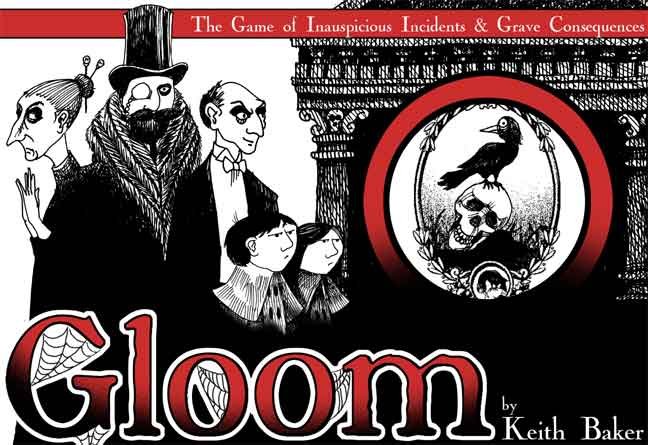
Back in 2004, Atlas Games published a card game of a singularly ingenious, yet depressingly design. It told the story of how the members of four families were driven each to a mournful end after a life time of ill omens, distressing events, and ennui to end it all. The cleverness of the design lay in the nature of the cards, for they were not cards at all, but each was a slice of thin, transparent plastic marked with various icons, images, and pieces of text. Game revolved laying cards upon the top of various family members, the transparency of the cards enabling various elements of the cards underneath the uppermost one to remain visible and in play until such times as they were covered up, their effects negated and replaced with the uppermost icons. In addition, the design of the game and its theme, inspired by the art and stories of the artist, Edward Gorey, enabled the game to work as a story telling game too, letting the players narrate how each member of his family was driven first to despair, and then to his or her death… The game in question was Gloom – The Game of Inauspicious Incidents & Grave Consequences, and it would win its publisher, and its designer, Keith Baker, the 2005 Origins Award for Traditional Card Game of the Year.

In 2011, Keith Baker returned to Gloom. Not though to provide us with another expansion, but rather to explore a new theme using the same basic format and mechanics. That new theme draws from a source as uncaring as that of the original Gloom before going on to exacerbate it with elements that are in turn batrachian, inhuman, and tentacular, if not to say, wholly unwholesome. The theme in question is the works of H.P. Lovecraft, and the new game is Cthulhu Gloom -- The Game of Unspeakable Incidents and Squamous Consequences.

As with the original Gloom, the aim in Cthulhu Gloom is to drive your “family” down a path of horror and madness to an untimely death, suffering the most horrifying stories possible, all the whilst attempting to keep the members of your opponents' family happy, healthy, and annoyingly alive. This done by playing Modifier cards and Event cards on top of the Character cards, the aim being to drive each character’s Pathos as deeply into the negative so as to give the lowest Self-Worth score possible before doing them in by having them suffer an Untimely Death. A game comes to an end when an entire family has been eliminated, all of its members having fallen prey to the same inevitable inter-dimensional doom that will befall us all – though the fate of the family members in Cthulhu Gloom will at least be more entertaining. In a non-Euclidean sense, that is... At which point the Pathos inflicted upon the dead members in each family is totalled, along with any points gained from Story Cards played. The player whose family has the lowest Family Value – or the highest negative Family Value – derived from the Self-Worth scores of those Family members who met an Untimely Death wins the game.

More recently, the original Gloom has been the subject of an episode of Wil Wheaton’s Tabletop. It is worth watching to get an idea of how the original Gloom is played and thus an idea of how Cthulhu Gloom is also played.

One difference between Gloom and Cthulhu Gloom is the nature of its families. In Gloom, the members are for the most part, related by blood. In Cthulhu Gloom, this is not necessarily the case. So whereas the Whateleys are all related as members of the old Dunwich family, and the Marshes are all related as members of the old Innsmouth family, the members of the other two families in Cthulhu Gloom are not. They are instead members of the faculty or students at Miskatonic University or staff and patients at Arkham Sanatorium. Thus, they are a family by association.

Designed for two to five players, aged thirteen years and up, Cthulhu Gloom is intended to play in an hour. The game comes with twenty Character cards, fifty-four Modifier cards, eleven Event cards, twenty Untimely Death cards, and five Story cards, along with the double-sided rules-sheet. Of all the cards, the Character cards, each of which has the name of the character, an illustration of the Character, and a piece of flavour text on it, do not have any game effect icons or text on them. The Modifier cards all also illustrated, but have one, two, or three icons on the left-hand and right-hand side of the illustration, place a game effect described in the text below. The icons on the left are always Pathos Points, the values ranging from +25 down to -30; whilst the icons on the right are either Effect icons, which indicate how and when the game effect takes place, or Story Telling icons – Blank, Goblet, Horror, Investigation, Madness, Magic, or Romance – which have two uses in the game. When a Character has certain icons visible on him, it allows other cards that require those icons to be visible to be played on him. The other use is if the game is being played as a Storytelling Game, in which case the icons are used to help tell the story of how the Character came to his Untimely Death.

For example, the “Gibbered with Ghouls” Modifier card has an illustration of a Ghoul on it, and to the illustration’s left is a single “-10” Pathos Points icon, whilst to the illustration’s right, is a Persistent effects icon (meaning that the card’s effect continues until covered with that of another card), plus a Madness and a Horror icon. The game text below tells the player that whilst his draw limit is decreased by 1 card, he can now draw from the top of the discard pile as well as the draw pile!

Event cards lack the illustrations and icons of the other card types, and once played from your hand, are discarded. For example, “The Thing on the Doorstep” allows a player to move one Untimely Death card from a dead Character to another along as the soon-to-be dead Character has negative Pathos Points, or “The Voorish Sign” which can be used to cancel another Event card when it is played.

Story cards also lack icons, but they do have dramatic and powerful effects when played and can benefit a player’s Family Value at the end of the game. For example, “The Call of Cthulhu” requires a player to have two Madness icons visible, but at the end of the game, all of the Pathos Points for a player’s Characters count towards his total Family Value, whether they are alive or dead! This is a very powerful card!

Lastly, the Untimely Death cards, one for each of the Family members in Cthulhu Gloom, are all illustrated with a skull. Some also have Pathos Point icons or blank icons that cover up Storytelling icons, but all have a small piece of game text that can be positive or negative. For example, the “Wasted Away” Untimely Death card adds an extra -10 Pathos Points if the Character it is played on has a Madness icon visible. Once an Untimely Death card is played on a Character, he and his cards are set aside. He is out of the game until the end, although he can be affected by certain Event cards.

At the start of the game, each player receives his Family, or four of them in a four-player game to prevent the game from going on too long, the discarded Family members combining to form a fifth Family if there is a fifth player; and a hand of five cards. Two random Story cards are placed in the middle of the table.

On his turn, a player can take two actions. He can play a Modifier card on any Character still alive – this will alter the Character’s Pathos Points and Storytelling icons, and give an effect too; play an Event card for a one-time effect; play an Untimely Death card on any character with negative Self-Worth score; claim a Story card and its benefits, though it is only possible to have one of these; discard his hand, or pass. These actions can be done in any order except that an Untimely Death card can only be played as a first action. A player cannot place a really good Modifier card on one of his Characters to make his Self-Worth score even worse and then protect the newly depressed Character by playing an Untimely Death card. He must wait until his next go to play the Untimely Death card as his first action, giving every other player the opportunity to improve that Character’s Self-Worth score and so make the playing of the Untimely Death card less attractive.

Strategy in Cthulhu Gloom is simple. Decrease your Self-Worth of the characters in your Family whilst attempting to improve that of characters in rival Families. In other words, make them have a less miserable time than yourself! A player should not refrain from having a rival Character suffer an Untimely Death, especially if his Self-Worth is not very low. This effectively takes that Character out of the game and prevents his Self-Worth from being lowered even further.

In addition to keeping a careful watch of the Self-Worth of each of the Characters in his rival Families, a player should keep an eye on the icons and the text visible on their cards. By covering these up with the icons and text on other Modifier cards, a player can stop negate the effect of a good card or reduce the number of Storytelling icons in play and so prevent an effect from a Story card, for example.

As clever a design as Cthulhu Gloom is, and Cthulhu Gloom is a clever design, it suffers from the same issues as Gloom did. The cards are too small. Not too small for a player to read them when they are in his hand or in front of him on the table, but too small to be read by other players sat round the table. Which leads to a lot of peering at other players’ Families and the cards played on them, and this has a disruptive effect as from a distance the cards appear to be a little too busy. In some ways, this fussiness seems strangely appropriate, but it is almost as if the game would have been better if the cards had been double the size… Of course, the cost would have been as proportionately large as well.

Physically, the cards in Cthulhu Gloom are well done, and pleasingly illustrated by Todd Remick. If there is a physical issue with the cards it is that in places it appears that the Storytelling icons do not match. This had me looking for a “quarter Moon” icon until I realised that it was actually a simplified Madness icon. The rulebook requires a care read through though, as the game actually looks more complex than it is.

Although not mechanically any different from the original Gloom, this is a well done reiteration. Where it improves on the original game is its theme, as thematically, Cthulhu Gloom is highly entertaining, especially if you know your Lovecraftian fiction. The game takes a slightly “tentacle in cheek” approach to its source, one that is just humorous enough to entertain, but not so as to detract from awfulness that will be inflicted upon the Families. Cthulhu Gloom is a fiendishly luminescent design with a fussiness that complements the theme and the source. Mannered and maddening, Cthulhu Gloom -- The Game of Unspeakable Incidents and Squamous Consequences is satisfyingly sanity sapping.

Saturday, 4 August 2012

Four for One: a Campaign

One of the problems with All For One: Régime Diabolique, the RPG of swashbuckling action, manners, magic, and monsters in seventeenth century France is a lack of support for it. Or rather, one format of support for it. For the truth is, the publisher has released some thirty adventures and supplements for it since the RPG’s release in 2010, but the majority of them appear only in PDF format. Fortunately the publisher, Triple Ace Games, has released two titles for the game that can be found on the shelves of your local gaming shop, All For One: Richelieu’s Guide Compendium Une and Le Mousquetaire Déshonoré. Both titles are also available as PDFs and both actually collect individual titles that are available separately. Where All For One: Richelieu’s Guide Compendium Une collates supplementary information that further details the setting, Le Mousquetaire Déshonoré brings together a quartet of scenarios that make up the basis of a mini campaign. It is this latter title that is being reviewed here.

Le Mousquetaire Déshonoré is designed for beginning characters who are members of the King’s Musketeers. Whilst working for Lieutenant Jean-Marc de Guerre, the player character Musketeers will find themselves sent on missions that will take them back and forth across France, from the heart of Paris and France’s borders with the Spanish Netherlands during a Habsburg invasion to her coasts in the fogbound North West and then the disgruntled South West. There is room in the campaign for slightly experienced characters, but it is really intended for use as a starting campaign. There is also room between the four parts of the campaign that takes place over the course of a year or so, for a GM to add his own adventures so that the campaign’s story can be extended and leavened out.

As the campaign’s title, Le Mousquetaire Déshonoré suggests, the plot behind the campaign revolves around a dishonoured King’s Musketeer. He is not known to the characters, although he is connected to one of them, and his search for revenge will draw them into his plans.

Subtitled “Revenge is a dish best served cold!”, Le Mousquetaire Déshonoré opens with “Désir Mortel.” The player characters are assigned the task of investigating the deaths of Sergeant Roger Dupin, Paul de Chamest, and de Chamest’s manservant near the village of Champs-Saint-Denis. Seigneur Dupin had offered to sponsor de Chamest , a young noble from Champagne for induction into the King’s Musketeers. The scenario, a mix of investigation, combat, and interaction, feels quite traditional in terms of storytelling, coming with it as it does with more victims, obstructive authorities, and a certain sense of misdirection. That said, the adventure contains lots of period detail and plenty of room swashbuckling action. One nice touch is that the adventure opens with a set of opening scenes that are tailored to the player characters’ Flaws. So for example, a character with the Flaw of Lustful can play through an opening scene that finds him awakening in the bed of his latest conquest only to find that her husband is home early! These are lovely inclusions and not only help to get the scenario and the campaign off to a colourful start, they also give each player a chance to shine.

The plot underpinning the campaign gets underway properly with the second scenario, “Le Baiser de la Mort.” As the Habsburg invasion of North East France continues, the player characters are once again tasked to investigate the death of a former musketeer, this time one Francois Joubert. Joubert had been tasked with delivering payment to a mysterious agent, Le Faucon. It is known that payment was made, but no information was forthcoming from Le Faucon, and now Joubert is dead. The trail takes the characters to mysterious and fabled island of Mont Saint-Michel, the waters around it increasingly fog bound, the monks that serve at its famous abbey, acting increasingly oddly, and Cardinal Richelieu’s having taken an interest in the Musketeers’ mission. This is a much more complex affair with a lot more going on, with multiple plot lines and numerous antagonists. That said, the setting itself nicely corrals them and keeps everything from sprawling out of control.

By the end of “Le Baiser de la Mort,” the player characters should be aware that a mysterious man known as “Delmar” is plotting against both them and the King’s Musketeers. Not only is this “Delmar” someone that is known to those who once dealt with the same outré threats to the King and to France that the player characters deal with now, but he also happens to be an ex-Musketeer! As “Rançon de Sang,” the third part of the campaign opens, the player characters will be able to gain further information about their antagonist from a very famous ex-Musketeer as well as an inmate of the Bastille. Visiting what is perhaps the most famous prison in France proves to be disturbingly genteel, although it does bring the characters to the attention of Cardinal Richelieu, again… Further information comes from an old contact that not only is another of “Delmar’s” ex-colleagues still alive, but also that his daughter, Jeannette d’Aronde, has been kidnapped! Duty-bound to rescue her, the player characters must travel to Bordeaux where all evidence points to a famous pirate as being the kidnapper!

Given the intrigue of the first two parts of Le Mousquetaire Déshonoré, “Le Baiser de la Mort” initially feels a little slow with little to punctuate its opening series of roleplaying encounters. Fortunately, once the player characters are out of Paris and reach Bordeaux events pick up a pace with plenty of opportunity to swashbuckle!

The campaign comes to a close and a finale with “Le Mousquetaire Final.” With no more leads as to the whereabouts of “Delmar,” the player characters are initially caught up with preparations for war with the Habsburgs, but their attention is fully piqued when Delmar first strikes from afar using magic and then forces them to act when he kidnaps their superior, Lieutenant Jean-Marie de Guerre. Of course, he is laying a trap for them, but what choice do the player characters have? Worse the trail forces the characters to confront the worst excesses of a French army on the march and leads them into the notorious Gévaudan region…

Physically, Le Mousquetaire Déshonoré is well written and well presented. It could do with an edit here and there, and is a bit lacking in certain places. The fact that the book contains black and white art instead of the colour art of the PDFs is understandable, but it would have been nice if the NPCs had been illustrated and some maps had been included. Neither is wholly necessary to run the campaign though. In terms of writing, the conclusions to each scenario and to the campaign itself feel underwritten and abbreviated, but with a little roleplaying upon the part of the GM should get around this.

There is nothing to stop a GM from running one part of Le Mousquetaire Déshonoré after another, but the campaign works better the more adventures that a GM runs between its parts. The adventures themselves present an excellent mix of intrigue and interaction, action and adventure, swordsplay and swashbuckling, making Le Mousquetaire Déshonoré an excellent way to get your All For One: Régime Diabolique campaign off to an entertaining start.

Monday, 2 July 2012

If you ain't got that...

An alternative title to Agents of S.W.I.N.G. from Postmortem Studios might be The Avengers RPG – and by that we do not mean the American comic series, but rather the iconic British television series, The Avengers, in which the umbrella swinging, bowler hatted John Steed investigated an array of Cold War, criminal, science fictional, and supernatural threats with a pretty and capable assistant by his side. Similarly, an alternative title to Agents of S.W.I.N.G. from Postmortem Studios might be the I.TC. TV RPG. For those of you not in the know, I.T.C. was a British television company headed by Lew Grade that during the 1960s and 1970s produced some of the United Kingdom’s most iconic television series and sold them worldwide. The Saint, Danger Man, The Prisoner, Thunderbirds, Captain Scarlet and the Mysterons, Department S, The Persuaders! , The Champions, and Jason King to name but a few. What these series had in common, including The Avengers, was their genre and the fact that they were “Cool.” Their genre was that of the “Adventure Series” or “Spy-Fi” and their Coolness was borne not just of the fact that they were good shows, but also that they were British and the 1960s, Britishness was cool and London was swinging…!

In Agents of S.W.I.N.G., you get to be cool, suave, and sophisticated, working as an agent for S.W.I.N.G. – “Supreme World Intelligence Network Group,” an international espionage and counter-espionage organisation that deals with threats to world peace and security above, beyond, and below the global obsession with the West versus East of the Cold War. Just like The Avengers, the agents will be investigating an array of threats and mysteries, but Agents of S.W.I.N.G. has the capacity to push further at the envelope of its genres in a number of ways. First, it draws upon the equally as cool action films of the period, most notably the James Bond films, thus moving more towards the “Spy Fi” genre. Second, it follows both the Adventure Series and I.T.C.’s output out of the 1960s and into the grimmer, more cynical decade of the 1970s, best typified by series such as The Sweeney and The Professionals, so shifting towards the crime genre. Third, it can shift towards the supernatural and the outré with series such as Doctor Who and Sapphire & Steel, neither of are necessarily produced or distributed by, but are nevertheless both Adventure Series and thus not only part of the genre, but also cool. Fourth, it can do the Science Fiction Adventure Serial such as Thunderbirds or Joe 90.

If this seems like a lot of genres for Agents of S.W.I.N.G. to encompass, it probably is, but its actual genre is not many but one – the Adventure Series – and that genre can include elements of many other genres. It is up to the game’s GM or Control to decide how far he wants to go with any one genre with his Agents of S.W.I.N.G. game.

For its mechanics, Agents of S.W.I.N.G. uses the FATE 3 engine. First seen in Evil Hat Production’s superb pulp action RPG, Spirit of the Century, the Fate system is a Fudge variant, one in which Fate Points play a major role. Just as in many other RPGs they can be spent to gain a bonus to a roll, but here they have a greater versatility. Like many “Indie” style games, a player can spend them to create and bring small elements into the game, what is known as “dramatic editing,” but under the Fate system, Fate Points can do a whole lot more. They can be spent to invoke a character Aspect and bring it into play, to tag another character or location related Aspect to bring it into play, to power a Stunt, or to make a Declaration, adding some small element to the story. The Fate system also ditches traditional attributes, instead defining characters by Skills, Aspects, and Stunts. It plays fast and easy – the player rolls two six-sided dice, each of a different colour, and deducts one from the other to a number from +5 down to -5. This number is added to any bonuses derived from Skills, Aspects, or Stunts to try and beat a target number, or to roll higher than an opponent in a contested roll. In a contested roll, the amount by which one side beats the other determines the amount of damage or Stress inflicted, whether Physical, Composure (mental), or Social Stress.

Sometimes though, a player will need a third die – a “SWING die.” Whenever a player rolls well, he earns one of these dice and gets to keep it in front of him. Later on in the game, the player can choose to use his “Swing die” to substitute the negative or the positive die in order to get a better result.

For example, the S.W.I.N.G. agents want to get a pass from an enemy agent, Gustav Zimmerman, which would give them access to a high security laboratory. They have followed Zimmerman to a masque ball where Claudia Romanov will engage the agent on the dance floor and attempt to distract him whilst slipping the pass out of his pocket. Control decides that this will be an opposed roll against Zimmerman’s Mental rating of +2. Claudia’s player decides to use her skill of +3 (Solid) Sleight of Hand and spends a Fate point to trigger Bump and Grind Aspect. Control agrees and allows her a +2 bonus to her roll. Control rolls +3 and -6 to get a total modifier of -3, which reduces Zimmerman’s +2 Mental down to -1 Bent. This gives an excellent target for Claudia to beat and her player’s roll of +6 and -3 gives a modifier of +3, which when added to her current Sleight of Hand skill gives a total result of +8 or Atsonishing. Since this is 3 higher than the target, Control awards Claudia a Swing Die to use later. Control also rules that Zimmerman was so oblivious that he will be delayed getting to the laboratory himself whilst he looks for it!

Characters are defined by their Skills, Stunts, and Aspects. Skills are areas in which a character is trained in, his knowledge and expertise; his Stunts are related to his Skills and grant a character small bonuses or permissions within the game; while Aspects define the character in some way, such as “You won’t break me” or “Champagne Charlie” and are the more interactive elements within the game. Sample skills might be +1 (Cool) Guns or +4 (Neat) Science, while possible typical stunts include abilities like Architect of Death and Hide in Plain Sight or possessions such as Custom Ride gives you a favoured vehicle that you have added a gadget to (tied to the Drive skill). Most Stunts do not require the expenditure of Fate Points, but those that do are slightly more powerful. A Fate Point can be spent to Invoke one of a character’s Aspects and so gain a bonus, but if Compelled by Control and brought into play, so developing complications and driving the story along, then the character earns a Fate Point. Lastly, Aspects belonging to another character, or to an object, place, or a scene can be Tagged by another character, again by paying out Fate Points. When choosing Aspects for a character, the designer’s advice is that they should never be boring and it should always be possible to view an Aspect in both a positive and a negative light. Otherwise, a character cannot participate in the game’s Fate Point economy – bring negative Aspects into the game and letting it act as a story hook, gets a character more Fate Points to spend in his favour.

At its most basic, character creation is simply a matter of choosing Skills, Stunts, and Aspects. A quick method of creating characters is provided, but of course, the game wants a little more than that from its players, asking them to create a simple background and tying Aspects to their character’s Section (the department that they work for in S.W.I.N.G.), past, and cover identity before being given a free choice of another five. A player has twenty points to assign to Skills, these ranging from +1 (Cool) and +2 (Hip) up to +7 (Far Out) and +8 (Out of Sight); four Stunts to choose; and lastly some equipment to take. It should be made clear that although Agents of S.W.I.N.G. gives detailed lists of Skills and Stunts, players are expected to create their Aspects, tying them into their agents’ concepts.

The first of our two sample characters is based on a character that I originally played in a friend’s James Bond 007 RPG campaign. She is of an impoverished White Russian noble family, who followed her father into his elicit trade of theft and burglary, stealing from the rich to support the family. She worked the high society scene around the world before being caught by a S.W.I.N.G. agent into whose room she had broken. Now she commits burglary as a S.W.I.N.G. agent herself.

Name: Claudia Romanov
Concept: Reformed Jewel Thief
Section: Section 10 – Acquisition
Cover: High Flying Photographer

Section: “In and Out Without a Trace”
Past: Nobility in Reduced Circumstances
Cover: “My camera gets me in everywhere…”
Aspects: “Looks can be deceiving…”, Takes a thief to catch a thief, Like good Russian vodka, Always dressed the part, “I did complete finishing school”
Skills: +5 (Groovy) Burglary; +3 (Solid) Sleight of Hand, Stealth; +2 (Hip) Academics (French, Russian), Photography, Social Standing; +1 (Cool) Contacts, Deceit, Fists
Stunts: Acrobatics, Bump and Grind, Network of Contacts, Unruffled

Stress
Physical Stress OOOOO Composure OOOOO Social OOOOOOO

Our second example character is based upon a friend of mine who happens to be a fan of the Adventure Series genre and uses elements of characters that he has played in the past. Doctor Exton was kidnapped whilst working in Nepal and when he returned, found that he had developed strange abilities. These were detected by other members of Section 8 who recruited him into S.W.I.N.G.

Name: Doctor Simon Exton
Concept: Psychic Doctor
Section: Section 8 – Uncanny Affairs
Cover: Consultant Toxicologist

Section: “I know your body, I know your mind”
Past: It was a strange holiday
Cover: Let me through, I’m a Doctor!
Aspects: “My, that does look painful”, It’s just a scratch, Sardonic Wit, I have just the thing for that in my bag, I sense that there is more to this
Skills: +6 (Fab) Science; +4 (Neat) Academics; +3 (Solid) Fists; +2 (Hip) Empathy, Intimidation; +1 (Cool) Contacts, Mysteries, Resolve
Stunts: Cold Read, Developed Immunities, Psychic Telepathy, Sixth Sense

Stress
Physical Stress OOOOO Composure OOOOOO Social OOOOO

The setting and genre is supported with rules for equipment and gadgets, organisations, a year by year breakdown of events of the setting’s timeframe – the 1960s and 1970s, along with some notes on Superscience! and the Supernatural. If Control wants to push his game in either of those latter two directions, he might find the guidance somewhat light. Then again, both usually figure as elements within the Adventure Series genre rather than serve as its mainstay or focus. Further, the primary genre for Agents of S.W.I.N.G. is “Spy-Fi.”

Advice for Control on running Agents of S.W.I.N.G. is well done, but essentially boils down to keep the game light, keep it moving, and take your cues from the players and their agents. Agents of S.W.I.N.G. do not come with a scenario as such. Instead it includes a detailed outline that can be used as scenario, all but ready to play.

Perhaps where its Adventure Series genre is best displayed in Agents of S.W.I.N.G. is in its chapter of SWINGers. Or rather, its chapter of some thirty or so S.W.I.N.G. agents, each of them drawn from the various television series that are the inspiration for the RPG. If you know your I.T.C. and other series, then there will be certain pleasure in recognising who Cobalt and Iron, John Chain, Agent Crimson Saul Metford, Andrew Bowie and Richard Foyle, Jackson Queen, and John Swan are, and which television series that they come from. That said, there is no explicitly given use for these characters, whether as sample player agents or NPCs. The given sample “Villainous Schemers,” which include a Chinese criminal organisation, an extremist Left wing revolutionary movement, and a American neo-Nazi movement, are of more immediate and useful use, providing something iniquitous for the player agents to investigate and interdict.

Physically, Agents of S.W.I.N.G. comes as a three-hundred-and-fifty-six page black and white digest sized book. The layout is done as if from a series of report files, illustrated with silhouettes of ladies in various action poses, sometimes armed, sometimes not, but either way, reminiscent of the opening film credits of the James Bond series. The only other artwork in the book is the illustrations of the sample characters. Unfortunately, whilst Agents of S.W.I.N.G. is readable, both layout of the book and its editing are at best wanting. Some of the book could have been better organised, and whilst the choice of fount, Courier New, is perfectly in keeping with the book’s genre, its size is too large, often leading to ragged paragraphs because the column width is too short. As to the editing, the book just needed another polish, preferably from another pair of eyes than those of the author’s.

There is one last issue with Agents of S.W.I.N.G. and that is Mike Myers. Much like a game of Pendragon threatens to tip into absurdity a la the film Monty Python and the Holy Grail, a game of Agents of S.W.I.N.G. can easily lurch into a parody of its genre, the Austin Powers trilogy of films. Given the title of the RPG, there is certain inevitability to this, but it is certainly within the purview of both the players and Control to rein any such tendencies to “schwing” that way in their Agents of S.W.I.N.G..

Being a “Spy-Fi” or Adventure Series RPG, Agents of S.W.I.N.G. is anything other than a serious treatment of the espionage genre. Agents of S.W.I.N.G. is not Ron Edwards’ SPIONE: STORY NOW in Cold War Berlin or even Crafty Games’ SpyCraft, but is rather a light, almost coy take upon the espionage genre, whilst also serving as a toolkit to do other light, almost fantastical genres. So for example, whilst Agents of S.W.I.N.G. will do The Avengers or even The Man from U.N.C.L.E. with a wink, a tip of the bowler hat, and even a cocked eyebrow, with a little effort upon the part of Control, it would also do Thunderbirds, U.F.O. , or even The Six Million Dollar Man. Overall, despite lacking something of the flair its genre calls for in terms of its production value Agents of S.W.I.N.G. is a pleasingly light version of the FATE engine that demands just enough from the players to do its genre justice.

Friday, 29 June 2012

An Elizabethan Whirl's Companion

The classics are not always perfect, and so it is with Maelstrom, the Tudor set RPG published in the United Kingdom by Puffin Books back in 1984. There is much to love about the game, including its period attention to detail, its simplicity, and its two scenarios, one for solo play and the other to be run by the GM. Unfortunately the RPG was lacking in terms of certain rules, for example, those for firearms and for two-weapon fighting, and background and setting detail. None of these issues were addressed when Arion Games released a new edition of the game, but fortunately now they have with the game’s very first supplement, The Maelstrom Companion.

The Maelstrom Companion comes as a slim, oversized paperback that contains an array of additions to the game and setting. In terms of rules, the most obvious and simple additions are the new rules for firearms and two-weapon fighting, which are both so simple and easy that the reader is left wondering why anyone had to wait for so long to get them. The obvious answer is that the original RPG had been out of print for over two decades before The Maelstrom Companion was even considered… That said, none of the firearms are named, being merely listed as having differing Attack Skill modifiers, damage ratings, ranges, and so on according to their size, whether a pistol or a musket. This was an omission when it came to weapons in the Maelstrom RPG, and it is one that is continued here.

One of the best aspects of Maelstrom is its Livings, the equivalent of its Classes in other RPGs. From Architects, Doctors, and Scriveners to Beggars, Blacksmiths, and Traders via Mages, Mercenaries, Priests, and Rogues, each of the game’s numerous Livings was presented in plenty of detail. The Maelstrom Companion adds several new Livings, including the Agent, who serves a political patron and works a network of contacts and informants in his master’s service; Alchemists, capable researching certain recipes, such as that for Aqua Vitae, Blackpowder, and Fireproof Cloth; Barber-Surgeons, capable of treating wounds – unlike Physicians!; law enforcement in the form of Beadles, Constables, and Watchmen; Farmers, who can raise crops and stock, handle and treat animals, and tell the weather; Friars, who are monks that actively spend time amongst the laity, often relying upon them for charity; Hunters, excellent shots and trappers who use their stealth as either game keeper or poacher; Sailors, who not only know how to sail and swim, but climb too; the Tavern Keeper, who in the course maintaining his establishment, gains a nose for food and drink as well as for trouble; and the Witch, who understands herbalism and medicines, but also knows curses.

Many of these are supported with new rules and expanded rules. For example, the Alchemist is supported with rules for Alchemy along with numerous recipes. Likewise, the Witch’s new rules for Witchcraft detail the nature of the Contracts that a practitioner enters with certain intelligences from the Maelstrom, be they “Demons” or “Devils” or not; her healing skills, or rather her “country wisdom;” her ability to make Curses and Charms; and her loyal Familiar. A Witch who pursues a knowledge of Herbalism cannot make Contracts or Curses and vice versa. The expanded rules cover magic, allowing a Mage to specialise as an Astrologer, an Elementalist, or a Skryer (a Mage that specialises in contacting and speaking to spirits and more). They expand and divide healing between the three Livings that become available with the advent of The Maelstrom Companion. Wounds are bandaged, internal bleeding is staunched, limbs splinted, and teeth pulled by a Barber-Surgeon, whereas the superior – in attitude, at least – Physician do not, and instead primarily treats diseases and infections. Overlapping between the skills of both is the Herbalist, who can treat minor wounds and diseases. Similarly, the Weaponsmith Living can now be a Gunsmith rather than a Bladesmith, and thus specialise in the manufacture of the firearms whose rules appear elsewhere in the book. Lastly, the Labourer Living is actually given a full benefit in that he can work for a full day and gain bed and board if not wages. Character generation overall is supported with a list of period Christian names, along with a table of distinguishing features, such as Alcoholic, Disconcerting Gaze, and Tall, that can be used to individualise a character.

Much of the contents of The Maelstrom Companion is for GM and player alike, but the GM is not ignored. He receives a supernatural bestiary, covering an array of unnatural creatures from Black Dogs to Robin Goodfellow; a short, if pertinent history that details the Tudor church and the Dissolution of the Monasteries – useful in particular if the setting provided in The Maelstrom Companion is used; and some actual campaign advice. This explores various campaign styles possible in the Tudor period – political, military, trade, business, criminal, and so on. Some of the descriptions of these styles are longer than others, but they are at least ideas and they are accompanied by sample campaign ideas. The reader though, will be left wanting more, and perhaps they could be expanded upon in future supplements.

Where Maelstrom provided information on the places along the road between St. Albans and London, The Maelstrom Companion gives a whole setting to explore and interact with. This is the Suffolk market town of Bury St. Edmunds in the year 1540 during the reign of Henry VIII. Once the county seat, the life of the town revolved around its powerful abbey, but with the break from Rome, the King’s establishment of the Church of England, and the dissolution of the monasteries, Bury St. Edmunds has lost much of its status. Into this power vacuum have moved various nobles, merchants, and guilds, each vying for influence and prestige, and each perhaps looking for a few good men (and women) who might be able to work behind the scenes to further their employer’s ends. The environs and personalities of the town are described in some detail, that latter organised by Living, and a timeline of events are given for the whole of 1540. Some adventure hooks are also given, though no scenario is included. It would be pleasing to see this further supported with actual scenarios set in the town. The Maelstrom Companion is rounded out with various useful game references, such as the Master Living list and quick guides to running both Basic and Advanced Combat.

Physically, once you get past the front cover, The Maelstrom Companion is disappointing. The layout is unsophisticated, even pedestrian. Where much of the artwork in the Maelstrom core rules conveyed much of the game’s feel, here it is murky and disappointing. For the most part, the book is decently written, but it does need another edit in places. It could also do with a reorganisation, so that the sections for the GM are clearly kept separated from those that the players can read.

The production values are this supplement’s Achilles Heel. They give the book a disparate and unfocused feel, which whilst unfair is not wholly unwarranted. For the most part, the new material is decent, especially that which builds upon the game’s primary highlight – its detailed Livings, whether that be the additional rules or the expanded ones. The supplement though points to the need for further development, whether that is in the form of expanded advice for the GM or scenarios, including those that could be set in Bury St. Edmund. Ultimately, whilst there is a goodly amount of useful and interesting information in The Maelstrom Companion, both the information presented and the book itself is let very much let down by its underwhelming production values.

Sunday, 24 June 2012

A Family by Gaslight

There is a pleasing, if personal note to the start of The Havering Adventures, a trilogy of adventures for Cubicle Seven Entertainment’s RPG of manners, magic, and fantasy in the early Gaslight era, Victoriana. Editor and author, Andrew Peregrine, explains how one of the encounters in the first adventure became the combat example in the core book in what was his very first run through of that scenario. That run through was also my first play of the game’s second edition and it was my character, frustrated at the rest of the players’ indecision that initiated that combat encounter. So it was interesting to note these coincidences in returning to the first of these adventures after a decade.

Originally written for convention play to showcase the setting, the three scenarios in The Havering Adventures have been expanded to give more detail and more support for the GM, as well as adding background material for the game in general. The trilogy concerns the doings of an infamous branch of the upper middle class Havering family, best known for its shipping interests. The branch is headed by Nathaniel, an inveterate gambler, and his decidedly improper wife, the beautiful and decadent Eldren, Susanna. Accompanying them is Nathanial younger brother, Jonathan, who is a police detective at Scotland Yard, and his wife, Selina, a woman of improper origins; plus the family servants. These are the Dwarf, Patterson, Nathanial’s loyal manservant who knows how to apply his fists, and sometimes a boot to almost any situation, and Tobin, Gnome wizardly academic who is attempting to teach Nathanial the art of sorcery.

Full write-ups are given for each of these six, and although the three scenarios are written with the sextet in mind, they can be run with the characters of the players’ own creation with relatively little adjustment. There is advice for the GM throughout the adventures. Further, whilst the scenarios are written as and are designed to be played as a trilogy, there is room between them for the GM to add other adventures. In addition, each of the three scenarios adds specific background material to the world of Victoriana, including horse racing, the royal family, and playing poker. This background material is interesting in and of itself.

The Havering Adventures trilogy opens with “Lost Luggage.” The Havering family has returned to England after a trip abroad, but before they have disembarked, the game is afoot. Someone has made off with their luggage and thus, much to Susanna Havering’s dismay, with all of the new dresses she purchased in Paris! In order to track them down, the adventurers must plumb the depths of the capital’s underworld before attending the hottest day out at the races.

Events take an international turn as the Haverings are invited to travel aboard the inaugural voyage of the Valiant Rose, a luxury airship that is set to revolutionise travel across the Atlantic. In "Behold, the Valiant ones shall cry," the family has the opportunity move among very high society. Given its contained location, this is a very much limited adventure, the player characters having fewer options as to what they can. Nevertheless, succeed at this adventure and they can make the highest connections possible!

Where “Lost Luggage” is a chase and "Behold, the Valiant ones shall cry" all but a “ship in a bottle” affair, the third adventure, "Dead Man's Hand" is a more personal, less adventurous affair that has strong horror elements. An inveterate and fortunately successful gambler, Nathanial spends much of the adventure at the gaming tables playing poker with his wife in tow, but the other family members will busy trying to follow up on the effects of a strange artefact that he wins and must eventually play for in the climax to both the adventure and the trilogy in The Havering Adventures.

Although it needs an edit or two in certain places, The Havering Adventures is a well presented book with decent art and reasonable maps. The advice for running the adventures is also good, and suggestions are given as to both possible sequels to the trilogy and how the trilogy could be run without making use of the Havering family. This is necessary as the adventures are written with the family in mind, but the demands required to make the player characters fit the adventure are relatively slight as long as the characters come from all strata of society. That said, one or more upper class characters are absolutely necessary to play The Havering Adventures, which might be an issue with some groups.

If a playing group was looking for adventures to play after that given in the Victoriana core rulebook, then The Havering Adventures would be a good choice. In fact, these are the best scenarios available for the second edition of the game. Overall, The Havering Adventures is an entertaining trilogy of scenarios that pleasingly brings the world of Victoriana to life.

Saturday, 16 June 2012

Free RPG Day 2012

Sorry if you have been wondering where the Reviews from R'lyeh have been for the last week. Please check out RPG.net for thirteen reviews of the titles available tomorrow for Free RPG Day 2012: http://www.rpg.net/reviews/ Normal service will return shortly.

Tuesday, 5 June 2012

Pitch Me

The Big Idea: The Game of Crazy Inventions from French publisher, FunForge, is not a new game. Rather, it is a new streamlined and re-designed version of a game originally published by Cheapass Games in 2000. As a publisher, Cheapass Games put out titles that focused on game play over components, each design coming with enough components to play the game. This invariably made Cheapass Games exactly that – cheap! Out of all of Cheapass Games’ titles, The Big Idea was always a favourite as it required a degree of inventiveness upon the part of the players, and it is this aspect of the original that the new version focuses upon, dropping the share investment element of the original all together. This very modern update now comes in full colour and is very much a party game rather than a gamer’s game in which the players have to create and pitch the “best” inventions possible. Given that the reality television series Dragon’s Den is broadcast in more than twenty countries across the globe, most people will be familiar with the idea behind The Big Idea.

Designed for play by between three and six players, The Big Idea: The Game of Crazy Inventions comes in a slim box that contains two ninety-two card “Item” and “Description” decks, six “Medal” cards, and twenty-four “Blank” cards as well as a slim rulebook that can be read and understood in a couple of minutes or so. The green-backed “Description” cards give single expressive words such as Bulletproof, Edible, and Exotic, whilst the blue-backed “Item” cards give objects such as Butler, Hanger, and Shades, accompanied on each card by a simple line of text such as “It’s like a stylin’ pair of sunglasses…” for the Shades Item card or “…that bullets cannot penetrate!” for the Bulletproof Description card, as well as a pleasing illustration. The “Medal” and the “Blank” cards are used by the players to vote on the inventions that they like and dislike.

The Big Idea is played in a series of rounds – the number varying according to the number of players – during each of which every player will have the opportunity to create and pitch a new invention. After all of the rounds have been played, the player with the least amount of negative votes is declared the “least worst” inventor and thus the winner.

At the start of a round each player has three “Description” and three “Item” cards in his hand. If a player is unhappy with his hand of cards, he is free to discard as many cards as he wants and refresh his hand of cards before putting together his invention. From these cards, he creates an invention using at least one “Description” and at least one “Item” card, although he is free to use as many cards from his hand as he thinks will be necessary for his invention. Once a player has an invention, he put the cards involved down and essentially pitches, or attempts to sell his invention to the other players. Once everyone has pitched an invention, each player votes on the inventions he has heard described. If a player likes an invention, he gives it a Medal card. To every other invention, he gives a Blank card. Any player who receives nothing but Blank cards keeps a single card from his invention as what is essentially a negative point. It is only possible to score negative points in The Big Idea.

For example, Chris has the “Decoy,” “Secretary,” and “Television” Item cards and the “Cute,” “Extraordinary,” and “Limited-Edition” Description cards; John-Paul has the “Gun,” “Mailbox,” and “Spectacle” Item cards and the “Amusing,” “Instant,” and “Kiddie” Description cards; and Simon has the “Beer,” “Medicine,” and “Plane” Item cards and the “Invisible,” “Sport-Utility,” and “Sweet” Description cards. Chris goes first, followed by John-Paul, and then Simon.

From his cards, Chris uses “Decoy,” “Secretary,” “Cute,” “Extraordinary,” and “Limited-Edition” to create The Limited-Edition Extraordinary Cute Secretary Decoy. He pitches this as…

“For the businessman too busy to see everyone… For the embezzler who needs a quick getaway when the fraud squad comes knocking at his door… For the accountant with an extra happy life love who just doesn’t need his wife to always know where is… The Limited-Edition Extraordinary Cute Secretary Decoy. A secretary who will always decoy or misdirect unwanted attention for her boss. Plus she’s cute.

From his cards, John-Paul uses “Gun,” “Spectacle,” “Amusing,” “Instant,” and “Kiddie” to create the Instant Amusing Kiddie Spectacle Gun. He pitches this as…

“We live in an armed society. A society with guns, but it does not always have to be an unfriendly society. Especially if we have kids, because that is why we have guns – to protect our kids. Sometimes we need a way to keep our kids happy, even if we have guns. Which is why you need the Instant Amusing Kiddie Spectacle Gun. One shot from this gun and your kid will have an amusing spectacle in an instant!”

From his cards, Simon uses “Beer,” “Medicine,” and “Sweet” to create Sweet Medicine Beer. He pitches this as…

“They always said that medicine was good for you and it was. It just never tasted as good as it was. And that remains as true as an adult as it was for you when you were a kid. Now you can have a medicine that tastes as good as the good it is doing to you: Sweet Medicine Beer.”

Once this is all done, each player votes on their favourite inventions created by his fellow players, giving a Medal to their favourite, and a Blank card to the others. In this case, Simon’s Sweet Medicine Beer garners two Medals and Chris’ The Limited-Edition Extraordinary Cute Secretary Decoy just the one. John-Paul’s Instant Amusing Kiddie Spectacle Gun ends up with nothing but Blank cards and so he must keep a single card to indicate the failure of his invention.

As much fun as The Big Idea is, it is not quite perfect. The scoring process could be easier, with players only receiving negative rather than positive points. The current scoring process, with only enough Medal cards for six players, also limits the number who can participate in a game. It would be a simple matter of ditching the current scoring process and allowing the players to give a counter to their preferred invention each round. This would allow more players to participate.

Like many a party game, the success of The Big Idea: The Game of Crazy Inventions depends on its players. Yet its simplicity combined with the entertaining nature of the cards, encourages both participation and invention upon the part of the players. The game can be played by gamers and non-gamers alike, and works just as well as a filler game as it does a party game. The Big Idea: The Game of Crazy Inventions lives up to its title and should prove a source of creative, imaginative fun every time that the box is opened.